
BuddhistCatholicContemplativeEvangelicalGeneral ChristianHinduJewishLatter-day SaintMuslimNew VisionsProgressive Christian
Beliefs
- Buddhist
- Catholic
- Contemplative
- Evangelical
- General Christian
- Hindu
- Jewish
- Latter-day Saint
- More Voices
- Muslim
- New Visions
- Pagan
- Progressive Christian
Topics
- Religion News
- Food and Religion
- Sports and Religion
- Religious Art
- Religious Music and Entertainment
- Religious Events
- History and Religion
- Style and Religion
- Politics and Religion
- Women in Religion
- Recreation Outdoors and Religion
- Business Finance and Religion
- Careers Workplace and Religion
- Education and Religion
- Family Parenting and Religion
- Health Fitness and Religion
- Home and Religion
- Relationships and Religion
- Technology and Religion
- Travel and Religion
Columnists
- Buddhist Columnists
- Business Finance and Religion Columnists
- Careers Workplace and Religion Columnists
- Catholic Columnists
- Contemplative Columnists
- Education and Religion Columnists
- Evangelists Columnists
- Family Parenting and Religion Columnists
- General Christian Columnists
- Health Fitness and Religion Columnists
- Hindu Columnists
- History and Religion Columnists
- Home and Religion Columnists
- Jewish Columnists
- More Voices Columnists
- Latter Day Columnists
- Muslim Columnists
- New Visions Columnists
- Nonreligious Columnists
- Pagan Columnists
- Politics and Religion Columnists
- Progressive Columnists
- Recreation Outdoors and Religion Columnists
- Relationships and Religion Columnists
- Religion News Columnists
- Religious Art Columnists
- Religious Events Columnists
- Religious Music and Entertainment Columnists
- Sports and Religion Columnists
- Style and Religion Columnists
- Technology and Religion Columnists
- Travel and Religion Columnists
- Women in Religion Columnists
Resource Library
- 2026 Calendar
- Library of World Religions
- The 100 Most Holy Places on Earth
- Patheos Answers
- Podcasts
- Videos
- Faith Leaders Database
- Anglican Episcopalian
- Bahai
- Baptist
- Buddhism
- Christianity
- Confucianism
- Eastern Orthodoxy
- Hinduism
- Holiness and Pentecostal
- ISKCON
- Islam
- Judaism
- Lutheran
- Methodist
- The Church of Jesus Christ of Latter-day Saints
- New Age
- Paganism
- Presbytarian and Reformed
- Protestantism
- Religion Behind the Scenes
- Roman Catholic
- Scientology
- Shia Islam
- Sikhism
- Sufism
- Sunni Islam
- Taoism
- Zen
- See all religions
Research Tools
 Ad-Free & Subscriber Log-In Subscription Support
Ad-Free & Subscriber Log-In Subscription Support
Follow Patheos 

- Trending:
- Forgiveness
- |
- Marriage
- |
- Consciousness
- |
- Death Penalty
- |
- Election
- |
- Halloween
 Numinous and Concrete
-
Archives
- Home
- Pagan
- God(s) Talk: Defining Terms
God(s) Talk: Defining Terms
Last updated on: May 15, 2014 at 7:08 am by T. Thorn Coyle
God(s) Talk: Defining Terms 2014-05-15T07:08:18-07:00 T. Thorn Coyle
Patheos Explore the world's faith through different perspectives on religion and spirituality! Patheos has the views of the prevalent religions and spiritualities of the world.
“It seems as though we must use sometimes the one theory and sometimes the other, while at times we may use either. We are faced with a new kind of difficulty. We have two contradictory pictures of reality; separately neither of them fully explains the phenomena of light, but together they do.” – Albert Einstein
Theology is limiting. One one hand, it takes our experience of the cosmos and tries to give it context or meaning. On the other hand, it holds up a template that our experiences and thoughts are supposed to fit themselves into. Sometimes our theologies contradict one another. We are trying to make sense of the cosmos, to “eff the ineffable” as a friend says, to chart the numinous and connect it to the concrete.
To engage with theology of any type, it is helpful to know what commonly used terms mean. I will try to do this in as simple a way as possible, understanding that those with a more sophisticated comprehension of theologies will correct me. Many terms are missing, simply for lack of space.
Defining Terms
Deism posits a singular creator God who then withdraws from the creation, allowing it to operate on its own.
Monotheism is a belief in one God who is usually seen as actively involved in the affairs of the world. This God is a singular being, separate from what it has created.
Monism is the belief or experience that there is either one substance or one source. In the “source” definition, all things come from one place, and that place is divinized. One “substance” means that all things are made of the same fabric. Most commonly, monism is viewed as there being a single reality.
Some people call Hinduism or some strands of Paganism “monotheist” when they really mean monist. A separate being named God is not the same as one substance in the cosmos.
Dualism is a sense of opposing forces or polarities that influence or make up the world. A Christian who believes that an evil force named “Satan”* opposes a good force named “God” is a dualist at core, not a monotheist. Other common forms of dualism are Zoroastrianism and Manichaeism. Dualism can also be seen in forms of Wicca that posit The God and The Goddess as polarized forces that help to create and express the cosmos. Other forms of dualism posit a strong separation between the mental or spiritual and the material.
Monotheism is represented by “one” which can therefore be a separate entity, and nondualism can be represented by “zero” because no separation is possible in that state. As I write in Kissing the Limitless: “that naming something one, instead of all, can be a first separation out; a distancing that turns the All into the Other.” This causes the turn of monotheism toward dualism: the Creator is not the Creation.
Nondualism sees no separation, no duality. It is the sense that everything is interconnected. In sanskrit, this is expressed as “neti-neti” which can translate into “not this, not that.” There is nothing to pinpoint. Nothing to differentiate or distinguish. Nondualism is often expressed by the mystics of any religious tradition. When the mystic is in a state of pure flow or dissolution, or what magical traditions sometimes call “light in extension,” she is tapping into awareness of the nondual. There is no quality that is distinct from any other in the nondual state. Everything just Is All.
Animism views all beings in the cosmos – rocks, animals, trees, stars, water, humans, insects, fire – as having spiritual essence.
Pantheism experiences the cosmos as divine. Divinity is immanent and non-personal.
Polytheism is the belief or experience that there are many deities, with separate names, qualities, attributes, character, and – depending on the believer or practitioner – substances. They have autonomy of action and each has its own work to do in the cosmos.
Some Atheists act as polytheists, working with the assumtion of Gods or Goddesses as archetypes. Still other people experience archetypes as real forces. Many polytheists are firm in a belief that Gods and Goddesses are all distinct and real.
Many of the theories and experiences above can intersect, because most theology gets messy when confronted with experience, its clean delineations blurring, shattering, or dissolving.
My Theology
I often call myself a “non-dualist and polytheist”. My experience of nonduality is clear: all things are interconnected. In my less mystic states, this can lead to a form of monism in which I speak of things as having one substance or one source. That feels like a theological and intellectual construct to me, though. My experience is that of nonduality, of not this thing and not that thing. No subject and no object. Everything just Is.
Duality, for me, is one way that we humans learn. We learn by differentiation: me, not me; hot, cold; night, day. We learn by this sense of separation. But even within this sense experience of separation, for me, the interconnectivity is always present. “I was divided for love’s sake, for a chance of union.”** Ultimately, for me, duality is a surface level explanation for how things work – pretending there are particles and waves – and the deeper reality is always pure connectivity or nonduality.
My polytheism is an expression of this nonduality. There are many sorts of humans. Several varieties of tree and beetle. Different bodies of water. Distinct stars. There are also ancestors, land spirits, Goddesses and Gods. I honor these to the best of my ability. I pour out glasses of wine for the Goddesses I work with. I offer water to the ancestors and food to the kitchen spirit. Other deities get other sorts of offerings: flowers, fruits, songs. Why make offerings? Offerings keep me in active relationship with these forces and enable me to become a better actor in the ongoing process of the cosmos. Just like I share a meal and conversation with a friend or lover, or water vegetables and trees, I share these things with the less corporeal.
How it Works
My sense of the interconnectivity of all things in the cosmos supports both my my polytheism and my animism. Other people see the world as filled with more separated forces, call them Gods, Goddesses, or beings.
Naming ourselves polytheists or monists, pantheists or dualists, whether we hold these things concurrently or discretely, reflects our experience of the cosmos and how our religious observance – or our magic if we do magic, or our worship, if we worship – functions.
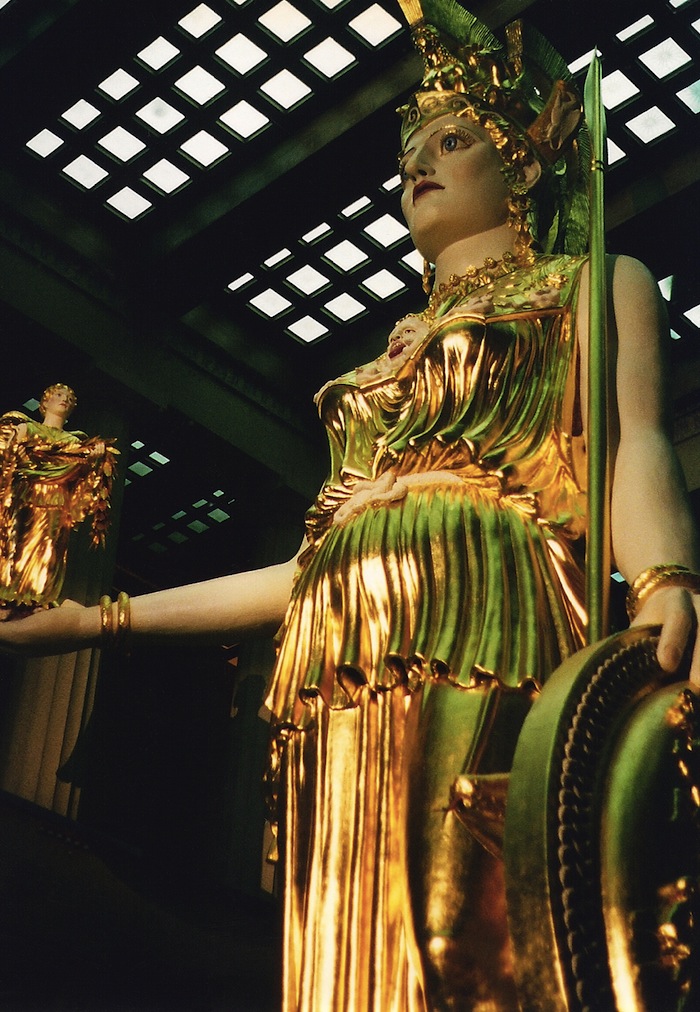
And that, my friends, requires an even longer conversation.
Footnotes:
*This is a misunderstanding of the word, which is actually a title meaning challenger or adversary, and not a singular being. Many angels in the Hebrew Bible, for example, held the title of the office “Satan.” See Elaine Pagels “Origins of Satan” for more on this.
* From Chapter One of the Book of the Law.*
Previous Post

April 23, 2014
Toppling Prisons, Healing Culture – Studying the New Jim Crow
Next Post
May 28, 2014 Caste and Systems: #NJC Intro & Ch 1
Browse Our Archives
Select a Category Community Justice New Jim Crow Teaching Theologies
Select a Month January 2015 December 2014 November 2014 October 2014 September 2014 August 2014 July 2014 June 2014 May 2014 April 2014
Follow Us!
TAKE THE
Religious Wisdom Quiz
Who received the Ten Commandments from God?
Select your answer to see how you score.
Abraham Joshua Aaron Moses
Related posts from Numinous and Concrete

Confronting Empire Takes Us All


Honoring the Gods: Pagan Values Month

TRENDING AT PATHEOS Pagan

I was recently chatting with someone on Instagram. She asked me what...

While there are many people who share their results, the end of...

On July 23, I saw Christopher Nolan's The Odyssey which is Homer’s...

As I write this two big events have just finished up. One...

Restoring the Watershed of Divine Love
Perhaps cooperation is not something we manufacture through legislation, ideology, or moral...

Many UUs don’t pray because of bad experiences in a previous religion,...
view all Pagan blogs
Ad-Free & Subscriber Log-In Subscription Support
- About Us
- 2026 Calendar
- Videos
- Podcasts
- Library of World Religions
- Faith In Media Tracker
- Advertise With Us
- Write for Us
- Privacy Policy
- Terms of Service
- Do Not Sell My Data
- Contact Us
- Radiant Digital
- Manage Newsletter Subscriptions
- Unsubscribe From Notifications
- Sitemap
Copyright 2008-2026, Patheos. All rights reserved.
Subscription Support Ad-Free & Subscriber Log-In
Follow Patheos