
BuddhistCatholicContemplativeEvangelicalGeneral ChristianHinduJewishLatter-day SaintMuslimNew VisionsProgressive Christian
Beliefs
- Buddhist
- Catholic
- Contemplative
- Evangelical
- General Christian
- Hindu
- Jewish
- Latter-day Saint
- More Voices
- Muslim
- New Visions
- Pagan
- Progressive Christian
Topics
- Religion News
- Food and Religion
- Sports and Religion
- Religious Art
- Religious Music and Entertainment
- Religious Events
- History and Religion
- Style and Religion
- Politics and Religion
- Women in Religion
- Recreation Outdoors and Religion
- Business Finance and Religion
- Careers Workplace and Religion
- Education and Religion
- Family Parenting and Religion
- Health Fitness and Religion
- Home and Religion
- Relationships and Religion
- Technology and Religion
- Travel and Religion
Columnists
- Buddhist Columnists
- Business Finance and Religion Columnists
- Careers Workplace and Religion Columnists
- Catholic Columnists
- Contemplative Columnists
- Education and Religion Columnists
- Evangelists Columnists
- Family Parenting and Religion Columnists
- General Christian Columnists
- Health Fitness and Religion Columnists
- Hindu Columnists
- History and Religion Columnists
- Home and Religion Columnists
- Jewish Columnists
- More Voices Columnists
- Latter Day Columnists
- Muslim Columnists
- New Visions Columnists
- Nonreligious Columnists
- Pagan Columnists
- Politics and Religion Columnists
- Progressive Columnists
- Recreation Outdoors and Religion Columnists
- Relationships and Religion Columnists
- Religion News Columnists
- Religious Art Columnists
- Religious Events Columnists
- Religious Music and Entertainment Columnists
- Sports and Religion Columnists
- Style and Religion Columnists
- Technology and Religion Columnists
- Travel and Religion Columnists
- Women in Religion Columnists
Resource Library
- 2026 Calendar
- Library of World Religions
- The 100 Most Holy Places on Earth
- Patheos Answers
- Podcasts
- Videos
- Faith Leaders Database
- Anglican Episcopalian
- Bahai
- Baptist
- Buddhism
- Christianity
- Confucianism
- Eastern Orthodoxy
- Hinduism
- Holiness and Pentecostal
- ISKCON
- Islam
- Judaism
- Lutheran
- Methodist
- The Church of Jesus Christ of Latter-day Saints
- New Age
- Paganism
- Presbytarian and Reformed
- Protestantism
- Religion Behind the Scenes
- Roman Catholic
- Scientology
- Shia Islam
- Sikhism
- Sufism
- Sunni Islam
- Taoism
- Zen
- See all religions
Research Tools
 Ad-Free & Subscriber Log-In Subscription Support
Ad-Free & Subscriber Log-In Subscription Support
Follow Patheos 

- Trending:
- Forgiveness
- |
- Marriage
- |
- Consciousness
- |
- Death Penalty
- |
- Election
- |
- Halloween

- Home
- Pagan
- Masculine Archetypes: Trickster at Samhain & Election Day
Masculine Archetypes: Trickster at Samhain & Election Day
Last updated on: November 5, 2024 at 1:24 am by Tom Swiss
Masculine Archetypes: Trickster at Samhain & Election Day 2024-11-05T01:24:12-04:00 Tom Swiss
Patheos Explore the world's faith through different perspectives on religion and spirituality! Patheos has the views of the prevalent religions and spiritualities of the world.
Over the this turn of the “Wheel of the Year”, we are investigating and paying respect to eight archetypes of mature, sacred masculinity. The Trickster at Samhain is the final installment in this series.
Context
(If you’ve been reading this series, you can skip this repeating section.)
Men’s mysteries matter. Today, young men are confronted on one hand with reactionary voices who advocate gender roles decades or centuries out of date, and on the other with professional-managerial class “progressive” voices who seem to think the answer to the reactionaries is to eliminate masculinity.
The transition to manhood is dangerous. Men are both more likely than women to be murdered and to commit murder. We’re more likely to be in prison, to be killed on the job, or to commit suicide. We’re less likely to finish high school or earn college degrees.
Boys who fail to make a successful transition to manhood end up at best being a drag on society, and at worst an active threat to people’s lives. And we will not help them make the transition by denying that manhood even exists.
To help young men through the transition, a system of archetypes can be a useful guide. No such system will be complete, of course. What I’m going to talk about in this series of posts is inspired by the book King, Warrior, Magician, Lover by Robert Moore and Douglas Gillette, and also by Robert Bly’s work, but it’s my own thing. Anything smart is probably copied from those others and anything dumb here is probably my own fault.
By considering these archetypes I am not claiming that these roles are unavailable to women or nonbinary folks. Nor am I claiming that this is the only way to be a man. I’m offering some ideas that have helped me come to terms with my own existence as an adult male human being. (And cognizant that that is as a “white” heterosexual American male, though still believing there’s enough universality in the way androgens shape our brains for the exercise to be useful). If they don’t work for you, fine, please tell us your secrets! If you’re not a man and find that they work for you, great!
For each of these archetypes, we’re going to discuss a balanced version, an excess version, and a shadow version.
Visualize us going around a mountain: at the top is the Wild Man and the realm of excess, up where the air is thin. It’s exhilarating but we can’t stay there. At the bottom is the shadow realm of fear. The healthy mature man moves around the middle heights of the mountain, in neither shadow not excess, moving between the archetypes as needed. Over this series, we will visit eight points around the mountain: the Magician, the Healer, the Lover, the Preacher, the King, the Captain, the Warrior, and the Trickster.
The Trickster
The trickster is found in myth and culture ranging from Odysseus, who famously tricked Polyphemus the Cyclops by giving his name as “Nobody”, so that when they fought and Polyphemus yelled “Nobody is hurting me!”, other Cyclopes told him “Well, shut up, then!”; to Bugs Bunny, famous rascally American incarnation of the Trickster. From Coyote and Loki and Br’er Rabbit, to Jedi Mind Tricks and Captain Kirk’s “Corbomite” maneuver, the Trickster is ancient and futuristic, eternal.
As a Discordian, I am quite partial to the myth of the Golden Apple, and this myth tells us quite a lot about the Trickster. While it is about a goddess rather than a god, the Trickster is the archetype least bound by gender differences. (I cite once again that rascally cross-dressing Bunny, Bugs.)
You may have heard of this story when you studied mythology: there was a wedding on Mount Olympus, the wedding of Peleus and Thetis, the parents of Achilles. Zeus invited all the gods and goddess except for Eris, the goddess of Chaos.
The Gift of the Golden Apple
Now, according to the official story, Eris was the goddess of discord and strife — thus her Roman name, Discordia — and so obviously she was a trouble-maker who should not be invited. And in response to this snub, Eris supposedly went and obtained a golden apple, put a gift tag on it reading “For The Prettiest One” (the Greek version of which is usually said to be “Kallisti” or some variant), and left it at the wedding.
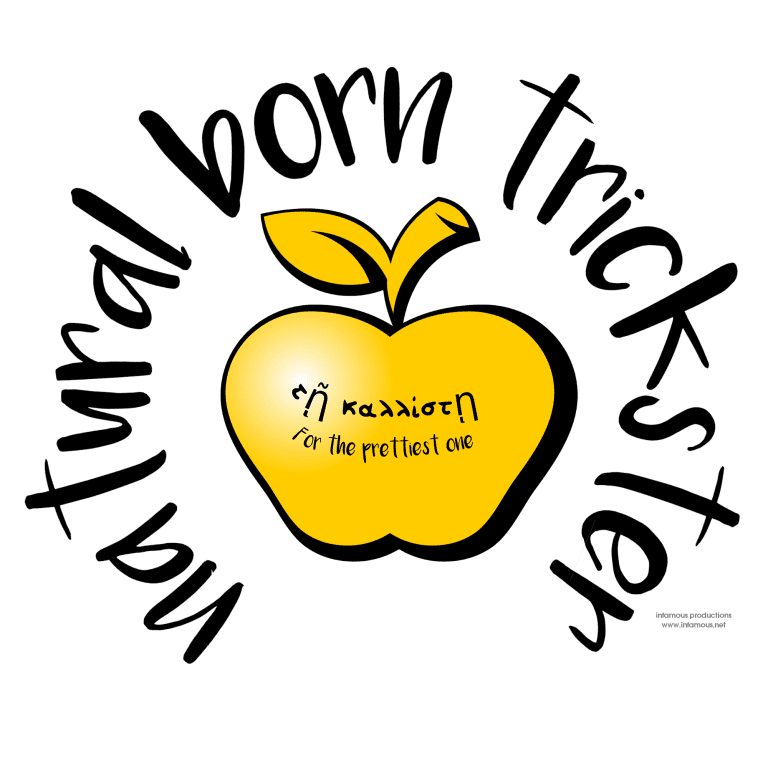
Athena, Aphrodite, and Hera each insisted that they were the prettiest one and that the apple should be theirs. Zeus wanted no part of the argument, and had Hermes take the three goddesses to the mortal Paris Alexander, commanding him to act as judge in a divine beauty contest, the famous “Judgment of Paris”.
The goddesses each tried to bribe Paris: Hera promised to make him a great and wealthy ruler, Athena promised to make him a great warrior skilled in every craft, and Aphrodite promised him the hand of Helen of Troy, most beautiful woman in the world.
Well, Paris had a healthy libido, declared Aphrodite the prettiest one, and the fact that Helen was already married made her the face that launched a thousand ships in the Trojan War. Paris was killed in the war, and Eris gets the blame for the whole mess.
But consider this: a golden apple is no small thing. Obtaining one was one of the labors of Heracles. They were the property of Zeus, guarded by a hundred-headed dragon. One did not merely pop over to Safeway to get a golden apple from the produce section. The official version would have us believe that Eris repeated one of the greatest feats of Heracles in order to pull off a prank.
And consider this also: who is the prettiest one, at any wedding? It’s not one of the guests, it is none of the bridesmaids, nor the mother of the bride or groom. In ancient Greece or in modern times, the bride is inarguably The Prettiest on the day of her wedding. The golden apple rightly belonged to Thetis.
With a little skepticism of the official account, we can see that Eris, paying no mind to Zeus’s snub, left a well-intended and clearly (if poetically) labeled gift for the bride at the wedding, even though she was unable to attend the party.
Eris the Trickster gets the blame. But she did nothing wrong; it was Hera, Athena, and Aphrodite who egotistically asserted that they were the fairest, and attempted to bribe the judge in a beauty contest.
Eris did not create chaos and discord with her gift. Her actions merely created circumstances where the petty jealousy of the gods was revealed.
This is an important point: the Trickster generally doesn’t make trouble so much as reveal the trouble inherent in the order of the world. The chaos is already there, but we want to sweep it under the rug, ignore it, pretend that the existing order of things is just and good. After all, if it were not, we’d have to work to change it — very inconvenient.
The Trickster won’t let us deceive ourselves like that. It is the Trickster who points out the elephant in room, announces that the Emperor wears no clothes, and declines to maintain the polite fictions of social convention. In doing so, he enables society to change and develop.
Divine Discontent and Longing
Abandoning those fictions is also important to personal growth. In Kenneth Grahame’s The Wind in the Willows, the Mole is engaged in socially responsible spring cleaning when he is seized by a “spirit of divine discontent and longing”, and goes blowing right by the duly constituted Authorities:
Jumping off all his four legs at once, in the joy of living and the delight of spring without its cleaning, he pursued his way across the meadow till he reached the hedge on the further side.
“Hold up!” said an elderly rabbit at the gap. “Sixpence for the privilege of passing by the private road!” He was bowled over in an instant by the impatient and contemptuous Mole, who trotted along the side of the hedge chaffing the other rabbits as they peeped hurriedly from their holes to see what the row was about. “Onion-sauce! Onion-sauce!” he remarked jeeringly, and was gone before they could think of a thoroughly satisfactory reply. Then they all started grumbling at each other. “How stupid you are! Why didn’t you tell him——” “Well, why didn’t you say——” “You might have reminded him——” and so on, in the usual way; but, of course, it was then much too late, as is always the case.
It all seemed too good to be true. Hither and thither through the meadows he rambled busily, along the hedgerows, across the copses, finding everywhere birds building, flowers budding, leaves thrusting—everything happy, and progressive, and occupied. And instead of having an uneasy conscience pricking him and whispering “whitewash!” he somehow could only feel how jolly it was to be the only idle dog among all these busy citizens.
And that Trickster impulse, to abandon civic respectability (not necessarily responsibility, but respectability) sets in motion a journey toward adventure and natural wonderment…
This day was only the first of many similar ones for the emancipated Mole, each of them longer and full of interest as the ripening summer moved onward. He learnt to swim and to row, and entered into the joy of running water; and with his ear to the reed-stems he caught, at intervals, something of what the wind went whispering so constantly among them.
…and even an encounter with the Horned God, the “Friend and Helper”, the Piper at the Gates of Dawn, the Great God Pan.
Warrior-Monk
In our circle of archetypes, the Trickster sits between the Warrior and the Magician. Like the Magician, the Trickster knows things. He’s the first to get the Cosmic Joke, that’s what enables him to be the Trickster. But the trickster also acts upon the world, in the manner of the Warrior.
The Trickster is a Jedi — those old Jedi Mind Tricks, “these aren’t the droids you’re looking for.” Or more generally the Warrior-Monk, who (in fiction if not in actual history) achieves victory more through cleverness and Trickery than force of arms.
Like the Magician/Monk, the Trickster has studied and contemplated. One of his topics of study is the Great Cosmic Joke. And like the Warrior, the Trickster has a mission — to make others get that Cosmic Joke, even if they’re resistant to it. A mission to keep us from taking ourselves too seriously, from getting overly involved in our models of the world rather than in the world as it is.
And that often puts him into conflict with authority figures. The Trickster does not make the same assumptions about social reality that others do. He does not conclude that just because his neighbors say a thing is so, that therefore it is so. Instead, he reminds us, in the words of the Jedi master Obi-Wan Kenobi, that many of the truths we cling to depend greatly upon our own point of view.
Most dangerously, he declines to take as axiomatic the authority of the Authorities.
The Trickster is not bound by conventional morality because the trickster is not bound by convention. That does not mean that the trickster is immoral or even that he takes a philosophically amoral stance; just that he does not care what the neighbors think. “It simply isn’t done!” is not an argument to the Trickster, it’s a challenge, a dare.
So to the sort of person who thinks human beings are naturally dangerous until tamed by society, the Trickster is inherently a dangerous man because he dares to go against that taming. But to those of us who think human beings are mostly harmless until prodded by society into oppression and mass murder, that war and genocide are more learned behaviors than reflections of humanity’s unconditioned nature, the Trickster is a hero who interferes with that horrible learning.
For the Trickster is a servant of the community. It’s the Trickster who steals fire from the gods in so many mythologies; who, in Shinto myths, lures the sun goddess Amaterasu out of her cave with a mirror when she is sulking and leaving the world dark; who in Maori mythology tricks the Patupaiarehe, the faeries, into leaving behind a fishing net so that humans can learn to make them.
Shadow: The Con Man
Like the Trickster, the Con Man is also free from social conventions, unbound by rules, not under the authority of the authorities. But he does not have the Trickster’s mission of saving us from taking ourselves too seriously, he does not seek any noble end. He uses his freedom from convention and restraint in the service of greed or egoism.
In this election season, of course, we have a fine example of the Con Man on display in our Presidential election.
Excess: The Psychopathic Joker
Leopold and Loeb, Szilveszter Matuska, thrill killers out to commit the perfect crime just for the lulz.
In some tellings of the Norse myths, this is Loki. But I suspect that Loki has been misrepresented much like Eris has.
In either case, we know the archetype from comic books and from all too real news stories. The Psychopathic Joker is free from convention like the Trickster, but they’re not motivated by greed like the con man; they “just want to watch the world burn”.
The Trickster at Samhain – and Election Day
With the leaves falling from the trees and skittering about in the wind, with the bones of trees showing through where lush greenery prevailed just weeks ago, with (most years if not this one) the first coming of frost, Samhain competes with the blooming May flowers of Beltane, the start of summer, for being the time of most dramatic change.
We don’t need supernaturalism to see that this is a liminal time, a time of transition between the way we lived and worked in the warm, active time and the way we must live and work to survive the cold dark time. It’s a good time to reflect on the fact that things are not always as they seem on the surface, that “reality is subject to change without notice”, as I once heard master magician Jeff “Magnus” McBride say.
Samhain is the the Irish word for the month of November. So contrary to popular interpretation it does not include “trick or treat” night, but it does follow hard on it.
And it does include election season here in the US — another good motivator to reflect on how that things are not always as they seem, on how Con Men and Psychopathic Jokers are trying to deceive you.
Evocation of the Trickster
Hail to the Trickster!
You come uninvited to save us from our worst selves
But now I invite you
I evoke and call forth
The Trickster in me
I honor and acknowledge
My capacity for cleverness and guile
And I acknowledge the temptation to use them for selfish ends –
I will not trick my self about that!
But I will choose the bigger joke
The Cosmic Jape
And use my tricks in its service
And in service to community
If I steal fire from the gods I will share it with all
If I steal freedom from the tyrants I will share it with all
So mote it be
New Visions
Ethics, Virtue, and Right Living
Previous Post
September 22, 2024
Masculine Archetypes: The Warrior at Mabon
Next Post

December 31, 2024 Fixing the Mailbox: A Holiday Omen
Recent Comments
"taking on the role of the mailman in several games of postal chessOK, I gotta ..."
Chess Grifters, Chinese Rooms, and AI
"Welcome back! Looking forward to new posts from you. I like the idea of an ..."
"What's the attendance at Starwood these days?"
For Best Magical Resilts, Set Your ..."
"1. It wasn't a metaphor. To suggest otherwise is blatant dishonesty; and seems to be ..."
Deconstructing the Bears Vs. Men Memeplex
Browse Our Archives
Select a Category 2017 52 Makeup 2020 52 Makeup Always Roaming With A Hungry Heart Art Because I Could Not Stop For Death Caught On Video COVID-19 Culture Discordianism Ethics, Virtue, and Right Living History Magic(k), Ritual, and Mysticism My Blogging Life and Times Philosophy Podcast Poetry Random Wednesdays Religion & Politics Seasonal Musings Techno-Pagan Theology Uncategorized Warrior Path Zen
Select a Month October 2026 September 2026 August 2026 March 2026 February 2026 January 2026 December 2025 March 2025 January 2025 December 2024 November 2024 September 2024 August 2024 June 2024 May 2024 April 2024 March 2024 February 2024 December 2023 September 2023 August 2023 July 2023 June 2023 May 2023 March 2023 February 2023 January 2023 December 2022 October 2022 September 2022 June 2022 April 2022 February 2022 January 2022 December 2021 November 2021 October 2021 September 2021 August 2021 July 2021 May 2021 April 2021 March 2021 February 2021 January 2021 December 2020 November 2020 October 2020 September 2020 August 2020 June 2020 May 2020 April 2020 March 2020 February 2020 January 2020 December 2019 November 2019 October 2019 September 2019 August 2019 July 2019 June 2019 May 2019 April 2019 March 2019 February 2019 January 2019 December 2018 November 2018 October 2018 September 2018 August 2018 July 2018 June 2018 May 2018 April 2018 March 2018 January 2018 December 2017 November 2017 October 2017 September 2017 August 2017 July 2017 June 2017 May 2017 April 2017 March 2017 February 2017 January 2017 December 2016 November 2016 October 2016 September 2016 August 2016 July 2016 June 2016 May 2016 April 2016 March 2016 February 2016 January 2016 December 2015 November 2015 October 2015 September 2015 August 2015 July 2015 June 2015
Follow Us!
TAKE THE
Religious Wisdom Quiz
How did God respond to Job’s complaints?
Select your answer to see how you score.
In a dream By sending an angel Through a prophet From a whirlwind
Related posts from The Zen Pagan

Chess Grifters, Chinese Rooms, and AI



Holiday Lights, Solstice Fires, and Jizo's Jewel
TRENDING AT PATHEOS Pagan

The Problem with False Prophets
Miller’s Station UMC| 10/18/26| Anchor Verse: Jeremiah 23: 1, 9-23 I...

Emotion in Early Christianity by Andrew Crislip
Andrew Crislip’s Emotion in Early Christianity examines an often overlooked dimension of...

16 Spiritual Touchstones for a More Grounded Life
After decades of spiritual study, here are 16 principles I try...

Catholic Evangelization: Sharing Your Faith Every Day
Welcome back to the Graceful Awakening mini-series called, “From Faith to Mission.” ...

The Pillar of the Boatmen: the Ancient Monument...
The Pillar of the Boatmen is a Romano-Gaulish sculpture that dates from...

In one sense walking into Westminster Abbey is like walking down the...
view all Pagan blogs
What Are Your Thoughts?leave a comment
Ad-Free & Subscriber Log-In Subscription Support
- About Us
- 2026 Calendar
- Videos
- Podcasts
- Library of World Religions
- Faith In Media Tracker
- Advertise With Us
- Write for Us
- Privacy Policy
- Terms of Service
- Do Not Sell My Data
- Contact Us
- Radiant Digital
- Manage Newsletter Subscriptions
- Unsubscribe From Notifications
- Sitemap
Copyright 2008-2026, Patheos. All rights reserved.
Subscription Support Ad-Free & Subscriber Log-In
Follow Patheos