
BuddhistCatholicContemplativeEvangelicalGeneral ChristianHinduJewishLatter-day SaintMuslimNew VisionsProgressive Christian
Beliefs
- Buddhist
- Catholic
- Contemplative
- Evangelical
- General Christian
- Hindu
- Jewish
- Latter-day Saint
- More Voices
- Muslim
- New Visions
- Pagan
- Progressive Christian
Topics
- Religion News
- Food and Religion
- Sports and Religion
- Religious Art
- Religious Music and Entertainment
- Religious Events
- History and Religion
- Style and Religion
- Politics and Religion
- Women in Religion
- Recreation Outdoors and Religion
- Business Finance and Religion
- Careers Workplace and Religion
- Education and Religion
- Family Parenting and Religion
- Health Fitness and Religion
- Home and Religion
- Relationships and Religion
- Technology and Religion
- Travel and Religion
Columnists
- Buddhist Columnists
- Business Finance and Religion Columnists
- Careers Workplace and Religion Columnists
- Catholic Columnists
- Contemplative Columnists
- Education and Religion Columnists
- Evangelists Columnists
- Family Parenting and Religion Columnists
- General Christian Columnists
- Health Fitness and Religion Columnists
- Hindu Columnists
- History and Religion Columnists
- Home and Religion Columnists
- Jewish Columnists
- More Voices Columnists
- Latter Day Columnists
- Muslim Columnists
- New Visions Columnists
- Nonreligious Columnists
- Pagan Columnists
- Politics and Religion Columnists
- Progressive Columnists
- Recreation Outdoors and Religion Columnists
- Relationships and Religion Columnists
- Religion News Columnists
- Religious Art Columnists
- Religious Events Columnists
- Religious Music and Entertainment Columnists
- Sports and Religion Columnists
- Style and Religion Columnists
- Technology and Religion Columnists
- Travel and Religion Columnists
- Women in Religion Columnists
Resource Library
- 2026 Calendar
- Library of World Religions
- The 100 Most Holy Places on Earth
- Patheos Answers
- Podcasts
- Videos
- Faith Leaders Database
- Anglican Episcopalian
- Bahai
- Baptist
- Buddhism
- Christianity
- Confucianism
- Eastern Orthodoxy
- Hinduism
- Holiness and Pentecostal
- ISKCON
- Islam
- Judaism
- Lutheran
- Methodist
- The Church of Jesus Christ of Latter-day Saints
- New Age
- Paganism
- Presbytarian and Reformed
- Protestantism
- Religion Behind the Scenes
- Roman Catholic
- Scientology
- Shia Islam
- Sikhism
- Sufism
- Sunni Islam
- Taoism
- Zen
- See all religions
Research Tools
 Ad-Free & Subscriber Log-In Subscription Support
Ad-Free & Subscriber Log-In Subscription Support
Follow Patheos 

- Trending:
- Forgiveness
- |
- Marriage
- |
- Consciousness
- |
- Death Penalty
- |
- Election
- |
- Halloween

- Home
- Pagan
- Masculine Archetypes: The Warrior at Mabon
Masculine Archetypes: The Warrior at Mabon
Last updated on: September 22, 2024 at 11:36 pm by Tom Swiss
Masculine Archetypes: The Warrior at Mabon 2024-09-22T23:36:28-04:00 Tom Swiss
Patheos Explore the world's faith through different perspectives on religion and spirituality! Patheos has the views of the prevalent religions and spiritualities of the world.
Over the this turn of the “Wheel of the Year”, we are investigating and paying respect to eight archetypes of mature, sacred masculinity. The Warrior At Mabon is the seventh installment in this series.
Context
(If you’ve been reading this series, you can skip this repeating section.)
Men’s mysteries matter. Today, young men are confronted on one hand with reactionary voices who advocate gender roles decades or centuries out of date, and on the other with professional-managerial class “progressive” voices who seem to think the answer to the reactionaries is to eliminate masculinity.
The transition to manhood is dangerous. Men are both more likely than women to be murdered and to commit murder. We’re more likely to be in prison, to be killed on the job, or to commit suicide. We’re less likely to finish high school or earn college degrees.
Boys who fail to make a successful transition to manhood end up at best being a drag on society, and at worst an active threat to people’s lives. And we will not help them make the transition by denying that manhood even exists.
To help young men through the transition, a system of archetypes can be a useful guide. No such system will be complete, of course. What I’m going to talk about in this series of posts is inspired by the book King, Warrior, Magician, Lover by Robert Moore and Douglas Gillette, and also by Robert Bly’s work, but it’s my own thing. Anything smart is probably copied from those others and anything dumb here is probably my own fault.
By considering these archetypes I am not claiming that these roles are unavailable to women or nonbinary folks. Nor am I claiming that this is the only way to be a man. I’m offering some ideas that have helped me come to terms with my own existence as an adult male human being. (And cognizant that that is as a “white” heterosexual American male, though still believing there’s enough universality in the way androgens shape our brains for the exercise to be useful). If they don’t work for you, fine, please tell us your secrets! If you’re not a man and find that they work for you, great!
For each of these archetypes, we’re going to discuss a balanced version, an excess version, and a shadow version.
Visualize us going around a mountain: at the top is the Wild Man and the realm of excess, up where the air is thin. It’s exhilarating but we can’t stay there. At the bottom is the shadow realm of fear. The healthy mature man moves around the middle heights of the mountain, in neither shadow not excess, moving between the archetypes as needed. Over this series, we will visit eight points around the mountain: the Magician, the Healer, the Lover, the Preacher, the King, the Captain, the Warrior, and the Trickster.
The Warrior
Of all the archetypes we’re considering, the Warrior may be both the most problematic and the most promising. Let us take care as we grapple with this archetype.
Why is the Warrior so fraught? Because the Powers That Be have always needed men to fight their wars. (Thanks to modern weaponry, these days they’ll take women, and often children, too, but still prefer men.) From the ancient world to modern geopolitics, to conquer or rule or merely “intervene to uphold human rights” or whatever excuse contemporary war mongers use, the Masters of War do not do the fighting themselves. They coerce or convince other men to do it for them.
But they know the more they enable men to fight The Great Enemy (whoever that may be this month), the more they enable those men to fight the Powers That Be. For example, consider the way that black veterans of WWII started resisting American segregation after they’d been taught to shoot at white men in Germany.
So would-be conquerors must present to their soldiers a limited or twisted version of the Warrior. (We’ll use “soldier”, lower case “s”, to speak of these actual men and the model they are given, in contrast with the archetype of the Warrior, capital “W”.) The solider is carefully taught what Wilfred Owen called “The old Lie: Dulce et decorum est / Pro patria mori.” — “It is sweet and proper to die for the country of one’s fathers.” Or as Thoreau put it,
A common and natural result of an undue respect for law is, that you may see a file of soldiers, colonel, captain, corporal, privates, powder-monkeys, and all, marching in admirable order over hill and dale to the wars, against their wills, ay, against their common sense and consciences, which makes it very steep marching indeed, and produces a palpitation of the heart. They have no doubt that it is a damnable business in which they are concerned; they are all peaceably inclined. Now, what are they? Men at all? or small movable forts and magazines, at the service of some unscrupulous man in power? Visit the Navy-Yard, and behold a marine, such a man as an American government can make, or such as it can make a man with its black arts- a mere shadow and reminiscence of humanity, a man laid out alive and standing, and already, as one may say, buried under arms with funeral accompaniments”.
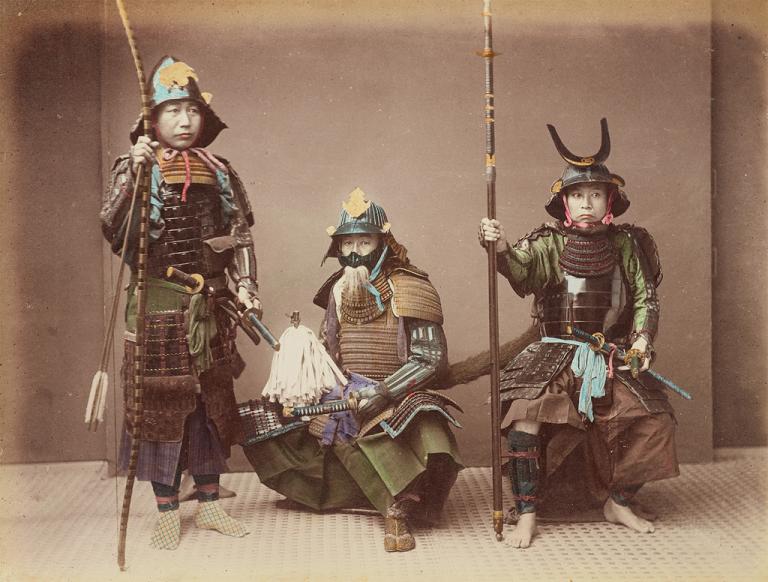
Kusakabe Kimbei, Public domain, via Wikimedia Commons

Mission and Boundaries
There are two words that we must focus on to understand the Warrior: “mission” and “boundaries”.
The Warrior’s essence is his Mission — his task, his purpose, his duty. To accomplish that mission the Warrior will pay any price, lay down his life; and there is a nobility in that. But he will also pay the price of laying down the lives of any innocents in the way. If the Mission is to drop bombs on a target, the Warrior, if not tempered by the other archetypes, will get it done.
A man who is all pure Warrior is all blade and no handle, the “small movable fort” that Thoreau speaks of. He must have access to the other archetypes in order to determine and understand if those bombs should be dropped, to be able to judge whether the Mission is worthy of him and worth the cost.
In the classic film Apocalypse Now, right near the beginning Captain Willard ruminates, “I wanted a mission, and for my sins, they gave me one.” The Warrior without a mission is restless, useless, frustrated.
Or as Tennyson’s “Ulysses” says, “How dull it is to pause, to make an end, / To rust unburnish’d, not to shine in use!” The Warrior knows that rust never sleeps. He is a man of action, he needs action to keep him bright and sharp, and needs a mission to give him purpose for that action.
Because the Warrior’s essence is tied up with the mission, he can even come to respect his opposing Warriors and their dedication to their mission. The mythology around men like Rommel and Robert E. Lee, who fought for utterly abhorrent causes yet — at least in the myth — did so with dedication and honor, illustrates this.
The Warrior’s Mission is very often a matter of maintaining boundaries. Even when it is a matter of expanding those boundaries, of aggressive invasion, it is presented to the soldier as a matter of restoring them to their rightful state.
The Warrior’s concern with boundaries is the yang to the Lover’s yin attitude toward them. The Lover desires to extend boundaries, to blend with what is on the other side. The Warrior seeks to protect what is on his side of the boundary. This is not a selfish grasping: he is selflessly protecting what lies behind him as he looks out over the boundary. He is acting out of love, though it is a different facet of love than the archetypical Lover we’ve discussed.
Sometimes it is through the actions of the Warrior that a man is best able to show love. A lovely expression of this is found in Robert Hayden’s poem “Those Winter Sundays”. The narrator of the poem speaks of how his father rose early in winter, even on Sunday mornings, to make a fire to warm the house, and polish the narrators good shoes (likely in preparation for church). “No one ever thanked him,” the narrator recalls, and ends the poem with the rhetorical question:
What did I know, what did I know
of love’s austere and lonely offices?
While the father here is fighting the elements and the disorder of dirty shoes rather than an opponent, this is the Warrior in action, pursuing a Mission to care for those within the boundary of his family.
Training
The Warrior may wield many weapons and tools to accomplish his mission, but his most important tool is himself. He trains dilligently to build and maintain his capability for action.
Honor
The utter destruction of an enemy is, even putting ethical issues aside, a costly undertaking. In many cases the Warrior’s goal is not the annihaltion of the enemy, but to cause his enemy to lay down his arms and surrender.
But the enemy is not going to do that unless he trusts the Warrior’s word about being treated mercifully. The Warrior must therefore cultivate a reputation for ethical and honest behavior, for trustworthiness — even under the life and death conditions of war.
This is the Warrior’s honor: virtuous behavior under pressure, such that even one’s enemy can rely on it.
Shadow: The Bully
We all understand the Bully. He acts for self-aggrandizement and for delight in harming others. While the Warrior in his fullness is about the defensive warfare of Athena, the Bully is all about the aggressive spear of “bloody, man-slaying Ares”.
Excess: the Berzerker
Many of our mythological warriors — Hercules, Thor, Worf — straddle the Warrior and the Wild Man, a powerful but dangerous combination. The berserkers, “tasters of blood”. Or in today’s mythology, the Incredible Hulk.
Cuchulainn’s “Warp-Spasm”, as Thomas Kinsella translated it, is a vivid illustration:
The first warp-spasm seized Cuchulainn, and made him into a monstrous thing,
hideous and shapeless, unheard of.His shanks and his joints, every knuckle and angle and organ from head to foot,
shook like a tree in the flood or a reed in the stream.
His body made a furious twist inside his skin,
so that his feet and shins and knees switched to the rear
and his heels and calves switched to the front.The balled sinews of his calves switched to the front of his shins,
each big knot the size of a warrior’s bunched fist.
On his head the temple-sinews stretched to the nape of his neck,
each mighty, immense, measureless knob as big as the head of a month-old child.His face and features became a red bowl;
he sucked one eye so deep into his head that a wild crane could not probe it onto his cheek out of the depths of his skull;
the other eye fell out along his cheek.His mouth weirdly distorted:
his cheek peeled back from his jaws until the gullet appeared;
his lungs and liver flapped in his mouth and throat;
his lower jaw struck the upper a lion-killing blow,
and fiery flakes large as a ram’s fleece reached his mouth from his throat.…
In that style, then,
he drove out to find his enemies
and did his thunder-feat
and killed a hundred,
then two hundred,
then three hundred,
then four hundred,
then five hundred…
The Warrior at Mabon
The equinoxes, standing at the balance of light and dark, are good times to consider these archetypes who stand at the boundaries: the Lover, whom we focused on six months ago, and the Warrior.
So take some time this season to consider your relationship with this important but hazardous archetype of the Warrior.
What is your Mission? What boundaries will you protect? Are you balancing your Warrior with the other archetypes, in order to best consider those questions and not be merely a “small movable fort” in the service of some despotic power? Are you cultivating honor so that even those who oppose you can trust your word?
Evocation of the Warrior
I evoke and call forth
The Warrior within me
I honor and acknowledge
My capacity for devoted pursuit of a mission
My ability to maintain boundaries to protect others
I will train myself diligently
So that I can best be of service to that mission
If I must fight I will do so with honor
So that even my enemies will trust in me
I will never use protecting boundaries
As an excuse to be cruel
So mote it be.
New Visions
Ethics, Virtue, and Right Living
Magic(k), Ritual, and Mysticism
Previous Post
August 1, 2024
Masculine Archetypes: The Captain at Lughnasadh
Next Post

November 5, 2024 Masculine Archetypes: Trickster at Samhain & Election Day
Recent Comments
"taking on the role of the mailman in several games of postal chessOK, I gotta ..."
Chess Grifters, Chinese Rooms, and AI
"Welcome back! Looking forward to new posts from you. I like the idea of an ..."
"What's the attendance at Starwood these days?"
For Best Magical Resilts, Set Your ..."
"1. It wasn't a metaphor. To suggest otherwise is blatant dishonesty; and seems to be ..."
Deconstructing the Bears Vs. Men Memeplex
Browse Our Archives
Select a Category 2017 52 Makeup 2020 52 Makeup Always Roaming With A Hungry Heart Art Because I Could Not Stop For Death Caught On Video COVID-19 Culture Discordianism Ethics, Virtue, and Right Living History Magic(k), Ritual, and Mysticism My Blogging Life and Times Philosophy Podcast Poetry Random Wednesdays Religion & Politics Seasonal Musings Techno-Pagan Theology Uncategorized Warrior Path Zen
Select a Month October 2026 September 2026 August 2026 March 2026 February 2026 January 2026 December 2025 March 2025 January 2025 December 2024 November 2024 September 2024 August 2024 June 2024 May 2024 April 2024 March 2024 February 2024 December 2023 September 2023 August 2023 July 2023 June 2023 May 2023 March 2023 February 2023 January 2023 December 2022 October 2022 September 2022 June 2022 April 2022 February 2022 January 2022 December 2021 November 2021 October 2021 September 2021 August 2021 July 2021 May 2021 April 2021 March 2021 February 2021 January 2021 December 2020 November 2020 October 2020 September 2020 August 2020 June 2020 May 2020 April 2020 March 2020 February 2020 January 2020 December 2019 November 2019 October 2019 September 2019 August 2019 July 2019 June 2019 May 2019 April 2019 March 2019 February 2019 January 2019 December 2018 November 2018 October 2018 September 2018 August 2018 July 2018 June 2018 May 2018 April 2018 March 2018 January 2018 December 2017 November 2017 October 2017 September 2017 August 2017 July 2017 June 2017 May 2017 April 2017 March 2017 February 2017 January 2017 December 2016 November 2016 October 2016 September 2016 August 2016 July 2016 June 2016 May 2016 April 2016 March 2016 February 2016 January 2016 December 2015 November 2015 October 2015 September 2015 August 2015 July 2015 June 2015
Follow Us!
TAKE THE
Religious Wisdom Quiz
True or False: Luke's Gospel is dedicated to someone named Theophilus.
Select your answer to see how you score.
FALSE TRUE
Related posts from The Zen Pagan

Chess Grifters, Chinese Rooms, and AI



Holiday Lights, Solstice Fires, and Jizo's Jewel
TRENDING AT PATHEOS Pagan

The Pillar of the Boatmen: the Ancient Monument...
The Pillar of the Boatmen is a Romano-Gaulish sculpture that dates from...

In one sense walking into Westminster Abbey is like walking down the...

'Super Scam Me' Exposes AI Jon Bon Jovi...
Leslie Pickett believed she was in a relationship with Jon Bon Jovi....

The Brazilian Remake of Kendricks' 'Flywheel' Opens in...
“Flywheel,” the story that launched the Kendrick Brothers’ filmmaking career is getting...

The Dangers of Gradual Accommodation (Winking at Sin)
Recently, the “law of gradualness” resurfaced during the opening of a weeklong,...

The Iron Gates and the Lion of the...
Yesterday, I didn't finish my report about, well, yesterday. So I'll...
view all Pagan blogs
What Are Your Thoughts?leave a comment
Ad-Free & Subscriber Log-In Subscription Support
- About Us
- 2026 Calendar
- Videos
- Podcasts
- Library of World Religions
- Faith In Media Tracker
- Advertise With Us
- Write for Us
- Privacy Policy
- Terms of Service
- Do Not Sell My Data
- Contact Us
- Radiant Digital
- Manage Newsletter Subscriptions
- Unsubscribe From Notifications
- Sitemap
Copyright 2008-2026, Patheos. All rights reserved.
Subscription Support Ad-Free & Subscriber Log-In
Follow Patheos