
BuddhistCatholicContemplativeEvangelicalGeneral ChristianHinduJewishLatter-day SaintMuslimNew VisionsProgressive Christian
Beliefs
- Buddhist
- Catholic
- Contemplative
- Evangelical
- General Christian
- Hindu
- Jewish
- Latter-day Saint
- More Voices
- Muslim
- New Visions
- Pagan
- Progressive Christian
Topics
- Religion News
- Food and Religion
- Sports and Religion
- Religious Art
- Religious Music and Entertainment
- Religious Events
- History and Religion
- Style and Religion
- Politics and Religion
- Women in Religion
- Recreation Outdoors and Religion
- Business Finance and Religion
- Careers Workplace and Religion
- Education and Religion
- Family Parenting and Religion
- Health Fitness and Religion
- Home and Religion
- Relationships and Religion
- Technology and Religion
- Travel and Religion
Columnists
- Buddhist Columnists
- Business Finance and Religion Columnists
- Careers Workplace and Religion Columnists
- Catholic Columnists
- Contemplative Columnists
- Education and Religion Columnists
- Evangelists Columnists
- Family Parenting and Religion Columnists
- General Christian Columnists
- Health Fitness and Religion Columnists
- Hindu Columnists
- History and Religion Columnists
- Home and Religion Columnists
- Jewish Columnists
- More Voices Columnists
- Latter Day Columnists
- Muslim Columnists
- New Visions Columnists
- Nonreligious Columnists
- Pagan Columnists
- Politics and Religion Columnists
- Progressive Columnists
- Recreation Outdoors and Religion Columnists
- Relationships and Religion Columnists
- Religion News Columnists
- Religious Art Columnists
- Religious Events Columnists
- Religious Music and Entertainment Columnists
- Sports and Religion Columnists
- Style and Religion Columnists
- Technology and Religion Columnists
- Travel and Religion Columnists
- Women in Religion Columnists
Resource Library
- 2026 Calendar
- Library of World Religions
- The 100 Most Holy Places on Earth
- Patheos Answers
- Podcasts
- Videos
- Faith Leaders Database
- Anglican Episcopalian
- Bahai
- Baptist
- Buddhism
- Christianity
- Confucianism
- Eastern Orthodoxy
- Hinduism
- Holiness and Pentecostal
- ISKCON
- Islam
- Judaism
- Lutheran
- Methodist
- The Church of Jesus Christ of Latter-day Saints
- New Age
- Paganism
- Presbytarian and Reformed
- Protestantism
- Religion Behind the Scenes
- Roman Catholic
- Scientology
- Shia Islam
- Sikhism
- Sufism
- Sunni Islam
- Taoism
- Zen
- See all religions
Research Tools
 Ad-Free & Subscriber Log-In Subscription Support
Ad-Free & Subscriber Log-In Subscription Support
Follow Patheos 

- Trending:
- Forgiveness
- |
- Marriage
- |
- Consciousness
- |
- Death Penalty
- |
- Election
- |
- Halloween

- Home
- Pagan
- Masculine Archetypes: The Captain at Lughnasadh
Masculine Archetypes: The Captain at Lughnasadh
Last updated on: August 28, 2024 at 11:30 pm by Tom Swiss
Masculine Archetypes: The Captain at Lughnasadh 2024-08-28T23:30:58-04:00 Tom Swiss
Patheos Explore the world's faith through different perspectives on religion and spirituality! Patheos has the views of the prevalent religions and spiritualities of the world.
Over the this turn of the “Wheel of the Year”, we are investigating and paying respect to eight archetypes of mature, sacred masculinity. The Captain At Lughnasadh/Lammas is the sixth installment in this series.
Context
(If you’ve been reading this series, you can skip this repeating section.)
Men’s mysteries matter. Today, young men are confronted on one hand with reactionary voices who advocate gender roles decades or centuries out of date, and on the other with professional-managerial class “progressive” voices who seem to think the answer to the reactionaries is to eliminate masculinity.
The transition to manhood is dangerous. Men are both more likely than women to be murdered and to commit murder. We’re more likely to be in prison, to be killed on the job, or to commit suicide. We’re less likely to finish high school or earn college degrees.
Boys who fail to make a successful transition to manhood end up at best being a drag on society, and at worst an active threat to people’s lives. And we will not help them make the transition by denying that manhood even exists.
To help young men through the transition, a system of archetypes can be a useful guide. No such system will be complete, of course. What I’m going to talk about in this series of posts is inspired by the book King, Warrior, Magician, Lover by Robert Moore and Douglas Gillette, and also by Robert Bly’s work, but it’s my own thing. Anything smart is probably copied from those others and anything dumb here is probably my own fault.
By considering these archetypes I am not claiming that these roles are unavailable to women or nonbinary folks. Nor am I claiming that this is the only way to be a man. I’m offering some ideas that have helped me come to terms with my own existence as an adult male human being. (And cognizant that that is as a “white” heterosexual American male, though still believing there’s enough universality in the way androgens shape our brains for the exercise to be useful). If they don’t work for you, fine, please tell us your secrets! If you’re not a man and find that they work for you, great!
For each of these archetypes, we’re going to discuss a balanced version, an excess version, and a shadow version.
Visualize us going around a mountain: at the top is the Wild Man and the realm of excess, up where the air is thin. It’s exhilarating but we can’t stay there. At the bottom is the shadow realm of fear. The healthy mature man moves around the middle heights of the mountain, in neither shadow not excess, moving between the archetypes as needed. Over this series, we will visit eight points around the mountain: the Magician, the Healer, the Lover, the Preacher, the King, the Captain, the Warrior, and the Trickster.
The Captain
Over his life, a man may be called upon to exhibit several different types of leadership. We’ve talked about the moral leadership of the Preacher, whose moral authority is rooted in how he lives his life; and the spiritual leadership of the King, whose very presence inspires and who acts as the conduit of blessings for his people.
In contrast, the Captain is a more practical leader, leading men in direct action. The Warrior (whom we’ll discuss next) is defined by his Mission — his task, his purpose — and his actions in support of that mission. The Captain leads Warriors in accomplishing their mission.
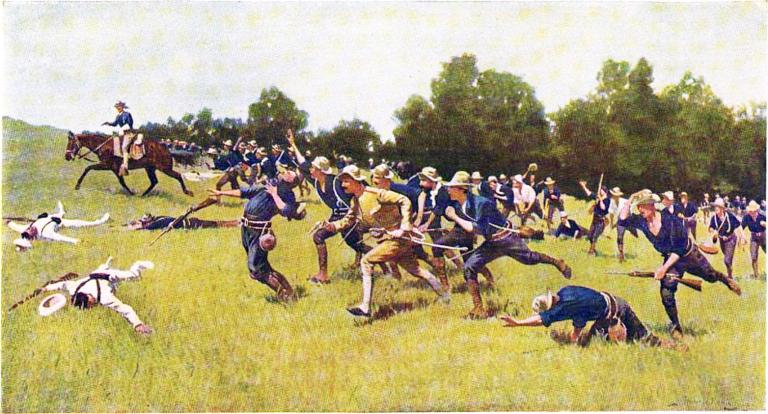
Charge of the Rough Riders at San Juan Hill by Frederic Remington. Public domain image via Wikipedia. Theodore Roosevelt (on horseback) mythologized as a Captain of battle, out in front of his Warriors
Many of the Kings of our mythology were Captains of battle first. King Arthur must conquer before he reigns; while in The Lord of the Rings Strider’s arc is to move from Warrior (a Ranger, acting alone) to Captain (leading first the Fellowship, then the Army of the West) to King. Perhaps this is a reflection of our bloody history of conquest; perhaps it’s just because battles make for rousing part of stories.
In many of these stories, the throne is empty, the Good Order of the World is out of joint, and someone (historically, and so also mythologically, a man) must step up to put things right. The King-to-be proves his ability to be that man by leading a first a small group, then larger and larger groups, out-competing all challengers; moving from structuring a small band of men in a practical goal, to becoming the incarnation of the structure of the world. But in that process he becomes more and more distant from those he leads, less a practical man of action and more concerned with the abstract. A mature man must be able to take on either of these roles as appropriate.
It’s noteworthy that the Captain can be a more democratic figure than the King. On pirate ships during the “golden age” of piracy, a captain would often be elected by the crew. In battle his authority was unquestioned, but part of that was because he was the men’s choice.
The idea of an unquestioned leader in action chosen by free election beforehand has occurred in other points in history. The Minutemen of the American colonial militias elected their officers, and anarchist militias in the Spanish Civil War similarly elected their commanders. We might also look to the way in which ancient Athens elected strategoi.
And of course the American President’s role as an elected Commander-In-Chief or the military has echos of this. When Lincoln was assassinated, Walt Whitman, self-styled bard of democracy, turned to the image of the Captain rather than the King in order to eulogize him:
The ship has weather’d every rack, the prize we sought is won,
The port is near, the bells I hear, the people all exulting,
While follow eyes the steady keel, the vessel grim and daring;
But O heart! heart! heart!
O the bleeding drops of red,
Where on the deck my Captain lies,
Fallen cold and dead.
There is a cliche that the boss says “go” while a leader says “let’s go”. This is a bit of an oversimplifiction — when we discussed the King, we saw how there is a place for the leader who is further off, an inspiring mythic incarnation of the community or principles in question — but this is a good way to view the distinction between the King and the Captain. The Captain is in the field or on the ship with those he leads, in the fray with them, leading the charge, while the King may be on the other side of the world. Men fight in the name of the King, but it is the Captain they follow into the hell of battle.
And the Captain cares directly for his men. He is mentor and caretaker, even if he can also be a stern taskmaster. The Captain goes down with the ship because he puts his men ahead of himself. But as a leader of Warriors, he puts the mission before all.
Shadow: The Martinet
Where the Captain puts his men ahead of himself, and uses the command hierarchy as a means to accomplish a Warrior’s mission, the Martinet loves hierarchy and rules for their own sake, so long as the structure put him on top. He puts himself above both his men and any idea of a mission.
Where the Captain is a leader of Warriors, the Martinet is a leader of bullies, the top dog — until he is pulled down by a stronger bully.
We all know the Martinet. He is every petty manager who delights in lording power over his staff.
Excess: the Vanderdecken
According to legend, Captain Vanderdecken (sometimes written as Van der Decken) was the captain of the Flying Dutchman. Like all good legends there are many versions and variations, but the core of the story is that the ship was rounding the Cape of Good Hope and the wind was against them, and the captain vowed that he wouldn’t give up until Judgment Day, and so his ghost ship is still there:
She was an Amsterdam vessel, and sailed from that port seventy years ago. Her master’s name was Vanderdecken. He was a staunch seaman, and would have his own way, in spite of the devil. For all that, never a sailor under him had reason to complain; though how it is on board with them now, nobody knows. The story is this, that in doubling the Cape, they were a long day trying to weather the Table Bay, which we saw this morning. However, the wind headed them, and went against them more and more, and Vanderdecken walked the deck, swearing at the wind. Just after sunset, a vessel spoke him, asking if he did not mean to go into the Bay that night. Vanderdecken replied, ‘May I be eternally d__d if I do, though I should beat about here till the day of judgment!’ And to be sure, Vanderdecken never did go into that bay; for it is believed that he continues to beat about in these seas still, and will do so long enough.
The Captain who would not yield…even to Nature or God, and so damned not only himself but his crew. The Captain must remember that he is responsible for the lives and welfare of his men, and not let his ego or pride lead him to destruction for the whole company.
The Captain at Lammas / Lughnasadh
What’s in a Name?
Way back in the 1990s when I was a twenty-something newly minted Pagan with a Wheel Of The Year poster on my wall, that poster noted the August cross-quarter day as “Lammas”. (And on August 2, not August 1.) It will always be Lammas to me, but more people seem to know it these days as Lughnasadh or Lughnasa.
Lugh Who?
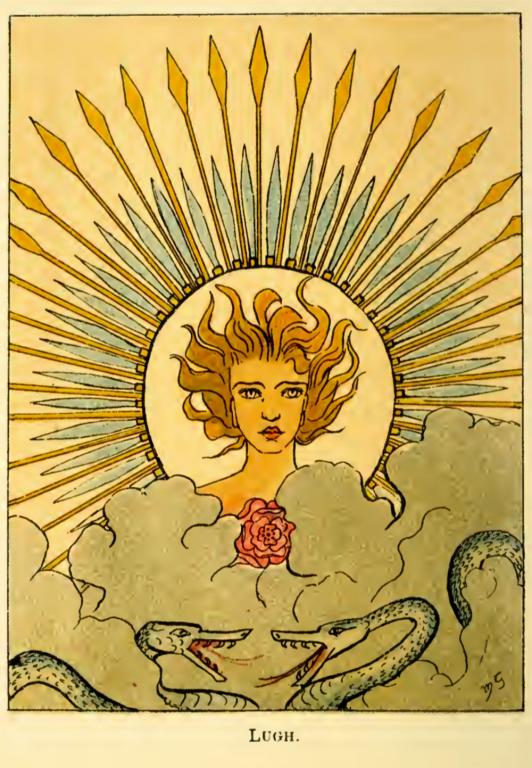
from The Coming of Lugh – A Celtic Wonder-tale retold by Ella Young. Illustrated by Maude Gonne.
Lughnasadh is “the assembly of Lugh”, a feast day founded by the god Lugh, the war captain of the Tuatha De Dannan in their battle against the Fomorians. Some stories say Lughnasadh was founded in honor of the memory of a dead goddess, in some stories his foster mother, in others his wife. Other stories have the origin being a celebration of Lugh’s victory as a harvest god over a tyrannical sun god.
Lugh is a great Warrior and a great leader of Warriors, and skilled in many arts: a smith and a Magician and a Healer and a poet and a harpist, so that one one his epithets is Samildanach, “many-gifted”; and some tales have him related to Kingship. But when battle is joined between the Tuatha De Dannan and the Fomorians:
…When the battle began, Lug escaped from his guardians with his charioteer, so that it was he who was in front of the hosts of the Tuatha De.
Then a keen and cruel battle was fought between the tribe of the Fomorians and the men of Ireland. Lug was heartening the men of Ireland that they should fight the battle fervently, so that they should not be any longer in bondage.
Lugh is not a King distant and isolated, but a Captain, at the vanguard of his Warriors, giving them heart and leading them to victory.
So Lughnasadh is a good time to consider your relationship with this archetype.
Evocation of the Captain
I evoke and call forth
The Captain within me
I honor and acknowledge
My ability to take command
To lead by example
To be guardian and caretaker of those I lead
I will use authority and discipline as means to an end
Never as an ego-engorging end in themselves
I resolve to be worthy of the trust others put in me
And use it in service of a proper Mission
Never throw away the lives or treasure or energy trusted to me
for petty ends
So mote it be.
New Visions
Ethics, Virtue, and Right Living
Magic(k), Ritual, and Mysticism
Previous Post
June 20, 2024
Masculine Archetypes: The King At Midsummer
Next Post
September 22, 2024 Masculine Archetypes: The Warrior at Mabon
Recent Comments
"taking on the role of the mailman in several games of postal chessOK, I gotta ..."
Chess Grifters, Chinese Rooms, and AI
"Welcome back! Looking forward to new posts from you. I like the idea of an ..."
"What's the attendance at Starwood these days?"
For Best Magical Resilts, Set Your ..."
"1. It wasn't a metaphor. To suggest otherwise is blatant dishonesty; and seems to be ..."
Deconstructing the Bears Vs. Men Memeplex
Browse Our Archives
Select a Category 2017 52 Makeup 2020 52 Makeup Always Roaming With A Hungry Heart Art Because I Could Not Stop For Death Caught On Video COVID-19 Culture Discordianism Ethics, Virtue, and Right Living History Magic(k), Ritual, and Mysticism My Blogging Life and Times Philosophy Podcast Poetry Random Wednesdays Religion & Politics Seasonal Musings Techno-Pagan Theology Uncategorized Warrior Path Zen
Select a Month October 2026 September 2026 August 2026 March 2026 February 2026 January 2026 December 2025 March 2025 January 2025 December 2024 November 2024 September 2024 August 2024 June 2024 May 2024 April 2024 March 2024 February 2024 December 2023 September 2023 August 2023 July 2023 June 2023 May 2023 March 2023 February 2023 January 2023 December 2022 October 2022 September 2022 June 2022 April 2022 February 2022 January 2022 December 2021 November 2021 October 2021 September 2021 August 2021 July 2021 May 2021 April 2021 March 2021 February 2021 January 2021 December 2020 November 2020 October 2020 September 2020 August 2020 June 2020 May 2020 April 2020 March 2020 February 2020 January 2020 December 2019 November 2019 October 2019 September 2019 August 2019 July 2019 June 2019 May 2019 April 2019 March 2019 February 2019 January 2019 December 2018 November 2018 October 2018 September 2018 August 2018 July 2018 June 2018 May 2018 April 2018 March 2018 January 2018 December 2017 November 2017 October 2017 September 2017 August 2017 July 2017 June 2017 May 2017 April 2017 March 2017 February 2017 January 2017 December 2016 November 2016 October 2016 September 2016 August 2016 July 2016 June 2016 May 2016 April 2016 March 2016 February 2016 January 2016 December 2015 November 2015 October 2015 September 2015 August 2015 July 2015 June 2015
Follow Us!
TAKE THE
Religious Wisdom Quiz
Who said, "Whom shall I send, and who will go for us?"
Select your answer to see how you score.
God Isaiah Jesus Moses
Related posts from The Zen Pagan

Chess Grifters, Chinese Rooms, and AI



Holiday Lights, Solstice Fires, and Jizo's Jewel
TRENDING AT PATHEOS Pagan

The Pillar of the Boatmen: the Ancient Monument...
The Pillar of the Boatmen is a Romano-Gaulish sculpture that dates from...

In one sense walking into Westminster Abbey is like walking down the...

'Super Scam Me' Exposes AI Jon Bon Jovi...
Leslie Pickett believed she was in a relationship with Jon Bon Jovi....

The Brazilian Remake of Kendricks' 'Flywheel' Opens in...
“Flywheel,” the story that launched the Kendrick Brothers’ filmmaking career is getting...

The Dangers of Gradual Accommodation (Winking at Sin)
Recently, the “law of gradualness” resurfaced during the opening of a weeklong,...

The Iron Gates and the Lion of the...
Yesterday, I didn't finish my report about, well, yesterday. So I'll...
view all Pagan blogs
What Are Your Thoughts?leave a comment
Ad-Free & Subscriber Log-In Subscription Support
- About Us
- 2026 Calendar
- Videos
- Podcasts
- Library of World Religions
- Faith In Media Tracker
- Advertise With Us
- Write for Us
- Privacy Policy
- Terms of Service
- Do Not Sell My Data
- Contact Us
- Radiant Digital
- Manage Newsletter Subscriptions
- Unsubscribe From Notifications
- Sitemap
Copyright 2008-2026, Patheos. All rights reserved.
Subscription Support Ad-Free & Subscriber Log-In
Follow Patheos