
BuddhistCatholicContemplativeEvangelicalGeneral ChristianHinduJewishLatter-day SaintMuslimNew VisionsProgressive Christian
Beliefs
- Buddhist
- Catholic
- Contemplative
- Evangelical
- General Christian
- Hindu
- Jewish
- Latter-day Saint
- More Voices
- Muslim
- New Visions
- Pagan
- Progressive Christian
Topics
- Religion News
- Food and Religion
- Sports and Religion
- Religious Art
- Religious Music and Entertainment
- Religious Events
- History and Religion
- Style and Religion
- Politics and Religion
- Women in Religion
- Recreation Outdoors and Religion
- Business Finance and Religion
- Careers Workplace and Religion
- Education and Religion
- Family Parenting and Religion
- Health Fitness and Religion
- Home and Religion
- Relationships and Religion
- Technology and Religion
- Travel and Religion
Columnists
- Buddhist Columnists
- Business Finance and Religion Columnists
- Careers Workplace and Religion Columnists
- Catholic Columnists
- Contemplative Columnists
- Education and Religion Columnists
- Evangelists Columnists
- Family Parenting and Religion Columnists
- General Christian Columnists
- Health Fitness and Religion Columnists
- Hindu Columnists
- History and Religion Columnists
- Home and Religion Columnists
- Jewish Columnists
- More Voices Columnists
- Latter Day Columnists
- Muslim Columnists
- New Visions Columnists
- Nonreligious Columnists
- Pagan Columnists
- Politics and Religion Columnists
- Progressive Columnists
- Recreation Outdoors and Religion Columnists
- Relationships and Religion Columnists
- Religion News Columnists
- Religious Art Columnists
- Religious Events Columnists
- Religious Music and Entertainment Columnists
- Sports and Religion Columnists
- Style and Religion Columnists
- Technology and Religion Columnists
- Travel and Religion Columnists
- Women in Religion Columnists
Resource Library
- 2026 Calendar
- Library of World Religions
- The 100 Most Holy Places on Earth
- Patheos Answers
- Podcasts
- Videos
- Faith Leaders Database
- Anglican Episcopalian
- Bahai
- Baptist
- Buddhism
- Christianity
- Confucianism
- Eastern Orthodoxy
- Hinduism
- Holiness and Pentecostal
- ISKCON
- Islam
- Judaism
- Lutheran
- Methodist
- The Church of Jesus Christ of Latter-day Saints
- New Age
- Paganism
- Presbytarian and Reformed
- Protestantism
- Religion Behind the Scenes
- Roman Catholic
- Scientology
- Shia Islam
- Sikhism
- Sufism
- Sunni Islam
- Taoism
- Zen
- See all religions
Research Tools
 Ad-Free & Subscriber Log-In Subscription Support
Ad-Free & Subscriber Log-In Subscription Support
Follow Patheos 

- Trending:
- Forgiveness
- |
- Marriage
- |
- Consciousness
- |
- Death Penalty
- |
- Election
- |
- Halloween

- Home
- Pagan
- Masculine Archetypes: The King At Midsummer
Masculine Archetypes: The King At Midsummer
Last updated on: June 25, 2024 at 10:59 pm by Tom Swiss
Masculine Archetypes: The King At Midsummer 2024-06-25T22:59:50-04:00 Tom Swiss
Patheos Explore the world's faith through different perspectives on religion and spirituality! Patheos has the views of the prevalent religions and spiritualities of the world.
Over the this turn of the “Wheel of the Year”, we are investigating and paying respect to eight archetypes of mature, sacred masculinity. The King At Midsummer is the fifth installment in this series.
Context
(If you’ve been reading this series, you can skip this repeating section.)
Men’s mysteries matter. Today, young men are confronted on one hand with reactionary voices who advocate gender roles decades or centuries out of date, and on the other with professional-managerial class “progressive” voice who seem to think the answer to the reactionaries is to eliminate masculinity.
The transition to manhood is dangerous. Men are both more likely than women to be murdered and to commit murder. We’re more likely to be in prison, to be killed on the job, or to commit suicide. We’re less likely to finish high school or earn college degrees.
Boys who fail to make a successful transition to manhood end up at best being a drag on society, and at worst an active threat to people’s lives. And we will not help them make the transition by denying that manhood even exists.
To help young men through the transition, a system of archetypes can be a useful guide. No such system will be complete, of course. What I’m going to talk about in this series of posts is inspired by the book King, Warrior, Magician, Lover by Robert Moore and Douglas Gillette, and also by Robert Bly’s work, but it’s my own thing. Anything smart is probably copied from those others and anything dumb here is probably my own fault.
By considering these archetypes I am not claiming that these roles are unavailable to women or nonbinary folks. Nor am I claiming that this is the only way to be a man. I’m offering some ideas that have helped me come to terms with my own existence as an adult male human being. (And cognizant that that is as a “white” heterosexual American male, though still believing there’s enough universality in the way androgens shape our brains for the exercise to be useful). If they don’t work for you, fine, please tell us your secrets! If you’re not a man and find that they work for you, great!
For each of these archetypes, we’re going to discuss a balanced version, an excess version, and a shadow version.
Visualize us going around a mountain: at the top is the Wild Man and the realm of excess, up where the air is thin. It’s exhilarating but we can’t stay there. At the bottom is the shadow realm of fear. The healthy mature man moves around the middle heights of the mountain, in neither shadow not excess, moving between the archetypes as needed. Over this series, we will visit eight points around the mountain: the Magician, the Healer, the Lover, the Preacher, the King, the Captain, the Warrior, and the Trickster.
The King
Of the archetypes we’re discussing in this series, the King may be the most problematic for us in modern democratic nations to connect to.
Hell, I’m an anarchist. (In a Thoreauvian or Zenarchist sense, not in the sense of “black bloc” ignoramuses smashing windows and throwing rocks or fireworks at people.) I’m against hierarcical power structures. I don’t want to rule anyone and I don’t want any kings ruling over me. I’ve got my issues with the American system of government, but one thing I’m certain the American Revolution did right was dump the divine right of kings and set up a new system without one.
Maybe when we hear “the king”, we think of Mel Brooks’s portrayal of Louis XVI in History of the World, Part I: an immensely privileged man, parasitic on those he rules, smirking as he says “it’s good to be the king”.
But that’s not what the archetypal Sacred King is about.
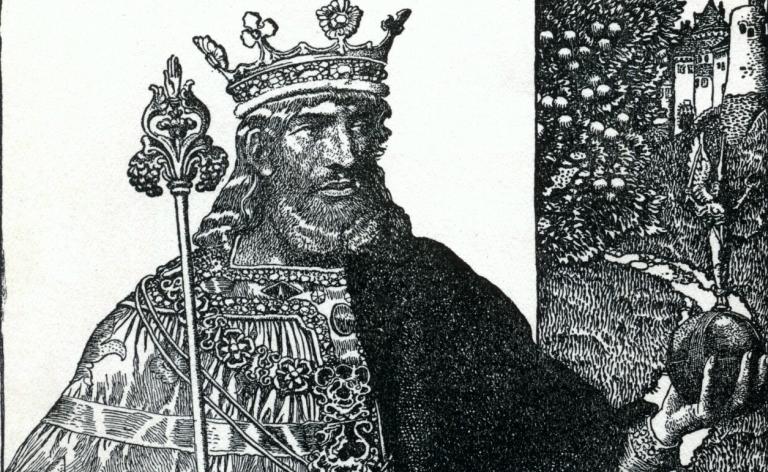
Howard Pyle illustration from the 1903 edition of The Story of King Arthur and His Knights. Public domain.
The King Is A Conduit For Blessings
The sort of King we are speaking of “reigns but does not rule”, as has often been said of the British kings under constitutional monarchy. He does not command, he is not a conqueror. Instead the King is the conduit of blessings for his people. This kingship is all duty and no power, no temporal power at least. The Emperor of Japan, who has been more of a hereditary high priest than a ruler, or the kings of various African peoples, are closer to the core of the thing than the feudal rulers of Europe. The conflation of conquerors with kingship may be a fundamental problem of European culture.
As Lucien Scubla wrote,*
The accumulated ethnographic and historical facts show that kingship is not, in principle, political power. It is an onerous ritual duty which results, more often then not, in the killing of the king. To reign does not mean to govern or to give orders, but to guarantee the order of the world and of the society by observing ritual prescriptions. The king is a sacred figure, but for this very reason he is ‘bound’ by the ritual. Under house arrest and a recluse in his palace, he submits to the same type of restrictions as those who are in a state of impurity…
…
…The king is not the master of the institution but its captive.
Kingship is a central theme of Tolkein’s The Lord of the Rings — the third volume is, after all, The Return Of The King. Aragorn is first seen as a Warrior, acting to fulfill a mission to escort Frodo and his companions; later in the story he leads a great army as a Captain. But it is not his abilities in battle that cause him to be recognized as the king. It is his ability to heal. As the wise woman Ioreth states, “it is said in old lore: The hands of the king are the hands of a healer. And so the rightful king could ever be known.”†
As literary critic Jane Chance explains, “the power of a king resides in his ability to heal, to knit together, to bring peace and fruitfulness to the community, and to return or renew that which has been torn or debilitated.“††
So this is not a physical healing — Aragorn is not setting broken bones or suturing wounds. And it’s not even an individual spiritual healing. Either of those would be the task of the Healer/Shaman.
Instead Aragorn is healing the Black Shadow, the blackness of the soul that the Nazgûl had cast en masse upon the land. Sauron and his servants have injured the order of the world, and it is this that the King heals.
The king is a conduit for blessings: the Chinese character for “king”, 王, is traditionally explained as showing the king as the central pillar connecting heaven, humanity, and earth. He is the man whom others want to be with, just because his company brings joy. Just by association with the King we become healed and empowered and inspired — “Only say the word and I shall be healed.”
In our modern culture, celebrity is a distorted reflection of this sort of kingship, so it’s no wonder that we’ve had so many “royal” entertainers, from Elvis the King, to Duke Ellington, Count Basie, Prince — subverted, perhaps, by Queen. But it is the role of the performer on stage to act as a focus for the energies of the audience, just as the King acts as a focus for the energies of his people.

Shrine of Remembrance, Brisbane. Photo by Wikimedia Commons user Kgbo, CC BY-SA 4.0

Next in this series we’ll be discussing the archetype of the Captain. The Captain is the man who leads Warriors (also to be discussed) into battle or other challenge; but the Warriors fight in the name of the King — “for King and Country”, as the cliche goes. Or “We live for the One, we die for the One,” for my fellow Babylon 5 fans.
The King Stands Alone
This role as focus for the energies of his people puts a lot of demands on the King. The crown is heavy.
We began our series at the other side of the year discussing the Magician, who works isolated in his tower, out of sight of others. The King’s isolation is different — he faces outward, he is front and center of his people, while the Magician faces inward. But his isolation is as deep. The King stands at the focus of the parabola of energies, apart from others.
We quoted Scubla above comparing Kingship to house arrest — a very different picture than Brooks’s satire of French royalty.
The archetypes we’re discussing can blend into one another, and all real people and fictional characters manifest more than one of them, so it is instructive to look at the edges between them. An interesting contrast which illustrates the line between the King and the Captain can be found in the first two interations of the Star Trek television series. In the original, Captain Kirk — an archetypal Captain through and through — often leads the landing parties as his crew explores strange new worlds. He is with them leading the way and directly giving orders.
But in The Next Generation, Captain Picard remains on the ship like the King in his palace, while his first officer leads the missions and commands in his name. Picard is more isolated and detached. He occupies not just a command role but a social role: the crew organizes “Captain Picard Day” for the ship’s children. “I’m a role model”, he explains to an admiral.
And not just in the story’s universe — Brandon T. Snider wrote a YA book What Would Captain Picard Do?
Shadow: The Vampire
Where the King energizes us, the vampire drains our energy. The classic vampire Dracula of course, or for my fellow Adventure Time fans, the Lich, who by a mere word can cause our hero to fall. In Lord of the Rings, the “Witch-king of Angmar” (leader of the Nazgul) casts a spiritual “Black Shadow” that drains its victims.
By association with the vampire we become disempowered…and yet he has a hold on us. He makes us into beings like him, as Dracula turns his victims into vampires.
Excess: the God-Emperor
According to Philo, when Caligula became Emperor of Rome, “all the world, from the rising to the setting sun, all the land in short on this side of the Ocean and beyond the Ocean, at which all the Roman people and all Italy rejoiced, and even all the Asiatic and European nations….universal prosperity and happiness…reigned every where, and the absence of all grief and fear, and the daily and nightly exhibitions of joy and festivity throughout every house and throughout the whole people, which lasted continually without any interruption during the first seven months of his reign.”
But in a few months, “he began to indulge in abundance of strong wine and eating of rich dishes, and in the abundant license of insatiable desires and great insolence, and in the unseasonable use of hot baths, and emetics, and then again in winebibbing and drunkenness, and returning gluttony, and in lust after boys and women, and in everything else which tends to destroy both soul and body.” In time, “he no longer chose to remain fettered by the ordinary limits of human nature, but aspired to raise himself above them, and desired to be looked upon as a god.”
Or, again for my fellow Babylon 5 fans, the Centauri Emperor Cartagia, who plans to sacrifice his entire planet in order to elevate himself to godhood.
Applying the archetype of the God-Emperor to the American presidential race of 2024 is left as an exercise for the reader.
The King at Midsummer
Some of our Neopagan traditions speak of the Holly King and Oak King, who do battle at the Winter and Summer solstices. At midsummer the Holly King deposes the Oak King, while at midwinter the Oak King deposed the Holly King; and each is reborn for the next seasonal cycle. “The king is dead, long live the King”; for while the individual king is mortal, the Sacred King represents the order of the world and so must go on.
So take some time this season, as the world blossoms into it fullness, to consider your relationship with this archetype.
Evocation of the King
I evoke and call forth
The Sacred King
I honor and acknowledge
My ability to convey blessings to others
To act as a focus of energies
The social energies, the cosmic energies
I will remember that I am a focus for, not the sole source of,
these sacred energies
I will seek to empower others, never to drain them
I will work to heal my community
I will manifest the Sacred King
And help all those I meet manifest their own sacred selves
So mote it be.
References
On-line references are given by links in the text above. In addition:
* Toklien, J.R.R. The Lord of the Rings, Part Three: The Return of the King. New York: Ballantine Books, 1965. p166
† Chance, Jane. The Lord of the Rings: The Mythology of Power. New York City: Twyane Publishers, 1992, 104; quoted in Calco, Lauren, “The Hands of a Healer:” J.R.R. Tolkien’s Understanding of Kingship, http://ashbrook.org/wp-content/uploads/2012/06/2006-Calco-Hands-of-a-Healer-PDF.pdf
†† Scubla, Lucien. “Sacred King, Sacrificial Victim, Surrogate Victim or Frazer, Hocart, Girard.” In The Character of Kingship, Declan Quigley ed., New York: Berg, 2005, p. 39-40
New Visions
Ethics, Virtue, and Right Living
Magic(k), Ritual, and Mysticism
Previous Post

May 5, 2024
Deconstructing the Bears Vs. Men Memeplex
Next Post
August 1, 2024 Masculine Archetypes: The Captain at Lughnasadh
Recent Comments
"taking on the role of the mailman in several games of postal chessOK, I gotta ..."
Chess Grifters, Chinese Rooms, and AI
"Welcome back! Looking forward to new posts from you. I like the idea of an ..."
"What's the attendance at Starwood these days?"
For Best Magical Resilts, Set Your ..."
"1. It wasn't a metaphor. To suggest otherwise is blatant dishonesty; and seems to be ..."
Deconstructing the Bears Vs. Men Memeplex
Browse Our Archives
Select a Category 2017 52 Makeup 2020 52 Makeup Always Roaming With A Hungry Heart Art Because I Could Not Stop For Death Caught On Video COVID-19 Culture Discordianism Ethics, Virtue, and Right Living History Magic(k), Ritual, and Mysticism My Blogging Life and Times Philosophy Podcast Poetry Random Wednesdays Religion & Politics Seasonal Musings Techno-Pagan Theology Uncategorized Warrior Path Zen
Select a Month October 2026 September 2026 August 2026 March 2026 February 2026 January 2026 December 2025 March 2025 January 2025 December 2024 November 2024 September 2024 August 2024 June 2024 May 2024 April 2024 March 2024 February 2024 December 2023 September 2023 August 2023 July 2023 June 2023 May 2023 March 2023 February 2023 January 2023 December 2022 October 2022 September 2022 June 2022 April 2022 February 2022 January 2022 December 2021 November 2021 October 2021 September 2021 August 2021 July 2021 May 2021 April 2021 March 2021 February 2021 January 2021 December 2020 November 2020 October 2020 September 2020 August 2020 June 2020 May 2020 April 2020 March 2020 February 2020 January 2020 December 2019 November 2019 October 2019 September 2019 August 2019 July 2019 June 2019 May 2019 April 2019 March 2019 February 2019 January 2019 December 2018 November 2018 October 2018 September 2018 August 2018 July 2018 June 2018 May 2018 April 2018 March 2018 January 2018 December 2017 November 2017 October 2017 September 2017 August 2017 July 2017 June 2017 May 2017 April 2017 March 2017 February 2017 January 2017 December 2016 November 2016 October 2016 September 2016 August 2016 July 2016 June 2016 May 2016 April 2016 March 2016 February 2016 January 2016 December 2015 November 2015 October 2015 September 2015 August 2015 July 2015 June 2015
Follow Us!
TAKE THE
Religious Wisdom Quiz
How many chapters are in the book of Genesis?
Select your answer to see how you score.
40 50 66 45
Related posts from The Zen Pagan

Chess Grifters, Chinese Rooms, and AI


Holiday Lights, Solstice Fires, and Jizo's Jewel
TRENDING AT PATHEOS Pagan

In one sense walking into Westminster Abbey is like walking down the...

'Super Scam Me' Exposes AI Jon Bon Jovi...
Leslie Pickett believed she was in a relationship with Jon Bon Jovi....

The Brazilian Remake of Kendricks' 'Flywheel' Opens in...
“Flywheel,” the story that launched the Kendrick Brothers’ filmmaking career is getting...

The Dangers of Gradual Accommodation (Winking at Sin)
Recently, the “law of gradualness” resurfaced during the opening of a weeklong,...

The Iron Gates and the Lion of the...
Yesterday, I didn't finish my report about, well, yesterday. So I'll...

The Image: On the Horror of Capitalism and...
The Image Then went the Pharisees, and took counsel how they might...
view all Pagan blogs
What Are Your Thoughts?leave a comment
Ad-Free & Subscriber Log-In Subscription Support
- About Us
- 2026 Calendar
- Videos
- Podcasts
- Library of World Religions
- Faith In Media Tracker
- Advertise With Us
- Write for Us
- Privacy Policy
- Terms of Service
- Do Not Sell My Data
- Contact Us
- Radiant Digital
- Manage Newsletter Subscriptions
- Unsubscribe From Notifications
- Sitemap
Copyright 2008-2026, Patheos. All rights reserved.
Subscription Support Ad-Free & Subscriber Log-In
Follow Patheos