
BuddhistCatholicContemplativeEvangelicalGeneral ChristianHinduJewishLatter-day SaintMuslimNew VisionsProgressive Christian
Beliefs
- Buddhist
- Catholic
- Contemplative
- Evangelical
- General Christian
- Hindu
- Jewish
- Latter-day Saint
- More Voices
- Muslim
- New Visions
- Pagan
- Progressive Christian
Topics
- Religion News
- Food and Religion
- Sports and Religion
- Religious Art
- Religious Music and Entertainment
- Religious Events
- History and Religion
- Style and Religion
- Politics and Religion
- Women in Religion
- Recreation Outdoors and Religion
- Business Finance and Religion
- Careers Workplace and Religion
- Education and Religion
- Family Parenting and Religion
- Health Fitness and Religion
- Home and Religion
- Relationships and Religion
- Technology and Religion
- Travel and Religion
Columnists
- Buddhist Columnists
- Business Finance and Religion Columnists
- Careers Workplace and Religion Columnists
- Catholic Columnists
- Contemplative Columnists
- Education and Religion Columnists
- Evangelists Columnists
- Family Parenting and Religion Columnists
- General Christian Columnists
- Health Fitness and Religion Columnists
- Hindu Columnists
- History and Religion Columnists
- Home and Religion Columnists
- Jewish Columnists
- More Voices Columnists
- Latter Day Columnists
- Muslim Columnists
- New Visions Columnists
- Nonreligious Columnists
- Pagan Columnists
- Politics and Religion Columnists
- Progressive Columnists
- Recreation Outdoors and Religion Columnists
- Relationships and Religion Columnists
- Religion News Columnists
- Religious Art Columnists
- Religious Events Columnists
- Religious Music and Entertainment Columnists
- Sports and Religion Columnists
- Style and Religion Columnists
- Technology and Religion Columnists
- Travel and Religion Columnists
- Women in Religion Columnists
Resource Library
- 2026 Calendar
- Library of World Religions
- The 100 Most Holy Places on Earth
- Patheos Answers
- Podcasts
- Videos
- Faith Leaders Database
- Anglican Episcopalian
- Bahai
- Baptist
- Buddhism
- Christianity
- Confucianism
- Eastern Orthodoxy
- Hinduism
- Holiness and Pentecostal
- ISKCON
- Islam
- Judaism
- Lutheran
- Methodist
- The Church of Jesus Christ of Latter-day Saints
- New Age
- Paganism
- Presbytarian and Reformed
- Protestantism
- Religion Behind the Scenes
- Roman Catholic
- Scientology
- Shia Islam
- Sikhism
- Sufism
- Sunni Islam
- Taoism
- Zen
- See all religions
Research Tools
 Ad-Free & Subscriber Log-In Subscription Support
Ad-Free & Subscriber Log-In Subscription Support
Follow Patheos 

- Trending:
- Forgiveness
- |
- Marriage
- |
- Consciousness
- |
- Death Penalty
- |
- Election
- |
- Halloween

- Home
- Pagan
- Masculine Archetypes: The Preacher at Beltane
Masculine Archetypes: The Preacher at Beltane
Last updated on: June 20, 2024 at 11:39 am by Tom Swiss
Masculine Archetypes: The Preacher at Beltane 2024-06-20T11:39:59-04:00 Tom Swiss
Patheos Explore the world's faith through different perspectives on religion and spirituality! Patheos has the views of the prevalent religions and spiritualities of the world.
Over this turn of the “Wheel of the Year”, it’s my plan to investigate and pay respect to eight archetypes of mature, sacred masculinity. The Preacher at Beltane is the fourth installment in this series.
Context
Men’s mysteries matter. Today, young men are confronted on one hand with reactionary voices who advocate gender roles decades or centuries out of date, and on the other with professional-managerial class “progressive” voice who seem to think the answer to the reactionaries is to eliminate masculinity.
The transition to manhood is dangerous. Men are both more likely than women to be murdered and to commit murder. We’re more likely to be in prison, to be killed on the job, or to commit suicide. We’re less likely to finish high school or earn college degrees.
Boys who fail to make a successful transition to manhood end up at best being a drag on society, and at worst an active threat to people’s lives. And we will not help them make the transition by denying that manhood even exists.
To help young men through the transition, a system of archetypes can be a useful guide. No such system will be complete, of course. What I’m going to talk about in this series of posts is inspired by the book King, Warrior, Magician, Lover by Robert Moore and Douglas Gillette, and also by Robert Bly’s work, but it’s my own thing. Anything smart is probably copied from those others and anything dumb here is probably my own fault.
By considering these archetypes I am not claiming that these roles are unavailable to women or nonbinary folks. Nor am I claiming that this is the only way to be a man. I’m offering some ideas that have helped me come to terms with my own existence as an adult male human being. (And cognizant that that is as a “white” heterosexual American male, though still believing there’s enough universality in the way androgens shape our brains for the exercise to be useful). If they don’t work for you, fine, please tell us your secrets! If you’re not a man and find that they work for you, great!
For each of these archetypes, we’re going to discuss a balanced version, an excess version, and a shadow version.
Visualize us going around a mountain: at the top is the Wild Man and the realm of excess, up where the air is thin. It’s exhilarating but we can’t stay there. At the bottom is the shadow realm of fear. The healthy mature man moves around the middle heights of the mountain, in neither shadow not excess, moving between the archetypes as needed. Over this series, we will visit eight points around the mountain: the Magician, the Healer, the Lover, the Preacher, the King, the Captain, the Warrior, and the Trickster.
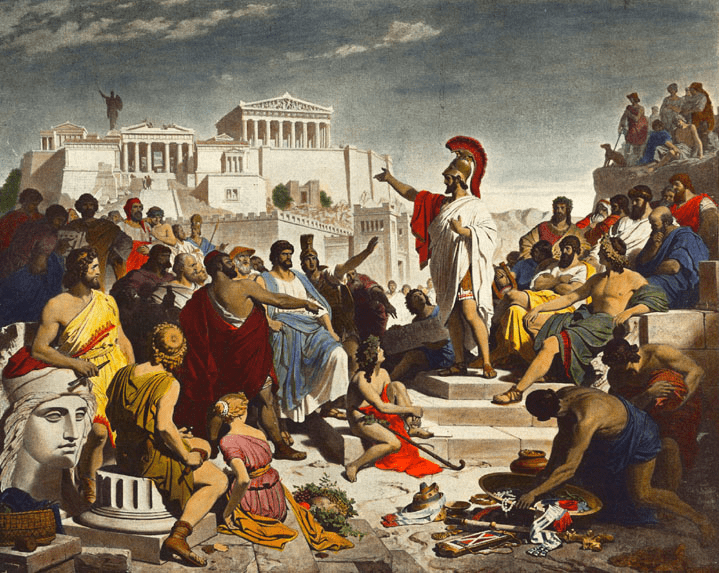
The Preacher
Some men lead others in the context of battle or other conflict; some men lead others in political contexts, questions of how to organize and structure communities.
But some men lead others through the process of figuring out how we should live.
The name for the field of philosophy that address the question of how we should live is “ethics”, though often that word has come to mean either moralistic scolding about breaking social norms, or abstract philosophical puzzlers like the trolley problem.
But I mean here the everyday practical problem of how to live a “good” life, where “good” is not determined by “what is the size of my bank account” or “what will the neighbors think?”, or even “what will some supernatural judge think?”, but is measured by one’s own long term deep contentment.
The men we’re talking about here lead us towards the good life in that sense.
Occasionally these men are writers — especially poets — but most often they are known for their oratory, their ability to speak to groups. Sometimes they occupy a role as religious ritualists or as academic educators, but here were are focusing on their ability to inspire people.
We might name this archetype the “Preacher/Teacher”, or even the “Preacher/Teacher/Coach” to include a way in which many men encounter this archectype. (My father filled this role for many boys over the years as a baseball coach.)
But for convenience we’ll just say “Preacher”.
We can see the archetype of the Preacher in John the Baptist, crying in the wilderness “Prepare ye the way of the Lord.” Jesus and Buddha viewed through a historical lens are Preachers, though through the lenses of the faiths of their followers they are more the King archetype.
Martin Luther King was certainly a great American Preacher, as was Henry David Thoreau. (Today we tend to think of Thoreau as a writer rather then an orator, but he delivered over seventy public lectures, and many of his texts we read today were lectures first.)
Robin William’s character Mr. Keating in Dead Poet’s Society is a great fictional example.
From history, Pericles of the “golden age” of Athens, know for his funeral oration at the end of the first year of the Peloponnesian War, is one of the great examples: a man whose words helped Athenians come to a greater conception of themselves.
Think of the times your own favorite teacher went off on tangents from algebra or literature to broader issues of how to live. Or your favorite coach giving life lessons to the team rather than talking about how to throw or kick a ball. He is speaking with the intent to inspire his listeners to better lives — he is, to sum it up in a single word, preaching.
The Preacher does not issue orders or set himself above those he speaks to in a power hierarchy. The authority he has is “moral authority”, rooted in the rightness of what he says and in congruence between those words and his actions.
Authority
“Authority” is a tricky word. As a libertarian (of the small-l variety, as in “civil libertarian”), in raising the topic I don’t want to suggest that being a healthy and mature man means seeking power or dominance over others. Indeed, the opposite is true: it is the fear-filled “shadows” of the archetypes that are involved in that.
But as a man succeeds, others will look up to him. Part of the role of a man is to lead the younger or less experienced males, both in the practical tasks that have to get done for society to prosper and in their own inner journeys to mature masculinity.
Three of our archetypes — the Preacher, the King, and the Captain — deal with authority, and in the real world effective authority requires a blend of the Preacher’s moral authority, the King’s transcendent authority, and the Captain’s results-based authority.
Thus even a military leader, who we would mostly associate with the Captain, has to be able to access the Preacher’s moral authority. Gene Kamena of the Air War College gives an excellent explanation of how this authority works. While he’s speaking in a military context what he says here has universal application:
A key component of personal authority is moral authority… Moral authority emanates from within and is reflective of a leader’s character. Thus, a leader of good character generates the moral authority required to hold others to a high standard of moral and ethical behavior. Moral authority is also the basis for trust; without it, trust is never established between a leader and followers. Ultimately, moral authority translates into credibility and legitimacy. It is imperative for leaders to remember three points concerning moral authority: it is generated from within (that is, it cannot be given or granted), it is always tested and it is fragile.
There’s a story about moral authority often told about Gandhi. The same story is also told about Mullah Nasrudin, so it’s apocryphal, but we’ll stick with Gandhi for our telling.
The story goes that the mother of a young boy came to see the great man:
“Mahatma, please help me with my son. He has a terrible habit of eating sugar. I know it’s so bad for his health to eat it like he does, and it’s expensive when he filches it from the kitchen! He admires you so much, if you told him to stop, I know that he would.”
Gandhi pondered for a minute. “I can’t today, but bring the boy to me in two weeks.”
Two weeks later the mother returned, with her son. “Stop eating sugar,” Gandhi told the boy.
“Yes sir, I’ll stop,” said the son.
“Thank you sir,” the mother said, “but why couldn’t you just tell him that two weeks ago?”
“Because,” Gandhi replied, “two weeks ago I was eating sugar.”
The authority of the preacher comes from him “walking his talk”, not from any power structure. The Preacher uses that moral authority to lead a community towards a positive vision of what is possible for them.
Shadow: The Demagogue
The Preacher uses his words — especially spoken words — and a moral authority based on sincere action to lead a community to greater knowledge of itself.
The Demagogue similarly uses the power the word to lead people, but leads them into enriching and empowering him. He pretends to sincerity but his words seldom match his actions. Another word we might use for this shadow archetype is “hypocrite”.
In our modern culture they’re easy to find: switch on any televangelist, and you’ll find the shadow of the Preacher. And it’s even easier in the US this year, since it’s an election season: hypocrisy is the rule in our politics.
Excess: The Self-Elected Messiah
From Jim Jones to David Koresh, we have plenty of examples of cult leaders who had a sincere belief in what they said, who walked their talk and thought they were leading others to a better way…only to go completely and fatally off the rails. The Preacher must always keep a little self-doubt, some consciousness of his limits.
The Preacher at Beltane
I don’t know what the seasonal calendar is like where you are, but here in the mid-Atlantic, it’s in late April and early May that it’s finally warm enough to hold large, extended outdoor gatherings. The season has just started for street festivals and for camping festivals.
In the ancient Celtic world, this is when people gathered en masse for Beltane celebrations. These had ritual, political, and social structure specific to that culture, but underlying it was the seasonal cycle and the basic fact that it’s warm outside again! We no long feel the need to huddle indoors. We’re entering the half of the year marked more by gathering together.
In today’s world of mass broadcast media, a speaker can address a large audience at any time. But in earlier ages, speaking to a large audience required the right season for such an audience to gather; and even today, as we gather in person at outdoor events this time of year, the archetype of the Preacher becomes more apparent.
So take some time this season to consider your relationship with this archetype.
Evocation of the Preacher/Teacher
I evoke and call forth
The Teacher, the Preacher
I honor and acknowledge
My capacity to inspire others
I resolve to act and speak with sincerity
While maintaining a healthy sense of my own limits
I will lead by moral authority, by example
Not by force
I resolve to continue my efforts
To inspire others as others have inspired me
So mote it be.
New Visions
Ethics, Virtue, and Right Living
Magic(k), Ritual, and Mysticism
Previous Post

April 4, 2024
Eclipse 2024: Ritual For A Reset
Next Post

May 5, 2024 Deconstructing the Bears Vs. Men Memeplex
Recent Comments
"taking on the role of the mailman in several games of postal chessOK, I gotta ..."
Chess Grifters, Chinese Rooms, and AI
"Welcome back! Looking forward to new posts from you. I like the idea of an ..."
"What's the attendance at Starwood these days?"
For Best Magical Resilts, Set Your ..."
"1. It wasn't a metaphor. To suggest otherwise is blatant dishonesty; and seems to be ..."
Deconstructing the Bears Vs. Men Memeplex
Browse Our Archives
Select a Category 2017 52 Makeup 2020 52 Makeup Always Roaming With A Hungry Heart Art Because I Could Not Stop For Death Caught On Video COVID-19 Culture Discordianism Ethics, Virtue, and Right Living History Magic(k), Ritual, and Mysticism My Blogging Life and Times Philosophy Podcast Poetry Random Wednesdays Religion & Politics Seasonal Musings Techno-Pagan Theology Uncategorized Warrior Path Zen
Select a Month October 2026 September 2026 August 2026 March 2026 February 2026 January 2026 December 2025 March 2025 January 2025 December 2024 November 2024 September 2024 August 2024 June 2024 May 2024 April 2024 March 2024 February 2024 December 2023 September 2023 August 2023 July 2023 June 2023 May 2023 March 2023 February 2023 January 2023 December 2022 October 2022 September 2022 June 2022 April 2022 February 2022 January 2022 December 2021 November 2021 October 2021 September 2021 August 2021 July 2021 May 2021 April 2021 March 2021 February 2021 January 2021 December 2020 November 2020 October 2020 September 2020 August 2020 June 2020 May 2020 April 2020 March 2020 February 2020 January 2020 December 2019 November 2019 October 2019 September 2019 August 2019 July 2019 June 2019 May 2019 April 2019 March 2019 February 2019 January 2019 December 2018 November 2018 October 2018 September 2018 August 2018 July 2018 June 2018 May 2018 April 2018 March 2018 January 2018 December 2017 November 2017 October 2017 September 2017 August 2017 July 2017 June 2017 May 2017 April 2017 March 2017 February 2017 January 2017 December 2016 November 2016 October 2016 September 2016 August 2016 July 2016 June 2016 May 2016 April 2016 March 2016 February 2016 January 2016 December 2015 November 2015 October 2015 September 2015 August 2015 July 2015 June 2015
Follow Us!
TAKE THE
Religious Wisdom Quiz
What city was Jesus born in?
Select your answer to see how you score.
Jerusalem Capernaum Nazareth Bethlehem
Related posts from The Zen Pagan

Chess Grifters, Chinese Rooms, and AI



Holiday Lights, Solstice Fires, and Jizo's Jewel
TRENDING AT PATHEOS Pagan

The Problem with False Prophets
Miller’s Station UMC| 10/18/26| Anchor Verse: Jeremiah 23: 1, 9-23 I...

Emotion in Early Christianity by Andrew Crislip
Andrew Crislip’s Emotion in Early Christianity examines an often overlooked dimension of...

16 Spiritual Touchstones for a More Grounded Life
After decades of spiritual study, here are 16 principles I try...

Catholic Evangelization: Sharing Your Faith Every Day
Welcome back to the Graceful Awakening mini-series called, “From Faith to Mission.” ...

The Pillar of the Boatmen: the Ancient Monument...
The Pillar of the Boatmen is a Romano-Gaulish sculpture that dates from...

In one sense walking into Westminster Abbey is like walking down the...
view all Pagan blogs
What Are Your Thoughts?leave a comment
Ad-Free & Subscriber Log-In Subscription Support
- About Us
- 2026 Calendar
- Videos
- Podcasts
- Library of World Religions
- Faith In Media Tracker
- Advertise With Us
- Write for Us
- Privacy Policy
- Terms of Service
- Do Not Sell My Data
- Contact Us
- Radiant Digital
- Manage Newsletter Subscriptions
- Unsubscribe From Notifications
- Sitemap
Copyright 2008-2026, Patheos. All rights reserved.
Subscription Support Ad-Free & Subscriber Log-In
Follow Patheos