
BuddhistCatholicContemplativeEvangelicalGeneral ChristianHinduJewishLatter-day SaintMuslimNew VisionsProgressive Christian
Beliefs
- Buddhist
- Catholic
- Contemplative
- Evangelical
- General Christian
- Hindu
- Jewish
- Latter-day Saint
- More Voices
- Muslim
- New Visions
- Pagan
- Progressive Christian
Topics
- Religion News
- Food and Religion
- Sports and Religion
- Religious Art
- Religious Music and Entertainment
- Religious Events
- History and Religion
- Style and Religion
- Politics and Religion
- Women in Religion
- Recreation Outdoors and Religion
- Business Finance and Religion
- Careers Workplace and Religion
- Education and Religion
- Family Parenting and Religion
- Health Fitness and Religion
- Home and Religion
- Relationships and Religion
- Technology and Religion
- Travel and Religion
Columnists
- Buddhist Columnists
- Business Finance and Religion Columnists
- Careers Workplace and Religion Columnists
- Catholic Columnists
- Contemplative Columnists
- Education and Religion Columnists
- Evangelists Columnists
- Family Parenting and Religion Columnists
- General Christian Columnists
- Health Fitness and Religion Columnists
- Hindu Columnists
- History and Religion Columnists
- Home and Religion Columnists
- Jewish Columnists
- More Voices Columnists
- Latter Day Columnists
- Muslim Columnists
- New Visions Columnists
- Nonreligious Columnists
- Pagan Columnists
- Politics and Religion Columnists
- Progressive Columnists
- Recreation Outdoors and Religion Columnists
- Relationships and Religion Columnists
- Religion News Columnists
- Religious Art Columnists
- Religious Events Columnists
- Religious Music and Entertainment Columnists
- Sports and Religion Columnists
- Style and Religion Columnists
- Technology and Religion Columnists
- Travel and Religion Columnists
- Women in Religion Columnists
Resource Library
- 2026 Calendar
- Library of World Religions
- The 100 Most Holy Places on Earth
- Patheos Answers
- Podcasts
- Videos
- Faith Leaders Database
- Anglican Episcopalian
- Bahai
- Baptist
- Buddhism
- Christianity
- Confucianism
- Eastern Orthodoxy
- Hinduism
- Holiness and Pentecostal
- ISKCON
- Islam
- Judaism
- Lutheran
- Methodist
- The Church of Jesus Christ of Latter-day Saints
- New Age
- Paganism
- Presbytarian and Reformed
- Protestantism
- Religion Behind the Scenes
- Roman Catholic
- Scientology
- Shia Islam
- Sikhism
- Sufism
- Sunni Islam
- Taoism
- Zen
- See all religions
Research Tools
 Ad-Free & Subscriber Log-In Subscription Support
Ad-Free & Subscriber Log-In Subscription Support
Follow Patheos 

- Trending:
- Forgiveness
- |
- Marriage
- |
- Consciousness
- |
- Death Penalty
- |
- Election
- |
- Halloween

- Home
- Pagan
- Religious Music & Entertainment
- Netflix’s Sandman Is Just Okay
Netflix’s Sandman Is Just Okay
Last updated on: September 6, 2022 at 11:53 pm by Tom Swiss
Netflix’s Sandman Is Just Okay 2022-09-06T23:53:05-04:00 Tom Swiss
Patheos Explore the world's faith through different perspectives on religion and spirituality! Patheos has the views of the prevalent religions and spiritualities of the world.
I am about to deliver an opinion which may shock and upset some.
An opinion about a topic of much current interest and discussion, but which does not fit either of the trends I see emerging in how people talk about it. An opinion which seems to be singular and unique, perhaps not shared by anyone else.
Netflix’s adaption of Neil Gaiman’s Sandman is…okay.
Good, but not as excellent as it might have been. “Television worth watching”, as the old slogan had it, but not the best thing to appear on my screen over the summer. (I have to give an overall higher mark to Season 3 of Love, Death, and Robots.)
There are some A+ elements, some moments as good as anything put on film or video. But there are some things that should have been better, flaws ranging from the aggravating to the disappointing. It averages out to perhaps a B+, a good job but I can’t concur with some of the superlatives going around social media
Let me be clear that I am a drooling fanboy of the original graphic novels; I’ve written that we may eventually see Gaiman’s Endless take their place as a religious pantheon as valid as any other. I discovered the stories early on, in about 1990 or 91, and it’s been nice to be an early adopter and watch others pick up on Gaiman’s work.*
So my beefs with the adaption are mostly in comparison with the original comics. If you’ve never read them, I’ll leave it to you to decide if you should do so before viewing the adaption and run the risk of disappointment in the Netflix version not living up; or view first, than read, which has the risk of cluttering up or spoiling your response to the books. I’m an “always read first” guy, myself, but people are wired differently, so do as thou wilt.
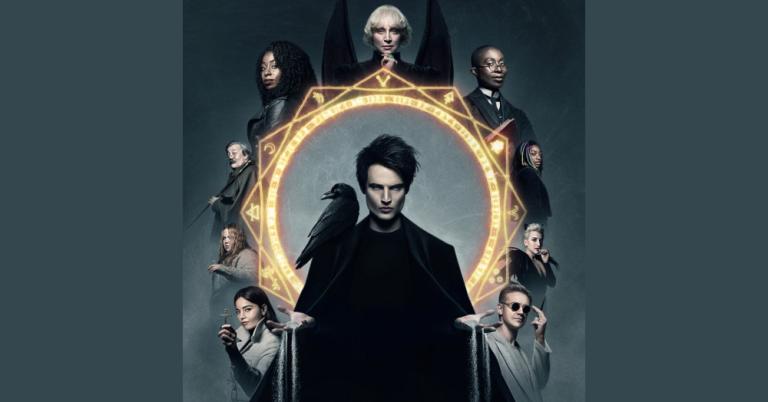
Cover art for Netflix “The Sandman”. Fair use.
In some ways the reaction to the Netflix adaptation seems to have been yet another thing tainted by our culture wars. The fact that there are LGBT characters and (pardon the phrasing) a black Death, lets self-identified social justice warriors and wokeies signal their virtue by declaring how superlatively awesome it is; while cultural conservatives (and perhaps to a lesser extent the anti-identarian left) can signal theirs by declaring that it’s awful, that Gaiman has ruined his own work with some sort of affirmative action casting of a black woman in a role whose comic book appearance was modeled after a specific white woman and inserting even a bit more gay, lesbian, and queer content, as if it were a woke form of fan service.
So this “not awesome, not awful, it’s okay” review may draw brickbats from both groups…but that’s familiar ground here at TZP.
The Good
The comic version of The Sandman is part of DC comics continuity. The entire concept is a re-imagining of a Golden Age character who wore a gas mask and used a sleeping gas gun to knock out bad guys, more in the tradition of The Shadow or Doc Savage than of Superman or Batman.
The original Wesley Dodds Sandman is retconned by Gaiman’s version. (“Retroactive continuity”, where old facts are put into new context or sometimes just contradicted with “no, it’s always been this way”, is a common tactic of long-running SF franchises.) According to Gaiman’s tale, Dodds was inspired to don his gas mask and put bad guys to sleep by a sort of psychic echo of Morpheus in his helm, during the latter’s captivity.
In the comic book version of the tale, Morpheus encounters Justice League superheroes Scott Free (Mister Miracle) and J’onn J’onzz (The Martian Manhunter) during his quest for his stolen tools, and his ruby is wielded against him by supervillian Doctor Destiny, who has previously tangled with heroes like the Green Lantern.
In that continuity, Hector and Lyta Hall are existing character for whom Gaiman finds new and interesting roles. They are the children of, respectively, Hawkman and Hawkgirl, and Wonder Woman and Steve Trevor…except then the Crisis on Infinite Earths event happened happened and their timeline was destroyed, but they were saved by the power of retcon, but then Hector was killed, but that doesn’t stop superheroes so he became another version of The Sandman in a dream dimension, and…it’s complicated.
Making a clean break from that tangled and sometimes silly DC continuity is probably the right call. (Though I would be interested to see the series work a Wesley Dodds tale into a flashback episode. I don’t think he’s ever appeared in a video adaptation, though I’m sure I’ll be corrected in the comments if so.)
It does mean that we didn’t get to see working-class hero magician John Constantine, with his place in the story replaced by an expanded role for Jenna Coleman as both 18th century adventurer Lady Johanna Constantine and her 21st century descendant of the same name. That has been cause for complaint from some viewers. But while I would have like to have seen John, I will never complain about getting to see the Impossible Girl actress do her thing, and given that John Constantine has appeared in several different film and TV versions already, it was a necessary change to set the series apart.
Also on the matter of casting, this first season includes an adaption of “The Sound of Her Wings”, the comic which first introduced Gaiman’s version of Death. And Kirby Howell-Baptiste plays the hell out of the role. Yes, her face does not look quite like the face that appears in the comics. But every facial expression, every vocal choice, every gesture and element of timing, is spot on, and I look forward to seeing more of her take on the role.
Another spot-on casting choice was Stephen Fry’s Fiddler’s Green. Playing a dream of a place who takes on the guise of a mortal — if eccentric — man, requires an actor to make choices that present the character as grounded but unusual while hinting at unmentioned depths, and Fry nails it.
Even more remarkable is Boyd Holbrook’s Corinthian. The Corinthian’s role in the streaming version is expanded from that in the comics, making him a more significant antagonist for Dream. And Holbrook brings out the most dangerous and frightening aspect of classic serial killers: their charm.
What’s most disturbing about a killer like Ted Bundy or Jeffrey Dahmer isn’t just that they kill — killers, sadly, are a dime a dozen in this world. What’s disturbing is that they get people to trust them, to like them, to even be attracted to them, and then turn on them.
Holbrook’s Corinthian is witty and charming. Gay men and straight women are drawn to him; he charms a young boy into traveling across country with him without question; his fellow serial killers are starstruck by his presence. And Holbrook makes this all believable. You’d buy him a drink or lend him twenty dollars, no questions asked. Or walk around the corner with him into an alley, all unsuspecting…
Tom Sturridge has the right look as Morpheus, but his performance has been criticized as one-note. But this is appropriate for where the character is at this point in the story. Morpheus has only one emotional setting: brooding. So I don’t think we can judge Sturridge’s performance yet.
The Less-Than-Good
The term “fridge logic, popularized by the TVTropes website, refers to plot holes that a viewer caught in the momentum of a story may not notice but become apparent later as that viewer gazes into their refrigerator looking for a beer or a snack. The Netflix Sandman suffers from a gaping plot hole which is not present in the comics, and which viewers might overlook in the coolness of having the protagonist engage in a magical battle with Lucifer, but once spotted it annoys like a sore tooth.
In both versions of the story, Morpheus’s helm is in the possession of the demon Choronzon, a Duke of Hell, a being of some rank and power but not one of the primary powers of the Cosmos. In the comics, it is this demon with whom Morpheus does magical battle via the transformation game, and Morpheus is able to defeat him. It makes sense that, in his de-powered state, Morpheus might find a challenge but ultimately victory in facing this mid-level demon.
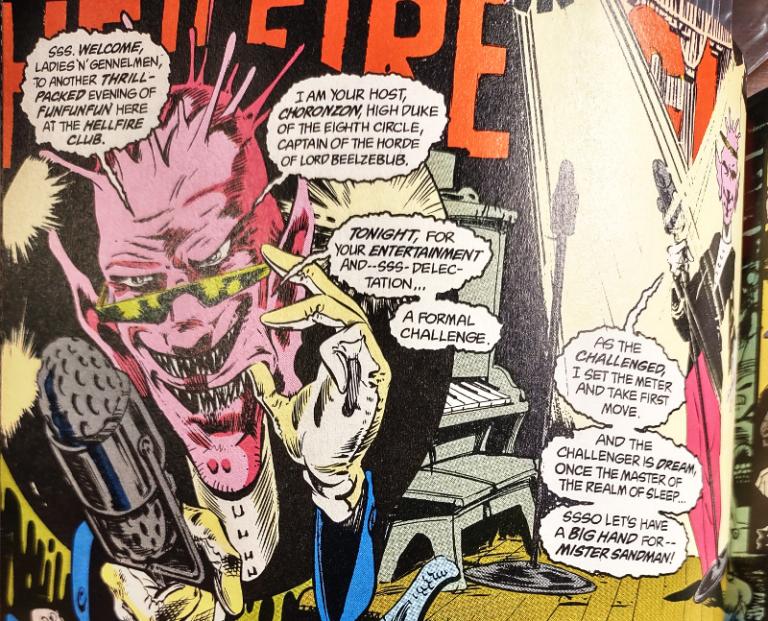
From :”A Hope In Hell”. Fair use.
The Netflix version, however, has Choronzon pick Lucifer — described by Morpheus himself just moments earlier as possibly the most powerful being in existence save only for “the Creator”, and far more powerful than Morpheus in his current state — as his champion, and take his place in the fight. But Morpheus, weakened by a century of captivity, missing two of the three magical tools into which he has put most his power, is still able to defeat Lucifer on his home turf and on Lucifer’s terms in a fair fight, just because Morpheus has a positive, hopeful attitude? Who then can offer any challenge to him? What obstacle would impede him enough to make a worthwhile story?
Once seen, this just doesn’t work. It’s a disappointing failure of plotting from a master storyteller like Gaiman — especially when he got it right the first time.
Also on the topic of Morpheus’s power level, a change made at the very beginning of the plot doesn’t sit well. In the comics version, Morpheus is vulnerable to the ritual magic of mortals because he is exhausted, having just completed a monumental task on the other side of the Universe. In Gaiman’s words in the introduction to the collected “The Doll’s House” story, “Burgess’s Chant of Summoning had proved the final straw to Someone–Something--already tried almost beyond endurance.” (We are not told what that task was; decades later Gaiman filled in the story in Sandman: Overture.)
But in the streaming version we’re told that Morpheus just happens to be conveniently vulnerable when traveling in the waking world. We’re asked to accept that the King of Dreams is, in a weakened state, powerful enough to defeat Lucifer on Lucifer’s terms in Lucifer’s own living room; yet weak enough, at his full power, to be captured by a not-particularly-impressive mortal magician.
These elements work better and make much more sense in the original comics, and it seems they were changed for no good cause. More attention to continuity would have helped here.
The other problem with the adaption is that it does not seem to trust its audience the way that the comic did.
We can see an example of this in the setup for the aforementioned battle between Morpheus and Lucifer. In the comics, Morpheus’s response of “hope” as the thing which can stand against “anti-life, the Beast of Judgement, the dark at the end of everything” is the sort of moment which makes you put the book down to catch your breath. But the adaption has Nada make a big point of how “I will not give up hope. I will never give up,” and Matthew deliver a homily about “Dreams don’t fucking die,” before that moment.
It’s as if this version doesn’t trust the viewer to appreciate the moment, and so underlines and highlights it to such a degree that it almost tilts into bathos.
Even worse is the end of the adaption of Calliope in the “bonus” episode. In the comics Morpheus is motivated to come to his ex’s rescue largely by his own experience of captivity. He is, at this point, acting more out of an echo of his anger than out of any moral virtue.
But the series doesn’t trust the viewer to understand that it was bad for Erasmus Fry and Richard Madoc to hold Calliope captive and to rape her. We need her to tell us how she now plans to “inspir[e] humanity to want better for themselves and each other”, that she plans to rewrite the laws by which she was held — implying that the magical rules of the series’s universe can easily be changed, in contradiction to all the talk during Morpheus’s visit to Hell about rules and protocols which must be followed.
And then Morpheus — who, let us remember, has had an ex-lover imprisoned in Hell for longer than all of recorded human history and recently declined to forgive and release her — tells us that he will do the same in his realm, use his dream powers to urge humanity onto a “better” course. The series tries to make him into a moral hero at this point in the tale in order to underline the “locking a woman away and raping her is bad” point, but it’s too early, too much in contrast of his decision to continue Nada’s punishment.
I don’t know if this reflects an older Gaiman losing his trust in his audience, or a bit of failure in supervising a group of screenwriters to get them to incorporate such trust into their work.
If in the next season, the writers can trust the audience more and think more deeply about whether changes they make from the comics actually make sense within the series’s universe, then The Sandman could become priory viewing, the sort of show to rewatch over and over.
But for now, while I’m not disappointed in season 1, I’m not enthusiastic about it, and don’t know that I’ll bother to rewatch it.
It’s okay.
Which should be enough; but part of my brain itches and says that the Endless deserve a little more.
* Drooling fanboy moment: I got to see Gaiman in person back when that was a thing you could just do for free during a bookstore tour, rather than needing a high-priced ticket on the lecture circuit. I think it was when American Gods (the novel, not yet the series) was coming out. Even got to talk with him. Me, seeing a favorite author about to walk past me on his way to the autograph table: “Uhhhhhh, hi Neil, thanks for coming out.” Him: “My pleasure.” Return
Religious Music & Entertainment
Previous Post

June 23, 2022
What We Owe The Babies
Next Post

September 15, 2022 Parental Death, Ancestor Work, And The Search For Love
Browse Our Archives
Select a Category 2017 52 Makeup 2020 52 Makeup Always Roaming With A Hungry Heart Art Because I Could Not Stop For Death Caught On Video COVID-19 Culture Discordianism Ethics, Virtue, and Right Living History Magic(k), Ritual, and Mysticism My Blogging Life and Times Philosophy Podcast Poetry Random Wednesdays Religion & Politics Seasonal Musings Techno-Pagan Theology Uncategorized Warrior Path Zen
Select a Month October 2026 September 2026 August 2026 March 2026 February 2026 January 2026 December 2025 March 2025 January 2025 December 2024 November 2024 September 2024 August 2024 June 2024 May 2024 April 2024 March 2024 February 2024 December 2023 September 2023 August 2023 July 2023 June 2023 May 2023 March 2023 February 2023 January 2023 December 2022 October 2022 September 2022 June 2022 April 2022 February 2022 January 2022 December 2021 November 2021 October 2021 September 2021 August 2021 July 2021 May 2021 April 2021 March 2021 February 2021 January 2021 December 2020 November 2020 October 2020 September 2020 August 2020 June 2020 May 2020 April 2020 March 2020 February 2020 January 2020 December 2019 November 2019 October 2019 September 2019 August 2019 July 2019 June 2019 May 2019 April 2019 March 2019 February 2019 January 2019 December 2018 November 2018 October 2018 September 2018 August 2018 July 2018 June 2018 May 2018 April 2018 March 2018 January 2018 December 2017 November 2017 October 2017 September 2017 August 2017 July 2017 June 2017 May 2017 April 2017 March 2017 February 2017 January 2017 December 2016 November 2016 October 2016 September 2016 August 2016 July 2016 June 2016 May 2016 April 2016 March 2016 February 2016 January 2016 December 2015 November 2015 October 2015 September 2015 August 2015 July 2015 June 2015
Follow Us!
TAKE THE
Religious Wisdom Quiz
Why was Moses placed in a basket in the Nile?
Select your answer to see how you score.
To hide him from Egyptian soldiers To send him to another land To save him from Pharaoh’s decree As part of a religious ritual
Related posts from The Zen Pagan


Deconstructing the Bears Vs. Men Memeplex
The Unabomber and the Escalation of Disorder
Artistic Opinions Aren't Religious Virtues
TRENDING AT PATHEOS Pagan

The Problem with False Prophets
Miller’s Station UMC| 10/18/26| Anchor Verse: Jeremiah 23: 1, 9-23 I...

Emotion in Early Christianity by Andrew Crislip
Andrew Crislip’s Emotion in Early Christianity examines an often overlooked dimension of...

16 Spiritual Touchstones for a More Grounded Life
After decades of spiritual study, here are 16 principles I try...

Catholic Evangelization: Sharing Your Faith Every Day
Welcome back to the Graceful Awakening mini-series called, “From Faith to Mission.” ...

The Pillar of the Boatmen: the Ancient Monument...
The Pillar of the Boatmen is a Romano-Gaulish sculpture that dates from...

In one sense walking into Westminster Abbey is like walking down the...
view all Pagan blogs
Ad-Free & Subscriber Log-In Subscription Support
- About Us
- 2026 Calendar
- Videos
- Podcasts
- Library of World Religions
- Faith In Media Tracker
- Advertise With Us
- Write for Us
- Privacy Policy
- Terms of Service
- Do Not Sell My Data
- Contact Us
- Radiant Digital
- Manage Newsletter Subscriptions
- Unsubscribe From Notifications
- Sitemap
Copyright 2008-2026, Patheos. All rights reserved.
Subscription Support Ad-Free & Subscriber Log-In
Follow Patheos