
BuddhistCatholicContemplativeEvangelicalGeneral ChristianHinduJewishLatter-day SaintMuslimNew VisionsProgressive Christian
Beliefs
- Buddhist
- Catholic
- Contemplative
- Evangelical
- General Christian
- Hindu
- Jewish
- Latter-day Saint
- More Voices
- Muslim
- New Visions
- Pagan
- Progressive Christian
Topics
- Religion News
- Food and Religion
- Sports and Religion
- Religious Art
- Religious Music and Entertainment
- Religious Events
- History and Religion
- Style and Religion
- Politics and Religion
- Women in Religion
- Recreation Outdoors and Religion
- Business Finance and Religion
- Careers Workplace and Religion
- Education and Religion
- Family Parenting and Religion
- Health Fitness and Religion
- Home and Religion
- Relationships and Religion
- Technology and Religion
- Travel and Religion
Columnists
- Buddhist Columnists
- Business Finance and Religion Columnists
- Careers Workplace and Religion Columnists
- Catholic Columnists
- Contemplative Columnists
- Education and Religion Columnists
- Evangelists Columnists
- Family Parenting and Religion Columnists
- General Christian Columnists
- Health Fitness and Religion Columnists
- Hindu Columnists
- History and Religion Columnists
- Home and Religion Columnists
- Jewish Columnists
- More Voices Columnists
- Latter Day Columnists
- Muslim Columnists
- New Visions Columnists
- Nonreligious Columnists
- Pagan Columnists
- Politics and Religion Columnists
- Progressive Columnists
- Recreation Outdoors and Religion Columnists
- Relationships and Religion Columnists
- Religion News Columnists
- Religious Art Columnists
- Religious Events Columnists
- Religious Music and Entertainment Columnists
- Sports and Religion Columnists
- Style and Religion Columnists
- Technology and Religion Columnists
- Travel and Religion Columnists
- Women in Religion Columnists
Resource Library
- 2026 Calendar
- Library of World Religions
- The 100 Most Holy Places on Earth
- Patheos Answers
- Podcasts
- Videos
- Faith Leaders Database
- Anglican Episcopalian
- Bahai
- Baptist
- Buddhism
- Christianity
- Confucianism
- Eastern Orthodoxy
- Hinduism
- Holiness and Pentecostal
- ISKCON
- Islam
- Judaism
- Lutheran
- Methodist
- The Church of Jesus Christ of Latter-day Saints
- New Age
- Paganism
- Presbytarian and Reformed
- Protestantism
- Religion Behind the Scenes
- Roman Catholic
- Scientology
- Shia Islam
- Sikhism
- Sufism
- Sunni Islam
- Taoism
- Zen
- See all religions
Research Tools
 Ad-Free & Subscriber Log-In Subscription Support
Ad-Free & Subscriber Log-In Subscription Support
Follow Patheos 

- Trending:
- Forgiveness
- |
- Marriage
- |
- Consciousness
- |
- Death Penalty
- |
- Election
- |
- Halloween

- Home
- Pagan
- Am I Insurrecting Or Not?
Am I Insurrecting Or Not?
Last updated on: May 26, 2021 at 8:42 pm by Tom Swiss
Am I Insurrecting Or Not? 2021-05-26T20:42:18-04:00 Tom Swiss
Patheos Explore the world's faith through different perspectives on religion and spirituality! Patheos has the views of the prevalent religions and spiritualities of the world.
Test your political thinking — and learn a little about US history.
When describing the recent disaster at the Capitol, many people have gone beyond using words like “rioting”, “vandalism”, “theft”, and “assault”, and are talking about “insurrection”, “a coup attempt”, “sedition”, “incitement”, and so on.
Is this appropriate, or is it using double standards and fanning the flames of partisanship in a way that is likely to boomerang? Will pressing charges of insurrection and incitement against Trumpist activists set a precedent that will be used against progressives?
Let’s investigate these questions with a little exercise.
In a democracy, laws about speech, protest, and political action must be content-neutral. The state must give equal protection under the law to those who support its policies and those who oppose them and advocate reform — even radical (root-level) reform like altering the structure of government, or changing who is allowed to vote.
So I am going to describe five incidents of unrest throughout US history — but I will not tell you who was involved or when they happened.
When fallacies about the ends justifying the means are set aside and we must judge only the means, how do we draw the lines between legitimate protest, civil disobedience, rioting, self-defense, insurrection, and sedition? Without knowing whether these people were on “your side” or not, what neutral standards will you use to judge their actions?
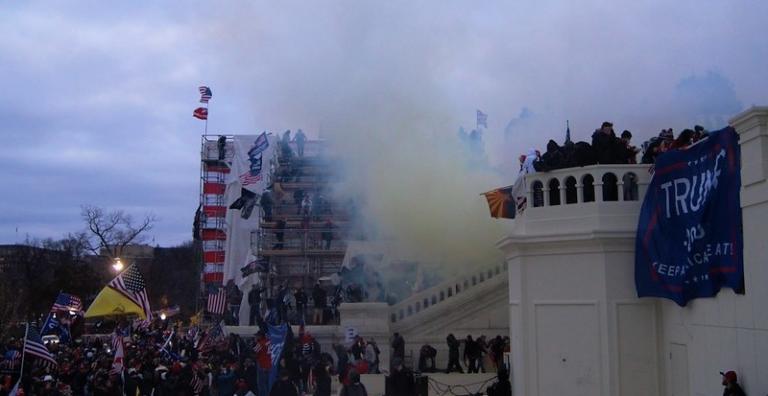
Photo by Flickr user Tyler Merbler, CC-BY-2.0
The incidents below might be from the 1790s, or from last week. Each might describe the behavior of progressives or of reactionaries. Each of them is real — and may surprise you, there’s some fascinating history of American unrest here that you may not know about.
After presenting them in a content-neutral fashion and letting you think about how to judge, I’ll reveal the who, when, and why for each.
The Cases
1. Election ends in firefight
In a certain town, a man is elected sheriff. Some allege that the election is fraudulent. The new sheriff institutes a system of fees and fines regarded by some as corrupt. Over a decade or so the sheriff and his allies continue to win local elections. The federal Department of Justice investigates complaints of election rigging — but brings no charges.
A group emerges which is opposed to this administration. Most of its members are ex-military. They set up a slate of opposition candidates for an election, and send armed individuals out on Election Day as poll watchers. Armed deputies, put into office by the current administration, are also at the polls.
This volatile situation breaks into violence on Election Day, when a deputy shoots a voter. Protesters break into the local National Guard armory to steal weapons, including automatic firearms. In the midst of crowded streets and sidewalks, they open fire on local officials and the building where votes are being counted. They continue the attack with firebombs and dynamite.
The firefight goes on for six hours, and includes four dynamite blasts. The local officials are forced to surrender to the protesters; one is shot, one has his throat slashed, another is beaten senseless. More than 20 people are hospitalized. Miraculously, there are no deaths.
Was this a coup attempt? Sedition? Insurrection? What sort of charges and punishment should people who interrupt the vote count with gunfire and explosives draw?
2. Tens of thousands occupy capital
Tens of thousands of demonstrators descend on the national capital city to demand that a certain policy benefiting them be implemented. They occupy parks and some empty, condemned buildings. The protest camp is generally orderly and sanitary and the protest is initially peaceful. Local police even aid the protesters by asking the locals for contributions food, medical assistance, and supplies.
The policy proposal is approved by the House but rejected by the Senate. With this failure some protesters leave and go home, but many others stay.
The federal government orders protesters to leave the condemned buildings. They refuse, throwing bricks and stones at police sent to evict them. Three officers are injured, including one whose skull is fractured. Police open fire, shooting three protesters; two of them die.
The President deploys federal troops to drive the protesters out. He says afterward “A challenge to the authority of the United States Government has been met, swiftly and firmly.” 135 protesters are arrested, 54 injured in the removal.
Should the actions of these protesters be described as insurrection? Should they be prosecuted? If so, does that apply only to those directly committing violence, or should they all be prosecuted for conspiracy?
3. Proposed dictatorship leads to soft coup plot
This one is a twofer, a story of both a reach for dictatorship by a President and a plot for a soft coup against him.
As a newly elected President prepares to take office in troubled times, a portion of the population wants him to take on dictatorial powers to handle the crisis. One magazine says he should have “the powers of a virtual dictatorship” to reorganize the government. A well-known opinion writer tells his readers that the times call for a “mild” form of dictatorship. On Inauguration Day, one newspaper runs a headline, “For Dictatorship If Necessary.”
The incoming President’s party has control of both chambers of Congress; he requests that they grant him sweeping power to reorganize or eliminate entire bureaus of the government. The incoming Vice-President, currently serving in Congress, proposes an even broader expansion of Presidential authority. Supporters claim that this is necessary in order to slash out-of-control government spending.
A well-known producer of popular entertainment (to abstract when this took place, I will leave it vague whether I am referring to a novel, a play, a film, or a radio drama) prepares to present a story which positively portrays a fictional U.S. President who dissolves Congress, declares martial law, organizes a secret army to execute criminal leaders, and creates an “Army of Construction” to employ people. (That last idea, not so bad.) He presents the work to the incoming President for review; the new President approves of it, and even gives the producer notes.
That much is firmed established in the historical record. The next part is an alleged secret conspiracy which was never proven, but it is instructional to consider.
Allegedly, a group of business leaders alarmed by the incoming President’s policies makes a plan for a soft coup. They approach a popular war hero, and suggest a secret plot to reduce the President’s power.
In their plan, the hero would help them organize a large veteran’s group. The business leaders would offer the President’s this group’s support during the crisis, and push to create a new Cabinet position for the war hero to assume, a position which would handle most of the day-to-day executive function while leaving the President in place as head of state.
Were those who called for “dictatorship if necessary” and presented pro-dictatorship propaganda enemies of democracy and our Constitutional system of checks and balances? Or is there room in the Constitution for a strongman savior when Congress fails to solve a crisis? And were those who (allegedly) plotting this “soft coup” villains trying to overthrow a democratically elected leader, or heroes trying to stop a slide towards dictatorship?
4. Armed protesters disrupt legislature
While the legislature of a certain state is in session, thirty protesters openly carrying rifles, shotguns, and handguns enter the state capitol building and make their way into the assembly chamber, in order to speak against a bill the legislature is considering.
The protesters are from a group which openly brands itself “revolutionary”. They are disarmed and removed by police without violence.
Was the presence of armed people in the halls of government a form of terrorism? Did disrupting government business via armed protest constitute sedition?
5. Congressional objections and inaugural rioting
After a contentious Presidential election, protests against the result escalate into riots in at least two cities. A group of popular entertainers publishes a call for members of the Electoral College to overturn the result, but that does not happen.
When the House of Representatives meets to certify the vote, members from several states formally object, citing conspiracy theories.
A few weeks later at the inauguration, while many of those who oppose the new President are protesting peacefully, others have come with a plan for violence. Protesters openly call for the murder of police. They set fires, and hurl missiles including rocks, bricks, and bottles at people and damage shops and businesses. Six police are injured and over 200 protesters are arrested.
Are the Representatives — who knew violence was possible, as it had already happened — responsible for the inaugural riots? Did their objection to the electoral count constitute sedition or incitement? Was the inaugural rioting an act of insurrection?
Details Revealed
Now that you’ve had a chance to consider these events from a neutral point of view, let’s reveal the details.
1. Election ends in firefight
In 1946, returning WWII veterans in Athens, Tennessee, tried to end a decade of political corruption, facing off with a powerful political machine by running a reform slate of candidates. The Election Day violence started when a racist deputy denied a black voter entry, shot him in the back, and took two of the veterans’ poll watchers hostage; the vets escaped, escalated the violence in retaliation, and things went as described.
Only one person faced criminal charges for the violence: the deputy who sparked the violence drew a sentence of one to three years.
A year later, little had changed. The vet’s reform government collapsed; in the words of an open letter from them, “We abolished one machine only to replace it with another and more powerful one in the making.” The New York Times reported, “Today it appears that this political coalition of World War II veterans for direct action in community affairs, which many at the time regarded as a factor likely to develop nationally in the postwar period, was purely [a] local phenomenon in which veteran participation was incidental.”
References:
Seiber, Lones. “The Battle of Athens.” American Heritage, February-March 1985 / Vol 36, Issue 2. American Heritage Publishing. https://www.americanheritage.com/battle-athens
Derose, Chris. “‘Get the Hell Out of Here and Get Something to Shoot With’.” Politico, 1 Nov 2020. https://www.politico.com/news/magazine/2020/11/01/world-war-ii-veterans-rigged-election-433773
Budanovic, Nikola. “The Battle Of Athens – When WWII Veterans stood up to the corrupt Local Government in Tennessee”. War History Online. 20 Dec 2017. Timera. https://www.warhistoryonline.com/instant-articles/battle-athens-group.html
2. Tens of thousands occupy capital
In the summer of 1932, with the nation firmly in the grip of the Depression, the “Bonus Army” of World War I veterans came to Washington to march on the Capitol and demand early payment of military service bonuses. Hoover’s decision to forcibly remove the veterans is widely regarded as a factor in his 1932 loss to Franklin D. Roosevelt.
The veterans slain by police were not regarded as seditionists, but were buried at Arlington National Cemetery with full military honors.
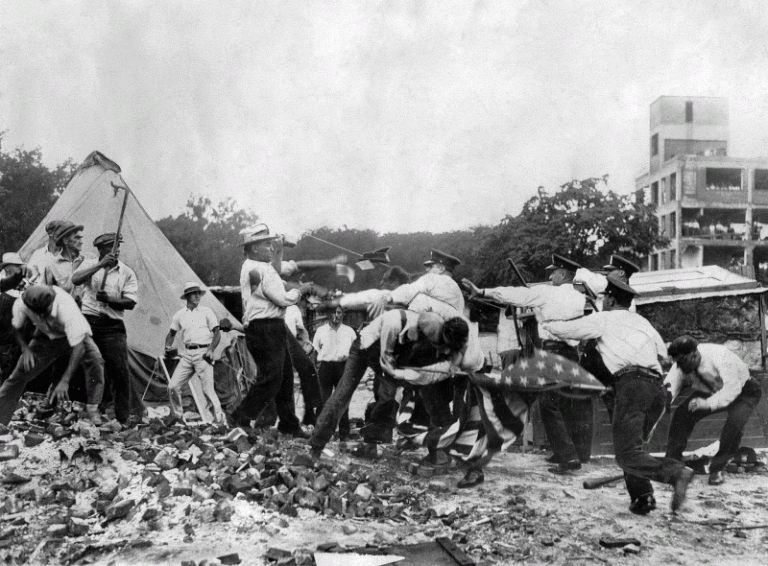
Photograph of Bonus marchers. 1932. Via Wikimedia Commons

A year later, with Roosevelt in the White House, another contingent of veterans came to Washington to make the same demand for early bonus payment. Roosevelt also opposed the payment, but rather than calling out the troops he sent First Lady Eleanor Roosevelt to speak to the vets, and offered employment in the Civilian Conservation Corps. (Only some took that opportunity, with others regarding the $1 per day wage as a form of slavery.)
Three years later, Congress passed the bonus payment — over FDR’s veto.
References:
Longley, Robert. “The 1932 March of the Veterans Bonus Army.” 4 Feb 2019. ThoughtCo. https://www.thoughtco.com/bonus-army-march-4147568
Kingseed, Wyatt, “The ‘Bonus Army’ Storm Into Washington.” American History, June 2004. HistoryNet. https://www.historynet.com/wwi-bonus-army-protest-in-washington.htm
“Battle of Washington”. Time. 8 Aug 1932. Via Internet Archive. https://web.archive.org/web/20081025065911/http://www.time.com/time/magazine/article/0,9171,744107,00.html
Dickson, Paul and Allen, Thomas B. “Marching on History”. Smithsonian Magazine, Feb 2003. Via Internet Archive. https://web.archive.org/web/20140504134911/http://www.smithsonianmag.com/history/marching-on-history-75797769/?all
3. Proposed dictatorship leads to soft coup plot
In 1933, as Franklin D. Roosevelt entered the White House, many people were desperate. When they looked at the fascist dictatorships of Italy and Germany, they saw strong leadership, and more than a few wanted that here.
Leading journalist Walter Lippmann wrote at the time that “A mild species of dictatorship will help us over the roughest spots in the road ahead.”, while the Catholic magazine Commonweal wrote that Roosevelt should have “the powers of a virtual dictatorship to reorganize the government.” The “For Dictatorship If Necessary” headline appeared in the New York Herald-Tribune.
The “popular entertainment” mentioned was the film Gabriel Over the White House (based, oddly enough, on a novel by a British solider), produced by William Randolph Hearst.
The alleged “Business Plot” or “White House Putsch” was revealed in testimony of retired Marine Corps Major General Smedley Butler. Historians disagree on how much of a plot there actually was, how serious a threat it posed, and to what degree Butler — whose politics had grown into strident populism and anti-militarism — may have exaggerated. (Not that there’s anything wrong with strident populism and anti-militarism.)
Some writer, still seeing FDR as a great hero of freedom and democracy rather than an ambiguous figure on the edge of dictatorship, have portrayed the goal of the scheme (however serious or unserious it was) as completely overthrowing the elected President and installing a fascist regime. But according to Butler’s testimony, the plotters’ model was France, not Germany or Italy, and they planned to keep FDR in a depowered ceremonial role as head of state: “…that they were going to have somebody take the patronage off of his shoulders and take all the worries and details off of his shoulders, and then he will be like the President of France…The President will go around and christen babies and dedicate bridges, and kiss children.”
References:
FDR Presidential Library & Museum, Marist College. “Dictatorship: The Road Not Taken”. fdrlibrary.marist.edu http://www.fdrlibrary.marist.edu/archives/pdfs/dictatorship.pdf
“Defeat Faces Roosevelt ‘Autocracy’.” The Daily Times-News (Burlington, N. Carolina), 10 Feb 1933. Via Newspapers.com. https://www.newspapers.com/clip/33848984/defeat-faces-roosevelt-autocracy/
“Democrats Agree To Let Roosevelt Wipe Out Bureaus: Broad Grant of Economy Authority is Pushed to the Fore by the Tax Problem.” New York Times (1923-Current file), 30 Dec 1932, pp. 1. ProQuest. https://search.proquest.com/historical-newspapers/democrats-agree-let-roosevelt-wipe-out-bureaus/docview/99745360/se-2?accountid=34685
Fleming, Dewey L. “Garner Is Told Dictator Plan Goes Too Far: Democratic Senators Oppose Sweeping Powers Proposed For Roosevelt.” The Sun (1837-1995), Feb 11, 1933, pp. 1. ProQuest. https://search.proquest.com/historical-newspapers/garner-is-told-dictator-plan-goes-too-far/docview/540627588/se-2?accountid=34685
American Film Institute. “Gabriel over the White House.” AFI Catalog Of Feature Films: The First 100 Years 1893–1993. https://catalog.afi.com/Catalog/moviedetails/7206
Greenfield, Jeff. “The Hollywood Hit Movie That Urged FDR to Become a Fascist”. Politico, 25 Mar 2018. https://www.politico.com/magazine/story/2018/03/25/gabriel-over-the-white-house-fdr-inauguration-217349
Testimony of Major General Smedley Darlington Butler before the McCormack-Dickstein Committee, 1933; from Wikisource contributors, ‘McCormack–Dickstein Committee’, Wikisource , 23 Oct 2019. https://en.wikisource.org/w/index.php?title=McCormack%E2%80%93Dickstein_Committee&oldid=9667976#Testimony_of_Maj._Gen._S._D._Butler_(Retired)
4. Armed protesters disrupt legislature
On May 2, 1967, thirty armed members of the Black Panther Party entered the California state Capitol to protest a gun control bill. They were charged with felony conspiracy to disrupt a legislative session. Bobby Searle accused police of manufacturing “trumped up charges”, and the protesters ended up pleading guilty to lesser, misdemeanor charges — not with terrorism, insurrection, or the like.
The bill they came to protest, the Mulford Act, was designed to stop the Panther’s armed patrols against police violence. It was quickly passed after the demonstration/invasion, and was one of the first modern gun control laws, pushed by conservatives and signed into law by Ronald Reagan.
The demonstration of “Black Power” aided recruitment, and even gained the Black Panther Party support among more radical white people.
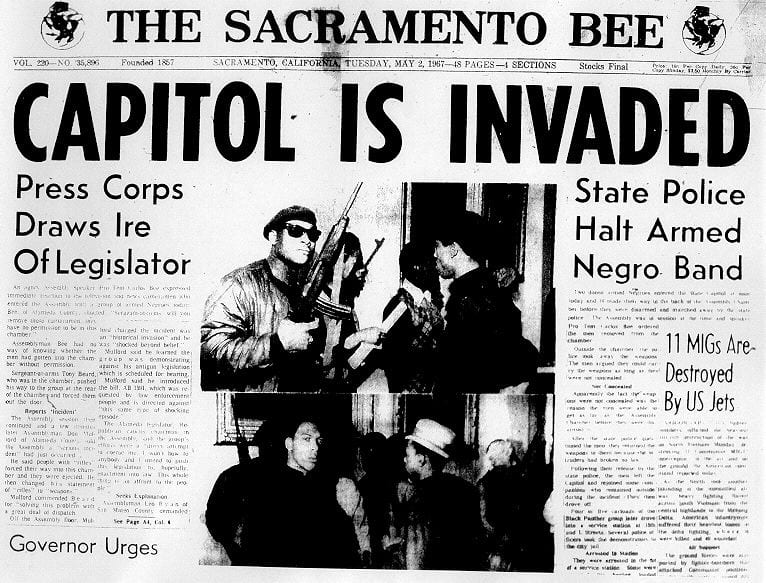
Front page of the Sacramento Bee, May 2 1967. Fair use. Via 14 East
References:
“From the pages of The Bee, 1967: Armed Black Panthers invade Capitol”. Sacramento Bee, 2017 reprint of 2 May 1967 story “Armed Black Panthers invade Capitol”. https://www.sacbee.com/news/local/history/article148667224.html
Wing, Nick. “Here’s How The Nation Responded When A Black Militia Group Occupied A Government Building.” HuffPost, 6 Jan 2016. HuffPost News/Verizon Media. https://www.huffpost.com/entry/black-panthers-california-1967_n_568accfce4b014efe0db2f40.
McFadden, Chuck. “Armed Black Panthers in the Capitol, 50 years on”. Capitol Weekly, 26 Apr 2017. Open California. https://capitolweekly.net/black-panthers-armed-capitol/.
5. Congressional objections and inaugural rioting
After Trump won the 2016 elections, rioting broke out in Oakland and Portland. Anti-Trump group Unite For America put together a video featuring 18 celebrities including Martin Sheen, Debra Messing, Moby, and Bob Odenkirk, urging Electoral College members to deny Trump victory.
In January 2017, Representatives from Alabama, Florida, Michigan, Texas, Mississippi, North Carolina, and South Carolina objected to the electoral vote count on the floor of Congress. Their complaints ranged from claims that the mechanics of polling were unfair, to conspiracy theories about foreign interference.
Weeks later, violent protest by the “Disrupt J20” movement broke out at the inauguration.
None of this was described as “sedition” or “incitement”. And it seems that many people have forgotten these events of only four years ago, or never knew of them in the first place.
References:
Hernandez, Tony. “Portland wakes up to damage from anti-Trump riot.” OregonLive, 11 Nov 2016. Advance Local Media. https://www.oregonlive.com/portland/2016/11/pearl_district_ne_portland_wak.html
Associated Press. “Protests, riots after Trump elected.” Chattanooga Times Free Press, 9 Nov 2016. https://www.timesfreepress.com/news/politics/elections/story/2016/nov/09/anger-over-trump-explodes-protesters-set-fires-smash-glass/396953/
Chiacu, Doina and Cornwell, Susan. “U.S. Congress certifies Trump’s Electoral College victory.” Reuters, 6 Jan 2017. https://www.reuters.com/article/us-usa-trump-congress-idUSKBN14Q25R
CBS/AP. “Trump inauguration protest damages parts of downtown Washington”. CBS News, 21 Jan 2017. CBS Interactive. https://www.cbsnews.com/news/donald-trump-inauguration-protest-damages-downtown-washington/
Greenwood, Max. “Celebrities Urge GOP Electors To Deny Trump Electoral College Win.” HuffPost, 15 Dec 2016. HuffPost News/Verizon Media. https://www.huffpost.com/entry/celebrities-trump-electoral-college_n_5851cb3be4b016e9c1187b63
Reasoning about politics
Our politics have become dangerously polarized. Empathy has declined and the fundamental attribution error is the rule of the day. When “our side” does something wrong, it is because we are fundamentally good and merely became overheated in the moment — after all, extremism in defense of liberty, or equality, or justice, or patriotism, or whatever noble values we hold, is no vice. But when “their side” does something wrong it is because they are fundamentally deplorable traitors who hate America, and what do you expect from them?
This is not a sustainable situation. We must stop thinking this way, or descend into a long cycle of violence. That’s not to say that there are not individual people who are fundamentally deplorable, and it’s not to say that the solution lies in some sort of political centrism. But a democracy rests on the ability of citizens to treat each other as fellow sovereigns.
If this little exercise worked, perhaps you judged at least one of the cases in a certain way but found yourself suddenly feeling differently when the details were revealed. Perhaps it gave you a useful example of how our partisan attachments can override our rational judgement.
I hope that it illustrates a useful mode for reasoning about politics: abstract away the specifics to get away from those sorts of gut-level responses, and try to apply neutral general principles.
Previous Post

December 20, 2020
Yule Movies: Returning from the Darkness
Next Post

January 20, 2021 A Spell for Vaccination
Browse Our Archives
Select a Category 2017 52 Makeup 2020 52 Makeup Always Roaming With A Hungry Heart Art Because I Could Not Stop For Death Caught On Video COVID-19 Culture Discordianism Ethics, Virtue, and Right Living History Magic(k), Ritual, and Mysticism My Blogging Life and Times Philosophy Podcast Poetry Random Wednesdays Religion & Politics Seasonal Musings Techno-Pagan Theology Uncategorized Warrior Path Zen
Select a Month October 2026 September 2026 August 2026 March 2026 February 2026 January 2026 December 2025 March 2025 January 2025 December 2024 November 2024 September 2024 August 2024 June 2024 May 2024 April 2024 March 2024 February 2024 December 2023 September 2023 August 2023 July 2023 June 2023 May 2023 March 2023 February 2023 January 2023 December 2022 October 2022 September 2022 June 2022 April 2022 February 2022 January 2022 December 2021 November 2021 October 2021 September 2021 August 2021 July 2021 May 2021 April 2021 March 2021 February 2021 January 2021 December 2020 November 2020 October 2020 September 2020 August 2020 June 2020 May 2020 April 2020 March 2020 February 2020 January 2020 December 2019 November 2019 October 2019 September 2019 August 2019 July 2019 June 2019 May 2019 April 2019 March 2019 February 2019 January 2019 December 2018 November 2018 October 2018 September 2018 August 2018 July 2018 June 2018 May 2018 April 2018 March 2018 January 2018 December 2017 November 2017 October 2017 September 2017 August 2017 July 2017 June 2017 May 2017 April 2017 March 2017 February 2017 January 2017 December 2016 November 2016 October 2016 September 2016 August 2016 July 2016 June 2016 May 2016 April 2016 March 2016 February 2016 January 2016 December 2015 November 2015 October 2015 September 2015 August 2015 July 2015 June 2015
Follow Us!
TAKE THE
Religious Wisdom Quiz
What did Jesus say about worrying about tomorrow?
Select your answer to see how you score.
Do not worry Worry every day Ignore today Plan for every detail
Related posts from The Zen Pagan


Comfort The Dying; We're All Dying

Fixing the Mailbox: A Holiday Omen

Masculine Archetypes: Trickster at Samhain & Election Day
TRENDING AT PATHEOS Pagan

Catholic Evangelization: Sharing Your Faith Every Day
Welcome back to the Graceful Awakening mini-series called, “From Faith to Mission.” ...

The Pillar of the Boatmen: the Ancient Monument...
The Pillar of the Boatmen is a Romano-Gaulish sculpture that dates from...

In one sense walking into Westminster Abbey is like walking down the...

'Super Scam Me' Exposes AI Jon Bon Jovi...
Leslie Pickett believed she was in a relationship with Jon Bon Jovi....

The Brazilian Remake of Kendricks' 'Flywheel' Opens in...
“Flywheel,” the story that launched the Kendrick Brothers’ filmmaking career is getting...

The Dangers of Gradual Accommodation (Winking at Sin)
Recently, the “law of gradualness” resurfaced during the opening of a weeklong,...
view all Pagan blogs
Ad-Free & Subscriber Log-In Subscription Support
- About Us
- 2026 Calendar
- Videos
- Podcasts
- Library of World Religions
- Faith In Media Tracker
- Advertise With Us
- Write for Us
- Privacy Policy
- Terms of Service
- Do Not Sell My Data
- Contact Us
- Radiant Digital
- Manage Newsletter Subscriptions
- Unsubscribe From Notifications
- Sitemap
Copyright 2008-2026, Patheos. All rights reserved.
Subscription Support Ad-Free & Subscriber Log-In
Follow Patheos