
BuddhistCatholicContemplativeEvangelicalGeneral ChristianHinduJewishLatter-day SaintMuslimNew VisionsProgressive Christian
Beliefs
- Buddhist
- Catholic
- Contemplative
- Evangelical
- General Christian
- Hindu
- Jewish
- Latter-day Saint
- More Voices
- Muslim
- New Visions
- Pagan
- Progressive Christian
Topics
- Religion News
- Food and Religion
- Sports and Religion
- Religious Art
- Religious Music and Entertainment
- Religious Events
- History and Religion
- Style and Religion
- Politics and Religion
- Women in Religion
- Recreation Outdoors and Religion
- Business Finance and Religion
- Careers Workplace and Religion
- Education and Religion
- Family Parenting and Religion
- Health Fitness and Religion
- Home and Religion
- Relationships and Religion
- Technology and Religion
- Travel and Religion
Columnists
- Buddhist Columnists
- Business Finance and Religion Columnists
- Careers Workplace and Religion Columnists
- Catholic Columnists
- Contemplative Columnists
- Education and Religion Columnists
- Evangelists Columnists
- Family Parenting and Religion Columnists
- General Christian Columnists
- Health Fitness and Religion Columnists
- Hindu Columnists
- History and Religion Columnists
- Home and Religion Columnists
- Jewish Columnists
- More Voices Columnists
- Latter Day Columnists
- Muslim Columnists
- New Visions Columnists
- Nonreligious Columnists
- Pagan Columnists
- Politics and Religion Columnists
- Progressive Columnists
- Recreation Outdoors and Religion Columnists
- Relationships and Religion Columnists
- Religion News Columnists
- Religious Art Columnists
- Religious Events Columnists
- Religious Music and Entertainment Columnists
- Sports and Religion Columnists
- Style and Religion Columnists
- Technology and Religion Columnists
- Travel and Religion Columnists
- Women in Religion Columnists
Resource Library
- 2026 Calendar
- Library of World Religions
- The 100 Most Holy Places on Earth
- Patheos Answers
- Podcasts
- Videos
- Faith Leaders Database
- Anglican Episcopalian
- Bahai
- Baptist
- Buddhism
- Christianity
- Confucianism
- Eastern Orthodoxy
- Hinduism
- Holiness and Pentecostal
- ISKCON
- Islam
- Judaism
- Lutheran
- Methodist
- The Church of Jesus Christ of Latter-day Saints
- New Age
- Paganism
- Presbytarian and Reformed
- Protestantism
- Religion Behind the Scenes
- Roman Catholic
- Scientology
- Shia Islam
- Sikhism
- Sufism
- Sunni Islam
- Taoism
- Zen
- See all religions
Research Tools
 Ad-Free & Subscriber Log-In Subscription Support
Ad-Free & Subscriber Log-In Subscription Support
Follow Patheos 

- Trending:
- Forgiveness
- |
- Marriage
- |
- Consciousness
- |
- Death Penalty
- |
- Election
- |
- Halloween

- Home
- Pagan
- Lady Liberty, American Goddess
Lady Liberty, American Goddess
Last updated on: February 6, 2020 at 12:25 am by Tom Swiss
Lady Liberty, American Goddess 2020-02-06T00:25:36-04:00 Tom Swiss
Patheos Explore the world's faith through different perspectives on religion and spirituality! Patheos has the views of the prevalent religions and spiritualities of the world.
Where do gods come from?
In whatever sense we might say that the gods exist (a question that depends on the ontological stance we take), either their existence is independent of that of humans and we merely discover them; or their existence is in some way dependent on us, we create them or the co-arise with us.
Whether they are discovered or created, the process often starts with impressions and images (along the general lines of “totems”, in the Durkheimian sense of that word) rather than stories or dogma. Images can be more accessible, and different images don’t directly contradict each other the way different stories do. We can resolve two very different images more easily than we can resolve contradictory stories.
Creating anthropomorphic or zoomorphic images of a larger-than-life being who embodies abstract aspects of our human experience may often be the first step to discovering or creating a god.
And it doesn’t take long to get going with it — according to the Old Testament, it only took forty days for the ancient Israelites to whip up a god-statue of a golden calf. (And to be murdered for it by zealot Jehovah-worshipers.)
But what’s interesting is that we still create these sort of images today.
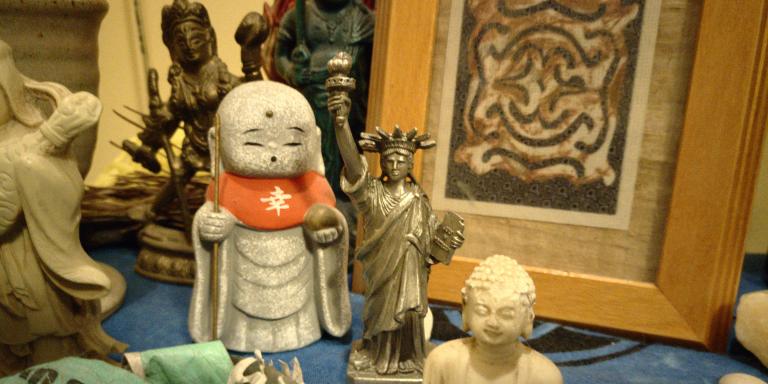
In fact two of them reside on my altar, next to ancient gods and spirits and heroes. Along with Pan and Kali, Fudō Myō-ō/Acala and the Buddha, Benzaiten/Sarasvati and Hotei, you will find on my altar Lady Liberty, the American goddess whose Statue stands in New York Harbor, and Sento-kun, a Japanese genius loci of the city of Nara, of recent creation but ancient roots.
Sento-kun is a very interesting example of a Horned God, with roots in the role of deer as messengers of the kami in Shinto, but also in the cartoonish nature of mascots. We may return to him another time.
For the moment I’d like to focus on Lady Liberty, the newest addition to my altar. I visited Liberty Island while I was in New York recently, and it seemed meet to pick up a figurine at the gift shop (had to look a bit to find one made the US) to let her take her place besides other deities whose domains (physical or spiritual) I have visited.
I think I first encountered the idea of Lady Liberty as a deity in the 1980s, in a piece in Poul Anderson’s collection Fantasy titled “Bullwinch’s Mythology”, a satirical look at the “twentieth century American pantheon”. Then sometime in the 1990s I read an issue of Neil Gaiman’s Sandman where she is mentioned, along with King Kong and Marilyn Monroe, as part of a group of “later gods, new altars and icons.” The idea has stuck with me since then.
Of course the Statue of Liberty was heavily influenced by the Roman Libertas, but she has distinct properties — some present at the statue’s creation, some developed in the years after. The idea of “Liberty Enlightening the World” (her full name) is one from the post-Enlightenment modern West, not ancient Rome. In fact it came from an earlier idea her sculptor, Frédéric Auguste Bartholdi, had for a lighthouse on the Suez Canal to be built in the form of an statue of an ancient Egyptian woman; the proposed statue was to be called “Egypt Carrying the Light to Asia”.
Bartholdi did not have immigration or the idea of the “Mother of Exiles” in mind. The famous Emma Lazarus poem was written for one of many fundraisers for the statue’s pedestal. It was not part of the official building or unveiling of the statue at all; only after the poet’s death did friends of hers begin a campaign to immortalize her through the poem, and a plaque with words from the sonnet was placed on the inner wall of the pedestal in 1903.
(On a side note, Lazarus dedicated an early collection of her poems to her friend Ralph Waldo Emerson, whose influence on Paganism I discuss in Why Buddha Touched The Earth.)
But history has always shown the gods to evolve over the course of their existence. Athena, goddess of democracy, started off as a Minoan-Mycenaean palace goddess. Or contrast the Jehovah of the Old and New Testaments.
Lady Liberty entered human minds in relation to the ideals of (small-r) republican governance and the abolition of slavery, but her geographical position — influenced by Bartholdi’s old idea of a lighthouse — made her America’s greeter for those arriving at Ellis Island.

But with fewer immigrants arriving by boat, perhaps her influence on that area has waned.
She has been and will be invoked by people with diametrically opposed viewpoints, which seems to be an occupational hazard for the gods. Just as both hippie peace-and-love “Jesus freaks” and like authoritarian right-wingers like Mike Pence and George W. Bush call on Jesus, so both aristocratic socialist Emma Lazarus and the unrestrained capitalists of the Libertarian Party have called on Lady Liberty, with the LP using her in their logo up until a few years ago. (She was never a good fit for a political philosophy that is often, as Kim Stanley Robinson put it, “anarchists who want police protection from their slaves.”)
She is the totem of the United States, and if her attributes seem contradictory and confusing perhaps that’s best seen as a reflection of the animating contest of democracy. (Or maybe there’s a little bit of my lady Eris in her makeup.)
Previous Post

January 28, 2020
Broken and Golden (52 Make-Up, Week 3)
Next Post

February 9, 2020 We All Get To Do Everything, Because We're All Everyone
Browse Our Archives
Select a Category 2017 52 Makeup 2020 52 Makeup Always Roaming With A Hungry Heart Art Because I Could Not Stop For Death Caught On Video COVID-19 Culture Discordianism Ethics, Virtue, and Right Living History Magic(k), Ritual, and Mysticism My Blogging Life and Times Philosophy Podcast Poetry Random Wednesdays Religion & Politics Seasonal Musings Techno-Pagan Theology Uncategorized Warrior Path Zen
Select a Month October 2026 September 2026 August 2026 March 2026 February 2026 January 2026 December 2025 March 2025 January 2025 December 2024 November 2024 September 2024 August 2024 June 2024 May 2024 April 2024 March 2024 February 2024 December 2023 September 2023 August 2023 July 2023 June 2023 May 2023 March 2023 February 2023 January 2023 December 2022 October 2022 September 2022 June 2022 April 2022 February 2022 January 2022 December 2021 November 2021 October 2021 September 2021 August 2021 July 2021 May 2021 April 2021 March 2021 February 2021 January 2021 December 2020 November 2020 October 2020 September 2020 August 2020 June 2020 May 2020 April 2020 March 2020 February 2020 January 2020 December 2019 November 2019 October 2019 September 2019 August 2019 July 2019 June 2019 May 2019 April 2019 March 2019 February 2019 January 2019 December 2018 November 2018 October 2018 September 2018 August 2018 July 2018 June 2018 May 2018 April 2018 March 2018 January 2018 December 2017 November 2017 October 2017 September 2017 August 2017 July 2017 June 2017 May 2017 April 2017 March 2017 February 2017 January 2017 December 2016 November 2016 October 2016 September 2016 August 2016 July 2016 June 2016 May 2016 April 2016 March 2016 February 2016 January 2016 December 2015 November 2015 October 2015 September 2015 August 2015 July 2015 June 2015
Follow Us!
TAKE THE
Religious Wisdom Quiz
Where did Elisha multiply oil?
Select your answer to see how you score.
Jericho Samaria Shunem Zarephath
Related posts from The Zen Pagan


Comfort The Dying; We're All Dying

Fixing the Mailbox: A Holiday Omen

Masculine Archetypes: Trickster at Samhain & Election Day
TRENDING AT PATHEOS Pagan

Emotion in Early Christianity by Andrew Crislip
Andrew Crislip’s Emotion in Early Christianity examines an often overlooked dimension of...

16 Spiritual Touchstones for a More Grounded Life
After decades of spiritual study, here are 16 principles I try...

Catholic Evangelization: Sharing Your Faith Every Day
Welcome back to the Graceful Awakening mini-series called, “From Faith to Mission.” ...

The Pillar of the Boatmen: the Ancient Monument...
The Pillar of the Boatmen is a Romano-Gaulish sculpture that dates from...

In one sense walking into Westminster Abbey is like walking down the...

'Super Scam Me' Exposes AI Jon Bon Jovi...
Leslie Pickett believed she was in a relationship with Jon Bon Jovi....
view all Pagan blogs
Ad-Free & Subscriber Log-In Subscription Support
- About Us
- 2026 Calendar
- Videos
- Podcasts
- Library of World Religions
- Faith In Media Tracker
- Advertise With Us
- Write for Us
- Privacy Policy
- Terms of Service
- Do Not Sell My Data
- Contact Us
- Radiant Digital
- Manage Newsletter Subscriptions
- Unsubscribe From Notifications
- Sitemap
Copyright 2008-2026, Patheos. All rights reserved.
Subscription Support Ad-Free & Subscriber Log-In
Follow Patheos