
BuddhistCatholicContemplativeEvangelicalGeneral ChristianHinduJewishLatter-day SaintMuslimNew VisionsProgressive Christian
Beliefs
- Buddhist
- Catholic
- Contemplative
- Evangelical
- General Christian
- Hindu
- Jewish
- Latter-day Saint
- More Voices
- Muslim
- New Visions
- Pagan
- Progressive Christian
Topics
- Religion News
- Food and Religion
- Sports and Religion
- Religious Art
- Religious Music and Entertainment
- Religious Events
- History and Religion
- Style and Religion
- Politics and Religion
- Women in Religion
- Recreation Outdoors and Religion
- Business Finance and Religion
- Careers Workplace and Religion
- Education and Religion
- Family Parenting and Religion
- Health Fitness and Religion
- Home and Religion
- Relationships and Religion
- Technology and Religion
- Travel and Religion
Columnists
- Buddhist Columnists
- Business Finance and Religion Columnists
- Careers Workplace and Religion Columnists
- Catholic Columnists
- Contemplative Columnists
- Education and Religion Columnists
- Evangelists Columnists
- Family Parenting and Religion Columnists
- General Christian Columnists
- Health Fitness and Religion Columnists
- Hindu Columnists
- History and Religion Columnists
- Home and Religion Columnists
- Jewish Columnists
- More Voices Columnists
- Latter Day Columnists
- Muslim Columnists
- New Visions Columnists
- Nonreligious Columnists
- Pagan Columnists
- Politics and Religion Columnists
- Progressive Columnists
- Recreation Outdoors and Religion Columnists
- Relationships and Religion Columnists
- Religion News Columnists
- Religious Art Columnists
- Religious Events Columnists
- Religious Music and Entertainment Columnists
- Sports and Religion Columnists
- Style and Religion Columnists
- Technology and Religion Columnists
- Travel and Religion Columnists
- Women in Religion Columnists
Resource Library
- 2026 Calendar
- Library of World Religions
- The 100 Most Holy Places on Earth
- Patheos Answers
- Podcasts
- Videos
- Faith Leaders Database
- Anglican Episcopalian
- Bahai
- Baptist
- Buddhism
- Christianity
- Confucianism
- Eastern Orthodoxy
- Hinduism
- Holiness and Pentecostal
- ISKCON
- Islam
- Judaism
- Lutheran
- Methodist
- The Church of Jesus Christ of Latter-day Saints
- New Age
- Paganism
- Presbytarian and Reformed
- Protestantism
- Religion Behind the Scenes
- Roman Catholic
- Scientology
- Shia Islam
- Sikhism
- Sufism
- Sunni Islam
- Taoism
- Zen
- See all religions
Research Tools
 Ad-Free & Subscriber Log-In Subscription Support
Ad-Free & Subscriber Log-In Subscription Support
Follow Patheos 

- Trending:
- Forgiveness
- |
- Marriage
- |
- Consciousness
- |
- Death Penalty
- |
- Election
- |
- Halloween

- Home
- Pagan
- Violence as a Koan
Violence as a Koan
Last updated on: January 8, 2020 at 11:18 am by Tom Swiss
Violence as a Koan 2020-01-08T11:18:16-04:00 Tom Swiss
Patheos Explore the world's faith through different perspectives on religion and spirituality! Patheos has the views of the prevalent religions and spiritualities of the world.
The Zen term kōan literally means “public record.” Originally it referred to an interaction or incident that was recorded and used as a teaching example. In some schools of Zen, kōan practice evolved over time so that it has the student facing a question which cannot be reasonably answered, yet which demands an answer — the famous “what is the sound of one hand clapping” or the challenge to “show me your face before your mother was born.”
Another example is “Kyogen Mounts the Tree” from the Mumonkan (Gateless Gate) [Nyogen Senzaki and Paul Reps translation]:
Kyogen said: “Zen is like a man hanging in a tree by his teeth over a precipice. His hands grasp no branch, his feet rest on no limb, and under the tree another person asks him: ‘Why did Bodhidharma come to China from India?'”
“If the man in the tree does not answer, he fails; and if he does answer, he falls and loses his life. Now what shall he do?”
Bodhidharma was the mythical founder of Zen; in the language of Zen, asking why Bodhidharma came to China from India is to ask “Please teach me about Zen.” In some versions of the koan, if the man does not answer he not only fails in his duty but will be killed for his failure.
Imagine it! You’re hanging high above the ground by your teeth, only your jaw gripping the branch or a rope or something. Feel the pain and fatigue of your jaw muscles. And here comes a question you must answer. To speak you must let go, but to let go is to die, and if you die you can’t speak, but if you don’t speak you fail and die.
(The dilemma is the inspiration for the title of a fine collection of dharma talks, Open Mouth Already A Mistake, by Wu Kwang.)
The idea of this sort of practice is that the student keeps beating their head against that unsolvable riddle until their rational mind gives up, and permits a response from the unconditioned mind.
At first glance the 1980s action movie Roadhouse seems a world away from the eight-century-old Mumonkan. In that movie Patrick Swayze plays a bouncer named Dalton, who is hired to clean up a bar where violence has become commonplace. Of course, this being the movies, he ends up not just cleaning up the bar but stopping the corrupt businessman who owns the town, and wins the heart of the beautiful woman.
Be Nice
In one notable scene, when Dalton takes over he gives instructions to his staff, starting with the primary rule: be nice. Some of the bouncers have questions about this plan:
Dalton: If somebody gets in your face and calls you a c*cks*cker I want you to be nice…Ask him to walk, be nice. If he won’t walk, walk him, but be nice. If you can’t walk him, one of the others will help you and you will both be nice. I want you to remember that it’s the job, it’s nothing personal.
Bouncer 1: Being called a c*cks*cker isn’t personal?
Dalton: No, it’s two nouns combined to elicit a prescribed response.
Bouncer 1: What if somebody calls my Mama a whore?
Dalton: Is she? [Laughter.] I want you to be nice — until it’s time to not be nice.
Bouncer 2: So, how are we supposed to know when that is?
Dalton: You won’t. I’ll let you know.
In the Manichean world of an action movie, it’s easy to tell when it’s time to not be nice, easy to tell the drunken patron who just needs to go home and sober up from the true bad guys. But for those of us who live in the messy and ambiguous real world, “when is it time to stop being nice?” is actually one heck of a question.
Indeed, perhaps for those of us whose Zen in rooted in the practice of the martial arts, it might fill the role of a kōan.

When is it time to stop being nice and use force? When do we shift from being being Kannon, Avalokiteśvara, the Bodhisattva of mercy and compassion who hears the cries of the world, to being Fudō Myō-ō, Acala, the wrathful deity “whose powers are of lava, of magma, of deep rock strata, of gunpowder, and the Sun”, in the words of poet Gary Snyder?
The budōka, the martial artist, is called on to be benevolent and merciful and calm; but also devotes much of their life to developing the capability to act with great violence.
There is a reason that Zen Buddhism has assigned deities to personify both of these attributes. Neither can be neglected.
In one conversation with a student who was worried about his son wanting a toy gun, the 20th century Zen Master Seung Sahn said:
Your son wants a toy gun. You think that that is not so good. But instead, you should view the problem as: How do you use this correctly? Don’t make good or bad: how do you teach the correct function of this gun, OK? That’s very important—more important than just having a gun or not. If you use this gun correctly, you can help many people, but if it is not used correctly, then maybe you will kill yourself, kill your country, kill other people. So the gun itself is originally not good, not bad. More important is: what is the correct function of this gun?
What is the correct function of the gun, or the fist, or of the sword and lariat that Fudō Myō-ō is usually portrayed as carrying?
Wrong Answers
Like many deep questions, this has had many simple, straightforward, and entirely wrong answers proposed for it.
One popular answer is that laws or political processes can give us the answer: that we can turn our judgment over to legislators, judges, or superior officers.
Those in power have good reasons for promoting this answer. To maintain their power they need people who will be nice to them and non-nice to their opponents. They need enforcers, witting or unwitting, who will be non-nice only upon their orders. But “I was only following orders” didn’t fly at Nuremberg.
Some organized religions provide their own sets of propositions, detailed moral rules about when to be merciful and when war or killing is sanctioned. Zen inherits from Taoism a skepticism about this sort of moralism. Lao Tzu referred to such rulesets when he wrote, “If we could renounce our benevolence and discard our righteousness, the people would again become filial and kindly.” Many Taoist stories follow the theme of a Taoist sage chiding a Confucian for too much rule-bound moralism.
Zen absorbed this skepticism. Hui Neng, the Sixth Patriarch of Zen, cut through the tangles of ethical dilemmas when he asked a monk, “When you do not think good and when you do not think not-good, what is your true self?”
We cannot give our moral judgment — the definition of “good” and “not-good” — over to others, to generals or legislators or priests who will point out an enemy and say, “Be nice to everyone but them.”
No Enemy
For as the Discordians say, “There is no enemy anywhere.”
I think often of a passage from Jack Kerouac’s The Dharma Bums, which concisely explains the compassionate teachings of Mahayana Buddhism:
“I sit down and say, and I run all my friends and relatives and enemies one by one in this, without entertaining any angers or gratitudes or anything, and I say, like ‘Japhy Ryder, equally empty, equally to be loved, equally a coming Buddha,’ then I run on, say to ‘David O. Selznick, equally empty, equally to be loved, equally a coming Buddha’ though I don’t use names like David O. Selznick, just people I know because when I say the words ‘equally a coming Buddha’ I want to be thinking of their eyes, like you take Morley, his blue eyes behind those glasses, when you think ‘equally a coming Buddha’ you think of those eyes and you really do suddenly see the true secret serenity and the truth of his coming Buddhahood. Then you think of your enemy’s eyes.”
Can you imagine that? Think of the politician you most loathe, Donald Trump or Hillary Clinton or Boris Johnson or Jeremy Corbin, whomever. Think of an awful criminal, a mass murderer, Adam Lanza or Charles Manson or Jeffrey Dahmer or Dylan Roof, Hitler or Stalin or Mao or Pol Pot. Think of them as equally empty, equally to be loved, equally a coming Buddha as the greatest leaders or wisdom teachers.
Or if that’s too abstract, think of the guy who cut you off on the road this morning, or the bully who picked on you when you were ten years old. Your enemy is equally empty, equally to be loved, equally a coming Buddha as your loved ones, your family and friends.
It’s impossible! It can’t be! It’s as impossible as the Bodhisattva’s vow to save all sentient beings…or as Kyogen’s challenge to explain the teachings of Zen while hanging by one’s teeth.
That doesn’t mean that if one of these coming Buddhas, confused and ignorant of their own Buddha-hood, behaves aggressively that we just stand by and let them attack others. That’s just refusing to grapple with the question. Compassion for those whom the aggressors would attack drives us to take action, even violent action if necessary. But as the Tao Te Ching says,
His enemies are not demons,
but human beings like himself.
He doesn’t wish them personal harm.
Nor does he rejoice in victory.
How could he rejoice in victory
and delight in the slaughter of men?He enters a battle gravely,
with sorrow and with great compassion,
as if he were attending a funeral.
[Stephen Mitchell translation]
The Sword That Gives Life
On my left arm I have a tattoo of the kanji “katsu jin ken”, “the sword that gives life.” It is half of the proverb “satsu jin ken katsu jin ken”, “the sword that takes life is the sword that gives life”: another phrasing of the great riddle-koan of violence, carved into my flesh so that I see it in the mirror every morning when I step out of the shower.
That wrathful deity Fudō Myō-ō/Acala carries a sword as a key part of his iconography. We might expect that, with the wrath and all. But so does Mañjuśrī, the Bodhisattva of wisdom and insight, whose sutra (the “Sūtra of Mahā-Prajñā-Pāramitā Pronounced by Mañjuśrī Bodhisattva”) tells us that the key to insight is take all equally, to not compare or differentiate this against that, not even “good” against “evil”:
Not knowing [not perceiving subject and object] is the inconceivable state. The inconceivable state is what Buddhas know, such as neither grasping nor not grasping, seeing neither the appearance of past, present, or future, nor the appearance of coming or going, and grasping neither birth nor death, neither cessation nor perpetuity, neither arising nor acting. This knowledge is called the true wisdom-knowledge, the inconceivable wisdom-knowledge. Like the open sky, with neither appearances nor features, in unequaled equality, it makes no comparison, neither this against that nor good against evil.
Mañjuśrī’s sword is said to represent cutting through delusions and preferences of this versus that, for and against, so that we can get to the point of knowing that all these comparisons are just mental constructions.
As the Third Patriarch, Seng Ts’an, put it, “The conflict between right and wrong / Is the sickness of the mind.”
Or, in Dalton’s words in Roadhouse, it’s about knowing that “it’s nothing personal”, that being a human being in any given moment — even a moment where someone is in your face calling you a c*cks*cker — is just a job.
Ethics, Virtue, and Right Living
Previous Post

December 11, 2019
Magic As A Social Force
Next Post

December 16, 2019 Yule: Keeping The Pilot Light On
Browse Our Archives
Select a Category 2017 52 Makeup 2020 52 Makeup Always Roaming With A Hungry Heart Art Because I Could Not Stop For Death Caught On Video COVID-19 Culture Discordianism Ethics, Virtue, and Right Living History Magic(k), Ritual, and Mysticism My Blogging Life and Times Philosophy Podcast Poetry Random Wednesdays Religion & Politics Seasonal Musings Techno-Pagan Theology Uncategorized Warrior Path Zen
Select a Month October 2026 September 2026 August 2026 March 2026 February 2026 January 2026 December 2025 March 2025 January 2025 December 2024 November 2024 September 2024 August 2024 June 2024 May 2024 April 2024 March 2024 February 2024 December 2023 September 2023 August 2023 July 2023 June 2023 May 2023 March 2023 February 2023 January 2023 December 2022 October 2022 September 2022 June 2022 April 2022 February 2022 January 2022 December 2021 November 2021 October 2021 September 2021 August 2021 July 2021 May 2021 April 2021 March 2021 February 2021 January 2021 December 2020 November 2020 October 2020 September 2020 August 2020 June 2020 May 2020 April 2020 March 2020 February 2020 January 2020 December 2019 November 2019 October 2019 September 2019 August 2019 July 2019 June 2019 May 2019 April 2019 March 2019 February 2019 January 2019 December 2018 November 2018 October 2018 September 2018 August 2018 July 2018 June 2018 May 2018 April 2018 March 2018 January 2018 December 2017 November 2017 October 2017 September 2017 August 2017 July 2017 June 2017 May 2017 April 2017 March 2017 February 2017 January 2017 December 2016 November 2016 October 2016 September 2016 August 2016 July 2016 June 2016 May 2016 April 2016 March 2016 February 2016 January 2016 December 2015 November 2015 October 2015 September 2015 August 2015 July 2015 June 2015
Follow Us!
TAKE THE
Religious Wisdom Quiz
Who carried Jesus' cross partway to Golgotha?
Select your answer to see how you score.
A Roman centurion James Simon of Cyrene Peter
Related posts from The Zen Pagan

Chess Grifters, Chinese Rooms, and AI

Comfort The Dying; We're All Dying
Masculine Archetypes: Trickster at Samhain & Election Day
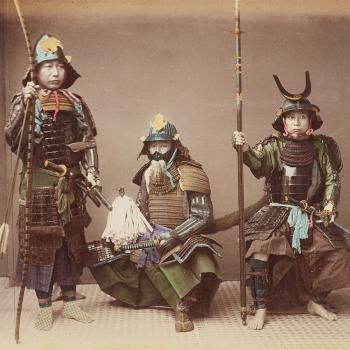
Masculine Archetypes: The Warrior at Mabon
TRENDING AT PATHEOS Pagan

Catholic Evangelization: Sharing Your Faith Every Day
Welcome back to the Graceful Awakening mini-series called, “From Faith to Mission.” ...

The Pillar of the Boatmen: the Ancient Monument...
The Pillar of the Boatmen is a Romano-Gaulish sculpture that dates from...

In one sense walking into Westminster Abbey is like walking down the...

'Super Scam Me' Exposes AI Jon Bon Jovi...
Leslie Pickett believed she was in a relationship with Jon Bon Jovi....

The Brazilian Remake of Kendricks' 'Flywheel' Opens in...
“Flywheel,” the story that launched the Kendrick Brothers’ filmmaking career is getting...

The Dangers of Gradual Accommodation (Winking at Sin)
Recently, the “law of gradualness” resurfaced during the opening of a weeklong,...
view all Pagan blogs
Ad-Free & Subscriber Log-In Subscription Support
- About Us
- 2026 Calendar
- Videos
- Podcasts
- Library of World Religions
- Faith In Media Tracker
- Advertise With Us
- Write for Us
- Privacy Policy
- Terms of Service
- Do Not Sell My Data
- Contact Us
- Radiant Digital
- Manage Newsletter Subscriptions
- Unsubscribe From Notifications
- Sitemap
Copyright 2008-2026, Patheos. All rights reserved.
Subscription Support Ad-Free & Subscriber Log-In
Follow Patheos