
BuddhistCatholicContemplativeEvangelicalGeneral ChristianHinduJewishLatter-day SaintMuslimNew VisionsProgressive Christian
Beliefs
- Buddhist
- Catholic
- Contemplative
- Evangelical
- General Christian
- Hindu
- Jewish
- Latter-day Saint
- More Voices
- Muslim
- New Visions
- Pagan
- Progressive Christian
Topics
- Religion News
- Food and Religion
- Sports and Religion
- Religious Art
- Religious Music and Entertainment
- Religious Events
- History and Religion
- Style and Religion
- Politics and Religion
- Women in Religion
- Recreation Outdoors and Religion
- Business Finance and Religion
- Careers Workplace and Religion
- Education and Religion
- Family Parenting and Religion
- Health Fitness and Religion
- Home and Religion
- Relationships and Religion
- Technology and Religion
- Travel and Religion
Columnists
- Buddhist Columnists
- Business Finance and Religion Columnists
- Careers Workplace and Religion Columnists
- Catholic Columnists
- Contemplative Columnists
- Education and Religion Columnists
- Evangelists Columnists
- Family Parenting and Religion Columnists
- General Christian Columnists
- Health Fitness and Religion Columnists
- Hindu Columnists
- History and Religion Columnists
- Home and Religion Columnists
- Jewish Columnists
- More Voices Columnists
- Latter Day Columnists
- Muslim Columnists
- New Visions Columnists
- Nonreligious Columnists
- Pagan Columnists
- Politics and Religion Columnists
- Progressive Columnists
- Recreation Outdoors and Religion Columnists
- Relationships and Religion Columnists
- Religion News Columnists
- Religious Art Columnists
- Religious Events Columnists
- Religious Music and Entertainment Columnists
- Sports and Religion Columnists
- Style and Religion Columnists
- Technology and Religion Columnists
- Travel and Religion Columnists
- Women in Religion Columnists
Resource Library
- 2026 Calendar
- Library of World Religions
- The 100 Most Holy Places on Earth
- Patheos Answers
- Podcasts
- Videos
- Faith Leaders Database
- Anglican Episcopalian
- Bahai
- Baptist
- Buddhism
- Christianity
- Confucianism
- Eastern Orthodoxy
- Hinduism
- Holiness and Pentecostal
- ISKCON
- Islam
- Judaism
- Lutheran
- Methodist
- The Church of Jesus Christ of Latter-day Saints
- New Age
- Paganism
- Presbytarian and Reformed
- Protestantism
- Religion Behind the Scenes
- Roman Catholic
- Scientology
- Shia Islam
- Sikhism
- Sufism
- Sunni Islam
- Taoism
- Zen
- See all religions
Research Tools
 Ad-Free & Subscriber Log-In Subscription Support
Ad-Free & Subscriber Log-In Subscription Support
Follow Patheos 

- Trending:
- Forgiveness
- |
- Marriage
- |
- Consciousness
- |
- Death Penalty
- |
- Election
- |
- Halloween

- Home
- Pagan
- Buddha Touched The Earth: A Zen Pagan Ritual Cycle
Buddha Touched The Earth: A Zen Pagan Ritual Cycle
Last updated on: July 17, 2019 at 5:24 pm by Tom Swiss
Buddha Touched The Earth: A Zen Pagan Ritual Cycle 2019-07-17T17:24:49-04:00 Tom Swiss
Patheos Explore the world's faith through different perspectives on religion and spirituality! Patheos has the views of the prevalent religions and spiritualities of the world.
This year’s Free Spirit Gathering, held June 11-16, marked the 18th anniversary of the first time I gave a public talk about the idea of “Zen Paganism”. This eventually grew into my book Why Buddha Touched The Earth and this blog.
(And yes, if you follow me on Facebook I am a whole festival behind here, just returning from Starwood but only now posting about FSG. There will be posts about Starwood to come, so stay tuned.)
By “coincidence”, FSG’s theme this year was “Be Here Now” and the artwork was a Buddha-like figure sitting under a tree, the same theme as the wonderful cover art Peter Hollinghurst did for my book.
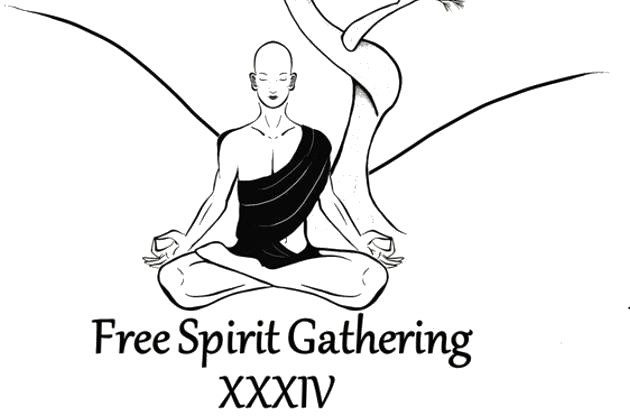
Free Spirit Gathering 2019 art
Of course it’s a classic subject — I’m not alleging plagiarism, just pointing out the resonance.
But when I saw it, almost immediately I had an inspiration for the Gathering’s ritual cycle.
FSG is a ecumenical community, and each year a different group does our opening, main, and closing rituals. We’ve had variations on Wicca, Druid, and Heathen/Asatru/Norse themes, as well as various eclectic cross-genre efforts. (One year’s rituals were based on Where The Wild Things Are; another year featured a diverse set of archetypes. I got to be the Wind that time, and dance around with a sword…fun!)
My inspiration for this year was that the story of the Four Sights could make an fine opening ritual; the story of the Buddha touching the Earth and the Goddess of the Earth bearing him witness could be an excellent main ritual; and Mara trying to tempt Buddha to stay under the Bo Tree in bliss rather than returning to the world could be a suitable closing ritual.
I was extremely fortunate to get great volunteers to play roles in the rituals — especially in the opening ritual, where people spoke their own truths about aging, sickness, and grieving. I think they all went okay, and introduced a lot of people to one of the great stories of the world’s religions.
So here are the scripts to this year’s Free Spirit Gathering rituals. They were taken loosely and the actual performance was a bit more improv, and I’ve done some extra editing and cleanup, but these get the idea across.
Opening ritual: “The Four Sights”
The young Prince Siddhartha sneaks away from his sheltered life and encounters old age, sickness and death for the first time.
The “Four Sights” is one the the great “calls to adventure” in the world’s religious tradition. The Buddha-to-be, Siddhartha, was born a prince and led a sheltered life of pleasure, until he found out some unpleasant truths — like old age, sickness, and death — and went out to try to find a way to deal with them.
Finally, he sat down under a tree to try to figure it out. We invite you to sit with these conundrums of pleasure and suffering over the next few days.
Dramatis personae:
- 1-3 people to talk about aging
- 1-3 people to talk about illness
- 1-3 people to talk about death/grieving
- Sadhu
Props:
- Party music (James Brown playlist)
- Food
- Drink (alcoholic and non)
[Start the party as people are still arriving. Let music play, encourage dancing, drinking, etc., for several minutes.]
Narrator: Friends! Hello! [Turn off music]
I hope you are enjoying the festivities.
I would like to tell you a story. More than that, I would like to help you re-live a story, one of the greatest stories of the world’s spiritual traditions. In our ritual track for FSG this year, we invite you to re-enact the story of the Buddha.
We begin, like all the great tales, with a Call To Adventure.
The man who would become the Buddha, Siddhartha Gautama, was born bout 2,500 years ago in ancient India, in what’s now Nepal. He was a prince, and according to the legends a prophecy was made at his birth. It was said that if the young price became a ruler, he would build a great empire; but if he turned to the spiritual path, he would redeem humankind from suffering.
Well. His parents wanted him to go into the family business and become a king, and not go into some religious thing. They decided to keep him away from all this spiritual nonsense.
They did not want him to BE HERE NOW.
They figured that if they kept him distracted with worldly pleasures, he would grow up like he was supposed to and become a great king.
So he was kept in the palace, and always surrounded with comfort and beauty…and distractions. Sort of like our little party here.
He was taught all the arts that a prince should know, and when he was old enough — which was pretty young, back in those days — a marriage to a beautiful princess was arranged, and soon the Prince even had a son. Siddhartha’s parents probably thought they had him securely on the path of the unexamined life.
But if you have kids or have ever worked with young people, you know that trying to keep things hidden from them never really works in the long run.
One day the young prince slipped out of the palace, taking only his chariot driver — his chauffeur, if you will — with him to be his guide. He made his way to a nearby village. And he discovered some things about the world that his parents had hidden from him.
Friends, put yourself in the Buddha’s shoes for a moment. Imagine that your whole life has been a party like we’ve just been having. And come with me for a moment.
[We walk 1/4 of the way around the circle]
In the palace everyone was young and pretty, but here in the village there were people with…grey hair! And wrinkles! “What’s with these people?” the prince asked. “These are old people. Human beings are subject to AGING,” his guide said.
[A few of our senior citizens say a few words about aging]
And there was more.
[We walk 1/4 of the way around the circle]
In the palace everyone was healthy. (Royalty has a pretty good health plan.) But here there were people who weren’t in such good shape. “What’s with these people?” the prince asked. “These people are ill, oh prince. Human beings are subject to SICKNESS,” his guide said.
[ A few of our folks with health conditions say a few words about sickness]
But that wasn’t all.
[We walk 1/4 of the way around the circle]
And in the palace, everyone was, well, alive. But as the prince was still trying to figure out this old age and sickness thing, a funeral procession came by. “Why are these people weeping?” the prince asked. “They are grieving the death of someone they love, oh prince. Human beings are subject to DEATH,” his guide said.
[A few of our folks who have been grieving, say a few words]
Well, the prince was stunned. The world was not at all what he thought it was. He had been surrounded by beauty and pleasure, but now he saw ugliness and pain under it all. It all seemed so empty.
But then, in the middle of all this ugliness and pain, all this disharmony, he saw one man calm and smiling in the middle of it all.
[We walk 1/4 of the way around the circle, to the sadhu, who has been sitting calmly in a meditative posture while we’ve been going around]
“Who are you?” the prince asked. “How can you be calm in the middle of all of this?
SADHU: I am a sadhu, oh Prince. A holy man, a mendicant, a yogi. I have renounced the worldly life! I spend my days meditating and contemplating the divine.
So the young Prince Siddhartha resolved to learn what it was that this sadhu knew the let him be calm in the midst of all of this suffering, without trying to hide in distractions.
And with that, the prince’s parents’ plan crumbled. Having seen all this suffering, he could never again go back to the distractions of his palace life.
He stepped on the path that would make him the Buddha. He was starting to wake up.
He was starting to Be Here Now.
For the next few days, we invite you to leave the distractions behind and step on your own path to awakening, to Being Here Now.
So, friends, I ask you: is it your will, your magickal purpose, to be here now, even though it’s hard, even though being here now means being in this world with its suffering, with pain and illness and death?
[Crowd assents]
And I ask you again, my friends: is it your will to be fully present here the next few days?
[Crowd assents]
Now this is important, so I will ask you a third time: will you now set your magickal intention to Be Here Now for this Gathering?
[Crowd assents]
Good. But please remember that Being Here Now is not just being with these hard things! It is also being here with the pleasant ones we have this week: the friends you’re seeing, the music, the fire and dancing and wonderful performances.
The challenge is to extend to be fully with both ends of our experience. May you find your way to that.
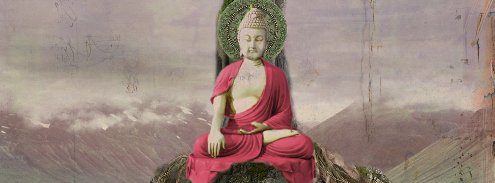
From the cover of Why Buddha Touched the Earth, art by Peter Hollinghurst
Main Ritual: “The Buddha Touched The Earth”
The power of the Earth — of grounding — showed the Buddha that the cause of suffering was trying live outside of this moment, in anticipation or fear or nostalgia or regret. So here now this weekend, we invite you, as you are able, to be fully present and see these distractions as empty.
Dramatis personae:
- Army of Demons
- Mara
- Earth Goddess
In the days before the ritual, we invited people to make signs naming the distractions that pull us out of the moment, so that we could “name and shame” them in the ritual.
Hello friends.
In our ritual track for FSG this year, we invite you to re-enact the story of the Buddha.
So to recap our opening ritual: the young prince Siddhartha, the Buddha-to-be, was sheltered by his parents so that his mind would stay fixed on his royal inheritance, rather than getting involved in spiritual matters. But he left a sheltered life of short-term pleasurable distractions and encountered human suffering, learned about old age, sickness, and death, saw how empty those distractions back at the palace were.
First he tried the spiritual traditions of his culture. He sought out the best meditation and yoga teachers in the land. Because he was kind of a brilliant guy, he quickly mastered their teachings. He learned to enter all kinds of special altered states of consciousness.
Now in the Buddhist writings there are some fancy-pants names for those states of consciousness. And they say that even Siddhartha took a while to master them.
But I wanted to give us, as we re-enact his journey, just a little symbolic taste of altered consciousness. So to keep it simple now, friends, I ask you and I invite you to join with me in a old trick you might not have done since you were five years old — spinning and laughing.
[spin and laugh]
Now, do you feel different? Great! Feels kind of nice, right?
But does it help you solve the problem of suffering, of old age, sickness, and death?
Not really. It’s just another distraction, another way to not Be Here Now when things get tough.
So Siddhartha gave up on the idea that some special state of consciousness was the key.
He tried something else — asceticism. The ordeal path. Maybe if he toughened himself up, really pushed his body to the limit, he could find the answer.
He stopped bathing, until the dirt fell off of him under its own weight. He ate only a handful of food a day.
Now, we don’t have time for that. (And anyway, yuck.) But I wanted to give us, as we re-enact his journey, a little taste of asceticism. So I ask you and I invite you to join with me in pushing your body a little bit. We’re going to squat down in a horse stance, hold our arms straight out in front the side, and push your tongue real hard up against the roof of your mouth. Let it be uncomfortable, and just sit with it. Let’s try to hold that for half a minute. (If you absolutely can’t, fine, I’m not here to judge your medical condition. But if it’s just a matter of discomfort, just try sitting with it.)
[ouch]
There! Are you enlightened yet? Well, neither was Siddhartha. In fact, since he took it so much further than we just did, he almost died from starvation.
So Siddhartha decided to sit down under a tree. (Maybe the Druids talked him in that part, I don’t know.)
Let’s sit with him.
[Everyone (except the ritual players) sits around a tree or central point, facing outward]
Now, Siddhartha had tried the way of extreme pleasure, back in the palace. And that didn’t have the answer. And he tried the way of extreme asceticism, and that didn’t have the answer either.
So maybe the path was in between. He sat…but he didn’t just lounge around. Nor did he twist his body into some impossible painful contortions. Or course he was already an experienced yogi and had done harsh training, so what was easy for him might be impossible and painful for us, but let’s stick with the spirit of the thing. Let’s try to sit neither too rigidly nor too softly. Attentive, but relaxed.
Another word for this, is meditation.
Now, as Price Siddhartha deepened his meditation, Mara, the Lord of Illusion, appeared with his army of demons — distractions from the here and now.
[Mara and the demon army come forward and walk around, taunting people]
What pulls us out of Being Here Now?
Friends, what distractions from the moment can you think of? Let’s name and shame them.
[These were the ones our attendees contributed. :
- Our phones
- What other people think
- Money stress
- Anxiety
- Depression
- Worry
- Stress
- Brain squirrels
- Work preoccupation
- What’s happening at home
- Negativity
- Argumentation
As each is mentioned, one of our army of demons takes on the role, runs around, yells something improv’ed that’s appropriate, waves the poster for it]
All these distractions danced on by, but Siddhartha wasn’t fooled.
Finally, Mara himself stepped forward.
MARA: Hey! Get up out of that seat. Who are you to seek enlightenment? You’re nobody. If anybody here deserves enlightenment, it’s me. Look at my mighty army of demons! They’ll all vouch for me! [Demons chant “Mara! Mara! Mara! He’s the man! Whoo!” etc.] You’re nobody. You’ve got no one to bear you witness, no one to back you up.
And the Buddha said, “You’re right. I have no one to vouch for me. Except…”
Now! Imagine yourself as the Buddha. You’ve tried all the best teachers, and found they couldn’t help you. You tried your hardest to master your body, and you almost died from it. You might be a little lost. A little dazed and confused.
Friends, you are magickal people. What did the Buddha need to do? He needed to…
**** GROUND ******
[Touch the ground]
The Buddha reached down and touched the Earth. Friends, I ask you and I invite you to join with me in touching the Earth.
[Pause]
[Remain touching the ground]
And when Siddhartha touched the Earth, the Goddess of the Earth arose.
And the Goddess said:
GODDESS: I am the Earth. I am the foundation of truth. I nourish and support all beings, from the lowliest grasses to the greatest Bodhisattvas. And I bear you witness.
And all the demons fled!
[Demons RUN AWAY]
Siddhartha had grounded. He touched the Earth, and all those distractions disappeared.
He saw the morning star and realized that we’re all already Here And Now!!! WE ARE ALL ALREADY BUDDHAS!!! We just forget that sometimes.
And so, my friends, BY THE POWER VESTED IN ME BY THIS PRESENT MOMENT IN THIS PLACE, I remind you that YOU ARE ALL ENLIGHTENED BUDDHAS!!! AND THE EARTH LOVES YOU! Woohoo!
So I ask you:
Is it your magickal intent to remember that you are an enlightened Buddha?
[Crowd assents]
That’s great, but you’re going to forget.
So I ask again: is it your magickal intent to remember that you are an enlightened Buddha?
[Crowd assents]
And when you forget again, and again, and again, I ask: is it your magickal intent to remember that you are an enlightened Buddha?
[Crowd assents]
Then may you dwell in Right Recollection — also called Right Mindfulness — here and now, and for the rest of FSG, and for the rest of your lives.
So mote it be.
Closing Ritual: “The Last Temptation of the Buddha”
After the Buddha’s enlightenment, he had to make a choice: to remain in peaceful bliss under the Bo tree, or to go back out and help the world.
Dramatis personae:
- Mara
Hello friends. Thanks for coming to the closing ritual. I know this is always the hardest one to get to. But there is an important piece of magickal business to be done here.
In our opening ritual, we set an intent to Be Here Now for this week. Now we set a new intent as we return to the world.
We talked about how the Prince Siddhartha, the Buddha-to-be, learned about the problem of human suffering. And in our main ritual, we talk about how after going through a bunch of proposed solutions and finding them failures, he sat down under a tree to figure it out.
And if you’ll remember, Mara, the Lord of Illusion showed up with an army of demons to try to scare him off. But the Buddha grounded himself, called upon the Goddess of the Earth, who testified to his right to Be Here Now rather than be caught up in Mara’s dance. And all the demons ran away, and the Buddha saw the morning star and realized that we’re all already Here And Now, we just forget that sometimes.
But old Mara had one more trick up his sleeve.
Friends, the world out there…it’s a mess. And it wasn’t really much less of a mess back in the Buddha’s day.
How many of you want to go home today? Wouldn’t you rather stay here? That was Mara’s pitch.
MARA: Hey, Siddhartha, nice job. You saw though all my illusions! You’ve learned to be in the moment. And it’s pretty nice here, in this moment, under this tree, right? Nice and quiet and peaceful. None of the distractions you had back in the palace, none of those dirty suffering peasants from the village.
NARRATOR: (Remember them from back in the opening ritual?)
MARA: “Look, if you go back out into that messy world, no one is going to understand what you have to say. It’s going to be really hard to keep this peaceful, in-the-moment mind back among all those distractions. So, why don’t you just stay here in enlightened bliss?”
Now, I think the Buddha probably thought about that for a minute. I know I think about it sometimes! We could just drop out. Quit the world. Set up our own little isolated commune or monastery or intentional community and let the rest of the world go to hell.
But remember what set the Buddha on the path: he learned about suffering, and he had great compassion the world. He took what he had learned out to help all sentient beings, and he spent the rest of his life teaching.
And so we invite you and we ask you to take some of the energy and wisdom of this time and place, out to a world that sorely needs it.
Friends, is it your magickal intent to take what you have learned and cultivated here his week, out with you to aid a suffering world?
[Crowd assents]
I ask you again: is it your intent to go forth from here with compassion for all sentient beings?
[Crowd assents]
Now, I ask you a third time, because I believe that that which you tell me three times is true…
[Crowd assents]
Then I thank you, for that and for being part of our rituals here, and wish you safe journey home.
Magic(k), Ritual, and Mysticism

About Tom Swiss
Tom Swiss describes his spiritual path as "Zen Pagan Taoist Atheist Discordian", which usually baffles questioners enough to leave him alone. He is the author of Why Buddha Touched the Earth (Megalithica Books, 2013) and has previously served as President of the Free Spirit Alliance. You can read more about the author here.
Previous Post
June 2, 2019
Pagan Priests Vs. Whitman's Kosmos
Next Post

July 19, 2019 Space Is For Robots (For Now)
Browse Our Archives
Select a Category 2017 52 Makeup 2020 52 Makeup Always Roaming With A Hungry Heart Art Because I Could Not Stop For Death Caught On Video COVID-19 Culture Discordianism Ethics, Virtue, and Right Living History Magic(k), Ritual, and Mysticism My Blogging Life and Times Philosophy Podcast Poetry Random Wednesdays Religion & Politics Seasonal Musings Techno-Pagan Theology Uncategorized Warrior Path Zen
Select a Month October 2026 September 2026 August 2026 March 2026 February 2026 January 2026 December 2025 March 2025 January 2025 December 2024 November 2024 September 2024 August 2024 June 2024 May 2024 April 2024 March 2024 February 2024 December 2023 September 2023 August 2023 July 2023 June 2023 May 2023 March 2023 February 2023 January 2023 December 2022 October 2022 September 2022 June 2022 April 2022 February 2022 January 2022 December 2021 November 2021 October 2021 September 2021 August 2021 July 2021 May 2021 April 2021 March 2021 February 2021 January 2021 December 2020 November 2020 October 2020 September 2020 August 2020 June 2020 May 2020 April 2020 March 2020 February 2020 January 2020 December 2019 November 2019 October 2019 September 2019 August 2019 July 2019 June 2019 May 2019 April 2019 March 2019 February 2019 January 2019 December 2018 November 2018 October 2018 September 2018 August 2018 July 2018 June 2018 May 2018 April 2018 March 2018 January 2018 December 2017 November 2017 October 2017 September 2017 August 2017 July 2017 June 2017 May 2017 April 2017 March 2017 February 2017 January 2017 December 2016 November 2016 October 2016 September 2016 August 2016 July 2016 June 2016 May 2016 April 2016 March 2016 February 2016 January 2016 December 2015 November 2015 October 2015 September 2015 August 2015 July 2015 June 2015
Follow Us!
TAKE THE
Religious Wisdom Quiz
According to 1 Timothy, what is a trustworthy saying deserving of full acceptance?
Select your answer to see how you score.
Christ Jesus came into the world to save sinners God is love Faith without works is dead The Lord is our shepherd
Related posts from The Zen Pagan

Starwood 2026 -- This Is Not A Review


TRENDING AT PATHEOS Pagan

Emotion in Early Christianity by Andrew Crislip
Andrew Crislip’s Emotion in Early Christianity examines an often overlooked dimension of...

16 Spiritual Touchstones for a More Grounded Life
After decades of spiritual study, here are 16 principles I try...

Catholic Evangelization: Sharing Your Faith Every Day
Welcome back to the Graceful Awakening mini-series called, “From Faith to Mission.” ...

The Pillar of the Boatmen: the Ancient Monument...
The Pillar of the Boatmen is a Romano-Gaulish sculpture that dates from...

In one sense walking into Westminster Abbey is like walking down the...

'Super Scam Me' Exposes AI Jon Bon Jovi...
Leslie Pickett believed she was in a relationship with Jon Bon Jovi....
view all Pagan blogs
Ad-Free & Subscriber Log-In Subscription Support
- About Us
- 2026 Calendar
- Videos
- Podcasts
- Library of World Religions
- Faith In Media Tracker
- Advertise With Us
- Write for Us
- Privacy Policy
- Terms of Service
- Do Not Sell My Data
- Contact Us
- Radiant Digital
- Manage Newsletter Subscriptions
- Unsubscribe From Notifications
- Sitemap
Copyright 2008-2026, Patheos. All rights reserved.
Subscription Support Ad-Free & Subscriber Log-In
Follow Patheos