
BuddhistCatholicContemplativeEvangelicalGeneral ChristianHinduJewishLatter-day SaintMuslimNew VisionsProgressive Christian
Beliefs
- Buddhist
- Catholic
- Contemplative
- Evangelical
- General Christian
- Hindu
- Jewish
- Latter-day Saint
- More Voices
- Muslim
- New Visions
- Pagan
- Progressive Christian
Topics
- Religion News
- Food and Religion
- Sports and Religion
- Religious Art
- Religious Music and Entertainment
- Religious Events
- History and Religion
- Style and Religion
- Politics and Religion
- Women in Religion
- Recreation Outdoors and Religion
- Business Finance and Religion
- Careers Workplace and Religion
- Education and Religion
- Family Parenting and Religion
- Health Fitness and Religion
- Home and Religion
- Relationships and Religion
- Technology and Religion
- Travel and Religion
Columnists
- Buddhist Columnists
- Business Finance and Religion Columnists
- Careers Workplace and Religion Columnists
- Catholic Columnists
- Contemplative Columnists
- Education and Religion Columnists
- Evangelists Columnists
- Family Parenting and Religion Columnists
- General Christian Columnists
- Health Fitness and Religion Columnists
- Hindu Columnists
- History and Religion Columnists
- Home and Religion Columnists
- Jewish Columnists
- More Voices Columnists
- Latter Day Columnists
- Muslim Columnists
- New Visions Columnists
- Nonreligious Columnists
- Pagan Columnists
- Politics and Religion Columnists
- Progressive Columnists
- Recreation Outdoors and Religion Columnists
- Relationships and Religion Columnists
- Religion News Columnists
- Religious Art Columnists
- Religious Events Columnists
- Religious Music and Entertainment Columnists
- Sports and Religion Columnists
- Style and Religion Columnists
- Technology and Religion Columnists
- Travel and Religion Columnists
- Women in Religion Columnists
Resource Library
- 2026 Calendar
- Library of World Religions
- The 100 Most Holy Places on Earth
- Patheos Answers
- Podcasts
- Videos
- Faith Leaders Database
- Anglican Episcopalian
- Bahai
- Baptist
- Buddhism
- Christianity
- Confucianism
- Eastern Orthodoxy
- Hinduism
- Holiness and Pentecostal
- ISKCON
- Islam
- Judaism
- Lutheran
- Methodist
- The Church of Jesus Christ of Latter-day Saints
- New Age
- Paganism
- Presbytarian and Reformed
- Protestantism
- Religion Behind the Scenes
- Roman Catholic
- Scientology
- Shia Islam
- Sikhism
- Sufism
- Sunni Islam
- Taoism
- Zen
- See all religions
Research Tools
 Ad-Free & Subscriber Log-In Subscription Support
Ad-Free & Subscriber Log-In Subscription Support
Follow Patheos 

- Trending:
- Forgiveness
- |
- Marriage
- |
- Consciousness
- |
- Death Penalty
- |
- Election
- |
- Halloween

- Home
- Pagan
- How The Gods And Heroes Operate
How The Gods And Heroes Operate
Last updated on: February 28, 2019 at 11:55 pm by Tom Swiss
How The Gods And Heroes Operate 2019-02-28T23:55:45-04:00 Tom Swiss
Patheos Explore the world's faith through different perspectives on religion and spirituality! Patheos has the views of the prevalent religions and spiritualities of the world.
Some of my favorite moments in superhero stories are not about the caped characters themselves, but about how other people are inspired to heroics (albeit on a more mortal scale) by them.
When Superman dies in the classic 1990s comics storyline The Death of Superman (spoiler: he gets better), ordinary guy “Bibbo” Bibbowski takes to the streets in his neighborhood in a Superman t-shirt to clean things up, while super-scientist John Henry Irons fits himself out in powered armor with the famous “S” logo to stop energy-cannon toting street gangs. (Irons eventually develops into a superhero in his own ight, Steel.)
In the 2002 Spider-Man movie starring Tobey Maguire, when Spidey fights the Green Goblin, ordinary New Yorkers join in, throwing bricks and debris. As they rise up against the villain, one yells “You mess with one of us, you mess with all of us!” (A sentiment with extra meaning in New York in the wake of 9/11.)
The exploits of superheroes can inspire the merely mortal citizens of their comic book and movie worlds to be better, braver, and more empathetic. But more than that: their power is such that they can reach out from those fictional universes into ours, and inspire us in measurable ways.
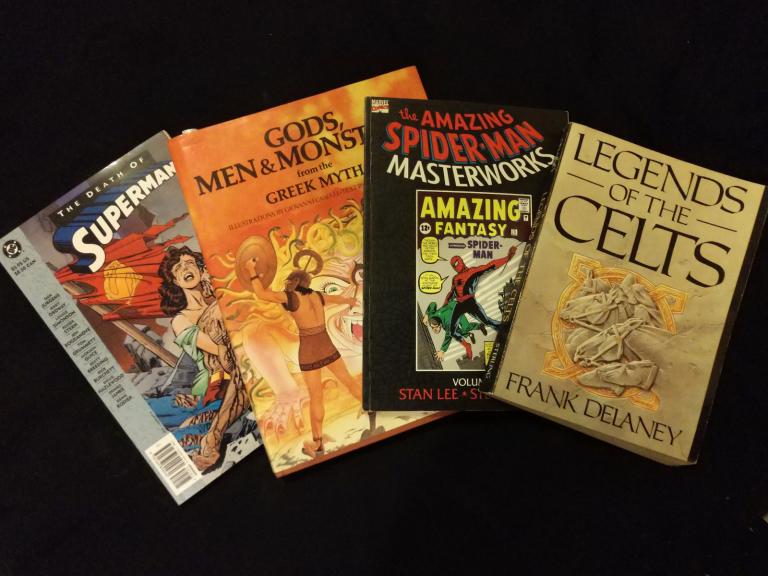
Myths old and new, from my library
In research published late last year, a team of psychologists examined the effect of “priming” people by exposing them to a picture of Superman. The subjects, who had signed up for a 30 minute research time-slot, were brought into a room that had a small poster of either Supes or a bicycle. (A note on the wall explained away the poster’s presence, saying it was for a different “media images” study.)
The questionnaire they were given was designed to only take 10 minutes. Then they were told they were free to leave, but if they would like to help they could stick around for the rest of their 30 minute slot and participate in an additional pilot study (for no additional credit), and that it would be extremely helpful to the researchers.
Almost 92% of those who were “primed” by seeing Superman volunteered to help, compared to just under 76% of the control group who saw the bicycle poster.
The influence starts at an early age. In a study published in 2016, children age four and six were given a boring task to do, but also given the opportunity to take video game breaks. Some of them were dressed up as characters — including Batman but also such kid-level superheroes as Bob the Builder and Dora the Explorer — and were encouraged to ask themselves “Is Batman (or whoever) working hard?” during the task. The costumed kids displayed the most grit.
(Interestingly, kids who were encouraged to think of themselves in the third person — a classic technique of mental discipline — also showed more grit than whose who encouraged to take a first-person view, but not as much as the cosplayers did.)
Now, I have argued previously that tales of the superheroes are our modern myths; and comics writer and chaos magician Grant Morrison has argued that Superman qualifies as a god:
He was Apollo, the sun god, the unbeatable supreme self, the personal greatness of which we all know we’re capable. He was the righteous inner authority and lover of justice that blazed behind the starched-shirt front of hierarchical conformity.
In other words, then, Superman was the rebirth of our oldest idea: He was a god. His throne topped the peaks of an emergent dime-store Olympus, and, like Zeus, he would disguise himself as a mortal to walk among the common people and stay in touch with their dramas and passions.
[From Morrison’s Supergods : What Masked Vigilantes, Miraculous Mutants, and a Sun God from Smallville Can Teach Us About Being Human, Spiegel & Grau, 2012; p 15-16.]
We come up once again against the question “What is a god[*]?”, but I think we can get broad agreement on two points:
- One does not have to believe that the gods exist independent of human beings to acknowledge them as a real socio-psychological phenomenon.
- When the gods act in the human realm, they rarely perform direct-action miracles; they act through human beings, assisting some and hindering others. Perhaps your tribal gods help your army strike true and mire the feet of the barbarians of the other tribe; but they never seem to just wipe the other tribe off the battlefield with a disintegration ray from the heavens. As the cliche says, the gods help those who help themselves.
([*] I am using the word “god” in the gender-neutral sense it had in Old English, prior to Christianity.)
So a consideration of how heroes and gods as socio-psychological phenomena act through humans is of interest, whether or not one believes they also act in some supernatural manner.
And if superheroes making people a little more kind or possessed of a little more stick-to-itiveness seems like fluffy bunny nonsense, please keep this in mind: on September 11 2001, when the passengers of Flight 93 rebelled against the terrorists who planned to use their plane as a weapon, Superman may have been an inspiration to one of the heroes. Artist and comic historian Arlen Schumer wrote:
…I heard Amy Nacke — the wife of passenger Louis Nacke — tell Dateline how much Louis loved Superman; why, she said, he even had Superman’s “S” shield tattooed on his shoulder for years! I bolted upright from my drawing board when I heard that, because now I knew why it had bothered me so much when those writers claimed superheroes didn’t really matter in real life. “Where were the Superheroes on September 11th?,” they asked? Well, I’ll tell you:
Superman was on United Flight #93.
I believe that Louis Nacke’s love of Superman, emblemized by that tattoo on his shoulder, helped motivate him — even if only “on a small subconscious level” — to garner the courage to confront a terribly hopeless situation. And then to respond heroically, with his fellow passengers, in those desperate moments when action mattered most.
Maybe my conviction is so strong because I know that many of those who face life and death every day — police officers and firefighters — became police officers and firefighters because of superheroes like Superman….
…Superman afforded me, in a more dynamic and accessible form than family or religion could ever really compete with, a specific morality from which to understand the difference between right and wrong and good and evil; and with that, the strength to act on those convictions. Perhaps, on that late summer morning, in the air above Pennsylvania, Superman gave Louis Nacke that strength, too. And in that way, Superman became real.
[From “Text of Arlen Schumer’s Speech Delivered at the Society of Illustrators’ Memorial Exhibition, February 1, 2012” on The Art and Writing of Arlen Schumer, www.arlenschumer.com]
It seems to me that if one wants to worship — “assign worth to” — a god or a hero, the best way to do that is to help do their work.
Previous Post
February 10, 2019
Why The Moment Calls For Magic
Next Post

March 15, 2019 "Shaman" Is A Fine Word For A Shaman
Browse Our Archives
Select a Category 2017 52 Makeup 2020 52 Makeup Always Roaming With A Hungry Heart Art Because I Could Not Stop For Death Caught On Video COVID-19 Culture Discordianism Ethics, Virtue, and Right Living History Magic(k), Ritual, and Mysticism My Blogging Life and Times Philosophy Podcast Poetry Random Wednesdays Religion & Politics Seasonal Musings Techno-Pagan Theology Uncategorized Warrior Path Zen
Select a Month October 2026 September 2026 August 2026 March 2026 February 2026 January 2026 December 2025 March 2025 January 2025 December 2024 November 2024 September 2024 August 2024 June 2024 May 2024 April 2024 March 2024 February 2024 December 2023 September 2023 August 2023 July 2023 June 2023 May 2023 March 2023 February 2023 January 2023 December 2022 October 2022 September 2022 June 2022 April 2022 February 2022 January 2022 December 2021 November 2021 October 2021 September 2021 August 2021 July 2021 May 2021 April 2021 March 2021 February 2021 January 2021 December 2020 November 2020 October 2020 September 2020 August 2020 June 2020 May 2020 April 2020 March 2020 February 2020 January 2020 December 2019 November 2019 October 2019 September 2019 August 2019 July 2019 June 2019 May 2019 April 2019 March 2019 February 2019 January 2019 December 2018 November 2018 October 2018 September 2018 August 2018 July 2018 June 2018 May 2018 April 2018 March 2018 January 2018 December 2017 November 2017 October 2017 September 2017 August 2017 July 2017 June 2017 May 2017 April 2017 March 2017 February 2017 January 2017 December 2016 November 2016 October 2016 September 2016 August 2016 July 2016 June 2016 May 2016 April 2016 March 2016 February 2016 January 2016 December 2015 November 2015 October 2015 September 2015 August 2015 July 2015 June 2015
Follow Us!
TAKE THE
Religious Wisdom Quiz
Which parable teaches about praying persistently, like a widow before a judge?
Select your answer to see how you score.
The Sower The Persistent Widow The Mustard Seed The Talents
Related posts from The Zen Pagan


Masculine Archetypes: Trickster at Samhain & Election Day

Deconstructing the Bears Vs. Men Memeplex

The Unabomber and the Escalation of Disorder
TRENDING AT PATHEOS Pagan

Emotion in Early Christianity by Andrew Crislip
Andrew Crislip’s Emotion in Early Christianity examines an often overlooked dimension of...

16 Spiritual Touchstones for a More Grounded Life
After decades of spiritual study, here are 16 principles I try...

Catholic Evangelization: Sharing Your Faith Every Day
Welcome back to the Graceful Awakening mini-series called, “From Faith to Mission.” ...

The Pillar of the Boatmen: the Ancient Monument...
The Pillar of the Boatmen is a Romano-Gaulish sculpture that dates from...

In one sense walking into Westminster Abbey is like walking down the...

'Super Scam Me' Exposes AI Jon Bon Jovi...
Leslie Pickett believed she was in a relationship with Jon Bon Jovi....
view all Pagan blogs
Ad-Free & Subscriber Log-In Subscription Support
- About Us
- 2026 Calendar
- Videos
- Podcasts
- Library of World Religions
- Faith In Media Tracker
- Advertise With Us
- Write for Us
- Privacy Policy
- Terms of Service
- Do Not Sell My Data
- Contact Us
- Radiant Digital
- Manage Newsletter Subscriptions
- Unsubscribe From Notifications
- Sitemap
Copyright 2008-2026, Patheos. All rights reserved.
Subscription Support Ad-Free & Subscriber Log-In
Follow Patheos