
BuddhistCatholicContemplativeEvangelicalGeneral ChristianHinduJewishLatter-day SaintMuslimNew VisionsProgressive Christian
Beliefs
- Buddhist
- Catholic
- Contemplative
- Evangelical
- General Christian
- Hindu
- Jewish
- Latter-day Saint
- More Voices
- Muslim
- New Visions
- Pagan
- Progressive Christian
Topics
- Religion News
- Food and Religion
- Sports and Religion
- Religious Art
- Religious Music and Entertainment
- Religious Events
- History and Religion
- Style and Religion
- Politics and Religion
- Women in Religion
- Recreation Outdoors and Religion
- Business Finance and Religion
- Careers Workplace and Religion
- Education and Religion
- Family Parenting and Religion
- Health Fitness and Religion
- Home and Religion
- Relationships and Religion
- Technology and Religion
- Travel and Religion
Columnists
- Buddhist Columnists
- Business Finance and Religion Columnists
- Careers Workplace and Religion Columnists
- Catholic Columnists
- Contemplative Columnists
- Education and Religion Columnists
- Evangelists Columnists
- Family Parenting and Religion Columnists
- General Christian Columnists
- Health Fitness and Religion Columnists
- Hindu Columnists
- History and Religion Columnists
- Home and Religion Columnists
- Jewish Columnists
- More Voices Columnists
- Latter Day Columnists
- Muslim Columnists
- New Visions Columnists
- Nonreligious Columnists
- Pagan Columnists
- Politics and Religion Columnists
- Progressive Columnists
- Recreation Outdoors and Religion Columnists
- Relationships and Religion Columnists
- Religion News Columnists
- Religious Art Columnists
- Religious Events Columnists
- Religious Music and Entertainment Columnists
- Sports and Religion Columnists
- Style and Religion Columnists
- Technology and Religion Columnists
- Travel and Religion Columnists
- Women in Religion Columnists
Resource Library
- 2026 Calendar
- Library of World Religions
- The 100 Most Holy Places on Earth
- Patheos Answers
- Podcasts
- Videos
- Faith Leaders Database
- Anglican Episcopalian
- Bahai
- Baptist
- Buddhism
- Christianity
- Confucianism
- Eastern Orthodoxy
- Hinduism
- Holiness and Pentecostal
- ISKCON
- Islam
- Judaism
- Lutheran
- Methodist
- The Church of Jesus Christ of Latter-day Saints
- New Age
- Paganism
- Presbytarian and Reformed
- Protestantism
- Religion Behind the Scenes
- Roman Catholic
- Scientology
- Shia Islam
- Sikhism
- Sufism
- Sunni Islam
- Taoism
- Zen
- See all religions
Research Tools
 Ad-Free & Subscriber Log-In Subscription Support
Ad-Free & Subscriber Log-In Subscription Support
Follow Patheos 

- Trending:
- Forgiveness
- |
- Marriage
- |
- Consciousness
- |
- Death Penalty
- |
- Election
- |
- Halloween

- Home
- Pagan
- Masculinity On The Razor’s Edge
Masculinity On The Razor’s Edge
Last updated on: January 21, 2019 at 1:06 pm by Tom Swiss
Masculinity On The Razor’s Edge 2019-01-21T13:06:05-04:00 Tom Swiss
Patheos Explore the world's faith through different perspectives on religion and spirituality! Patheos has the views of the prevalent religions and spiritualities of the world.
Gillete’s recent appeal to the post-#MeToo men’s movement has generated a lot of heat on social media.
Let’s be clear on this point: for Proctor & Gamble it’s about selling razors and nothing more, just as their ad “The Talk” was about selling beauty products. As a publicly traded corporation, an immortal psychopath created by government fiat, P&G is constitutionally incapable of any interest in the politics or philosophy of gender or race beyond how it affects shareholder value. Bill Hicks’s comments about marketing still apply.
As Bret Weinstein pointed out, citing photos of models at a racing event in skin-tight outfits with “Gillette” branded across their rear ends, “Sex sells. Sometimes woke sells. “Sales” is the common factor.”
And yet, if a razor ad is a threat to your idea of What It Is To Be A Man, you need a better version of manhood, my friend. And if in this consumer culture a razor ad gets a few guys to do a little self-examination, to ask themselves what sort of men they want to be and what sort example they want to give their sons, that’s all to the good.
A tangential point of trivia: King Camp Gillette, they guy who started the razor company, was a Utopian Socialist who though that most of the US population should live in one giant city, powered by Niagara Falls and run by a “United Company” in which women would be equal partners.
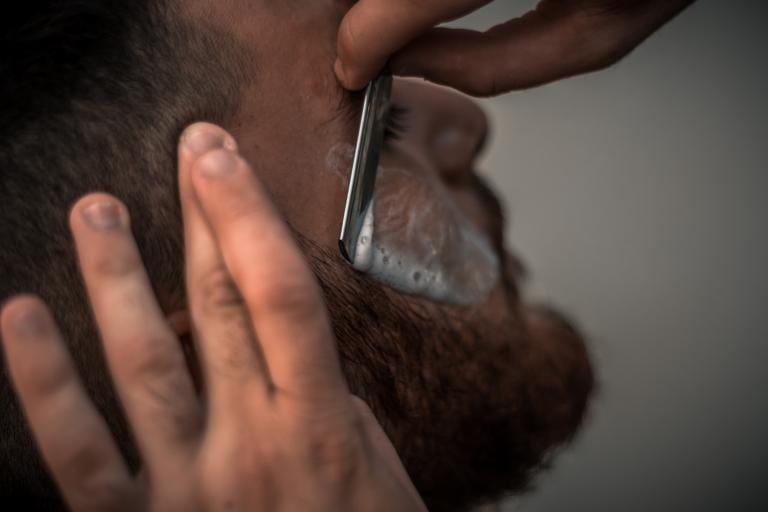
Photo by Nick Demou from Pexels
Anyway. This Gillette moment comes when the American Psychological Association has just issued new guidelines for treatment of boys and men. The APA points out that men experience challenges including higher rates of violence, incarceration, suicide, and substance abuse, as well as academic drop-out, suspension, and expulsion. They associate this with something they refer to as “traditional masculinity ideology”:
Although there are differences in masculinity ideologies, there is a particular constellation of standards that have held sway over large segments of the population, including: anti-femininity, achievement, eschewal of the appearance of weakness, and adventure, risk, and violence. These have been collectively referred to as traditional masculinity ideology.
Now, it should be noted that the APA’s mens’ studies division has since issued a clarification that “When we report that some aspects of ‘traditional masculinity’ are potentially harmful, we are referring to a belief system held by a few that associates masculinity with extreme behaviors that harm self and others. It is the extreme stereotypical behaviors—not simply being male or a ‘traditional male’—that may result in negative outcomes.”
But still, this brings two questions to my mind:
1. Is this “traditional masculinity ideology” a cause or a response to the challenges that men face?
2. Is “traditional masculinity ideology” harmful or maladaptive in itself, or is the problem that these standards need to be balanced by additional values that put them in a healthy context?
Today I’d like to focus on that first question. We’ll look into the second one in a subsequent post.
Fathers And “Soft” Boys
In my role as a martial arts teacher, from time to time I get the impression that a father is bringing his young son to me for training because he is worried about him being “soft”.
I don’t mean that he is disappointed in his son, or does not love him. Rather the impression I get is that the father knows that his son is likely to face direct physical challenges like bullying as well as the social challenges of dominance hierarchies, and he wants his son to be able to deal with them.
In these situations, the boy’s mother usually seems supportive of these aims but it’s the father who says something to me about his concerns. Also let me be clear that I am proud to also teach women and girls, and there is a set of reasons and challenges about training there which partly overlap and are partly different. We may explore those another time, but I want to focus on the boys today.
In reference to the APA’s idea of “traditional masculinity ideology”, these fathers want their sons to be competent in the use of violence, because they foresee them possibly having to fight. They want their sons prepared for risk and adventure, and able to project an appearance of strength rather than weakness.
They want this because they believe the boys will need those characteristics in order to not be pushed to the bottom in a world that can (in their belief) be tough. And I don’t think they’re wrong to think that — but their thinking may be incomplete, as I’ve talked about before. So I feel like it’s a good thing that they end up bringing their sons to me rather than to a more “Cobra Kai” sort of teacher.
Class, Masculinity, And The Hierarchy of Needs
There seem to be class issues involved in the concerns these fathers bring. Again this is a personal impression, I have not collected data about family income or educational attainment; but it seems like the more a father is “working class” the more likely these sorts of concerns are to be present. “Professional class” parents, in contrast, are more likely to be concerned with their kids acquiring self-discipline and confidence, and maybe having an extra-curricular activity to look good on a college application.
These professional class sons (and daughters), in other words, are starting a little higher up on Maslow’s hierarchy of needs. The working-class parents are concerned about their sons’ safety needs, where professional class parents are assured their kids will be able to meet those and are working on esteem needs.
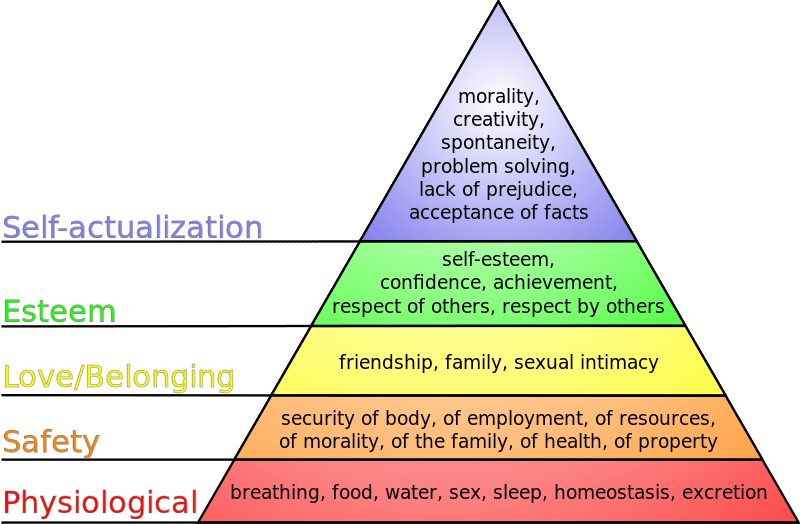
J. Finkelstein via Wikimedia Commons. CC-BY-SA 3.0

It is problematic that our talk about gender tends to leave out the very different experiences of men of different classes. It is true that when you look at corporate boardrooms, you disproportionately see men — upper class men. But it is also true that when you look at our prisons, or at the lists of those killed in the military or through violence or on the job, you disproportionately see men — men of the lower classes.
(On a side note, this is another reason framing exemption from the penalties of sexism as a “privilege” is problematic: not only does it confuse rights with privileges, but it also draws incredulity from many low-status individuals when they are described as “privileged”. It’s ineffective rhetoric and should be eschewed.)
It seems to me that these APA guidelines are in part upper-class professional men looking down on a version of masculinity that is lower on the hierarchy of needs than theirs.
It’s true also of that Gillette ad: except for the clip of real-life hero Ibn Ali Miller breaking up a fight on the streets of Atlantic City, the male characters in the ad seem to be pretty middle class. (See them line up behind their grills along those suburban wooden fences.) And I will bet you a nickel the advertising “creatives” who created it do not have dirt under their fingernails or calluses on their hands.
Of course class is not an excuse for bad behavior; and as the Kavanaugh hearings reminded us, upper class boys and men can be dangerous sexist pigs. Indeed much of the #MeToo movement has been about revealing the bad behavior of powerful men in the upper classes.
But it seems to me that if we’re going to talk about the problems of “traditional masculinity ideology”, we need to see how that ideology is sometimes an attempt (however flawed) to deal with real problems in men’s lives. And if we want men to “do better”, we have to propose alternative solutions to those problems.
That’s a task we’ll leave to a future post.
You can keep up with “The Zen Pagan” by subscribing via RSS or e-mail.
If you do Facebook, you might choose to join a group on “Zen Paganism” I’ve set up there. And don’t forget to “like” Patheos Pagan and/or The Zen Pagan over there, too.
Previous Post

January 20, 2019
MAGA Teens, The Native Elder, And Our Projections
Next Post

January 26, 2019 Patton Oswalt's Twitter Act Of Kindness
Browse Our Archives
Select a Category 2017 52 Makeup 2020 52 Makeup Always Roaming With A Hungry Heart Art Because I Could Not Stop For Death Caught On Video COVID-19 Culture Discordianism Ethics, Virtue, and Right Living History Magic(k), Ritual, and Mysticism My Blogging Life and Times Philosophy Podcast Poetry Random Wednesdays Religion & Politics Seasonal Musings Techno-Pagan Theology Uncategorized Warrior Path Zen
Select a Month October 2026 September 2026 August 2026 March 2026 February 2026 January 2026 December 2025 March 2025 January 2025 December 2024 November 2024 September 2024 August 2024 June 2024 May 2024 April 2024 March 2024 February 2024 December 2023 September 2023 August 2023 July 2023 June 2023 May 2023 March 2023 February 2023 January 2023 December 2022 October 2022 September 2022 June 2022 April 2022 February 2022 January 2022 December 2021 November 2021 October 2021 September 2021 August 2021 July 2021 May 2021 April 2021 March 2021 February 2021 January 2021 December 2020 November 2020 October 2020 September 2020 August 2020 June 2020 May 2020 April 2020 March 2020 February 2020 January 2020 December 2019 November 2019 October 2019 September 2019 August 2019 July 2019 June 2019 May 2019 April 2019 March 2019 February 2019 January 2019 December 2018 November 2018 October 2018 September 2018 August 2018 July 2018 June 2018 May 2018 April 2018 March 2018 January 2018 December 2017 November 2017 October 2017 September 2017 August 2017 July 2017 June 2017 May 2017 April 2017 March 2017 February 2017 January 2017 December 2016 November 2016 October 2016 September 2016 August 2016 July 2016 June 2016 May 2016 April 2016 March 2016 February 2016 January 2016 December 2015 November 2015 October 2015 September 2015 August 2015 July 2015 June 2015
Follow Us!
TAKE THE
Religious Wisdom Quiz
Be strong and ____; do not be afraid or terrified because of them, for the Lord your God goes with you; he will never leave you nor forsake you.
Select your answer to see how you score.
Vigilant Steadfast Courageous Patient
Related posts from The Zen Pagan


Masculine Archetypes: Trickster at Samhain & Election Day
Masculine Archetypes: The Warrior at Mabon
Masculine Archetypes: The Captain at Lughnasadh
TRENDING AT PATHEOS Pagan

The Problem with False Prophets
Miller’s Station UMC| 10/18/26| Anchor Verse: Jeremiah 23: 1, 9-23 I...

Emotion in Early Christianity by Andrew Crislip
Andrew Crislip’s Emotion in Early Christianity examines an often overlooked dimension of...

16 Spiritual Touchstones for a More Grounded Life
After decades of spiritual study, here are 16 principles I try...

Catholic Evangelization: Sharing Your Faith Every Day
Welcome back to the Graceful Awakening mini-series called, “From Faith to Mission.” ...

The Pillar of the Boatmen: the Ancient Monument...
The Pillar of the Boatmen is a Romano-Gaulish sculpture that dates from...

In one sense walking into Westminster Abbey is like walking down the...
view all Pagan blogs
Ad-Free & Subscriber Log-In Subscription Support
- About Us
- 2026 Calendar
- Videos
- Podcasts
- Library of World Religions
- Faith In Media Tracker
- Advertise With Us
- Write for Us
- Privacy Policy
- Terms of Service
- Do Not Sell My Data
- Contact Us
- Radiant Digital
- Manage Newsletter Subscriptions
- Unsubscribe From Notifications
- Sitemap
Copyright 2008-2026, Patheos. All rights reserved.
Subscription Support Ad-Free & Subscriber Log-In
Follow Patheos