
BuddhistCatholicContemplativeEvangelicalGeneral ChristianHinduJewishLatter-day SaintMuslimNew VisionsProgressive Christian
Beliefs
- Buddhist
- Catholic
- Contemplative
- Evangelical
- General Christian
- Hindu
- Jewish
- Latter-day Saint
- More Voices
- Muslim
- New Visions
- Pagan
- Progressive Christian
Topics
- Religion News
- Food and Religion
- Sports and Religion
- Religious Art
- Religious Music and Entertainment
- Religious Events
- History and Religion
- Style and Religion
- Politics and Religion
- Women in Religion
- Recreation Outdoors and Religion
- Business Finance and Religion
- Careers Workplace and Religion
- Education and Religion
- Family Parenting and Religion
- Health Fitness and Religion
- Home and Religion
- Relationships and Religion
- Technology and Religion
- Travel and Religion
Columnists
- Buddhist Columnists
- Business Finance and Religion Columnists
- Careers Workplace and Religion Columnists
- Catholic Columnists
- Contemplative Columnists
- Education and Religion Columnists
- Evangelists Columnists
- Family Parenting and Religion Columnists
- General Christian Columnists
- Health Fitness and Religion Columnists
- Hindu Columnists
- History and Religion Columnists
- Home and Religion Columnists
- Jewish Columnists
- More Voices Columnists
- Latter Day Columnists
- Muslim Columnists
- New Visions Columnists
- Nonreligious Columnists
- Pagan Columnists
- Politics and Religion Columnists
- Progressive Columnists
- Recreation Outdoors and Religion Columnists
- Relationships and Religion Columnists
- Religion News Columnists
- Religious Art Columnists
- Religious Events Columnists
- Religious Music and Entertainment Columnists
- Sports and Religion Columnists
- Style and Religion Columnists
- Technology and Religion Columnists
- Travel and Religion Columnists
- Women in Religion Columnists
Resource Library
- 2026 Calendar
- Library of World Religions
- The 100 Most Holy Places on Earth
- Patheos Answers
- Podcasts
- Videos
- Faith Leaders Database
- Anglican Episcopalian
- Bahai
- Baptist
- Buddhism
- Christianity
- Confucianism
- Eastern Orthodoxy
- Hinduism
- Holiness and Pentecostal
- ISKCON
- Islam
- Judaism
- Lutheran
- Methodist
- The Church of Jesus Christ of Latter-day Saints
- New Age
- Paganism
- Presbytarian and Reformed
- Protestantism
- Religion Behind the Scenes
- Roman Catholic
- Scientology
- Shia Islam
- Sikhism
- Sufism
- Sunni Islam
- Taoism
- Zen
- See all religions
Research Tools
 Ad-Free & Subscriber Log-In Subscription Support
Ad-Free & Subscriber Log-In Subscription Support
Follow Patheos 

- Trending:
- Forgiveness
- |
- Marriage
- |
- Consciousness
- |
- Death Penalty
- |
- Election
- |
- Halloween

- Home
- Pagan
- A Sigil For Political-Artistic Liberation In 2019
A Sigil For Political-Artistic Liberation In 2019
Last updated on: January 5, 2019 at 3:19 am by Tom Swiss
A Sigil For Political-Artistic Liberation In 2019 2019-01-05T03:19:01-04:00 Tom Swiss
Patheos Explore the world's faith through different perspectives on religion and spirituality! Patheos has the views of the prevalent religions and spiritualities of the world.
I ended up staying in on the night of the Winter Solstice a few weeks ago. I had planned to go to a friend’s party/ritual but felt called to stay home and cultivate some yin energy at the dark of the year.
I realized that I needed to set some intention for the coming year, for intention is the first step in any magical working. As I thought of what I needed, for magic answers need, I ended up creating a sigil for the theme “Creativity, Insight, and Willpower”.
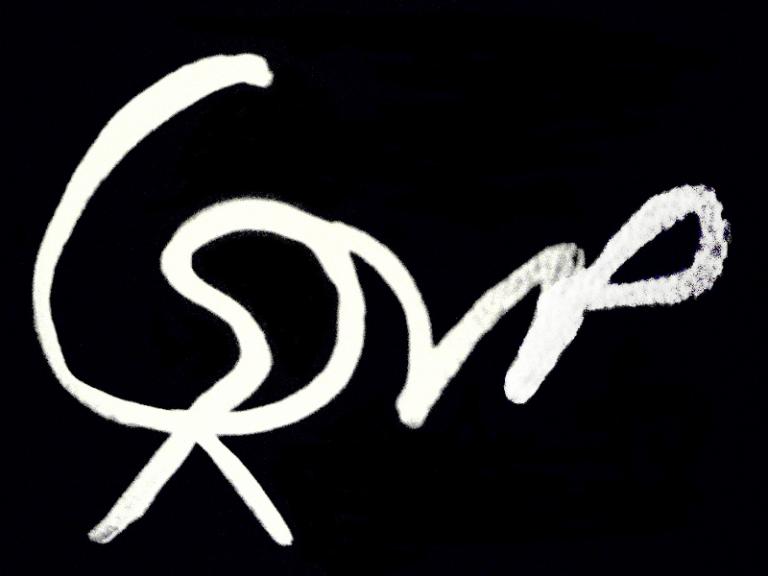
As I’ve thought about it more, it has occurred to me that this isn’t just what I need. It’s what we all need.
I think we can always see the utility of willpower, and insight — intuitively apprehending the nature of things — is sort of where we live as magical people.
But creativity? We sometimes think of creativity as a light, playful thing, an airy-fairy luxury for the good times. But this is not so. Creativity is essential for liberation. More and more we hear the slogan “A better world is possible”; to envision that world takes an act of creative imagination.
Creativity In Difficult and Dangerous Times
Creativity is what we most need in difficult and dangerous time. For as Robert Shea and Robert Anton Wilson wrote in The Illuminatus! Trilogy, “Freedom won’t come through Love, and it won’t come through Force. It will come through the Imagination.”
In an old blog post, I called that statement the “First Law of Political-Artistic Liberation” — FLOPAL, to give it a snappy (?) acronym.
The idea has been much on my mind lately, so I’m going to recycle that rambling old blog post here…settle in for a “long read”, friends.
Shea and Wilson explain the idea later on in the book, in a discussion between the characters Hagbard Celine and Simon Moon, as they wait for the cops and the tear gas in Chicago in 1968:
“Chairman Mao didn’t say half of it,” Hagbard replied holding a handkerchief to his own face. His words came through muffled: “It isn’t only political power that grows out of the barrel of a gun. So does a whole definition of reality. A set. And the action that has to happen on that particular set and on none other.”
“Don’t be so bloody patronizing,” I objected, looking around a corner in time and realizing this was the night I would be Maced. “That’s just Marx: the ideology of the ruling class becomes the ideology of the whole society.”
“Not the ideology. The Reality.” He lowered his handkerchief. “This was a public park until they changed the definition. Now, the guns have changed the Reality. It isn’t a public park. There’s more than one kind of magic.”
“Just like the Enclosure Acts,” I said hollowly. “One day the land belonged to the people. The next day it belonged to the landlords.”
“And like the Narcotics Acts,” he added. “A hundred thousand harmless junkies became criminals overnight, by Act of Congress, in nineteen twenty-seven. Ten years later, in thirty-seven, all the pot-heads in the country became criminals overnight, by Act of Congress. And they really were criminals, when the papers were signed. The guns prove it. Walk away from those guns, waving a joint, and refuse to halt when they tell you. Their Imagination will become your Reality in a second.”
Much of the “Reality” of human experience is created by Authority. And not just the social and legal aspects — a few hundred years ago, the physical “Reality” that the Earth was the center of the Universe was enforced by putting Galileo under arrest. Less than a century ago, the Tennessee legislature and courts used the guns and clubs and cages at their disposal to create the biological “Reality” that Homo sapiens was not related to apes.
Even though these Authorities are gone, substantial numbers of people still dwell in the Realities they created.
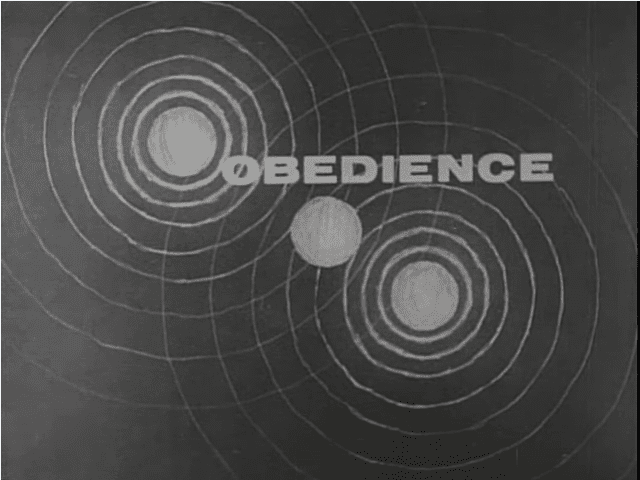
Title card to Obedience, Milgram’s 1965 documentary on his experiment. Via Wikipedia.
Authority is hard-wired into the human brain — the famous Milgram experiment showed how our natural submission to Authority will get otherwise sane and ordinary people to commit acts of torture. Like gravity, Authority warps space around it: and like gravity, when concentrated to the extreme, it will form a black hole that tears up everything in reach.
Fighting Authority
What can fight Authority? What can break its Realities, disperse its warp?
Imagination.
Now, Authority needs Imagination, else it would have done away with it a long time ago. But it can’t let Imagination have free reign and pose a threat.
It needs enough Imagination around to design shiny new cars for people to buy to keep the economy of consumption humming, but not so much as to conceive of transit systems that will make cars obsolete. It needs Imagination to keep the propaganda machine going, but not enough Imagination to let people see through the propaganda. It needs Imagination to develop new strategies for war and new weapons, but not to imagine what it’s like to be on the receiving end, to see your loved ones crushed in the rubble of a bombing or to have your own leg blown off.
Authority needs Imagination in order to survive, but it can’t let Imagination run around unfettered, because Imagination is inherently a threat to the status quo power structure.
Every bit of human progress begins with an act of Imagination — before slaves can fight for freedom, before a community can organize to bypass kings or capitalists or any other forms of rulers, there must be someone who imagines that thing to be possible.
That is the line that Authority cannot let Imagination cross.
There’s a T. E. Lawrence quote from The Seven Pillars of Wisdom that I’ve always liked: “All men dream: but not equally. Those who dream by night in the dusty recesses of their minds wake in the day to find that it was vanity: but the dreamers of the day are dangerous men, for they may act their dream with open eyes, to make it possible.”
Those who dream only at night are those whose imagination is safely fettered.
Neither Force Nor Love
But — and here’s what Lawrence and his cohorts missed — those who dream that Force can change things, and act their dream through war, are not dreaming big enough either. For Force merely replaces one Authority with another. Meet the new Boss, same as the old Boss. You’ve broken away from one black hole, only to find yourself falling into another.
If Force can’t change things, what of Love? Isn’t Love the answer? All we need is Love, right?
But Love, in itself, is not enough. Many of those who burned witches and tortured heretics did so in the name of Love, convinced (by spiritual Authorities) that it was better for the victims to suffer here on Earth and repent, rather than lose the “reward” of some afterlife.
How many parents beat their children out of love! How many laws are made that lock people in cages, to lovingly protect them from themselves! “We love you and want what’s best for you, so we will punish you until you: stop being gay / stop believing that Earth moves around the Sun / stop using unauthorized drugs / stop having sex in a manner that we don’t approve of / stop practicing your false religion and join our true one / et cetera ad nauseam.”
Without Imagination, without the ability to put ourselves in the shoes of another and imagine life from their perspective, and the ability to imagine all the different ways to express and explore Love, and (most importantly) the ability to imagine that our view of what’s best for others just might be wrong and so we should be a little hesitant in backing our Love up with Force, Love can be the most binding of prisons.
So neither Force nor Love will do. And even Imagination, so long as it remains fettered, is a servant of Authority.
Unchaining Imagination With Skepticism
What can open Imagination’s chains, and help it bring about Freedom rather than preserve Authority?
There’s a type of Imagination that always challenges, that always asks, “Are you kidding me? Am I kidding myself?”, that always seeks radical honesty, and is therefore always hostile to Authority. We might, to introduce yet another Capital Letter Term into the discussion, call it Skepticism.
Though we must keep in mind that many (perhaps even most) who describe themselves as “skeptics”, are anything but. Those who ask that vital question “Are you kidding me?” only of certain parties — for example, “skeptics” who demand blinded controlled studies of acupuncturists but willingly go under the knife when no surgical procedure has ever passed a blinded controlled study, or 9/11 “skeptics” who question the NIST reports about the structural failure of the WTC towers but readily swallow anything they read on conspiracy websites — are not employing Skepticism.
True Skepticism begins with checking if we are kidding ourselves.
In a famous piece titled “Cargo Cult Science”, Nobel Prize winning physicist Richard Feynman said that “The first principle [of scientific integrity] is that you must not fool yourself — and you are the easiest person to fool. So you have to be very careful about that. After you’ve not fooled yourself, it’s easy not to fool other scientists.”
And the way to not fool yourself, is to imagine all the ways that you could be fooled. In his talk Feynman describes an experimenter in animal psychology who did an excellent job of this, in an experiment about training rats:
The question was, how did the rats know, because the corridor was so beautifully built and so uniform, that this was the same door as before? Obviously there was something about the door that was different from the other doors. So he painted the doors very carefully, arranging the textures on the faces of the doors exactly the same. Still the rats could tell. Then he thought maybe the rats were smelling the food, so he used chemicals to change the smell after each run. Still the rats could tell. Then he realized the rats might be able to tell by seeing the lights and the arrangement in the laboratory like any commonsense person. So he covered the corridor, and still the rats could tell.
He finally found that they could tell by the way the floor sounded when they ran over it. And he could only fix that by putting his corridor in sand. So he covered one after another of all possible clues and finally was able to fool the rats so that they had to learn to go in the third door. If he relaxed any of his conditions, the rats could tell.
That’s pretty imaginative, to think of all those factors, and make sure that you’re not fooling yourself with your experimental design.
We might contrast it with the strange case of N-rays, a phenomenon documented in 300 published articles by 120 scientists — before it was proven that they did not actually exist, and that those who observed N-rays were fooling themselves.
The N-rays case is often cited as a case where too much Imagination ran roughshod over science. But it’s not. It’s a case of too little Imagination: those who saw N-rays, didn’t imagine the possibility that what they were seeing was a creation of their own nervous system, without external referent.
Already Free
If we come back to the question of Authority and Imagination, and ask how Imagination might be freed, let’s try this on for size: Imagination is already free! It has been fooled by Authority into thinking that it is not. To become free it must become Skeptical and ask “Are you fooling me, or am I fooling myself, into thinking that I am chained, when in fact I am not?”
The first principle of artistic integrity — including integrity in the Arts Magickal — is the same as that of spiritual integrity and political integrity and scientific integrity: you must not fool yourself.
Authority relies on us fooling ourselves. It doesn’t have the resources to put together grand conspiracy plans to keep us under its thumb, but it doesn’t need them. It need only give us a few hints on how to fool ourselves, and we will quite easily create the Reality that it suggests.
With just a little encouragement, we will fool ourselves quite well into thinking that national boundaries, or property lines, or money, or copyrights, or laws, are as real as rain or dirt or gravity or poems, and can never be questioned and will never change.
We will readily believe that That’s Just The Way Things Are. It’s part of the pack-animal program wired into the brain, to accept the same Reality as the rest of the pack.
And at one time, when our distant ancestors were trying not to get eaten by large predators, perhaps that was useful. But it’s time to let it go now.
We can’t get rid of that neural circuit; but we can become aware of it, can hack around it, disconnect and preempt it, through the usual methods of mind-changing: meditation and magic.
And in the end, more than any political change of who is in office or what laws get passed, what we need for human liberation is that sort of change of mind. We must be able to create a new world in the mind before we can work to make it real.
So may 2019 bring us the creative power we need.
Magic(k), Ritual, and Mysticism
Previous Post

January 1, 2019
Mastering Time And Space With The Bullet Journal
Next Post

January 9, 2019 Heathen Sailors, LGBT Shintōists, And Sexy Biceps
Browse Our Archives
Select a Category 2017 52 Makeup 2020 52 Makeup Always Roaming With A Hungry Heart Art Because I Could Not Stop For Death Caught On Video COVID-19 Culture Discordianism Ethics, Virtue, and Right Living History Magic(k), Ritual, and Mysticism My Blogging Life and Times Philosophy Podcast Poetry Random Wednesdays Religion & Politics Seasonal Musings Techno-Pagan Theology Uncategorized Warrior Path Zen
Select a Month October 2026 September 2026 August 2026 March 2026 February 2026 January 2026 December 2025 March 2025 January 2025 December 2024 November 2024 September 2024 August 2024 June 2024 May 2024 April 2024 March 2024 February 2024 December 2023 September 2023 August 2023 July 2023 June 2023 May 2023 March 2023 February 2023 January 2023 December 2022 October 2022 September 2022 June 2022 April 2022 February 2022 January 2022 December 2021 November 2021 October 2021 September 2021 August 2021 July 2021 May 2021 April 2021 March 2021 February 2021 January 2021 December 2020 November 2020 October 2020 September 2020 August 2020 June 2020 May 2020 April 2020 March 2020 February 2020 January 2020 December 2019 November 2019 October 2019 September 2019 August 2019 July 2019 June 2019 May 2019 April 2019 March 2019 February 2019 January 2019 December 2018 November 2018 October 2018 September 2018 August 2018 July 2018 June 2018 May 2018 April 2018 March 2018 January 2018 December 2017 November 2017 October 2017 September 2017 August 2017 July 2017 June 2017 May 2017 April 2017 March 2017 February 2017 January 2017 December 2016 November 2016 October 2016 September 2016 August 2016 July 2016 June 2016 May 2016 April 2016 March 2016 February 2016 January 2016 December 2015 November 2015 October 2015 September 2015 August 2015 July 2015 June 2015
Follow Us!
TAKE THE
Religious Wisdom Quiz
Which parable teaches about praying persistently, like a widow before a judge?
Select your answer to see how you score.
The Persistent Widow The Talents The Mustard Seed The Sower
Related posts from The Zen Pagan


Holiday Lights, Solstice Fires, and Jizo's Jewel

Comfort The Dying; We're All Dying
TRENDING AT PATHEOS Pagan

Emotion in Early Christianity by Andrew Crislip
Andrew Crislip’s Emotion in Early Christianity examines an often overlooked dimension of...

16 Spiritual Touchstones for a More Grounded Life
After decades of spiritual study, here are 16 principles I try...

Catholic Evangelization: Sharing Your Faith Every Day
Welcome back to the Graceful Awakening mini-series called, “From Faith to Mission.” ...

The Pillar of the Boatmen: the Ancient Monument...
The Pillar of the Boatmen is a Romano-Gaulish sculpture that dates from...

In one sense walking into Westminster Abbey is like walking down the...

'Super Scam Me' Exposes AI Jon Bon Jovi...
Leslie Pickett believed she was in a relationship with Jon Bon Jovi....
view all Pagan blogs
Ad-Free & Subscriber Log-In Subscription Support
- About Us
- 2026 Calendar
- Videos
- Podcasts
- Library of World Religions
- Faith In Media Tracker
- Advertise With Us
- Write for Us
- Privacy Policy
- Terms of Service
- Do Not Sell My Data
- Contact Us
- Radiant Digital
- Manage Newsletter Subscriptions
- Unsubscribe From Notifications
- Sitemap
Copyright 2008-2026, Patheos. All rights reserved.
Subscription Support Ad-Free & Subscriber Log-In
Follow Patheos