
BuddhistCatholicContemplativeEvangelicalGeneral ChristianHinduJewishLatter-day SaintMuslimNew VisionsProgressive Christian
Beliefs
- Buddhist
- Catholic
- Contemplative
- Evangelical
- General Christian
- Hindu
- Jewish
- Latter-day Saint
- More Voices
- Muslim
- New Visions
- Pagan
- Progressive Christian
Topics
- Religion News
- Food and Religion
- Sports and Religion
- Religious Art
- Religious Music and Entertainment
- Religious Events
- History and Religion
- Style and Religion
- Politics and Religion
- Women in Religion
- Recreation Outdoors and Religion
- Business Finance and Religion
- Careers Workplace and Religion
- Education and Religion
- Family Parenting and Religion
- Health Fitness and Religion
- Home and Religion
- Relationships and Religion
- Technology and Religion
- Travel and Religion
Columnists
- Buddhist Columnists
- Business Finance and Religion Columnists
- Careers Workplace and Religion Columnists
- Catholic Columnists
- Contemplative Columnists
- Education and Religion Columnists
- Evangelists Columnists
- Family Parenting and Religion Columnists
- General Christian Columnists
- Health Fitness and Religion Columnists
- Hindu Columnists
- History and Religion Columnists
- Home and Religion Columnists
- Jewish Columnists
- More Voices Columnists
- Latter Day Columnists
- Muslim Columnists
- New Visions Columnists
- Nonreligious Columnists
- Pagan Columnists
- Politics and Religion Columnists
- Progressive Columnists
- Recreation Outdoors and Religion Columnists
- Relationships and Religion Columnists
- Religion News Columnists
- Religious Art Columnists
- Religious Events Columnists
- Religious Music and Entertainment Columnists
- Sports and Religion Columnists
- Style and Religion Columnists
- Technology and Religion Columnists
- Travel and Religion Columnists
- Women in Religion Columnists
Resource Library
- 2026 Calendar
- Library of World Religions
- The 100 Most Holy Places on Earth
- Patheos Answers
- Podcasts
- Videos
- Faith Leaders Database
- Anglican Episcopalian
- Bahai
- Baptist
- Buddhism
- Christianity
- Confucianism
- Eastern Orthodoxy
- Hinduism
- Holiness and Pentecostal
- ISKCON
- Islam
- Judaism
- Lutheran
- Methodist
- The Church of Jesus Christ of Latter-day Saints
- New Age
- Paganism
- Presbytarian and Reformed
- Protestantism
- Religion Behind the Scenes
- Roman Catholic
- Scientology
- Shia Islam
- Sikhism
- Sufism
- Sunni Islam
- Taoism
- Zen
- See all religions
Research Tools
 Ad-Free & Subscriber Log-In Subscription Support
Ad-Free & Subscriber Log-In Subscription Support
Follow Patheos 

- Trending:
- Forgiveness
- |
- Marriage
- |
- Consciousness
- |
- Death Penalty
- |
- Election
- |
- Halloween

- Home
- Pagan
- Should You Bother To Vote?
Should You Bother To Vote?
Last updated on: November 5, 2018 at 4:57 pm by Tom Swiss
Should You Bother To Vote? 2018-11-05T16:57:46-04:00 Tom Swiss
Patheos Explore the world's faith through different perspectives on religion and spirituality! Patheos has the views of the prevalent religions and spiritualities of the world.
Athena, the goddess of democracy’s triumph over plutocracy[Harrison, 300-301], has never been very popular in the United States.
Right from the start, our Founding Fathers were clear that they did not want a Athenian-style democracy, one where every citizen has a direct voice through an open assembly and officeholders are selected at random — where, as C.L.R. James put it in the title of his famous essay, “Every Cook Can Govern”.
This was not just a question of the practical difficulties of scaling democracy from city-state to nation-state. The Founders explicitly wanted a republic, a system without a king but where an elite privileged class, the “better” sort of men (women not yet having been discovered), would hold power and control the passions of the rabble.
Partly that’s because they were that aristocratic privileged class, and had no desire to relinquish their power as a group. But also it’s because of their historical ignorance. They did not understand how it was democracy that laid the foundations for Western civilization. As James wrote:
Now if the ancient Greeks had done little beside invent and practice this unique form of human equality in government, they would have done enough to be remembered. The astonishing thing is that they laid the intellectual foundation of Western Europe. Today when we speak about philosophy, logic, dialect; when we speak of politics, democracy, oligarchy, constitution, law; when we speak of oratory, rhetoric, ethics; when we speak of drama, of tragedy and comedy; when we speak of history; when we speak of sculpture and architecture; in all these things we use the terms and build on the foundations that were discovered and developed by the Greeks.
…
…It was in the days when every citizen could and did govern equally with any other citizen, when in other words, equality was carried to its extreme, that the city produced the most varied, comprehensive and brilliant body of geniuses that the world has ever known.[James]
In the example of Athens, we see that radical equality can lead to radical creativity. But instead, the Founders choose to emulate the Roman Republic — the system that degraded into Empire from its own flaws. Roslyn Fuller explains how Rome’s republic destroyed itself in her landmark book Beasts And Gods:
We now know what the Founding Fathers had not quite grasped: that by placing wealth and power in a mutually enhancing relationship, both became concentrated in ever fewer hands, excluding the vast majority of citizens and their interests from any share in the decision-making process. The increasing pressure on Rome’s elite to win elections at all costs set off a competition so fierce that it triggered decades of political assassination and civil war. Rome decayed from the inside and it decayed into an absolute dictatorship.[Fuller, 273]
Does this pattern sound more than a bit familiar?
How were the Founders — highly educated men — ignorant about this? This view of democracy and republicanism was widespread in their time, and largely it’s the fault of one of history’s most widely read assholes, Plato.
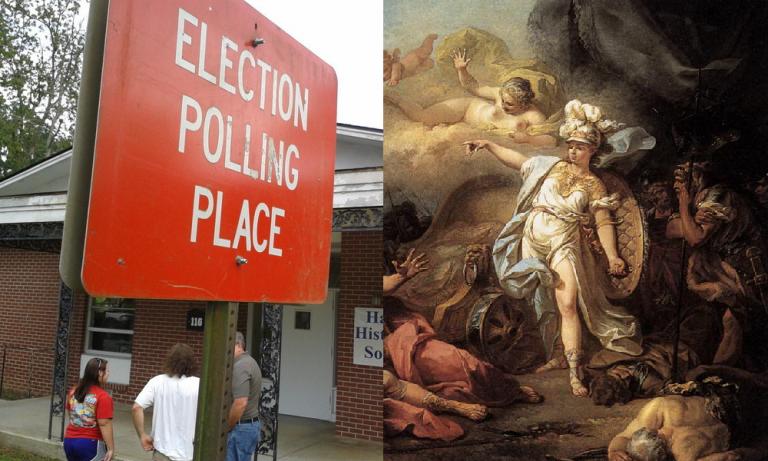
Polling place photo by John S. Quarterman, CC BY 2.0; Minerva Fighting Mars by Jacques-Louis David, image via Wikipedia

Socrates the Proto-fascist
It is through Plato’s writings that our ideas about his mentor Socrates have been formed, and the idea of the sophisticated and wise Socrates being sentenced to death by the ignorant mob for challenging convention is a classic criticism of democracy. (I even reference it in my song Even Wise Men Get The Blues.)
It also seems to be untrue.
Socrates was a foe of democracy, who believed that people were naturally unequal, that only the superior should be permitted to rule, that this class of “guardians” should censor and lie to get “inferior” people to accept rule by their betters, and that a eugenics program should be set up to breed “better” Athenians.
Despite these odious views, Athens tolerated Socrates’s bullshit; the people knew better than to try “deplatforming” him.[Fuller 330-334]
But several of Socrates’s students were among the Thirty Tyrants, a violent group of dictators who overthrew the democracy and murdered 5% of the Athenian population in less than a year. Critias, a leader of the Tyrants, was particularly close with Socrates; Plato wrote dialogues that were supposed to be between the two.
In keeping with Socrates’s ideas about rule by the best, the Tyrants drew up a list of 3,000 of the “best” men; anyone not on the list lost all rights and could be executed at any time.[Stone; Fuller, 333]
While Socrates did not directly take part in their depredations, he was not exiled with the democrats, nor did he flee with the moderates.[Stone] Other than refusing to participate in one execution, he seemed fairly comfortable with the situation. When democracy was restored, the people of Athens knew that Socrates’s ideas were a major influence on the Tyrants’ bloodshed. That, at root, was what the trial was about.[Fuller 336-338]
Plato’s account is a twisted attack on democracy by colleague of tyrants — and it shaped Europe’s idea of democracy for centuries.
Your Vote Is Supposed To Not Matter Much
And so the Founders’ view of democracy — the view of centuries of European imperialism — was shaped by Plato’s twisted account, and by the accounts of other wealthy men of Athens who resented democracy because it failed to give them political power. Literacy and writing was still the province of the well-off in Athens; the common people who were democracy’s staunchest defenders were less likely to leave behind any writings.
Similarly, views of Roman republicanism were shaped by writings surviving from Roman oligarchs, who found the corruption of politics by money quite to the their liking, not by the plebs.[Fuller, 272]
And of course, the Founders themselves were wealthy men with strong interest in preserving their power.
Though the Anti-Federalists managed to get a few compromises (like the Bill of Rights) toward democracy into the Constitution, by and large the whole point of the American system of government form the start has been to keep the levers of power out of the hands of the people.
And it’s succeeded.
A study published in Perspectives on Politics in 2014 looked at 1,779 cases where citizens were polled about what policy outcomes they wanted, and compared the people’s desires with the actual political outcomes. The authors found that “economic elites and organized groups representing business interests have substantial independent impacts on U.S. government policy, while average citizens and mass-based interest groups have little or no independent influence.”[Gilens]
It is ironic and problematic that this style of republic, structured from the start to restrict democracy and preserve the power of the wealthy, has become synonymous with “democracy” in modern conversation.
In general, your vote matters little. That’s how the system was designed from the start. As George Carlin put it, “It’s a big club and you ain’t in it.”
Vote To Keep In Practice
Still, that’s a general conclusion. You may have an exception on your ballot.
If you have a have a clear choice between good and bad candidates, and the outcome has not already been predetermined by restrictive ballot-access laws, gerrymandering, voter purge shenanigans, or the like, cast your vote feeling that it matters.
But what about the rest of us? What if your vote doesn’t matter? Why bother to go to the polls?
If democracies are better than republics, and if the United States is a republic and not a democracy, than we ought to do what we can to push the nation to grow in a more democratic direction. Athens didn’t start as a democracy, after all; the had experimented with representative government and found its failures before building their democracy.
(For a preliminary look at what direct democracy might look like in the modern world on the scale of technological-industrial nation-states rather than agricultural city-states, I recommend Fuller’s book.)
But in the meanwhile, it is a worthwhile principle of healing that the sick or injured patient should exercise whatever capacities they do have in order to prevent atrophy. If participating in a true democracy is a healthy person living an active life, then voting in our ailing republic is a patient in the ICU struggling to move their fingers and toes.
But we won’t get better if we don’t exercise the tiny capacity we do have. So go vote!
You can keep up with “The Zen Pagan” by subscribing via RSS or e-mail.
References
Fuller, Roslyn. Beasts and gods : how democracy changed its meaning and lost its purpose. London: Zed Books, 2015.
Gilens, Martin, and Benjamin I. Page. “Testing Theories of American Politics: Elites, Interest Groups, and Average Citizens.” Perspectives on Politics. Vol 12 No 3, 2014, pp. 564–581. doi:10.1017/S1537592714001595 <https://www.cambridge.org/core/journals/perspectives-on-politics/article/testing-theories-of-american-politics-elites-interest-groups-and-average-citizens/62327F513959D0A304D4893B382B992B/core-reader#>
Harrison, Jane Ellen. Prolegomena to the study of Greek religion. 2nd ed. Cambridge University Press, 1908. <https://archive.org/details/prolegomenatostu00harr/>
James, C.L.R. “Every Cook Can Govern.” Correspondence Vol. 2, No. 12. June 1956. <https://www.marxists.org/archive/james-clr/works/1956/06/every-cook.htm>
Stone, I.F. “I.F. Stone Breaks The Socrates Story.” New York Times 8 Apr 1979: SM6. <https://www.nytimes.com/1979/04/08/archives/if-stone-breaks-the-socrates-story-an-old-muckraker-sheds-fresh.html>

About Tom Swiss
Tom Swiss describes his spiritual path as "Zen Pagan Taoist Atheist Discordian", which usually baffles questioners enough to leave him alone. He is the author of Why Buddha Touched the Earth (Megalithica Books, 2013) and has previously served as President of the Free Spirit Alliance You can read more about the author here.
Previous Post

October 29, 2018
The Veil And The Void
Next Post

November 11, 2018 Armistice Day, Veterans' Day
Browse Our Archives
Select a Category 2017 52 Makeup 2020 52 Makeup Always Roaming With A Hungry Heart Art Because I Could Not Stop For Death Caught On Video COVID-19 Culture Discordianism Ethics, Virtue, and Right Living History Magic(k), Ritual, and Mysticism My Blogging Life and Times Philosophy Podcast Poetry Random Wednesdays Religion & Politics Seasonal Musings Techno-Pagan Theology Uncategorized Warrior Path Zen
Select a Month October 2026 September 2026 August 2026 March 2026 February 2026 January 2026 December 2025 March 2025 January 2025 December 2024 November 2024 September 2024 August 2024 June 2024 May 2024 April 2024 March 2024 February 2024 December 2023 September 2023 August 2023 July 2023 June 2023 May 2023 March 2023 February 2023 January 2023 December 2022 October 2022 September 2022 June 2022 April 2022 February 2022 January 2022 December 2021 November 2021 October 2021 September 2021 August 2021 July 2021 May 2021 April 2021 March 2021 February 2021 January 2021 December 2020 November 2020 October 2020 September 2020 August 2020 June 2020 May 2020 April 2020 March 2020 February 2020 January 2020 December 2019 November 2019 October 2019 September 2019 August 2019 July 2019 June 2019 May 2019 April 2019 March 2019 February 2019 January 2019 December 2018 November 2018 October 2018 September 2018 August 2018 July 2018 June 2018 May 2018 April 2018 March 2018 January 2018 December 2017 November 2017 October 2017 September 2017 August 2017 July 2017 June 2017 May 2017 April 2017 March 2017 February 2017 January 2017 December 2016 November 2016 October 2016 September 2016 August 2016 July 2016 June 2016 May 2016 April 2016 March 2016 February 2016 January 2016 December 2015 November 2015 October 2015 September 2015 August 2015 July 2015 June 2015
Follow Us!
TAKE THE
Religious Wisdom Quiz
What does Paul tell Timothy to flee from in 2 Timothy?
Select your answer to see how you score.
Evil desires of youth Persecution The love of money False teaching
Related posts from The Zen Pagan


Comfort The Dying; We're All Dying

Fixing the Mailbox: A Holiday Omen
Masculine Archetypes: Trickster at Samhain & Election Day
TRENDING AT PATHEOS Pagan

Jad Gillies on New Hillsong Worship Songs and...
For worship leader Jad Gillies, Hillsong Worship’s next chapter is not about...

Looking at the Largest Orthodox Cathedral on Earth
There is often a considerable amount of anger and, shall we...

The Problem with False Prophets
Miller’s Station UMC| 10/18/26| Anchor Verse: Jeremiah 23: 1, 9-23 I...

Emotion in Early Christianity by Andrew Crislip
Andrew Crislip’s Emotion in Early Christianity examines an often overlooked dimension of...

16 Spiritual Touchstones for a More Grounded Life
After decades of spiritual study, here are 16 principles I try...

Catholic Evangelization: Sharing Your Faith Every Day
Welcome back to the Graceful Awakening mini-series called, “From Faith to Mission.” ...
view all Pagan blogs
Ad-Free & Subscriber Log-In Subscription Support
- About Us
- 2026 Calendar
- Videos
- Podcasts
- Library of World Religions
- Faith In Media Tracker
- Advertise With Us
- Write for Us
- Privacy Policy
- Terms of Service
- Do Not Sell My Data
- Contact Us
- Radiant Digital
- Manage Newsletter Subscriptions
- Unsubscribe From Notifications
- Sitemap
Copyright 2008-2026, Patheos. All rights reserved.
Subscription Support Ad-Free & Subscriber Log-In
Follow Patheos