
BuddhistCatholicContemplativeEvangelicalGeneral ChristianHinduJewishLatter-day SaintMuslimNew VisionsProgressive Christian
Beliefs
- Buddhist
- Catholic
- Contemplative
- Evangelical
- General Christian
- Hindu
- Jewish
- Latter-day Saint
- More Voices
- Muslim
- New Visions
- Pagan
- Progressive Christian
Topics
- Religion News
- Food and Religion
- Sports and Religion
- Religious Art
- Religious Music and Entertainment
- Religious Events
- History and Religion
- Style and Religion
- Politics and Religion
- Women in Religion
- Recreation Outdoors and Religion
- Business Finance and Religion
- Careers Workplace and Religion
- Education and Religion
- Family Parenting and Religion
- Health Fitness and Religion
- Home and Religion
- Relationships and Religion
- Technology and Religion
- Travel and Religion
Columnists
- Buddhist Columnists
- Business Finance and Religion Columnists
- Careers Workplace and Religion Columnists
- Catholic Columnists
- Contemplative Columnists
- Education and Religion Columnists
- Evangelists Columnists
- Family Parenting and Religion Columnists
- General Christian Columnists
- Health Fitness and Religion Columnists
- Hindu Columnists
- History and Religion Columnists
- Home and Religion Columnists
- Jewish Columnists
- More Voices Columnists
- Latter Day Columnists
- Muslim Columnists
- New Visions Columnists
- Nonreligious Columnists
- Pagan Columnists
- Politics and Religion Columnists
- Progressive Columnists
- Recreation Outdoors and Religion Columnists
- Relationships and Religion Columnists
- Religion News Columnists
- Religious Art Columnists
- Religious Events Columnists
- Religious Music and Entertainment Columnists
- Sports and Religion Columnists
- Style and Religion Columnists
- Technology and Religion Columnists
- Travel and Religion Columnists
- Women in Religion Columnists
Resource Library
- 2026 Calendar
- Library of World Religions
- The 100 Most Holy Places on Earth
- Patheos Answers
- Podcasts
- Videos
- Faith Leaders Database
- Anglican Episcopalian
- Bahai
- Baptist
- Buddhism
- Christianity
- Confucianism
- Eastern Orthodoxy
- Hinduism
- Holiness and Pentecostal
- ISKCON
- Islam
- Judaism
- Lutheran
- Methodist
- The Church of Jesus Christ of Latter-day Saints
- New Age
- Paganism
- Presbytarian and Reformed
- Protestantism
- Religion Behind the Scenes
- Roman Catholic
- Scientology
- Shia Islam
- Sikhism
- Sufism
- Sunni Islam
- Taoism
- Zen
- See all religions
Research Tools
 Ad-Free & Subscriber Log-In Subscription Support
Ad-Free & Subscriber Log-In Subscription Support
Follow Patheos 

- Trending:
- Forgiveness
- |
- Marriage
- |
- Consciousness
- |
- Death Penalty
- |
- Election
- |
- Halloween

- Home
- Pagan
- The Veil And The Void
The Veil And The Void
Last updated on: October 29, 2018 at 1:16 am by Tom Swiss
The Veil And The Void 2018-10-29T01:16:55-04:00 Tom Swiss
Patheos Explore the world's faith through different perspectives on religion and spirituality! Patheos has the views of the prevalent religions and spiritualities of the world.
Everybody knows the four classical elements: earth, air, fire, and water.
In the Western esoteric tradition, “spirit” is usually taken as the fifth element. And as we talk about the Samhain season, we often talk about a “veil” between this world and the “spirit world” becoming thinner.
But there is a Japanese tradition of five elements, the godai (五大). It has roots in Buddhist teachings from China and India, but seems to be uniquely Japanese. In this system, the fifth element in addition to earth, air, fire, and water is ku (空) — “void, emptiness”.
(The “five elements” of Taoism and Chinese medicine, which show up in Japanese culture in different contexts than the godai, are a different sort of beast. The wu xing (五行) — water, wood, fire, earth, and metal — are not “elements” that aggregate to form the things of the world, but “phases” or “processes” of a cycle that living systems go through, of storage and generation, growth, blossoming, stability, and decline and dissolution returning to the start of the cycle. A topic for another time.)
The character ku is also read “kara” — as in “kara-te”, “empty hand”, referring both to the fact that the practitioner’s hand holds no weapon and to the esoteric, spiritual idea of “emptiness”. (And also a sort of pun on a different character also read as “kara” but meaning “Chinese”; we’ll refrain exploring that tangent for now.) So it’s a concept that is near and dear to my heart.
One of the most famous discussions of the Japanese godai is in the samurai Miyamoto Musashi’s book Go Rin No Sho, the Book of Five Rings. In the chapter on void, he writes “By knowing things that exist, you can know that which does not exist. That is the void….In the void is virtue, and no evil. Wisdom has existence, principle has existence, the Way has existence, spirit is nothingness.” (Victor Harris translation.)
This “emptiness” does not indicate a lack or deficiency, as we might talk about an car’s fuel tank being empty of gasoline, or the glass in front of me being empty of beer. What things are empty of is an individual, stable, separate self-nature. Things “mutually arise”, a state of affairs that the contemporary Zen teacher Thich Nhat Hahn calls “interbeing”.
Many people think that Buddhists, by definition, believe in reincarnation: that there exists an immortal soul or spirit that abandons the body at death, perhaps goes to a spirit world for a while, and gets put into another body at some point; like a pilot bailing out, returning to base, and then being assigned a new plane. (Wicca quite likely first absorbed its idea of reincarnation from Gerald Gardner’s exposure to Buddhism when he lived in Ceylon.)
But it’s more complicated than that. Certainly many Buddhists do believe in what we might call that “naive” idea of reincarnation. And the Buddha and leading Buddhist teachers did refer to stories about reincarnation — though some interpret those references as metaphors or fables, or as speaking in terms that people could understand with existing beliefs.
(Brad Warner recently made the interesting observation that, due to the structure of the Japanese language, when the great Zen teacher Dōgen occasionally referenced this idea of reincarnation, he didn’t even give any name to refer to the putative entity that jumps from body to body.)
Given the way that our culture is saturated with a Christianity that focuses on belief in a god and eternal salvation in an afterlife, it’s easy to forget that Buddha was sort of apathetic on such supernatural topics. His focus was on ending human suffering in this life. If he was teaching people who had a certain belief that wasn’t relevant either way to his core mission, but that he could make use of to help them, he might well have done so.
But a fundamental part of the Buddha’s doctrine was the idea of anatman, “no self” — the idea of emptiness as applied to the human person. While Buddhism teaches that the karma, the cause-and-effect chain of our actions, continues after death, anatman is quite at odds with the naive model of reincarnation.
This “no self” doesn’t mean that there’s nothing there. It sort of means the very opposite: that everything is there. “All know that the drop merges into the ocean, but few know that the ocean merges into the drop,” as the Indian mystic Kabir put it.
The void, the vast emptiness, is not an extinction but an expansion.
What if we thought of the veil between the worlds not as a separation between our physical realm and a realm made out of some more rarefied substance, but as the boundary between the ordinary view of reality where “form is form and emptiness is emptiness”, and that fuller view which sees that “form is emptiness, emptiness is form”, as the Heart Sutra puts it?
Perhaps we can take this time when the leaves fall and the trees show us their bones and the space within their branches, this time of inwardly-drawing energy, this time when we make use of pumpkins be creating a void within them, as a reminder from the universe about the freedom of emptiness.

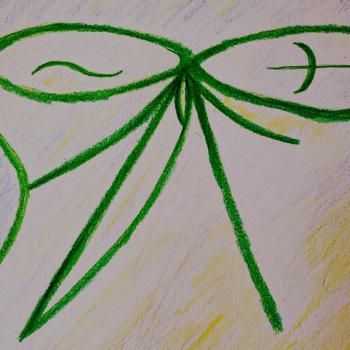
“Break the Sky”. Digital art by the author.
Because I Could Not Stop For Death

About Tom Swiss
Tom Swiss describes his spiritual path as "Zen Pagan Taoist Atheist Discordian", which usually baffles questioners enough to leave him alone. He is the author of Why Buddha Touched the Earth (Megalithica Books, 2013) and has previously served as President of the Free Spirit Alliance. You can read more about the author here.
Previous Post
October 28, 2018
Murder At The Tree Of Life
Next Post

November 5, 2018 Should You Bother To Vote?
Browse Our Archives
Select a Category 2017 52 Makeup 2020 52 Makeup Always Roaming With A Hungry Heart Art Because I Could Not Stop For Death Caught On Video COVID-19 Culture Discordianism Ethics, Virtue, and Right Living History Magic(k), Ritual, and Mysticism My Blogging Life and Times Philosophy Podcast Poetry Random Wednesdays Religion & Politics Seasonal Musings Techno-Pagan Theology Uncategorized Warrior Path Zen
Select a Month October 2026 September 2026 August 2026 March 2026 February 2026 January 2026 December 2025 March 2025 January 2025 December 2024 November 2024 September 2024 August 2024 June 2024 May 2024 April 2024 March 2024 February 2024 December 2023 September 2023 August 2023 July 2023 June 2023 May 2023 March 2023 February 2023 January 2023 December 2022 October 2022 September 2022 June 2022 April 2022 February 2022 January 2022 December 2021 November 2021 October 2021 September 2021 August 2021 July 2021 May 2021 April 2021 March 2021 February 2021 January 2021 December 2020 November 2020 October 2020 September 2020 August 2020 June 2020 May 2020 April 2020 March 2020 February 2020 January 2020 December 2019 November 2019 October 2019 September 2019 August 2019 July 2019 June 2019 May 2019 April 2019 March 2019 February 2019 January 2019 December 2018 November 2018 October 2018 September 2018 August 2018 July 2018 June 2018 May 2018 April 2018 March 2018 January 2018 December 2017 November 2017 October 2017 September 2017 August 2017 July 2017 June 2017 May 2017 April 2017 March 2017 February 2017 January 2017 December 2016 November 2016 October 2016 September 2016 August 2016 July 2016 June 2016 May 2016 April 2016 March 2016 February 2016 January 2016 December 2015 November 2015 October 2015 September 2015 August 2015 July 2015 June 2015
Follow Us!
TAKE THE
Religious Wisdom Quiz
What does the name "Jesus" mean?
Select your answer to see how you score.
God is with us Teacher The Lord saves Prince of peace
Related posts from The Zen Pagan



Holiday Lights, Solstice Fires, and Jizo's Jewel
TRENDING AT PATHEOS Pagan

16 Spiritual Touchstones for a More Grounded Life
After decades of spiritual study, here are 16 principles I try...

Catholic Evangelization: Sharing Your Faith Every Day
Welcome back to the Graceful Awakening mini-series called, “From Faith to Mission.” ...

The Pillar of the Boatmen: the Ancient Monument...
The Pillar of the Boatmen is a Romano-Gaulish sculpture that dates from...

In one sense walking into Westminster Abbey is like walking down the...

'Super Scam Me' Exposes AI Jon Bon Jovi...
Leslie Pickett believed she was in a relationship with Jon Bon Jovi....

The Brazilian Remake of Kendricks' 'Flywheel' Opens in...
“Flywheel,” the story that launched the Kendrick Brothers’ filmmaking career is getting...
view all Pagan blogs
Ad-Free & Subscriber Log-In Subscription Support
- About Us
- 2026 Calendar
- Videos
- Podcasts
- Library of World Religions
- Faith In Media Tracker
- Advertise With Us
- Write for Us
- Privacy Policy
- Terms of Service
- Do Not Sell My Data
- Contact Us
- Radiant Digital
- Manage Newsletter Subscriptions
- Unsubscribe From Notifications
- Sitemap
Copyright 2008-2026, Patheos. All rights reserved.
Subscription Support Ad-Free & Subscriber Log-In
Follow Patheos