
BuddhistCatholicContemplativeEvangelicalGeneral ChristianHinduJewishLatter-day SaintMuslimNew VisionsProgressive Christian
Beliefs
- Buddhist
- Catholic
- Contemplative
- Evangelical
- General Christian
- Hindu
- Jewish
- Latter-day Saint
- More Voices
- Muslim
- New Visions
- Pagan
- Progressive Christian
Topics
- Religion News
- Food and Religion
- Sports and Religion
- Religious Art
- Religious Music and Entertainment
- Religious Events
- History and Religion
- Style and Religion
- Politics and Religion
- Women in Religion
- Recreation Outdoors and Religion
- Business Finance and Religion
- Careers Workplace and Religion
- Education and Religion
- Family Parenting and Religion
- Health Fitness and Religion
- Home and Religion
- Relationships and Religion
- Technology and Religion
- Travel and Religion
Columnists
- Buddhist Columnists
- Business Finance and Religion Columnists
- Careers Workplace and Religion Columnists
- Catholic Columnists
- Contemplative Columnists
- Education and Religion Columnists
- Evangelists Columnists
- Family Parenting and Religion Columnists
- General Christian Columnists
- Health Fitness and Religion Columnists
- Hindu Columnists
- History and Religion Columnists
- Home and Religion Columnists
- Jewish Columnists
- More Voices Columnists
- Latter Day Columnists
- Muslim Columnists
- New Visions Columnists
- Nonreligious Columnists
- Pagan Columnists
- Politics and Religion Columnists
- Progressive Columnists
- Recreation Outdoors and Religion Columnists
- Relationships and Religion Columnists
- Religion News Columnists
- Religious Art Columnists
- Religious Events Columnists
- Religious Music and Entertainment Columnists
- Sports and Religion Columnists
- Style and Religion Columnists
- Technology and Religion Columnists
- Travel and Religion Columnists
- Women in Religion Columnists
Resource Library
- 2026 Calendar
- Library of World Religions
- The 100 Most Holy Places on Earth
- Patheos Answers
- Podcasts
- Videos
- Faith Leaders Database
- Anglican Episcopalian
- Bahai
- Baptist
- Buddhism
- Christianity
- Confucianism
- Eastern Orthodoxy
- Hinduism
- Holiness and Pentecostal
- ISKCON
- Islam
- Judaism
- Lutheran
- Methodist
- The Church of Jesus Christ of Latter-day Saints
- New Age
- Paganism
- Presbytarian and Reformed
- Protestantism
- Religion Behind the Scenes
- Roman Catholic
- Scientology
- Shia Islam
- Sikhism
- Sufism
- Sunni Islam
- Taoism
- Zen
- See all religions
Research Tools
 Ad-Free & Subscriber Log-In Subscription Support
Ad-Free & Subscriber Log-In Subscription Support
Follow Patheos 

- Trending:
- Forgiveness
- |
- Marriage
- |
- Consciousness
- |
- Death Penalty
- |
- Election
- |
- Halloween

- Home
- Pagan
- Even In Japan, Things Change
Even In Japan, Things Change
Last updated on: May 7, 2017 at 11:13 pm by Tom Swiss
Even In Japan, Things Change 2017-05-07T23:13:38-04:00 Tom Swiss
Patheos Explore the world's faith through different perspectives on religion and spirituality! Patheos has the views of the prevalent religions and spiritualities of the world.
Even in Japan, things change.
Oh, the Daibutsu is still there at Todai-ji in Nara, looking the same as when I saw him last; and maybe two miles or so away, the Medicine Buddha and the Twelve Heavenly Generals, warriors who drive out disease, are still at the 1,200 year old New Temple of the Medicine Buddha, Shin Yakushi-ji. (Some say that the character “shin” should be given some meaning other than “new” here, but my gut says “new” was at least part of what was meant in the naming.)
It was supposed to rain in Kyoto yesterday but be dry in Nara, so I headed out that way to pay my respects. These two temples were important parts of my first experience of Japan, years ago. And I needed to thank the Medicine Buddha for my mom’s recovery. That was an emotional moment.
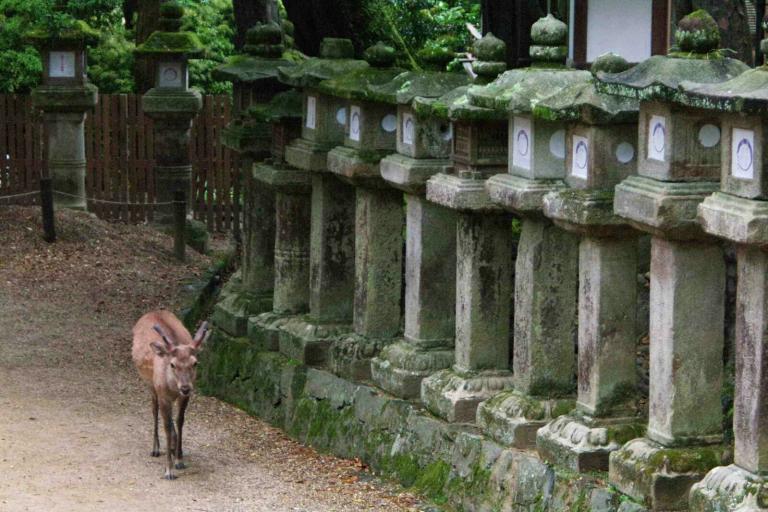
It turns out weather forecasting is not better in Japan that the US. The rain drove me to take shelter under the eaves of a building of a sub-shrine in Kasuga Taisha that I’d passed before and noted its heart-shaped ema, prayer cards. Well, the whole romance and relationship thing is an aspect of my life that needs improvement (more on that in a bit), so I forked over a few hundred yen for one of those ema and wrote my wish: “Love and Peace! May all beings be happy, love and be loved.” Got some photos of the iconic Nara deer and stone lanterns, the same as they have been for centuries.
 I survived the rain, as did my camera. And on the way back to the station, with a little Internet help I found a nice pub/izakaya with ten taps of craft beer and a vegan menu — LBK Craft, big win there. It’s a new place, so there’s a little positive change.
But today, I first headed to the eastern edge of the city, Nanzeniji, a big Zen temple complex. It gets mentioned in the opening pages of Why Buddha Touched the Earth, which wasn’t yet published when last I visited Japan, so I thought a “thanks for the inspiration” visit was appropriate.
It is also the setting for one of my favorite stories about Zen.
It seems that back in 1267, the Emperor Kameyama built a retirement villa on the site. A few years later the place developed a ghost problem. Kameyama invited priests from a variety of sects to exorcise the annoying spirit, but they all failed until the Zen priest Daiminkokushi came by.
He didn’t do any exorcism ritual. He didn’t recite any sutras.
He just sat zazen.
The ghost disappeared.
(I leave the interpretation of this to the reader.)
The retired emperor, suitably impressed, became Daiminkokushi’s student and donated the villa to the Zen sect — which was relatively new to Japan, only about a century old. So this was pretty significant.
(If you’ve been to my house, the dragon poster in my living room is a photo of the painting on the ceiling of the main hall of this temple.)
Behind the main complex, with famous gardens and all, is a small side temple, Saisho-in. This is a quirky little place. The last time I was there, in the wake of the Fukushima disaster, there was a “No Nukes!” cartoon dog on the temple gate; the temple master, Shuren Sakurai, was a Noh mask carver, exemplifying the unity of Zen and art. I very briefly met him twice and though we only exchanged a few words I got a great vibe off of him. It helped that he had this poem — in English — on a sign in the courtyard:
Summer, Saisho-in
The evening bell, solemn and bronze
in the grandfather temple down the hill,
sounds dimly here.
Slow beat of the mountain’s heart, perhaps,
or determined pulse of the pine tree (gift of the birds)
growing out of the crotch of the slippery monkey tree.
All one, perhaps–
bell, mountain, tree…
and steady cicada vibrato
and little white dog
and quiet artist-priest, carver of Noh masks,
Fashioning a bamboo crutch for the ancient peach tree–
symbol of strength, symbol of concern.
All cool under nodding crowns of the vertical forest,
all seeking in this place,
all finding in this place–
hidden yet open to all–
the spirit in the cedars heart.Saisho-in: a small, Eighth Century Buddhist temple in a mountain gorge near Kyoto, Japan.
He passed away two years ago, and I wanted to sort of pay my respects to the new boss. (Not that I expected to meet him, just a ritual/energetic thing.) But the place was closed, apparently under renovation. That was startling.
The poem-sign is still there, and I’ve read that his grandson has been installed as abbot of the temple. So I hope the same spirit will carry on, even as things change at a temple that’s been around since the eighth century. (Older than Nanzen-ji itself, apparently — maybe it was the neighborhood temple when Kameyama retired there? I can’t find much information about the place in English. But it speaks to my heart in some way.)
I hiked the trail up the hill in back of the temple, to the Shinto shrine and waterfall, just to pay respects to the kami of the forest hillside (also mentioned in the opening pages of my book); then decided to head to the other side of town.
Arashiyama, the Storm Mountain, gives its name to a beautiful district of western Kyoto. There you will find Tenryu-ji, the Temple of the Heavenly Dragon, whose Zen gardens are one of my favorite spots to visit. This time, the mail hall was open to visitors, I could go in and get stared at by the dragon painted on the ceiling here. It’s a new painting, dating to the 1990s, done so that the dragon’s eyes seem to follow you wherever you go in the room.
The temple souvenir shop had postcards for just 100 yen each, so I hustled to a FamilyMart with an ATM and back just before they closed, and picked up a bunch of them to give to my karate students as little omiyage.
With that done, I did a quick search for vegan restaurants in Arashiyama, and turned up the Arashiyama Kan, a little place run by an elderly couple. I only met the man, but he was the perfect conclusion to my trip.
Mr. Murakami (I only got his name as I left) had a few words of English, plus an iPad with Google Translate; and I had about 1/10 as much Japanese. So our back and forth was not always clear and I’m skipping over the unclear bits and summarizing. But sometimes, it was very clear.
He told me that this style of Japanese food was a thousand years old, suggested I order the bento (a boxed meal set), and after I did so he asked if I’d been sightseeing. I told him I’d seen Tenryu-ji, and he insisted on taking me on a quick tour of the temple next door, Horin-ji, while my dinner was being prepared.
Now, this is interesting because there is another temple also named Horin-ji in Kyoto. That one is also known as Daruma-dera, and I’ve visited it more than once and also mentioned in Why Buddha Touched the Earth. But I hadn’t been to this other Horin-ji. (Another eighth century Buddhist temple, by the way, though this one belongs to the Shingon sect.)
My host led me around the corner and up the long steep stairs — and let me mention that he was taking them better than I was, though I’d guess he was in his seventies at least; after all the walking of the past few days, my ankle is paining me. I want to be as genki as this guy when I grow up.
At the entrance to the temple are bronze plaques to Thomas Edison and Heinrich Hertz. My Google-fu reveals that this is because the grounds house a Shinto shrine dedicated to the god lightning, which honors those in the electronics and radio industries. So that’s nifty. (Though they ought to tear out that jerk Edison and replace him with Tesla!)
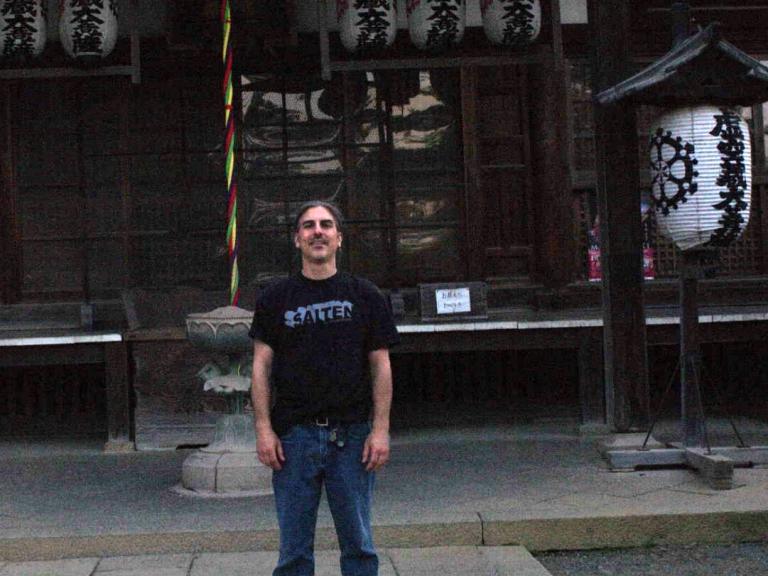 At the top of the hill, Murakami Sensei pointed out the view east over Kyoto (tremendous!), led me though the ritual ablution, and then to the front of the temple. He then asked if I was married.
Well. Of course I’m not, but the whole relationship thing has been on my mind these past few months. My mom’s brush with death, having a Very Serious Conversation with my dad about their relationship and the inevitable way it was going to end with the death of one of them or the other, and the fact that, while still pretty genki myself and in better shape than most guys ten years younger, I’m less than three years from the half-century mark…it’s pushed me to evaluate my own situation. It’s been a few years now since I’ve been In A Relationship, though I’ve had a few dates with some lovely and wonderful ladies over that time. It’s just worked out that way.
So, there at the Temple of the Dharma Wheel, my vegan restaurant host offered his blessing that I find a nice girl and start a family.
Very traditionally Japanese, that. My own ideas of romantic success are more open to the non-traditional, but I’ll take the blessing the the spirit in which it was offered.
So that’s something I’ll be contemplating as I head back home. Will that return be to life as usual? Well, if things can change at a 1,300-year-old Zen temple, maybe my life will change in unexpected ways too. Everything needs a little renovation now and again, even the human heart.
You can keep up with “The Zen Pagan” by subscribing via RSS or e-mail.
Have I mentioned my books lately? If you enjoy this blog, check out Why Buddha Touched the Earth or What Does It Mean For The Gods to Exist?.
Please consider supporting this blog with a donation or purchase. The Zen Pagan Merch-o-rama has t-shirts, mugs, posters and prints, and stickers designed by yours truly.
If you do Facebook, you might choose to join a group on “Zen Paganism” I’ve set up there. And don’t forget to “like” Patheos Pagan and/or The Zen Pagan over there, too.
Always Roaming With A Hungry Heart
Previous Post

May 6, 2017
Kyoto's Ancestors Are Watching; Deities In Commerce
Next Post
May 13, 2017 Kyoto Bonus: Daruma-dera Visit
Browse Our Archives
Select a Category 2017 52 Makeup 2020 52 Makeup Always Roaming With A Hungry Heart Art Because I Could Not Stop For Death Caught On Video COVID-19 Culture Discordianism Ethics, Virtue, and Right Living History Magic(k), Ritual, and Mysticism My Blogging Life and Times Philosophy Podcast Poetry Random Wednesdays Religion & Politics Seasonal Musings Techno-Pagan Theology Uncategorized Warrior Path Zen
Select a Month October 2026 September 2026 August 2026 March 2026 February 2026 January 2026 December 2025 March 2025 January 2025 December 2024 November 2024 September 2024 August 2024 June 2024 May 2024 April 2024 March 2024 February 2024 December 2023 September 2023 August 2023 July 2023 June 2023 May 2023 March 2023 February 2023 January 2023 December 2022 October 2022 September 2022 June 2022 April 2022 February 2022 January 2022 December 2021 November 2021 October 2021 September 2021 August 2021 July 2021 May 2021 April 2021 March 2021 February 2021 January 2021 December 2020 November 2020 October 2020 September 2020 August 2020 June 2020 May 2020 April 2020 March 2020 February 2020 January 2020 December 2019 November 2019 October 2019 September 2019 August 2019 July 2019 June 2019 May 2019 April 2019 March 2019 February 2019 January 2019 December 2018 November 2018 October 2018 September 2018 August 2018 July 2018 June 2018 May 2018 April 2018 March 2018 January 2018 December 2017 November 2017 October 2017 September 2017 August 2017 July 2017 June 2017 May 2017 April 2017 March 2017 February 2017 January 2017 December 2016 November 2016 October 2016 September 2016 August 2016 July 2016 June 2016 May 2016 April 2016 March 2016 February 2016 January 2016 December 2015 November 2015 October 2015 September 2015 August 2015 July 2015 June 2015
Follow Us!
TAKE THE
Religious Wisdom Quiz
Which prophet was commanded to buy a field during a siege?
Select your answer to see how you score.
Obadiah Jeremiah Isaiah Habakkuk
Related posts from The Zen Pagan

Starwood 2026 -- This Is Not A Review



TRENDING AT PATHEOS Pagan

Emotion in Early Christianity by Andrew Crislip
Andrew Crislip’s Emotion in Early Christianity examines an often overlooked dimension of...

16 Spiritual Touchstones for a More Grounded Life
After decades of spiritual study, here are 16 principles I try...

Catholic Evangelization: Sharing Your Faith Every Day
Welcome back to the Graceful Awakening mini-series called, “From Faith to Mission.” ...

The Pillar of the Boatmen: the Ancient Monument...
The Pillar of the Boatmen is a Romano-Gaulish sculpture that dates from...

In one sense walking into Westminster Abbey is like walking down the...

'Super Scam Me' Exposes AI Jon Bon Jovi...
Leslie Pickett believed she was in a relationship with Jon Bon Jovi....
view all Pagan blogs
Ad-Free & Subscriber Log-In Subscription Support
- About Us
- 2026 Calendar
- Videos
- Podcasts
- Library of World Religions
- Faith In Media Tracker
- Advertise With Us
- Write for Us
- Privacy Policy
- Terms of Service
- Do Not Sell My Data
- Contact Us
- Radiant Digital
- Manage Newsletter Subscriptions
- Unsubscribe From Notifications
- Sitemap
Copyright 2008-2026, Patheos. All rights reserved.
Subscription Support Ad-Free & Subscriber Log-In
Follow Patheos