
BuddhistCatholicContemplativeEvangelicalGeneral ChristianHinduJewishLatter-day SaintMuslimNew VisionsProgressive Christian
Beliefs
- Buddhist
- Catholic
- Contemplative
- Evangelical
- General Christian
- Hindu
- Jewish
- Latter-day Saint
- More Voices
- Muslim
- New Visions
- Pagan
- Progressive Christian
Topics
- Religion News
- Food and Religion
- Sports and Religion
- Religious Art
- Religious Music and Entertainment
- Religious Events
- History and Religion
- Style and Religion
- Politics and Religion
- Women in Religion
- Recreation Outdoors and Religion
- Business Finance and Religion
- Careers Workplace and Religion
- Education and Religion
- Family Parenting and Religion
- Health Fitness and Religion
- Home and Religion
- Relationships and Religion
- Technology and Religion
- Travel and Religion
Columnists
- Buddhist Columnists
- Business Finance and Religion Columnists
- Careers Workplace and Religion Columnists
- Catholic Columnists
- Contemplative Columnists
- Education and Religion Columnists
- Evangelists Columnists
- Family Parenting and Religion Columnists
- General Christian Columnists
- Health Fitness and Religion Columnists
- Hindu Columnists
- History and Religion Columnists
- Home and Religion Columnists
- Jewish Columnists
- More Voices Columnists
- Latter Day Columnists
- Muslim Columnists
- New Visions Columnists
- Nonreligious Columnists
- Pagan Columnists
- Politics and Religion Columnists
- Progressive Columnists
- Recreation Outdoors and Religion Columnists
- Relationships and Religion Columnists
- Religion News Columnists
- Religious Art Columnists
- Religious Events Columnists
- Religious Music and Entertainment Columnists
- Sports and Religion Columnists
- Style and Religion Columnists
- Technology and Religion Columnists
- Travel and Religion Columnists
- Women in Religion Columnists
Resource Library
- 2026 Calendar
- Library of World Religions
- The 100 Most Holy Places on Earth
- Patheos Answers
- Podcasts
- Videos
- Faith Leaders Database
- Anglican Episcopalian
- Bahai
- Baptist
- Buddhism
- Christianity
- Confucianism
- Eastern Orthodoxy
- Hinduism
- Holiness and Pentecostal
- ISKCON
- Islam
- Judaism
- Lutheran
- Methodist
- The Church of Jesus Christ of Latter-day Saints
- New Age
- Paganism
- Presbytarian and Reformed
- Protestantism
- Religion Behind the Scenes
- Roman Catholic
- Scientology
- Shia Islam
- Sikhism
- Sufism
- Sunni Islam
- Taoism
- Zen
- See all religions
Research Tools
 Ad-Free & Subscriber Log-In Subscription Support
Ad-Free & Subscriber Log-In Subscription Support
Follow Patheos 

- Trending:
- Forgiveness
- |
- Marriage
- |
- Consciousness
- |
- Death Penalty
- |
- Election
- |
- Halloween

- Home
- Pagan
- What Science Is And Isn’t
What Science Is And Isn’t
Last updated on: April 22, 2017 at 10:31 pm by Tom Swiss
What Science Is And Isn’t 2017-04-22T22:31:12-04:00 Tom Swiss
Patheos Explore the world's faith through different perspectives on religion and spirituality! Patheos has the views of the prevalent religions and spiritualities of the world.
Hurrah for positive science! long live exact demonstration!
Fetch stonecrop mixt with cedar and branches of lilac,
This is the lexicographer, this the chemist, this made a grammar
of the old cartouches,
These mariners put the ship through dangerous unknown seas.
This is the geologist, this works with the scalpel, and this is a
mathematician.Gentlemen, to you the first honors always!
Your facts are useful, and yet they are not my dwelling,
I but enter by them to an area of my dwelling.
When it comes to science, I consider myself a booster. In college I was a physics major for a while, trying to do a dual degree with computer science, until my brain started to melt my junior year and I decided to just finish up the CS degree.
(It’s worth noting that “science” is being used in two different senses here: “science” in the sense of the natural sciences, the scientific method, and so on; and “science” as an organized body of knowledge, as in “motion picture arts and sciences”. Computer science has very little of the scientific method about it.)
There are two space science projects on my software development resume, and I take pride in that. The background wallpaper on my computer and my phone is the Hubble Deep Field image; so the beauty of the scientific view of the universe greets me every day.

Hubble Deep Field, via Wikipedia

But I’m ambivalent about the “March For Science” taking place today. In these partisan times, I worry about “science” becoming a partisan shibboleth. What percentage of those marching today have ever looked up an article in a peer-reviewed journal? How many know what a p-value, or error propagation, is?
When I look at the “I fucking love science!” Facebook page, I don’t see any discussion about the replication crisis or the Bayesian-frequentist controversy. Someone who really loves science ought to have at least some interest in those topics.
Scientism Is Not Science
I worry that too many people are letting the lab coat replace the clerical stole as a symbol of social authority, rather than respecting the methods of science, of publicly reviewed disciplined critical thinking based on empirical observation.
Professional scientists are human. Sometimes they don’t do science, even in their professional lives. They end up doing politics (civic, academic, or professional politics), or they become emotionally attached to ideas. Or they get corrupted, either consciously or unconsciously, by the possibility of money or prestige.
Or they use their social standing to wrap their cultural or political preferences in the cloak of “science”. From eugenics to Prohibition and the War on Drugs to the labeling of homosexuality as a mental illness, there are plenty of instances of that.
These things are bad. But they’re not science.
Science Is a Process
But still, the human failings of scientists can make people skeptical about the whole enterprise of science. A recent Facebook interlocutor asked, “What if science was wrong about pretty much everything?”
So it’s important to understand that science is a process, not an authority structure for a lab-coated priesthood and not a fixed body of knowledge.
Science is a means of finding things out about the objective, external, consensually-observed world. And the cool thing about it, the great breakthrough it represents in our thinking, is that it is a self-correcting process. If our model is wrong, if it contradicts what we can observe, eventually the truth will come out. Even if a bunch of professional scientists are stuck on the bad model, eventually the data will win out.
That seems so obvious to the modern mind that it’s easy to miss what a revolutionary idea it is. But even the concept that there is such a thing as a common, public space and time that we can all observe is a relatively new one, emerging from the work of Galileo and Newton. As F.S.C Northrop explained,
What Newton was saying here is that the space in which the laws or postulates of his physics locate the colorless, odorless physical objects is not the immediately sensed spatial extension of, and relation between, sensed data (which is a purely private space…), but is instead a single public space of nature which has the same mathematical, geometrical properties always and everywhere and is the same, regardless of the varying, distorted, sensed spaces which appear to different observers.
[Northrop, The Meeting of East and West, p76]
Now, there is a whole philosophical can of worms here. But for now let’s just say that given this ontological assumption of an external world with a number of observers who can each perceive only imprecisely (an assumption that is itself outside the realm of natural science, in the realm of metaphysics), science shows us how to pool our observations.
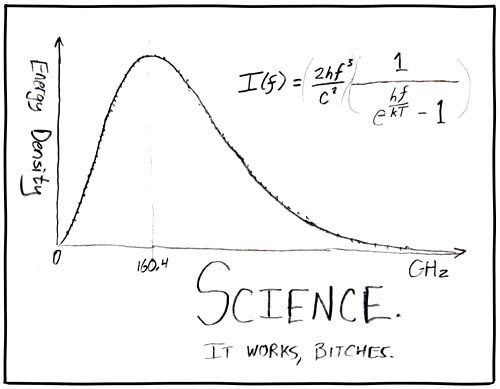
Science, Democracy, and Cosmopolitanism
Without that idea of public space, the observations and ideas of those at the top of the power hierarchy dominate. Before Galileo and Newton, the space in which the king dwelt was not the same as that in which commoners lived. This public space is the most critical philosophical substrate of democracy.
The public space is also the same for Americans as for Russians, the same for Christians and Muslims. Scientists often work with peers in other nations. That interaction leads to a certain cosmopolitan culture associated with science. That culture is a good thing — at least, I think it’s a good thing — but it is not, in itself, science; just a result of the circumstances in which scientists often work.
I emphasize that I think that culture is good, because value judgments are outside of science. That’s a point that came up recently in another Facebook conversation, where a different interlocutor envisioned putting scientists in charge of a project to formulate a system of morality for our society.
Science and Ethics
Science is an inquiry into what is, while ethics is an inquiry into what should be. If scientists have good ideas about ethics, they are not doing science when they talk about them.
Now that’s fine, scientists get to do other stuff. But it is a fallacy to believe that someone who knows science therefore knows about ethics. I see no evidence that on average, professional scientists have better or worse ethics than other educated professionals.
Indeed, to even answer that question we’d have to agree on an ethical framework within which we could judge people’s ideas and behavior.
What is, ethically, good? Is murder bad? Does human life have value? Is it good if the human species survives? The social sciences can tell us what different cultures think about these questions, they can even tell us what influence social norms have on behavior and whether a culture with such norms can sustain itself, but cannot say which answer is better than another.
And science’s professional ethics have not proven to be as self-correcting as scientific knowledge about the world. As an institution it has been continually reformed by outside forces of law and politics. Informed consent laws, for example, were not a self-correction by science, but were externally imposed.
So certainly, let us join with Uncle Walt in saying “Hurrah for positive science!” But let us not try to make scientific facts, free of the possibility of value, our dwelling place. And let us not make scientism into a cultural shibboleth, where accepting the word of someone in a lab coat without checking their work is considered a virtue.
Previous Post

April 16, 2017
Who Are You, What Have You Sacrificed?
Next Post

April 22, 2017 "Ka-Bloom!" (Photograph, "52 Make-Up" Week 15)
Browse Our Archives
Select a Category 2017 52 Makeup 2020 52 Makeup Always Roaming With A Hungry Heart Art Because I Could Not Stop For Death Caught On Video COVID-19 Culture Discordianism Ethics, Virtue, and Right Living History Magic(k), Ritual, and Mysticism My Blogging Life and Times Philosophy Podcast Poetry Random Wednesdays Religion & Politics Seasonal Musings Techno-Pagan Theology Uncategorized Warrior Path Zen
Select a Month October 2026 September 2026 August 2026 March 2026 February 2026 January 2026 December 2025 March 2025 January 2025 December 2024 November 2024 September 2024 August 2024 June 2024 May 2024 April 2024 March 2024 February 2024 December 2023 September 2023 August 2023 July 2023 June 2023 May 2023 March 2023 February 2023 January 2023 December 2022 October 2022 September 2022 June 2022 April 2022 February 2022 January 2022 December 2021 November 2021 October 2021 September 2021 August 2021 July 2021 May 2021 April 2021 March 2021 February 2021 January 2021 December 2020 November 2020 October 2020 September 2020 August 2020 June 2020 May 2020 April 2020 March 2020 February 2020 January 2020 December 2019 November 2019 October 2019 September 2019 August 2019 July 2019 June 2019 May 2019 April 2019 March 2019 February 2019 January 2019 December 2018 November 2018 October 2018 September 2018 August 2018 July 2018 June 2018 May 2018 April 2018 March 2018 January 2018 December 2017 November 2017 October 2017 September 2017 August 2017 July 2017 June 2017 May 2017 April 2017 March 2017 February 2017 January 2017 December 2016 November 2016 October 2016 September 2016 August 2016 July 2016 June 2016 May 2016 April 2016 March 2016 February 2016 January 2016 December 2015 November 2015 October 2015 September 2015 August 2015 July 2015 June 2015
Follow Us!
TAKE THE
Religious Wisdom Quiz
True or False: The entire city of Nineveh repented after Jonah preached to them.
Select your answer to see how you score.
TRUE FALSE
Related posts from The Zen Pagan

Chess Grifters, Chinese Rooms, and AI


Comfort The Dying; We're All Dying
Fixing the Mailbox: A Holiday Omen
TRENDING AT PATHEOS Pagan

The Problem with False Prophets
Miller’s Station UMC| 10/18/26| Anchor Verse: Jeremiah 23: 1, 9-23 I...

Emotion in Early Christianity by Andrew Crislip
Andrew Crislip’s Emotion in Early Christianity examines an often overlooked dimension of...

16 Spiritual Touchstones for a More Grounded Life
After decades of spiritual study, here are 16 principles I try...

Catholic Evangelization: Sharing Your Faith Every Day
Welcome back to the Graceful Awakening mini-series called, “From Faith to Mission.” ...

The Pillar of the Boatmen: the Ancient Monument...
The Pillar of the Boatmen is a Romano-Gaulish sculpture that dates from...

In one sense walking into Westminster Abbey is like walking down the...
view all Pagan blogs
Ad-Free & Subscriber Log-In Subscription Support
- About Us
- 2026 Calendar
- Videos
- Podcasts
- Library of World Religions
- Faith In Media Tracker
- Advertise With Us
- Write for Us
- Privacy Policy
- Terms of Service
- Do Not Sell My Data
- Contact Us
- Radiant Digital
- Manage Newsletter Subscriptions
- Unsubscribe From Notifications
- Sitemap
Copyright 2008-2026, Patheos. All rights reserved.
Subscription Support Ad-Free & Subscriber Log-In
Follow Patheos