
BuddhistCatholicContemplativeEvangelicalGeneral ChristianHinduJewishLatter-day SaintMuslimNew VisionsProgressive Christian
Beliefs
- Buddhist
- Catholic
- Contemplative
- Evangelical
- General Christian
- Hindu
- Jewish
- Latter-day Saint
- More Voices
- Muslim
- New Visions
- Pagan
- Progressive Christian
Topics
- Religion News
- Food and Religion
- Sports and Religion
- Religious Art
- Religious Music and Entertainment
- Religious Events
- History and Religion
- Style and Religion
- Politics and Religion
- Women in Religion
- Recreation Outdoors and Religion
- Business Finance and Religion
- Careers Workplace and Religion
- Education and Religion
- Family Parenting and Religion
- Health Fitness and Religion
- Home and Religion
- Relationships and Religion
- Technology and Religion
- Travel and Religion
Columnists
- Buddhist Columnists
- Business Finance and Religion Columnists
- Careers Workplace and Religion Columnists
- Catholic Columnists
- Contemplative Columnists
- Education and Religion Columnists
- Evangelists Columnists
- Family Parenting and Religion Columnists
- General Christian Columnists
- Health Fitness and Religion Columnists
- Hindu Columnists
- History and Religion Columnists
- Home and Religion Columnists
- Jewish Columnists
- More Voices Columnists
- Latter Day Columnists
- Muslim Columnists
- New Visions Columnists
- Nonreligious Columnists
- Pagan Columnists
- Politics and Religion Columnists
- Progressive Columnists
- Recreation Outdoors and Religion Columnists
- Relationships and Religion Columnists
- Religion News Columnists
- Religious Art Columnists
- Religious Events Columnists
- Religious Music and Entertainment Columnists
- Sports and Religion Columnists
- Style and Religion Columnists
- Technology and Religion Columnists
- Travel and Religion Columnists
- Women in Religion Columnists
Resource Library
- 2026 Calendar
- Library of World Religions
- The 100 Most Holy Places on Earth
- Patheos Answers
- Podcasts
- Videos
- Faith Leaders Database
- Anglican Episcopalian
- Bahai
- Baptist
- Buddhism
- Christianity
- Confucianism
- Eastern Orthodoxy
- Hinduism
- Holiness and Pentecostal
- ISKCON
- Islam
- Judaism
- Lutheran
- Methodist
- The Church of Jesus Christ of Latter-day Saints
- New Age
- Paganism
- Presbytarian and Reformed
- Protestantism
- Religion Behind the Scenes
- Roman Catholic
- Scientology
- Shia Islam
- Sikhism
- Sufism
- Sunni Islam
- Taoism
- Zen
- See all religions
Research Tools
 Ad-Free & Subscriber Log-In Subscription Support
Ad-Free & Subscriber Log-In Subscription Support
Follow Patheos 

- Trending:
- Forgiveness
- |
- Marriage
- |
- Consciousness
- |
- Death Penalty
- |
- Election
- |
- Halloween

- Home
- Pagan
- Social Rituals, Assembly-Line Confession, and Cosmological Confusion
Social Rituals, Assembly-Line Confession, and Cosmological Confusion
Last updated on: April 7, 2017 at 11:24 am by Tom Swiss
Social Rituals, Assembly-Line Confession, and Cosmological Confusion 2017-04-07T11:24:47-04:00 Tom Swiss
Patheos Explore the world's faith through different perspectives on religion and spirituality! Patheos has the views of the prevalent religions and spiritualities of the world.
Welcome to our mid-week randomness on The Zen Pagan. (A little behind schedule this week, but, well, it’s random!) Bringing you three interesting things before the weekend.
The Sociological Impact of Ritual
NPR reports on recent research into the sociological impact of rituals. The researchers created arbitrary simple rituals and investigated how those rituals affected trust in a game involving sharing money:
…Hobson and the other researchers find that complex rituals change how people interact with one another, especially when it comes to the amount of trust they repose in others. The researchers had volunteers play a game, for example, where they could share money with a partner, but they didn’t know whether the partner in turn would share money back with them.
…Those participants who did do the ritual over the course of the week gave more money or they entrusted more of their own money to fellow ingroup members with whom they shared this arbitrary, minimal ritual. And they actually ended up entrusting less money to their outgroup members with whom they didn’t share this ritual.
…If you can get people to do a complicated ritual and have them do it over a repeated period of days, it turns out that this can increase trust and cooperation.
So rituals can increase social cohesion — great, right? But of course there’s a flip side:
Of course, this research is also pointing to the downside of rituals, which is that even when they’re completely meaningless and made up they can cause us to distrust people from groups that do not share the same ritual.
Assembly-Line Confession
Speaking of ritual, this popped up on Twitter: a sign at a Catholic Church about rules for confession. It reads “Confession today (Saturday) will be until exactly 5:30PM. There is only one priest available for confession today. Make your confession direct and to the point and confess only your sins and offenses. No need to explain why you did it. Thank you very much.” (A little Google-fu shows this has been bouncing around the net for at least a year. but it’s new to me.)
On a lighter note, this sign, spotted at a Catholic Church, reads like a passive-aggressive flatmate angry with people using up the milk. pic.twitter.com/E4687eQBJs
— Alex Andreou (@sturdyAlex) March 29, 2017
Now, if ritual is primarily meant as a means of dividing people into an in group and an out group, this is entirely logical. You either do the ritual and are in the group, or don’t and are out of it. But to the degree that ritual is a means towards mystical or transformative experience, this is awful, an assembly-line approach than can never bring about a religious experience.
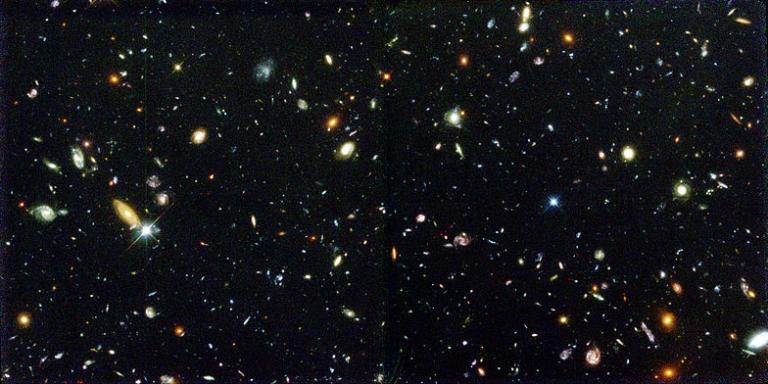
Hubble Deep Field. Public domain image.
Cosmological Confusion
Today, everyone who’s scientifically literate knows the universe began billions of years ago with the Big Bang. But this consensus didn’t always exist. It didn’t congeal until the 1970s, after the discovery of the cosmic microwave background radiation in 1964.
So in the 1960s and 70s, popular science books still treated the Big Bang as a hypothesis, alongside the Steady State theory. And as a precocious science nerd in the late 1970s reading all the astronomy books in the McCormick Elementary School library — books that may well have been ten or twenty years old, published in the 1960s or even 1950s — that was the impression I got: we still didn’t know if the universe had a beginning in a Big Bang, or had always been here in a Steady State.
Our currently accepted theories about the formation of the solar system and the moon are also rather different than those in my science books back then, which told of how the planets may have been formed when another star passed by the Sun and pulled material out of it, or the Moon formed from material torn loose from the Pacific basic when the early Earth was spinning much faster.
I bring these up to point out that our scientific knowledge of the world, far from being a rock of certainty, is a an ever-shifting interpolation of a limited set of data. That doesn’t means that we don’t have practical surety in some areas: the sun will come up tomorrow, objects will continue to be attracted to one another proportional (in most cases) to the product of their masses and inversely proportional to the square of the distance between them, we share an ancestor with other mammals, and carbon dioxide in the atmosphere traps heat. If anyone wants to bet against these propositions I will be happy to take your money. But on the big questions about cosmology, expect our best scientific ideas to keep changing change.
A current case in point is “dark energy”. In the 1990s, observations of Type Ia showed that, rather than slowing under the influence of gravity, the expansion of the universe is actually increasing. Scientists hypothesized that something called “dark energy” — estimated to make up 68% of the total energy of the universe — was driving the acceleration.
But in a paper recently published in the Monthly Notices of the Royal Astronomical Society, a team of researchers points out that the models that seem to call for the existence of dark energy pretend that the universe is smoothly expanding and homogeneous, while observations shows that our universe has a foam-like structure where matter (both normal and “dark” matter (another thing not in those 70s science books)) exists mostly in thin bubble walls with inconceivably vast and empty voids inside the bubbles.
A computer simulation of how gravity would affect such a structured universe shows an accelerating expansion, like the one we observe, without invoking dark energy.
And so what is currently thought to be 68% of the universe may suddenly disappear, if these calculations hold up. Science can indeed be destructive!

Next Post

April 8, 2017 "Beginning Anew" (Song, "52 Make-Up" Week 13)
Browse Our Archives
Select a Category 2017 52 Makeup 2020 52 Makeup Always Roaming With A Hungry Heart Art Because I Could Not Stop For Death Caught On Video COVID-19 Culture Discordianism Ethics, Virtue, and Right Living History Magic(k), Ritual, and Mysticism My Blogging Life and Times Philosophy Podcast Poetry Random Wednesdays Religion & Politics Seasonal Musings Techno-Pagan Theology Uncategorized Warrior Path Zen
Select a Month October 2026 September 2026 August 2026 March 2026 February 2026 January 2026 December 2025 March 2025 January 2025 December 2024 November 2024 September 2024 August 2024 June 2024 May 2024 April 2024 March 2024 February 2024 December 2023 September 2023 August 2023 July 2023 June 2023 May 2023 March 2023 February 2023 January 2023 December 2022 October 2022 September 2022 June 2022 April 2022 February 2022 January 2022 December 2021 November 2021 October 2021 September 2021 August 2021 July 2021 May 2021 April 2021 March 2021 February 2021 January 2021 December 2020 November 2020 October 2020 September 2020 August 2020 June 2020 May 2020 April 2020 March 2020 February 2020 January 2020 December 2019 November 2019 October 2019 September 2019 August 2019 July 2019 June 2019 May 2019 April 2019 March 2019 February 2019 January 2019 December 2018 November 2018 October 2018 September 2018 August 2018 July 2018 June 2018 May 2018 April 2018 March 2018 January 2018 December 2017 November 2017 October 2017 September 2017 August 2017 July 2017 June 2017 May 2017 April 2017 March 2017 February 2017 January 2017 December 2016 November 2016 October 2016 September 2016 August 2016 July 2016 June 2016 May 2016 April 2016 March 2016 February 2016 January 2016 December 2015 November 2015 October 2015 September 2015 August 2015 July 2015 June 2015
Follow Us!
TAKE THE
Religious Wisdom Quiz
What does Proverbs say about a soft answer?
Select your answer to see how you score.
It brings wealth It is useless It turns away wrath It starts a fight
Related posts from The Zen Pagan
Eclipse 2024: Ritual For A Reset

Yule: Holding Space For The Light

Travel, Renewal, and Ancestor Work
TRENDING AT PATHEOS Pagan

Jad Gillies on New Hillsong Worship Songs and...
For worship leader Jad Gillies, Hillsong Worship’s next chapter is not about...

Looking at the Largest Orthodox Cathedral on Earth
There is often a considerable amount of anger and, shall we...

The Problem with False Prophets
Miller’s Station UMC| 10/18/26| Anchor Verse: Jeremiah 23: 1, 9-23 I...

Emotion in Early Christianity by Andrew Crislip
Andrew Crislip’s Emotion in Early Christianity examines an often overlooked dimension of...

16 Spiritual Touchstones for a More Grounded Life
After decades of spiritual study, here are 16 principles I try...

Catholic Evangelization: Sharing Your Faith Every Day
Welcome back to the Graceful Awakening mini-series called, “From Faith to Mission.” ...
view all Pagan blogs
Ad-Free & Subscriber Log-In Subscription Support
- About Us
- 2026 Calendar
- Videos
- Podcasts
- Library of World Religions
- Faith In Media Tracker
- Advertise With Us
- Write for Us
- Privacy Policy
- Terms of Service
- Do Not Sell My Data
- Contact Us
- Radiant Digital
- Manage Newsletter Subscriptions
- Unsubscribe From Notifications
- Sitemap
Copyright 2008-2026, Patheos. All rights reserved.
Subscription Support Ad-Free & Subscriber Log-In
Follow Patheos