
BuddhistCatholicContemplativeEvangelicalGeneral ChristianHinduJewishLatter-day SaintMuslimNew VisionsProgressive Christian
Beliefs
- Buddhist
- Catholic
- Contemplative
- Evangelical
- General Christian
- Hindu
- Jewish
- Latter-day Saint
- More Voices
- Muslim
- New Visions
- Pagan
- Progressive Christian
Topics
- Religion News
- Food and Religion
- Sports and Religion
- Religious Art
- Religious Music and Entertainment
- Religious Events
- History and Religion
- Style and Religion
- Politics and Religion
- Women in Religion
- Recreation Outdoors and Religion
- Business Finance and Religion
- Careers Workplace and Religion
- Education and Religion
- Family Parenting and Religion
- Health Fitness and Religion
- Home and Religion
- Relationships and Religion
- Technology and Religion
- Travel and Religion
Columnists
- Buddhist Columnists
- Business Finance and Religion Columnists
- Careers Workplace and Religion Columnists
- Catholic Columnists
- Contemplative Columnists
- Education and Religion Columnists
- Evangelists Columnists
- Family Parenting and Religion Columnists
- General Christian Columnists
- Health Fitness and Religion Columnists
- Hindu Columnists
- History and Religion Columnists
- Home and Religion Columnists
- Jewish Columnists
- More Voices Columnists
- Latter Day Columnists
- Muslim Columnists
- New Visions Columnists
- Nonreligious Columnists
- Pagan Columnists
- Politics and Religion Columnists
- Progressive Columnists
- Recreation Outdoors and Religion Columnists
- Relationships and Religion Columnists
- Religion News Columnists
- Religious Art Columnists
- Religious Events Columnists
- Religious Music and Entertainment Columnists
- Sports and Religion Columnists
- Style and Religion Columnists
- Technology and Religion Columnists
- Travel and Religion Columnists
- Women in Religion Columnists
Resource Library
- 2026 Calendar
- Library of World Religions
- The 100 Most Holy Places on Earth
- Patheos Answers
- Podcasts
- Videos
- Faith Leaders Database
- Anglican Episcopalian
- Bahai
- Baptist
- Buddhism
- Christianity
- Confucianism
- Eastern Orthodoxy
- Hinduism
- Holiness and Pentecostal
- ISKCON
- Islam
- Judaism
- Lutheran
- Methodist
- The Church of Jesus Christ of Latter-day Saints
- New Age
- Paganism
- Presbytarian and Reformed
- Protestantism
- Religion Behind the Scenes
- Roman Catholic
- Scientology
- Shia Islam
- Sikhism
- Sufism
- Sunni Islam
- Taoism
- Zen
- See all religions
Research Tools
 Ad-Free & Subscriber Log-In Subscription Support
Ad-Free & Subscriber Log-In Subscription Support
Follow Patheos 

- Trending:
- Forgiveness
- |
- Marriage
- |
- Consciousness
- |
- Death Penalty
- |
- Election
- |
- Halloween

- Home
- Pagan
- The End of Experts or the End of Courtiers?
The End of Experts or the End of Courtiers?
Last updated on: December 29, 2016 at 10:56 am by Tom Swiss
The End of Experts or the End of Courtiers? 2016-12-29T10:56:14-04:00 Tom Swiss
Patheos Explore the world's faith through different perspectives on religion and spirituality! Patheos has the views of the prevalent religions and spiritualities of the world.
It has been the fashion among the pundit class for a while now to decry the death of expertise. The first rumblings go back almost a decade, but the complaints have accelerated in the past few years:
Blogs have become so dizzyingly infinite that they’ve undermined our sense of what is true and what is false, what is real and what is imaginary. These days, kids can’t tell the difference between credible news by objective professional journalists and what they read in joeshmoe.blogspot.com. For these Generation Y utopians, every posting is just another person’s version of the truth; every fiction is just another person’s version of the facts. — Andrew Keen, Silicon Valley entrepreneur and media critic, The Cult of the Amateur, 2007
There is no better example of the death of expertise than Jenny McCarthy. A television personality and ex-Playboy centerfold with zero medical training who nonetheless has become an autism expert, after her son was diagnosed with the malady. McCarthy—who was recently hired by ABC to co-host their daytime talk show “The View”—claims that vaccines trigger autism. Despite the fact that the central study promoting this view has been thoroughly discredited and the author stripped of his medical license, McCarthy has doubled down on her anti-vaccination claims and remains the celebrity ambassador to the vaccine-questioning autism organization Generation Rescue. According to a University of Michigan study, almost one-quarter of American parents put “some trust” in the medical advice given by celebrities like her. — Jessica Grose, writer and editor, “Please, Pinterest, Stop Telling Me How to Repurpose Mason Jars”, The New Republic, 2013
I fear we are witnessing the “death of expertise”: a Google-fueled, Wikipedia-based, blog-sodden collapse of any division between professionals and laymen, students and teachers, knowers and wonderers – in other words, between those of any achievement in an area and those with none at all. By this, I do not mean the death of actual expertise, the knowledge of specific things that sets some people apart from others in various areas. There will always be doctors, lawyers, engineers, and other specialists in various fields. Rather, what I fear has died is any acknowledgement of expertise as anything that should alter our thoughts or change the way we live. — Tom Nichols, professor of National Security Affairs at the U.S. Naval War College, “The Death Of Expertise”, The Federalist, 2014
Increasingly, expertise, and the role of “the expert” is losing the respect that for years had earned it premiums in any market where uncertainty was present and complex knowledge valued. Along with it, we are shedding our reverence for “expert evaluation,” resigning our regard for our Michelin guides and casting our lot with the peer-generated TripAdvisors and Yelps of the world. — Bill Fischer, professor of Innovation Management at IMD, “The End of Expertise”, Harvard Business Review, 2015
Now we cannot deny that there are some areas where Americans are rejecting the well-informed conclusions of experts in a problematic manner. The way that so many people believe in the debunked relationship between vaccination and autism is one example; climate change denialism is another.
But in many instances what is being rejected is not actually expert opinion but the opinion of courtiers.
I mean “courtiers” here in a sense generalized from PZ Myers use in “The Courtier’s Reply”. Myers coined the term to refer to a specific variety of ad hominem attack; in his original usage he likened Richard Dawkins’ book The God Delusion to the boy who revealed the Emperor’s nakedness in the fable, and compared critics who attacked Dawkins’ lack of credentials in theology to an imagined courtier denying the Emperor’s nakedness by appeal to haute couture:
I have considered the impudent accusations of Mr Dawkins with exasperation at his lack of serious scholarship. He has apparently not read the detailed discourses of Count Roderigo of Seville on the exquisite and exotic leathers of the Emperor’s boots, nor does he give a moment’s consideration to Bellini’s masterwork, On the Luminescence of the Emperor’s Feathered Hat. We have entire schools dedicated to writing learned treatises on the beauty of the Emperor’s raiment, and every major newspaper runs a section dedicated to imperial fashion; Dawkins cavalierly dismisses them all. He even laughs at the highly popular and most persuasive arguments of his fellow countryman, Lord D. T. Mawkscribbler, who famously pointed out that the Emperor would not wear common cotton, nor uncomfortable polyester, but must, I say must, wear undergarments of the finest silk.
Dawkins arrogantly ignores all these deep philosophical ponderings to crudely accuse the Emperor of nudity.
…
Until Dawkins has trained in the shops of Paris and Milan, until he has learned to tell the difference between a ruffled flounce and a puffy pantaloon, we should all pretend he has not spoken out against the Emperor’s taste.
— PZ Myers, The Courtier’s Reply”, Pharyngula, 24 Dec 2006
To expand on Myers’ metaphor, a courtier is one who possesses socially-recognized authority and peer-accepted knowledge, but that knowledge and authority is based on socio-political power structures rather than empirical reality.
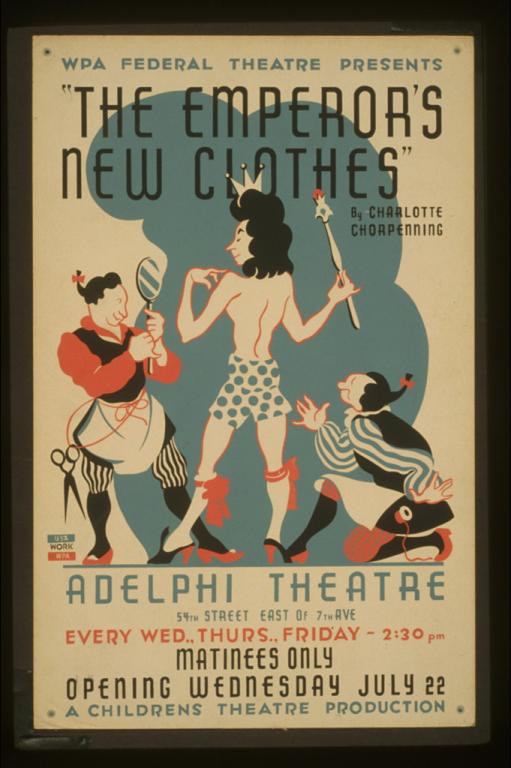
Public domain image via Wikimedia Commons
And we have been suffering a plague of courtiers for years.
They’ve been a problem in the academic humanities for decades. As John Brockman noted in 1991, “[T]he traditional American intellectuals are, in a sense, increasingly reactionary….Their culture, which dismisses science, is often nonempirical….It is chiefly characterized by comment on comments, the swelling spiral of commentary eventually reaching the point where the real world gets lost.”
Alan Sokal gave a definitive demonstration of the problem in 1996 when he submitted a paper of absolute gibberish, “Transgressing the Boundaries: Toward a Transformative Hermeneutics of Quantum Gravity”, to the journal Social Text. They fell for it hook, line and sinker.
Sokal later wrote, “The editors of Social Text liked my article because they liked its conclusion: that ‘the content and methodology of postmodern science provide powerful intellectual support for the progressive political project.’ They apparently felt no need to analyze the quality of the evidence, the cogency of the arguments, or even the relevance of the arguments to the purported conclusion.”
Unfortunately the problem has not gone away since Sokal’s hoax. Steven Pinker noted in 2013,
The humanities have yet to recover from the disaster of postmodernism, with its defiant obscurantism, dogmatic relativism, and suffocating political correctness. And they have failed to define a progressive agenda. Several university presidents and provosts have lamented to me that when a scientist comes into their office, it’s to announce some exciting new research opportunity and demand the resources to pursue it. When a humanities scholar drops by, it’s to plead for respect for the way things have always been done.
But if courtiers in the academic humanities are a problem, that’s only more true by an order of magnitude when they obtain political power.
Our aggressive and stupid foreign policy is a creation of courtiers, a product of a self-reinforcing orthodoxy untainted by facts or critical thinking. The same is true of our carceral state. It is courtiers, not experts in criminal justice, who tell us cops are justified when they shoot unarmed black men. It is courtiers, not experts in economics, who proclaim that the economy is doing fine despite the stagnation of real wages and the hollowing out of the middle class.
And certainly the election itself was a naked emperor moment for the Democrats and their allies in the mainstream media, who assured us of the certainty of a Clinton victory. Since then numerous stories have emerged of local party activists being ignored by the national Clinton campaign — the campaign’s experts were confident in their models and didn’t listen to empirical data coming in from the field.
They were as sure of their polling and their tactics as Myers’ courtier is of the feathers in the Emperor’s hat.
As the pundits tell us that the election of Trump (which is a horrible thing, don’t mistake me — but possibly in the long run the lesser of two horrors) marks a rejection of “expertise”, perhaps we all should consider what “experts” said about the likely outcome of the election, and think carefully about whether popular pundit wisdom might be as wrong in other areas.
If we can do that, then the end of “experts” might just lead to a rebirth of critical thinking.
You can keep up with “The Zen Pagan” by subscribing via RSS or e-mail.
What Does It Mean For The Gods To Exist? and other essays is now available as a free e-book! It collects my run on the Patheos Agora blog plus a few bonus pieces.
If you do Facebook, you might choose to join a group on “Zen Paganism” I’ve set up there. And don’t forget to “like” Patheos Pagan and/or The Zen Pagan over there, too.
Previous Post

December 21, 2016
Falling Down, Getting Up


Browse Our Archives
Select a Category 2017 52 Makeup 2020 52 Makeup Always Roaming With A Hungry Heart Art Because I Could Not Stop For Death Caught On Video COVID-19 Culture Discordianism Ethics, Virtue, and Right Living History Magic(k), Ritual, and Mysticism My Blogging Life and Times Philosophy Podcast Poetry Random Wednesdays Religion & Politics Seasonal Musings Techno-Pagan Theology Uncategorized Warrior Path Zen
Select a Month October 2026 September 2026 August 2026 March 2026 February 2026 January 2026 December 2025 March 2025 January 2025 December 2024 November 2024 September 2024 August 2024 June 2024 May 2024 April 2024 March 2024 February 2024 December 2023 September 2023 August 2023 July 2023 June 2023 May 2023 March 2023 February 2023 January 2023 December 2022 October 2022 September 2022 June 2022 April 2022 February 2022 January 2022 December 2021 November 2021 October 2021 September 2021 August 2021 July 2021 May 2021 April 2021 March 2021 February 2021 January 2021 December 2020 November 2020 October 2020 September 2020 August 2020 June 2020 May 2020 April 2020 March 2020 February 2020 January 2020 December 2019 November 2019 October 2019 September 2019 August 2019 July 2019 June 2019 May 2019 April 2019 March 2019 February 2019 January 2019 December 2018 November 2018 October 2018 September 2018 August 2018 July 2018 June 2018 May 2018 April 2018 March 2018 January 2018 December 2017 November 2017 October 2017 September 2017 August 2017 July 2017 June 2017 May 2017 April 2017 March 2017 February 2017 January 2017 December 2016 November 2016 October 2016 September 2016 August 2016 July 2016 June 2016 May 2016 April 2016 March 2016 February 2016 January 2016 December 2015 November 2015 October 2015 September 2015 August 2015 July 2015 June 2015
Follow Us!
TAKE THE
Religious Wisdom Quiz
What is the main theme of the Ten Commandments?
Select your answer to see how you score.
How to live and treat others How to earn your way to Heaven How to live in Jewish society How to be successful
Related posts from The Zen Pagan


Comfort The Dying; We're All Dying

Fixing the Mailbox: A Holiday Omen

Masculine Archetypes: Trickster at Samhain & Election Day
TRENDING AT PATHEOS Pagan

Emotion in Early Christianity by Andrew Crislip
Andrew Crislip’s Emotion in Early Christianity examines an often overlooked dimension of...

16 Spiritual Touchstones for a More Grounded Life
After decades of spiritual study, here are 16 principles I try...

Catholic Evangelization: Sharing Your Faith Every Day
Welcome back to the Graceful Awakening mini-series called, “From Faith to Mission.” ...

The Pillar of the Boatmen: the Ancient Monument...
The Pillar of the Boatmen is a Romano-Gaulish sculpture that dates from...

In one sense walking into Westminster Abbey is like walking down the...

'Super Scam Me' Exposes AI Jon Bon Jovi...
Leslie Pickett believed she was in a relationship with Jon Bon Jovi....
view all Pagan blogs
Ad-Free & Subscriber Log-In Subscription Support
- About Us
- 2026 Calendar
- Videos
- Podcasts
- Library of World Religions
- Faith In Media Tracker
- Advertise With Us
- Write for Us
- Privacy Policy
- Terms of Service
- Do Not Sell My Data
- Contact Us
- Radiant Digital
- Manage Newsletter Subscriptions
- Unsubscribe From Notifications
- Sitemap
Copyright 2008-2026, Patheos. All rights reserved.
Subscription Support Ad-Free & Subscriber Log-In
Follow Patheos