
BuddhistCatholicContemplativeEvangelicalGeneral ChristianHinduJewishLatter-day SaintMuslimNew VisionsProgressive Christian
Beliefs
- Buddhist
- Catholic
- Contemplative
- Evangelical
- General Christian
- Hindu
- Jewish
- Latter-day Saint
- More Voices
- Muslim
- New Visions
- Pagan
- Progressive Christian
Topics
- Religion News
- Food and Religion
- Sports and Religion
- Religious Art
- Religious Music and Entertainment
- Religious Events
- History and Religion
- Style and Religion
- Politics and Religion
- Women in Religion
- Recreation Outdoors and Religion
- Business Finance and Religion
- Careers Workplace and Religion
- Education and Religion
- Family Parenting and Religion
- Health Fitness and Religion
- Home and Religion
- Relationships and Religion
- Technology and Religion
- Travel and Religion
Columnists
- Buddhist Columnists
- Business Finance and Religion Columnists
- Careers Workplace and Religion Columnists
- Catholic Columnists
- Contemplative Columnists
- Education and Religion Columnists
- Evangelists Columnists
- Family Parenting and Religion Columnists
- General Christian Columnists
- Health Fitness and Religion Columnists
- Hindu Columnists
- History and Religion Columnists
- Home and Religion Columnists
- Jewish Columnists
- More Voices Columnists
- Latter Day Columnists
- Muslim Columnists
- New Visions Columnists
- Nonreligious Columnists
- Pagan Columnists
- Politics and Religion Columnists
- Progressive Columnists
- Recreation Outdoors and Religion Columnists
- Relationships and Religion Columnists
- Religion News Columnists
- Religious Art Columnists
- Religious Events Columnists
- Religious Music and Entertainment Columnists
- Sports and Religion Columnists
- Style and Religion Columnists
- Technology and Religion Columnists
- Travel and Religion Columnists
- Women in Religion Columnists
Resource Library
- 2026 Calendar
- Library of World Religions
- The 100 Most Holy Places on Earth
- Patheos Answers
- Podcasts
- Videos
- Faith Leaders Database
- Anglican Episcopalian
- Bahai
- Baptist
- Buddhism
- Christianity
- Confucianism
- Eastern Orthodoxy
- Hinduism
- Holiness and Pentecostal
- ISKCON
- Islam
- Judaism
- Lutheran
- Methodist
- The Church of Jesus Christ of Latter-day Saints
- New Age
- Paganism
- Presbytarian and Reformed
- Protestantism
- Religion Behind the Scenes
- Roman Catholic
- Scientology
- Shia Islam
- Sikhism
- Sufism
- Sunni Islam
- Taoism
- Zen
- See all religions
Research Tools
 Ad-Free & Subscriber Log-In Subscription Support
Ad-Free & Subscriber Log-In Subscription Support
Follow Patheos 

- Trending:
- Forgiveness
- |
- Marriage
- |
- Consciousness
- |
- Death Penalty
- |
- Election
- |
- Halloween

- Home
- Pagan
- Religious Liberty: Something Pastafarians and Evangelicals Both Deserve
Religious Liberty: Something Pastafarians and Evangelicals Both Deserve
Last updated on: May 10, 2016 at 11:16 am by Tom Swiss
Religious Liberty: Something Pastafarians and Evangelicals Both Deserve 2016-05-10T11:16:26-04:00 Tom Swiss
Patheos Explore the world's faith through different perspectives on religion and spirituality! Patheos has the views of the prevalent religions and spiritualities of the world.
Consider this: the United States is a nation with a secular constitution that guarantees religious freedom, while New Zealand’s head of state is legally required to be a Protestant Christian. Yet a U.S. federal District Court in the United States recently ruled, in Cavanaugh v. Bartelt, that Pastafarianism is not a real religion entitled to legal protection, while New Zealand just saw its first wedding performed by a legally recognized Pastafarian officiant. Mysterious indeed are the ways of the world.
As a Genuine and Authorized Discordian Pope (Hail Eris!) and a dues-paying SubGenius awaiting the pleasure saucers from Planet X to rapture me off this rock, I’m always on the lookout for holy ridiculousness. So I was an early evangelist for the word of the Flying Spaghetti Monster, blogging about Bobby Henderson’s original letter to the Kansas State Board of Education in September 2005, just a few months after it was first made public and well before the publication of the book The Gospel of the Flying Spaghetti Monster.
And while Henderson’s original intent was clearly satirical, I was not surprised when some people started to treat Pastafarianism as something more than a joke.
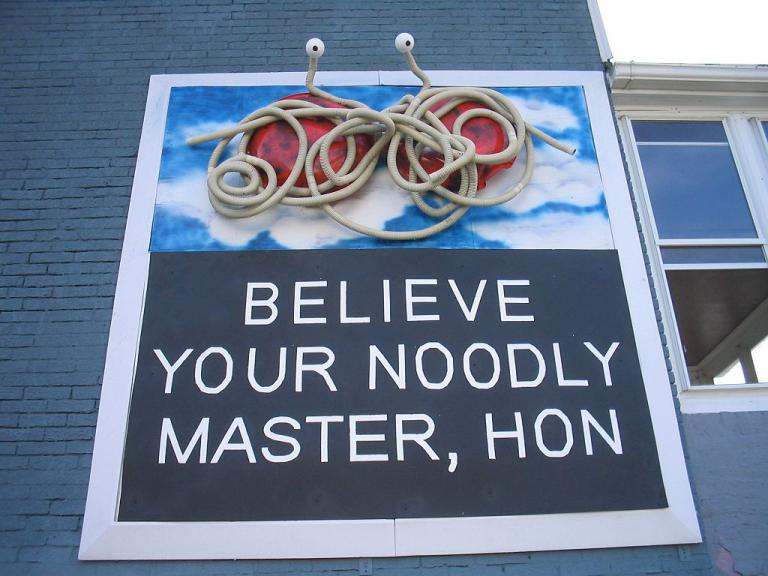
A public outdoor shrine to the FSM in Hampden, Baltimore, incorporates a local political slogan (“Believe”) and a bit of dialect important to local identity (“hon”). Photo by Gavin St. Ours via Wikimedia Commons

Decades ago, the culture of computer hackers identified the idea of “ha ha only serious”. As the Jargon File puts it, the term applies “to parodies, absurdities, and ironic jokes that are both intended and perceived to contain a possibly disquieting amount of truth, or truths that are constructed on in-joke and self-parody.” Or as Gregory Hall put it in the Principia Discordia through his alter ego Malaclypse the Younger,
GREATER POOP: Are you really serious or what?
MAL-2: Sometimes I take humor seriously. Sometimes I take seriousness humorously. Either way it is irrelevant.
Discordianism began as a joke — a somewhat juvenile one at that, if you look through the first edition of the Principia. But I will state for the record that I have had Discordian experiences that are as genuine as anyone’s mystical epiphanies. Eris herself has walked next to me and whispered in my ear a revelation about the myth of the Golden Apple. I have felt her comforting presence on more than one occasion as I watched some supposed “order” that I thought was stable dissolve.
I don’t claim to be a prophet but I tell you this: I have had more direct religious experience of Eris as a Discordian than I had of Jesus during my childhood Catholicism, a faith which I took quite seriously. (I’m feeling much better now.)
I haven’t (yet?) had as deep an experience with the word of “Bob”, but I’ve met the founder of the Church of the SubGenius, Ivan Stang. He’s a Starwood regular, and the SubGenius “X Day” is the weekend before Starwood at the same campground, so several times I’ve gone out early and waited for the flying saucers. (No luck yet.)
There’s no doubt that that Church started entirely as satire, yet in these strange gatherings I’ve seen traces of genuine spirituality, people investigating their relationship to themselves and to the universe. The very act of finding other people who are weird in the same way you are, of finding others who look at “reality” from an angle similar to yours, is fundamental to building spiritual community. I remember one fire-side conversation — after we’d burned “Bob” in effigy for failing us once again — where Reverend Stang reflected on how his joke had, in some sense, turned real, had created a community where people supported each other in their pursuit of sacred creativity and weirdness.
And Reverand Stang isn’t the only founder of an interesting Church I’ve met through Starwood; I’ve also had the chance to hang out with Oberon Zell-Ravenheart, founder of the science-fiction inspired Church of All Worlds. So it’s notable that District Judge John Gerrard found in Cavanaugh v. Bartelt that “[a] prisoner could just as easily read the works of Vonnegut or Heinlein and claim it as his holy book, and demand accommodation of Bokononism or the Church of All Worlds.” Gerrard does recognize the existence of CAW in a footnote: “Not that such a thing would be impossible: Heinlein’s fictional church, at least, inspired foundation of a pagan church of the same name…. But Cavanaugh does not allege allegiance to any comparable organization—he simply relies on the FSM Gospel, taken at face value.”
But let us imagine that our friend Oberon, or one of his co-conspirators in the early days of CAW before it was legally formalized, had landed in jail over some dispute or misunderstanding with the state, and demanded recognition of his or her religious conscience with no documentation beyond Heinlein’s novel. It is indefensible to claim that a person’s religious liberty is dependent on the existence of an organization claiming the same faith or ideas. Religion, the fundamental matter of reconnecting with the universe, is not multiple choice between extant organizations. It is an essay question which we all answer differently. Some answers may fall into well-divided categories but some will be unique. And some of those unique ones will eventually attract others to answer in the same fashion. The first American Buddhists, for example, could rely only on the texts of sutras, not on any organization with American presence.
The point here is that the measure of a religious practice is not its origins or any associated organizations, but its results. A joke religion can lead people to genuine experiences of the ineffable. So can a religion started as a con — see Scientology and Mormonism. (Determining what other historical religions might fit this category is left as an exercise for the reader.) So can a religion founded on mistaken anthropology — see Gardnerian Wicca. Of course we must be free as individual citizens to debate and criticize these beliefs and practices, but the state must respect the basic religious conscience of all persons, no matter the origins or contents of their beliefs.
In 1919 Harlan Fiske Stone, who would later become Chief Justice of the Supreme Court, wrote:
“[B]oth morals and sound policy require that the state should not violate the conscience of the individual. All our history gives confirmation to the view that liberty of conscience has a moral and social value which makes it worthy of preservation at the hands of the state. So deep in its significance and vital, indeed, is it to the integrity of man’s moral and spiritual nature that nothing short of the self-preservation of the state should warrant its violation; and it may well be questioned whether the state which preserves its life by a settled policy of violation of the conscience of the individual will not in fact ultimately lose it by the process.” [*]
[* Stone, The Conscientious Objector, 21 Col.Univ.Q. 253, 269 (1919), quoted in United States v. Seeger, 380 U.S. 163 (1965)]
The hard part is that this obligation and protection includes religious ideas that are not just silly but stupid and nasty, such as homophobia, sexism, and racism.
Civil libertarianism has always meant standing up for unpopular ideas. A march for motherhood, apple pie, and puppies is unlikely to encounter opposition, so the controversy is always over ideas that are not widely accepted, either bad ones or ones ahead of their time. To defend free expression and the freedom of conscience is never easy.
But it seems to have become even more unfashionable of late, with many on the left willing to adopt “politically correct” authoritarian means of pushing their idea of “progress”, from official censorship to mob shutdown; while many on the right are happy to have the state push Christian “family values” and generally whip into shape anyone who doesn’t love the flag and Jesus.

Not my flag, but I’ll support your right to fly it. From the catalog of freak-flag.net
Now, basic concern for others and a reluctance to use state force against them ought to be enough to make us respect the basic liberties of others, even people who are wrong. But there’s also a very good self-centered practical reason: when we protect the rights of others, we protect our own.
We give the Devil himself the benefit of the law so that the same protection cannot be taken from us. The reason we let, for example, the KKK speak their horrible, horrible ides and march in the streets is not just because we find a spark of compassion even for morons that keeps us from sending in club-wielding police to stop them. It’s also because in preventing the state from interfering with the rights of idiots we also restrain it from interfering with the rights of moral leaders and true reformers.
You may have seen a recent story about the Pagan Federation Ireland’s response to a self-described “Odinist” who was searching for a wedding officiant who only performed heterosexual same-race marriages, and you may have cheered (as I did) their response telling that jerk “Fuck off” (their actual words). But the legal right of Pagan clergy to pick those for whom they will preform ritual cannot be separated from the rights of racists, homophobes, and other dingbats to refuse to attend or participate in a same-sex ceremony.
Of course one person’s religious liberty ends where another person’s fundamental rights begin. Your religious liberty does not extend to choosing me as an involuntary human sacrifice to your chosen deity.
And if we are going to use the state to create a system of private property and wage slavery, part of the ante for that game is some protection for everyone in housing, employment, access to places of public accommodation, and other economic fundamentals. When you call the police to evict problematic tenants, intimidate insubordinate employees, eject unwelcome patrons, or patrol your rest rooms for gender “correctness” the burden is on you to justify that initiation of force. “My holy book says such-and-such” is not sufficient.
But a curious idea that has taken hold among some authoritarian progressives the past few years that those basic rights include having the photographer or baker of one’s choice provide services to one’s rituals. Some seem to believe that the state should actively force social acceptance on people with threats of fines or jail time.
That joke religion Discordianism has an important teaching that’s relevant here: the Law of Eristic Escalation. As Discordian Society co-founder Kerry Thornley explained:
Eristic Avatars are sent down into Reality, the original Rorschach, for the purpose keeping things from becoming so well ordered that they stop working. This they often accomplish by insisting that certain arbitrary interpretations of reality are the only valid ones. That causes Strife which results in Confusion which revitalizes Holy Chaos….
That is made possible by the Law of Eristic Escalation…
This Law pertains to any arbitrary or coercive imposition of order. It is: Imposition of Order = Escalation of Chaos.
Fenderson’s Amendment adds that the tighter the order in question is maintained, the longer the consequent chaos takes to escalate, BUT the more it does when it does!
Armed with the Law of Eristic Escalation and Fenderson’s Amendment any imbecile – not just a sociologist – can understand politics.
So I will translate into the lingua franca of the Western world: An imposition of order creates a chaos deficit, which compounds until it is paid off (by enduring all the outstanding chaos).[*]
[* Thornley, Kerry. Introduction, Principia Discordia, Fifth edition. IllumiNet Press, 1991.]
The law of Eristic Escalation does not discriminate as to what sort of order is imposed; imposing a “good” order results in an escalation of disorder just as surely as imposing a “bad” order.
A culture of acceptance and justice must grow naturally in its own time. You don’t make the grass grow by pulling on it. (Though you can still water it, fertilize it, and do what can be done to create circumstances conducive to growth.) Just so, you don’t make human beings more tolerant of diversity through lawsuits. If anything, a heavy hand causes resentment and resistance that slows the progress toward justice.
And if that lesson in wisdom is found in a satirical religion invented in a bowling alley by beer-drunk kids just out of high school, who knows what noodley truths the Flying Spaghetti Monster may grace us with in time?
You can keep up with “The Zen Pagan” by subscribing via RSS or e-mail.
Detail TBD, but I’ll be at the Free Spirit Gathering this June, and the Starwood Festival this July.
If you do Facebook, you might choose to join a group on “Zen Paganism” I’ve set up there. And don’t forget to “like” Patheos Pagan and/or The Zen Pagan over there, too.
Ethics, Virtue, and Right Living
Previous Post

May 4, 2016
What Would Luke Skywalker Do?
Next Post

May 17, 2016 When the Land Changes
Browse Our Archives
Select a Category 2017 52 Makeup 2020 52 Makeup Always Roaming With A Hungry Heart Art Because I Could Not Stop For Death Caught On Video COVID-19 Culture Discordianism Ethics, Virtue, and Right Living History Magic(k), Ritual, and Mysticism My Blogging Life and Times Philosophy Podcast Poetry Random Wednesdays Religion & Politics Seasonal Musings Techno-Pagan Theology Uncategorized Warrior Path Zen
Select a Month October 2026 September 2026 August 2026 March 2026 February 2026 January 2026 December 2025 March 2025 January 2025 December 2024 November 2024 September 2024 August 2024 June 2024 May 2024 April 2024 March 2024 February 2024 December 2023 September 2023 August 2023 July 2023 June 2023 May 2023 March 2023 February 2023 January 2023 December 2022 October 2022 September 2022 June 2022 April 2022 February 2022 January 2022 December 2021 November 2021 October 2021 September 2021 August 2021 July 2021 May 2021 April 2021 March 2021 February 2021 January 2021 December 2020 November 2020 October 2020 September 2020 August 2020 June 2020 May 2020 April 2020 March 2020 February 2020 January 2020 December 2019 November 2019 October 2019 September 2019 August 2019 July 2019 June 2019 May 2019 April 2019 March 2019 February 2019 January 2019 December 2018 November 2018 October 2018 September 2018 August 2018 July 2018 June 2018 May 2018 April 2018 March 2018 January 2018 December 2017 November 2017 October 2017 September 2017 August 2017 July 2017 June 2017 May 2017 April 2017 March 2017 February 2017 January 2017 December 2016 November 2016 October 2016 September 2016 August 2016 July 2016 June 2016 May 2016 April 2016 March 2016 February 2016 January 2016 December 2015 November 2015 October 2015 September 2015 August 2015 July 2015 June 2015
Follow Us!
TAKE THE
Religious Wisdom Quiz
Who taught, "Love your enemies and pray for those who persecute you"?
Select your answer to see how you score.
James Paul Jesus John
Related posts from The Zen Pagan

Chess Grifters, Chinese Rooms, and AI


Comfort The Dying; We're All Dying

Fixing the Mailbox: A Holiday Omen
TRENDING AT PATHEOS Pagan

Emotion in Early Christianity by Andrew Crislip
Andrew Crislip’s Emotion in Early Christianity examines an often overlooked dimension of...

16 Spiritual Touchstones for a More Grounded Life
After decades of spiritual study, here are 16 principles I try...

Catholic Evangelization: Sharing Your Faith Every Day
Welcome back to the Graceful Awakening mini-series called, “From Faith to Mission.” ...

The Pillar of the Boatmen: the Ancient Monument...
The Pillar of the Boatmen is a Romano-Gaulish sculpture that dates from...

In one sense walking into Westminster Abbey is like walking down the...

'Super Scam Me' Exposes AI Jon Bon Jovi...
Leslie Pickett believed she was in a relationship with Jon Bon Jovi....
view all Pagan blogs
Ad-Free & Subscriber Log-In Subscription Support
- About Us
- 2026 Calendar
- Videos
- Podcasts
- Library of World Religions
- Faith In Media Tracker
- Advertise With Us
- Write for Us
- Privacy Policy
- Terms of Service
- Do Not Sell My Data
- Contact Us
- Radiant Digital
- Manage Newsletter Subscriptions
- Unsubscribe From Notifications
- Sitemap
Copyright 2008-2026, Patheos. All rights reserved.
Subscription Support Ad-Free & Subscriber Log-In
Follow Patheos