
BuddhistCatholicContemplativeEvangelicalGeneral ChristianHinduJewishLatter-day SaintMuslimNew VisionsProgressive Christian
Beliefs
- Buddhist
- Catholic
- Contemplative
- Evangelical
- General Christian
- Hindu
- Jewish
- Latter-day Saint
- More Voices
- Muslim
- New Visions
- Pagan
- Progressive Christian
Topics
- Religion News
- Food and Religion
- Sports and Religion
- Religious Art
- Religious Music and Entertainment
- Religious Events
- History and Religion
- Style and Religion
- Politics and Religion
- Women in Religion
- Recreation Outdoors and Religion
- Business Finance and Religion
- Careers Workplace and Religion
- Education and Religion
- Family Parenting and Religion
- Health Fitness and Religion
- Home and Religion
- Relationships and Religion
- Technology and Religion
- Travel and Religion
Columnists
- Buddhist Columnists
- Business Finance and Religion Columnists
- Careers Workplace and Religion Columnists
- Catholic Columnists
- Contemplative Columnists
- Education and Religion Columnists
- Evangelists Columnists
- Family Parenting and Religion Columnists
- General Christian Columnists
- Health Fitness and Religion Columnists
- Hindu Columnists
- History and Religion Columnists
- Home and Religion Columnists
- Jewish Columnists
- More Voices Columnists
- Latter Day Columnists
- Muslim Columnists
- New Visions Columnists
- Nonreligious Columnists
- Pagan Columnists
- Politics and Religion Columnists
- Progressive Columnists
- Recreation Outdoors and Religion Columnists
- Relationships and Religion Columnists
- Religion News Columnists
- Religious Art Columnists
- Religious Events Columnists
- Religious Music and Entertainment Columnists
- Sports and Religion Columnists
- Style and Religion Columnists
- Technology and Religion Columnists
- Travel and Religion Columnists
- Women in Religion Columnists
Resource Library
- 2026 Calendar
- Library of World Religions
- The 100 Most Holy Places on Earth
- Patheos Answers
- Podcasts
- Videos
- Faith Leaders Database
- Anglican Episcopalian
- Bahai
- Baptist
- Buddhism
- Christianity
- Confucianism
- Eastern Orthodoxy
- Hinduism
- Holiness and Pentecostal
- ISKCON
- Islam
- Judaism
- Lutheran
- Methodist
- The Church of Jesus Christ of Latter-day Saints
- New Age
- Paganism
- Presbytarian and Reformed
- Protestantism
- Religion Behind the Scenes
- Roman Catholic
- Scientology
- Shia Islam
- Sikhism
- Sufism
- Sunni Islam
- Taoism
- Zen
- See all religions
Research Tools
 Ad-Free & Subscriber Log-In Subscription Support
Ad-Free & Subscriber Log-In Subscription Support
Follow Patheos 

- Trending:
- Forgiveness
- |
- Marriage
- |
- Consciousness
- |
- Death Penalty
- |
- Election
- |
- Halloween

- Home
- Pagan
- In Praise of the Circular Argument
In Praise of the Circular Argument
Last updated on: December 6, 2015 at 11:39 pm by Tom Swiss
In Praise of the Circular Argument 2015-12-06T23:39:00-04:00 Tom Swiss
Patheos Explore the world's faith through different perspectives on religion and spirituality! Patheos has the views of the prevalent religions and spiritualities of the world.
I. An except from a debate between an idealist and a materialist:
Materialist: …And so, my friend, if we are not to be stuck in a dead end of some sort of non-falsifiable solipsism, if we accept the axiom that some sort of external world more or less matching our perceptions exists, if we make the unprovable but very useful assumption that I’m not a butterfly dreaming I’m a man, then according to the best evidence we have about that external world, ideas correlate with things that happen in brains, yes? The mental supervenes on the neurological. Yes, we’re still figuring out exactly how, but we know that we can cause mental events (or, to be more precise, the reporting of mental events) by stimulating the brain, and we can observe how brain activity correlates with mental events (or the reporting thereof).
Idealist: Well…
Materialist: And brains are biology! They are living tissue, which can be studied by the methods of anatomy and physiology, of the various disciplines of biology. And biology, in the end, supervenes on chemistry. Not that we understand all the details, but the idea of some élan vital can surely no longer be taken seriously. Biological phenomenon are the very complex interactions of proteins, nucleic acids, fats, various ions in solution, carbohydrates, and the like. Right?
Idealist: Okay, I’ll give you that one. In order to affect the physical bodies of living organisms an élan vital would have to be a form of physical energy anyway, so it’s really no points against my side.
Materialist: And chemistry is just applied physics — again, not to say that we understand it all or ever will, but we can assert confidently that all chemical phenomena have a basis in atomic physics. And the phenomena of atomic physics have basis in particle physics. All of the “ideas” that you say are the ultimate constituents of reality are nothing more than the very complex interactions of the particles and fields of the Standard Model of physics! And that model is well backed up by empirical data.
Idealist: Well, maybe that’s true from a certain point of view. But what did you just say these particles and fields are part of?
Materialist: The Standard Model. Our best understanding of fundamental physics. Yes, there are still gaps, but we’ve got a pretty solid outline.
Idealist: Oh, that’s fine, since our data is always finite I’ll allow your side some gaps. It’s that “model” part that’s interesting.
Materialist: How do you mean?
Idealist: Let’s start with this question: can you point at one of these “particles”? Directly, I mean, not as a track in a particle detector? Can you perceive one of them as part of your direct experience?
Materialist: Well, no, but…
Idealist: So as much as you talk about empiricism, these particles are not part of your empirical experience? There is a good deal of theorizing that connects your sensory perceptions with this supposed evidence?
Materialist: Yes, but am I supposed to ignore the reports of others? And the information we can gain from inductive and deductive reasoning?
Idealist: No, but it’s worth noting. Let me come back to that in a minute. Now, it’s the Standard Model that links that perceivable track in the detector with the positron or muon or alpha particle, right? That is, among various models, the Standard Model gives us the best available explanation of the size and shape and position and whatever of that track?
Materialist: True enough.
Idealist: And what is a model? In this scientific sense, I mean, obviously we’re not talking about model trains.
Materialist: Well, the Standard Model is a mathematical model. It’s a way of describing a system using mathematics.
Idealist: Of describing a system? To other physicists?
Materialist: Sure.
Idealist: So this standard model is a way for physicists to talk to other physicists, using a common language — mathematics. Right?
Materialist: Yeah, that’s a fair way to put it.
Idealist: And language, you must surely admit, is a sociological phenomenon.
Materialist: I don’t quite follow you.
Idealist: Language is not a given. And one person can’t invent it, right? If you dropped a newborn baby on a desert island along with a machine that saw to all of its physical needs but never spoke, that baby would not grow up to speak any language. Language is learned, on an individual level, and develops, over a long period of time, on a societal level. You can’t have a language without having some sort of society.
Materialist: Okay.
Idealist: So anything we can use language to talk about or write about, any linguistic phenomenon, is a social phenomenon.
Materialist: Well…
Idealist: And, to get back to an earlier point, inductive and deductive reasoning are also social phenomena.
Materialist: What?
Idealist: Were you born with the ability to perform inductive and deductive reasoning? That baby on a desert island wouldn’t be able to reason, right?
Materialist: I suppose not.
Idealist: So the making of mathematical models, and logical reasoning, are social phenomena. And the agreement that the Standard Model is the best model, that process of peer review and scientific consensus, is a social phenomena. And social phenomena are nothing but psychological phenomena acting en masse. You don’t have human societies without having individual thinking humans — in other words, humans with ideas! The “Standard Model particles” that you say are the ultimate constituents of reality, as well as the patterns of reasoning that you say lead to it, are nothing more than ideas!
Materialist: Well, maybe that’s true from a certain point of view. But where are these ideas?
Idealist: Hmm?
Materialist: Can you point at an idea? Can you observe an idea? Outside of your own subjective experience, I mean.
Idealist: Of course not. But…
Materialist: And if you’re only going to allow your own subjective experience, you can’t rule out being a brain in a vat, or Chuang Tzu’s butterfly dreaming he’s a man. But those sort of ideas are inherently non-falsifiable. There’s maybe a certain aesthetic pleasure in considering them, but if we want arrive at useful conclusions about the nature of the world, “Maybe we all live in the Matrix!” or “Maybe I’m the only real person and I’ve been living my life in some sort of massively multiplayer online role-playing game!” is a dead end.
Idealist: Sure.
(As the musicians say, Da Capo — back to the start.)
II. Circles Big and Small
When we say something is a circular argument, we usually mean that it assumes its conclusions and chases its own tail so tightly that nothing can be inferred from it. For example: the Bible is literally and completely true; we know this because it’s the Word Of God; we know this because the Bible tells us that it is the Word of God; and we know we can rely on the Bible’s statement that it is the divine word because the Bible is literally and completely and true.
I don’t mean to imply that all Christians believe this, by the way — I was raised Catholic and we were never taught Biblical literalsm. (Heck, it was a Catholic astronomer who proposed the “Big Bang” theory.) But this sort of belief in the literal infallibility of some scripture or another is a distressingly common argument.
Now this Biblical argument makes a small circle, one that encompasses nothing but the Bible and that part of the mythology of Christianity that it contains. Can we derive any propositions about biology from it? No. Anything about sociology, linguistics, physics? No. It does not give us any data that we can compare with our experience.
On the other hand — and here I freely admit that I am stepping out into thin air with no support, and may even be leaving philosophy being and falling into poetry — what if we could make a circular argument large enough to encompass our entire experience of the world?
Reductionism is an ancient idea, dating back at least to the ancient Greek philosophers who proposed that everything is made of atoms. (Their idea of atoms was rather different than our modern physical/chemical one — an “a-tom” is something that cannot (a-) be cut or divided (-tom), so the quarks and leptons and gauge particles of modern physics are closer to being “atomic” in the original sense than is an atom of hydrogen or uranium.) In this atomic view there is one level of absolute and true reality, and everything else is a mere epiphenomenon, a handy way of talking about a bunch of atomic interactions at once.
This idea was one of many for those old Greeks, but it really took hold during the Enlightenment up until to the early 20th century and worked quite well. We were able to use this strategy to make predictions about the observed world, and use that predictive knowledge to manipulate the physical world to give us the steam engine, electric power, antibiotics, space probes, and the like. As Uncle Walt put it, “Hurrah for positive science! Long live exact demonstration!”
But then we started to bump up against some fundamental questions about physics and the nature of observation.
Now I want to be clear that I’m not invoking any quantum woo or “consciousness causes collapse” hand-waving. But as we got to looking at smaller and smaller phenomena, we could no longer gloss over the fact that the way we receive and process information about those particles interacting “out there” was via a chain of the same sort of interactions as the one we were looking at.
In other words, when my high school physics teacher demonstrated the conservation of energy with a bowling ball pendulum swinging at my head (true story, we were inspired by a scene in Carl Sagan’s novel Contact), the way in which we observed that was via photons interacting with the ball and with my head and with the eyes of the class, a phenomenon on a scale so much finer than the swinging weight that it was lost in the noise and could be ignored for all practical purposes. But when we set out to observe the decay of a muon in a particle accelerator, our observation relies on phenomena of the same order as that which we are setting out to observe.
And so we run into fundamental questions of epistemology. What does it mean to observe something? What right do we have to make statements about things we observed in the past but are not observing now, or about things that common sense or physical theory say should be the case but we haven’t observed directly? It turns out that the intuitions about these matters with which natural selection programmed the brains of our distant primate ancestors, the intuitions that kept them from getting eaten and allowed them to survive long enough to breed and thus become ancestors, aren’t necessarily of great use when doing particle physics. (Or cosmology, as Einstein showed us.)
So physics starts to shade off into philosophy, into the realm of ideas.
But over the past century or so, we’ve also come to have some meager understanding of the workings of the brain, of the palace of ideas.
We can trace idealism also back to those old Greeks, to silly old Plato and his buddies who would be shocked at what we’ve figured out about the brain.
Much, indeed most, is still hidden and obscure, but we have some ideas about the electrochemical operation of axons and synapses. We’ve reached inside the skull and tickled parts of the brain and had it report of the experiences thereby produced. It’s clear that mental events supervene on physical phenomenon of the brain.
The physicalist has had to come to some accommodation with the world of ideas — while at the same time the idealist has had to make some peace with the fact that the mental supervenes on the physical.
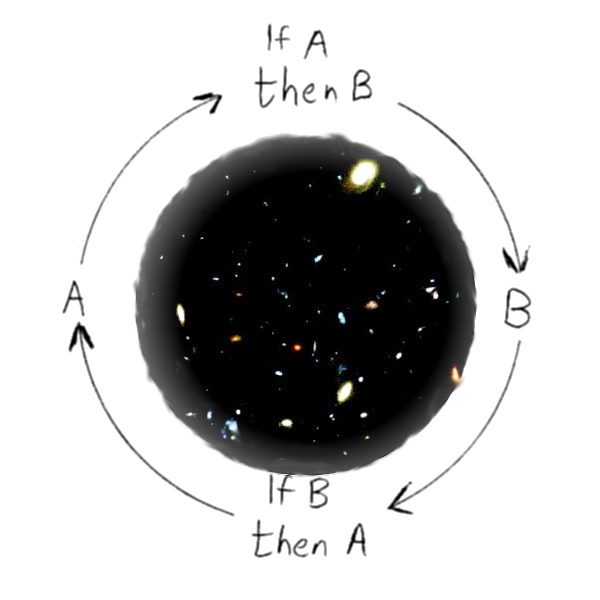
Students of the history of philosophy — of “philosophology”, to use Robert Pirsig’s word — may object that in my fictitious dialog above I’ve bent both materialism and idealism. And perhaps I have; one must bend determinedly parallel lines of inquiry in order to make them meet. (At least, if one accepts the axioms of Euclid.) But if we do bend them — and I think they are ductile enough to take it — we arrive at a remarkable sort of circular argument. Unlike the Biblical argument mentioned about, or similar circles of small circumference, this circular argument is large enough to encompass the entirety of human experience.
But the idea of two opposite but complementary principles, each dependent on the other and together encompassing the whole of reality, is not a new one. It’s another example of the principles the ancient Taoists called yin and yang: opposing, mutually interdependent, supporting each other, transforming into each other at the extremes, and infinitely divisible.
If we take these two ancient streams of thought, idealism and physicalist reductionism, ideas that go back to the Greeks and the roots of Western culture; and put them into a framework of yin and yang from the roots of Eastern culture…maybe we can find an idea big enough to encompass the universe.
You can keep up with “The Zen Pagan” by subscribing via RSS or e-mail.
Have I mentioned my book lately? Why Buddha Touched the Earth makes a great Yule gift for the Zen Pagan on your list.
If you do Facebook, you might choose to join a group on “Zen Paganism” I’ve set up there. And don’t forget to “like” Patheos Pagan and/or The Zen Pagan over there, too.
Previous Post

November 23, 2015
Giving Credit
Next Post

December 13, 2015 Death and the Holidays
Browse Our Archives
Select a Category 2017 52 Makeup 2020 52 Makeup Always Roaming With A Hungry Heart Art Because I Could Not Stop For Death Caught On Video COVID-19 Culture Discordianism Ethics, Virtue, and Right Living History Magic(k), Ritual, and Mysticism My Blogging Life and Times Philosophy Podcast Poetry Random Wednesdays Religion & Politics Seasonal Musings Techno-Pagan Theology Uncategorized Warrior Path Zen
Select a Month October 2026 September 2026 August 2026 March 2026 February 2026 January 2026 December 2025 March 2025 January 2025 December 2024 November 2024 September 2024 August 2024 June 2024 May 2024 April 2024 March 2024 February 2024 December 2023 September 2023 August 2023 July 2023 June 2023 May 2023 March 2023 February 2023 January 2023 December 2022 October 2022 September 2022 June 2022 April 2022 February 2022 January 2022 December 2021 November 2021 October 2021 September 2021 August 2021 July 2021 May 2021 April 2021 March 2021 February 2021 January 2021 December 2020 November 2020 October 2020 September 2020 August 2020 June 2020 May 2020 April 2020 March 2020 February 2020 January 2020 December 2019 November 2019 October 2019 September 2019 August 2019 July 2019 June 2019 May 2019 April 2019 March 2019 February 2019 January 2019 December 2018 November 2018 October 2018 September 2018 August 2018 July 2018 June 2018 May 2018 April 2018 March 2018 January 2018 December 2017 November 2017 October 2017 September 2017 August 2017 July 2017 June 2017 May 2017 April 2017 March 2017 February 2017 January 2017 December 2016 November 2016 October 2016 September 2016 August 2016 July 2016 June 2016 May 2016 April 2016 March 2016 February 2016 January 2016 December 2015 November 2015 October 2015 September 2015 August 2015 July 2015 June 2015
Follow Us!
TAKE THE
Religious Wisdom Quiz
What was Ezra's profession?
Select your answer to see how you score.
Priest Scribe Soldier Farmer
Related posts from The Zen Pagan

Chess Grifters, Chinese Rooms, and AI


The Serenity of Shikata Ga Nai

TRENDING AT PATHEOS Pagan

The Problem with False Prophets
Miller’s Station UMC| 10/18/26| Anchor Verse: Jeremiah 23: 1, 9-23 I...

Emotion in Early Christianity by Andrew Crislip
Andrew Crislip’s Emotion in Early Christianity examines an often overlooked dimension of...

16 Spiritual Touchstones for a More Grounded Life
After decades of spiritual study, here are 16 principles I try...

Catholic Evangelization: Sharing Your Faith Every Day
Welcome back to the Graceful Awakening mini-series called, “From Faith to Mission.” ...

The Pillar of the Boatmen: the Ancient Monument...
The Pillar of the Boatmen is a Romano-Gaulish sculpture that dates from...

In one sense walking into Westminster Abbey is like walking down the...
view all Pagan blogs
Ad-Free & Subscriber Log-In Subscription Support
- About Us
- 2026 Calendar
- Videos
- Podcasts
- Library of World Religions
- Faith In Media Tracker
- Advertise With Us
- Write for Us
- Privacy Policy
- Terms of Service
- Do Not Sell My Data
- Contact Us
- Radiant Digital
- Manage Newsletter Subscriptions
- Unsubscribe From Notifications
- Sitemap
Copyright 2008-2026, Patheos. All rights reserved.
Subscription Support Ad-Free & Subscriber Log-In
Follow Patheos