
BuddhistCatholicContemplativeEvangelicalGeneral ChristianHinduJewishLatter-day SaintMuslimNew VisionsProgressive Christian
Beliefs
- Buddhist
- Catholic
- Contemplative
- Evangelical
- General Christian
- Hindu
- Jewish
- Latter-day Saint
- More Voices
- Muslim
- New Visions
- Pagan
- Progressive Christian
Topics
- Religion News
- Food and Religion
- Sports and Religion
- Religious Art
- Religious Music and Entertainment
- Religious Events
- History and Religion
- Style and Religion
- Politics and Religion
- Women in Religion
- Recreation Outdoors and Religion
- Business Finance and Religion
- Careers Workplace and Religion
- Education and Religion
- Family Parenting and Religion
- Health Fitness and Religion
- Home and Religion
- Relationships and Religion
- Technology and Religion
- Travel and Religion
Columnists
- Buddhist Columnists
- Business Finance and Religion Columnists
- Careers Workplace and Religion Columnists
- Catholic Columnists
- Contemplative Columnists
- Education and Religion Columnists
- Evangelists Columnists
- Family Parenting and Religion Columnists
- General Christian Columnists
- Health Fitness and Religion Columnists
- Hindu Columnists
- History and Religion Columnists
- Home and Religion Columnists
- Jewish Columnists
- More Voices Columnists
- Latter Day Columnists
- Muslim Columnists
- New Visions Columnists
- Nonreligious Columnists
- Pagan Columnists
- Politics and Religion Columnists
- Progressive Columnists
- Recreation Outdoors and Religion Columnists
- Relationships and Religion Columnists
- Religion News Columnists
- Religious Art Columnists
- Religious Events Columnists
- Religious Music and Entertainment Columnists
- Sports and Religion Columnists
- Style and Religion Columnists
- Technology and Religion Columnists
- Travel and Religion Columnists
- Women in Religion Columnists
Resource Library
- 2026 Calendar
- Library of World Religions
- The 100 Most Holy Places on Earth
- Patheos Answers
- Podcasts
- Videos
- Faith Leaders Database
- Anglican Episcopalian
- Bahai
- Baptist
- Buddhism
- Christianity
- Confucianism
- Eastern Orthodoxy
- Hinduism
- Holiness and Pentecostal
- ISKCON
- Islam
- Judaism
- Lutheran
- Methodist
- The Church of Jesus Christ of Latter-day Saints
- New Age
- Paganism
- Presbytarian and Reformed
- Protestantism
- Religion Behind the Scenes
- Roman Catholic
- Scientology
- Shia Islam
- Sikhism
- Sufism
- Sunni Islam
- Taoism
- Zen
- See all religions
Research Tools
 Ad-Free & Subscriber Log-In Subscription Support
Ad-Free & Subscriber Log-In Subscription Support
Follow Patheos 

- Trending:
- Forgiveness
- |
- Marriage
- |
- Consciousness
- |
- Death Penalty
- |
- Election
- |
- Halloween

- Home
- Pagan
- Why I Am Still a Zen Pagan Taoist Atheist Discordian
Why I Am Still a Zen Pagan Taoist Atheist Discordian
Last updated on: August 11, 2015 at 3:21 pm by Tom Swiss
Why I Am Still a Zen Pagan Taoist Atheist Discordian 2015-08-11T15:21:15-04:00 Tom Swiss
Patheos Explore the world's faith through different perspectives on religion and spirituality! Patheos has the views of the prevalent religions and spiritualities of the world.
“I am of all faiths in my fashion.” — Morpheus, in Neil Gaiman’s “Sandman: Ramadan”
‘When I use a word,’ Humpty Dumpty said in rather a scornful tone, ‘it means just what I choose it to mean—neither more nor less.’ — Through the Looking-Glass, Lewis Carroll
Part of the fun of being on an eclectic self-defined path is getting to continually re-define it. Thus as I consider Patheos’s latest writing prompt, “Why I Am Still a ______,” and I focus on that word “still”, I have to ask myself, “Does being a Zen Pagan Taoist Atheist Discordian still mean the same thing to me it did when I first used that phrase?”
(Sometimes I throw “Transcendentalist” into that mix too, to claim some allegiance with Emerson, Thoreau, and Whitman, but five philosophies are enough to consider in one blog post.)
I see in my archives that I was calling myself a “Zen/Pagan/Taoist/Atheist” at least as far back as 1994. Sometime between then and 2000 I found the good news about Eris Discordia (though she had found me long before then) and added the “Discordian” bit. In 2000 I wrote:
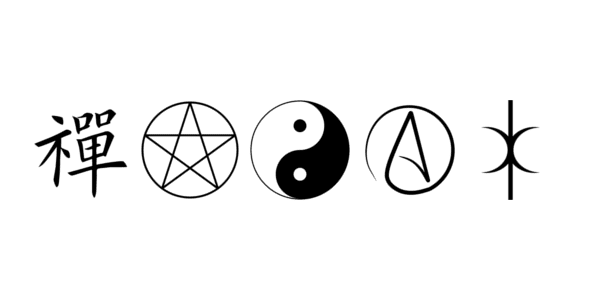
Zen Pagan Taoist Atheist Discordian? These are the main spiritual influences I draw on. To take them one at a time:
Zen: Zen Buddhism, of course. A set of philosophies and techniques for understanding how our minds work, how we cause our own suffering though our desires and through trying to hold fast to a world of illusions, and how to end that suffering.
Pagan: nature-based spirituality. Modern Paganism is an effort to revive useful ancient mythological and shamanistic ideas and practices. I wrote something that explains my view of it at [dead url].
Taoist: the ancient (c. 2500 years old) Chinese philosophy of harmonizing with nature. Taoism is in some ways an ancestor of Zen Buddhism: Indian Buddhism + Chinese Taoism = Ch’an Buddhism, which went to Japan and became Zen. (Zen and Ch’an are the Japanese and Chinese words for “meditation”) Taoism’s seminal work is the “Tao Te Ching”, of which there are many translations, some of which you can find online.
Atheist: given most people’s definitions of a god as some supernatural being outside the physical universe, I’ll take the atheist label. Given other definitions, I’ll take other labels: pantheist (“Everything is god”), autotheist (“I am god”), apatheist (“I don’t care about gods”), whatever.
Discordian: If there _are_ any gods or goddesses, obviously the one in charge of this universe is the Goddess of Chaos, known to the Greeks as Eris and to the Romans as Discordia. Discordianism is a faith of salvation though nonsense, that holds to the truth that “The human race will begin solving it’s problems on the day that it ceases taking itself so seriously.” The _Principia Discordia_ is a mixture of juvenile humor and deep philosophical truth; an online version can be found at [dead url — try http://pricipiadiscordia.com].
I look back at this after fifteen years, and it’s not terrible. I’ve come to deeper and more nuanced understandings of each of these points, but nothing that makes me disavow this explanation.
So then, what are those deeper and more nuanced understandings? What have I found that makes me keep each of these elements as a part of my well-balanced spiritual practice, and recommend them to others?
-
My Zen, such as it is, is mostly Karate Zen, the moving mediation of the martial arts. But I’ve managed to make good old zazen (seated mediation) part of it too, and I’ve come to see the truth of the old saying “Ken Zen Ichi Nyo” — the fist and Zen are one, or the sword and Zen are one, depending on how it’s written. (It’s a random coincidence, but one that we karate folks get some mileage out of, that in Japanese there is a word pronounced “ken” that means sword and also a different word pronounced “ken” that means “fist”.)
When I sit without a goal, or when I try to put my whole self into the movements of a kata, in either case not trying to make anything in my mind, still my brain goes on making things, spinning fantasies and fears that have nothing to do with the actual situation of the moment. Seeing how it does this, bearing witness to the mind, seeing a bit behind the scenes of the self-trickery (or perhaps I should say, the trickery that creates the “self”), the illusion grows a little less captivating, the “thus-ness” of things becomes a little clearer, and life is a little less out-of-joint.
-
In writing Why Buddha Touched the EarthI researched the history of Paganism going back to the Greco-Roman revival in European art in the late 18th century and the Romantic movement of the 19th. I’ve come to see Neo paganismas part of the reaction to industrialization and the destruction of the natural world…and the need for such a reaction has certainly not decreased. I’ve only become more convinced that we need a spirituality that honors nature, both in the sense of the natural world of forests and oceans and rock and air and in the sense of our own deepmost human nature, untamed by civilization.
I’ve done ritual with Wiccans (of several stripes), Druids (ADF and OBOD), Voodoo folks, Church of All Worlds members, and uncategorizable eclectic Pagans like and yet unlike myself. I’ve visited Shinto shrines, hiked up a holy mountain, danced all night around bonfires, led rituals with scores of participants, had a few mystical experiences (some catalyzed by strange chemicals, some not), and felt the liminal presence of the transpersonal in ways that sometimes seem completely transcendent and sometimes to have person-like characteristics. (Most notably, a sense of humor!) And I’ve only become more convinced that we need a spirituality that honors the fact that our minds can enter different states of consciousness, that values multiple perspectives and that cultivates techniques for moving between them — magic, in a word.
-
I’ve become a bit more familiar with Taoist philosophy through my studies of Chinese medicine. I’ve learned to think in terms of yin and yang, an important way of understanding the world. Western philosophy can be dangerously stuck in exclusive thinking — that there is only one ultimate and final truth, that either A or not-A must be the case; while Taoism right at the root has two opposing yet interdependent principles. Many great perplexities — free will versus determinism, individual vs. community, physicalism versus idealism, freedom versus security — evaporate when considered as example of the Taoist yin/yang principle.
-
A species with atomic bombs and the ability to wreck its planet’s biosphere cannot afford superstition or supernaturalism, or to hold on to ancient religious dogmas backed by nothing but priestly authority. My understanding of what it means for the gods to exist or not exist has gotten more philosophically sophisticated, and I find some of what’s coming from the “New Atheists” distressing (especially the Islamophobia); but given the usual naive “man on the street” ideas of what constitutes “deity” and “existence” I still have no hesitation in identifying as an atheist.
-
And if there’s one thing we’re definitely going to need if the species is going to make it through the next century or so, Goddess knows it’s a sense of humor, an appreciation for the fundamental ridiculousness of all things.
More than that, following a trickster (or perhaps more accurately, being claimed by one) has taught me about the nature of story and narrative, how stories can define us if we’re not careful. Everyone who’s well-educated knows the story of the golden apple; most have thought Eris to blame for the war started by the rivalry of Hera, Athena, and Aphrodite; few have considered just who the prettiest one at any wedding is and truly understood the story.
I’ve also found the Discordian Law of Fives to a truly great insight into the nature of reality. (Yes, really.) According to the Principia Discordia:
The Law of Fives states simply that: ALL THINGS HAPPEN IN FIVES, OR ARE DIVISIBLE BY OR ARE MULTIPLES OF FIVE, OR ARE SOMEHOW DIRECTLY OR INDIRECTLY APPROPRIATE TO 5.
The Law of Fives is never wrong.
In the Erisian Archives is an old memo from Omar to Mal-2: “I find the Law of Fives to be more and more manifest the harder I look.”
And so it goes for any magical, religious, philosophical, or political principle you adopt: the harder you look, the more you will find it.
So I might say, truthfully, that I find Zen Pagan Taoist Atheist Discordianism to be more and more manifest the harder I look.
You can keep up with “The Zen Pagan” by subscribing via RSS or e-mail.
If you do Facebook, you might choose to join a group on “Zen Paganism” I’ve set up there. And don’t forget to “like” Patheos Pagan and/or The Zen Pagan over there,
too.
Previous Post

August 7, 2015
Enchantment and objectivity
Next Post

August 20, 2015 Neopaganism: Looking Forward or Looking Back?
Browse Our Archives
Select a Category 2017 52 Makeup 2020 52 Makeup Always Roaming With A Hungry Heart Art Because I Could Not Stop For Death Caught On Video COVID-19 Culture Discordianism Ethics, Virtue, and Right Living History Magic(k), Ritual, and Mysticism My Blogging Life and Times Philosophy Podcast Poetry Random Wednesdays Religion & Politics Seasonal Musings Techno-Pagan Theology Uncategorized Warrior Path Zen
Select a Month October 2026 September 2026 August 2026 March 2026 February 2026 January 2026 December 2025 March 2025 January 2025 December 2024 November 2024 September 2024 August 2024 June 2024 May 2024 April 2024 March 2024 February 2024 December 2023 September 2023 August 2023 July 2023 June 2023 May 2023 March 2023 February 2023 January 2023 December 2022 October 2022 September 2022 June 2022 April 2022 February 2022 January 2022 December 2021 November 2021 October 2021 September 2021 August 2021 July 2021 May 2021 April 2021 March 2021 February 2021 January 2021 December 2020 November 2020 October 2020 September 2020 August 2020 June 2020 May 2020 April 2020 March 2020 February 2020 January 2020 December 2019 November 2019 October 2019 September 2019 August 2019 July 2019 June 2019 May 2019 April 2019 March 2019 February 2019 January 2019 December 2018 November 2018 October 2018 September 2018 August 2018 July 2018 June 2018 May 2018 April 2018 March 2018 January 2018 December 2017 November 2017 October 2017 September 2017 August 2017 July 2017 June 2017 May 2017 April 2017 March 2017 February 2017 January 2017 December 2016 November 2016 October 2016 September 2016 August 2016 July 2016 June 2016 May 2016 April 2016 March 2016 February 2016 January 2016 December 2015 November 2015 October 2015 September 2015 August 2015 July 2015 June 2015
Follow Us!
TAKE THE
Religious Wisdom Quiz
Who was Rebekah's father?
Select your answer to see how you score.
Abraham Bethuel Laban Terah
Related posts from The Zen Pagan

Chess Grifters, Chinese Rooms, and AI
Starwood 2026 -- This Is Not A Review


TRENDING AT PATHEOS Pagan

The Problem with False Prophets
Miller’s Station UMC| 10/18/26| Anchor Verse: Jeremiah 23: 1, 9-23 I...

Emotion in Early Christianity by Andrew Crislip
Andrew Crislip’s Emotion in Early Christianity examines an often overlooked dimension of...

16 Spiritual Touchstones for a More Grounded Life
After decades of spiritual study, here are 16 principles I try...

Catholic Evangelization: Sharing Your Faith Every Day
Welcome back to the Graceful Awakening mini-series called, “From Faith to Mission.” ...

The Pillar of the Boatmen: the Ancient Monument...
The Pillar of the Boatmen is a Romano-Gaulish sculpture that dates from...

In one sense walking into Westminster Abbey is like walking down the...
view all Pagan blogs
Ad-Free & Subscriber Log-In Subscription Support
- About Us
- 2026 Calendar
- Videos
- Podcasts
- Library of World Religions
- Faith In Media Tracker
- Advertise With Us
- Write for Us
- Privacy Policy
- Terms of Service
- Do Not Sell My Data
- Contact Us
- Radiant Digital
- Manage Newsletter Subscriptions
- Unsubscribe From Notifications
- Sitemap
Copyright 2008-2026, Patheos. All rights reserved.
Subscription Support Ad-Free & Subscriber Log-In
Follow Patheos