
BuddhistCatholicContemplativeEvangelicalGeneral ChristianHinduJewishLatter-day SaintMuslimNew VisionsProgressive Christian
Beliefs
- Buddhist
- Catholic
- Contemplative
- Evangelical
- General Christian
- Hindu
- Jewish
- Latter-day Saint
- More Voices
- Muslim
- New Visions
- Pagan
- Progressive Christian
Topics
- Religion News
- Food and Religion
- Sports and Religion
- Religious Art
- Religious Music and Entertainment
- Religious Events
- History and Religion
- Style and Religion
- Politics and Religion
- Women in Religion
- Recreation Outdoors and Religion
- Business Finance and Religion
- Careers Workplace and Religion
- Education and Religion
- Family Parenting and Religion
- Health Fitness and Religion
- Home and Religion
- Relationships and Religion
- Technology and Religion
- Travel and Religion
Columnists
- Buddhist Columnists
- Business Finance and Religion Columnists
- Careers Workplace and Religion Columnists
- Catholic Columnists
- Contemplative Columnists
- Education and Religion Columnists
- Evangelists Columnists
- Family Parenting and Religion Columnists
- General Christian Columnists
- Health Fitness and Religion Columnists
- Hindu Columnists
- History and Religion Columnists
- Home and Religion Columnists
- Jewish Columnists
- More Voices Columnists
- Latter Day Columnists
- Muslim Columnists
- New Visions Columnists
- Nonreligious Columnists
- Pagan Columnists
- Politics and Religion Columnists
- Progressive Columnists
- Recreation Outdoors and Religion Columnists
- Relationships and Religion Columnists
- Religion News Columnists
- Religious Art Columnists
- Religious Events Columnists
- Religious Music and Entertainment Columnists
- Sports and Religion Columnists
- Style and Religion Columnists
- Technology and Religion Columnists
- Travel and Religion Columnists
- Women in Religion Columnists
Resource Library
- 2026 Calendar
- Library of World Religions
- The 100 Most Holy Places on Earth
- Patheos Answers
- Podcasts
- Videos
- Faith Leaders Database
- Anglican Episcopalian
- Bahai
- Baptist
- Buddhism
- Christianity
- Confucianism
- Eastern Orthodoxy
- Hinduism
- Holiness and Pentecostal
- ISKCON
- Islam
- Judaism
- Lutheran
- Methodist
- The Church of Jesus Christ of Latter-day Saints
- New Age
- Paganism
- Presbytarian and Reformed
- Protestantism
- Religion Behind the Scenes
- Roman Catholic
- Scientology
- Shia Islam
- Sikhism
- Sufism
- Sunni Islam
- Taoism
- Zen
- See all religions
Research Tools
 Ad-Free & Subscriber Log-In Subscription Support
Ad-Free & Subscriber Log-In Subscription Support
Follow Patheos 

- Trending:
- Forgiveness
- |
- Marriage
- |
- Consciousness
- |
- Death Penalty
- |
- Election
- |
- Halloween

- Home
- Pagan
- The Big Picture, Part I: From Shamans to Priests
The Big Picture, Part I: From Shamans to Priests
Last updated on: June 11, 2015 at 10:00 am by Tom Swiss
The Big Picture, Part I: From Shamans to Priests 2015-06-11T10:00:53-04:00 Tom Swiss
Patheos Explore the world's faith through different perspectives on religion and spirituality! Patheos has the views of the prevalent religions and spiritualities of the world.
I’d like to tell you a just-so story about the Neopagan movement and how it started in the nineteenth century as a response to industrialization.
Set the Wayback Machine for, say, 15,000 years ago — before the Neolithic Revolution, before the dawn of civilization. Our ancestors at this time were gatherer-hunters and their cultures were not very complicated. There was little division of labor, except perhaps by gender.
So if you grabbed a fifteen-year-old boy out of a hypothetical composite pre-agricultural tribe, you could expect him to be competent in every aspect of its culture and technology available to its males.[Campbell 142-144] He might not be the best at tracking game, but he can do it. He might not be the best at chipping an arrowhead, but he can make one. He might not be the best at finding medicinal herbs, but he knows what leaves to chew if he’s got a stomach ache.
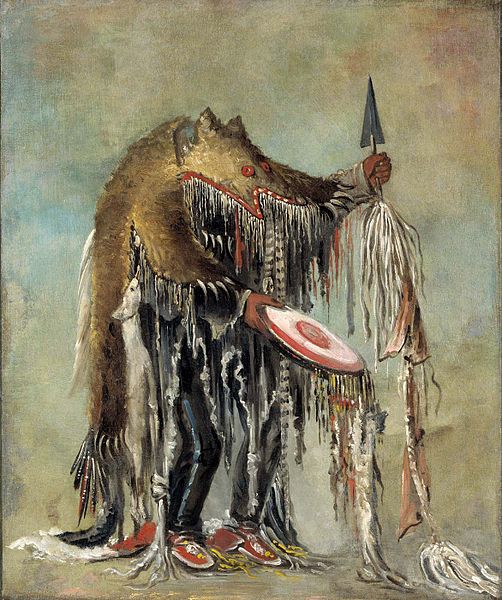
George Caitlin, “Medicine Man, Performing His Mysteries over a Dying Man (Blackfoot/Siksika)”. Image courtesy Wikimedia Commons.
And he might not be the best at going into a visionary, mystical state of consciousness — that person would be the tribal shaman — but he’s had such experiences. In fact he went on a vision quest as part of his initiation into manhood.[Campbell 158](I am using the word “shaman” here in a very broad sense, after Krippner: an individual in a tribe who has access to extraordinary sources of information via deliberate alteration of consciousness, who uses that information of the benefit of the tribe, and is recognized by the tribe as having a special role.[Krippner])
Though there were certainly tribal taboos and myths and rituals, with everyone having direct religious experiences and no possibilities for holy books to be written (this was before writing, remember), it was hard for complex religious dogma to get much of a foothold.
If you skipped back a few thousand years to 20,000 years ago, or forward to 10,000 YA, you’d find much the same. Of course there were differences between tribes, but this general pattern of human existence as tribal gatherer-hunters with shamanistic religion would still hold.
But then agriculture gets going and people settle down in one place to work the land. Villages, towns, eventually cities form. Civilization is born, and with it comes specialization. Life in a agricultural society is too complicated for one person to know it all — indeed it’s so complicated that we have to invent writing to manage it. We get merchants and artisans of all stripes and peasant farmers and warriors and royalty and scribes and middle managers.
And we get priests. The priest is very different from the shaman. A shaman is often “chosen by the spirits” in some way. See for example Black Elk, who fell ill near death for twelve days while he had his first major vision.[Elk 20-48] While they may apprentice to learn techniques, ultimately their power or authority does not come from any other human being but directly from their relationship to the spirit world or the deities. But a priest is trained in their rituals and invested with their authority by other priests, sometimes as a family lineage. Think of the sacrament of Holy Orders and chain of apostolic succession in some Christian denominations, the Jewish kohens in the line of Aaron, the Hindu Brahmin caste, the intensive training of the ancient Druids. Ordinary people no longer have direct and unmediated access to the divine; they go through the priests, whose job is to maintain the complex social order, to make society follow the heavenly order.[Campbell 153-155]
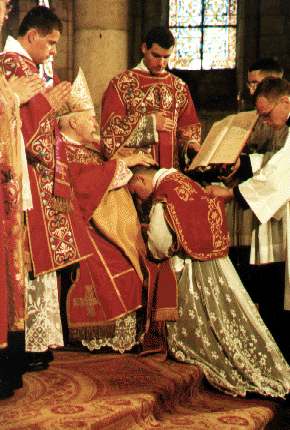
Ordination of a priest. Courtesy Wikimedia commons.
For a long time it was thought that we had agriculture and permanent settlement first, and priestly religion was a subsequent development. But more recent archeology suggests that we were building places of worship 11,000 years ago at sites like Gobekli Tepe (a 25 acre complex of stone circles in what is now Turkey), and that the need to feed and organize worshipers and workers led to the development of agriculture and permanent settlement.[Curry; Scaham; Schmidt]
But whichever came first, they developed together. The new way of making a living in the material world went hand-in-hand with a new way to relating to the deep emotional/mystical/spiritual word.
We are greatly oversimplifying the history of civilization and religion here, and there are scores of exceptions and counter-currents. But if you step back and squint your eyes, this is the picture that emerges: humans in gatherer-hunter cultures with fairly flat social structures and shamanistic spirituality based around individual visions, from behavioral modernity on the order of 50-100,000 years ago up through the Neolithic revolution about 12,000 YA; then the development of hierarchical agricultural civilizations and priestly religion based around complex group ritual from that point up through the end of the Middle Ages in Europe.
If you grabbed an Sumerian from the age of Gilgamesh, about 4,800 years ago, and brought them forward in your time machine 3,000 years to the Roman Empire or 4,000 years to medieval Europe, the general structure of society would not be unfamiliar to him. Who’s the king? (Well, the Romans had an Emperor with a tradition of denying kingship but it was largely a distinction without a difference at that point.) Where’s the temple? Who are the priests? Most people are still working the land, be it as peasants or slaves. Of course you could find “uncivilized” places along the way to drop him off, or exceptional civilizations like democratic Athens, but the general pattern of those ancient Mesopotamian cultures persisted and spread pretty well for a long time.
But just a few hundred years ago we started to get something new. With the end of the manor system in Europe we started to see “cottage industry” — for the first time, a large number of people were involved in economic production other than agriculture. Land enclosure began, commons were privatized, and the feudal lord demanding a share of the peasants crops transitioned into a landlord demanding rent and with the ability to evict.[Greer 245-249, 446-447] In just a few centuries the Renaissance begat the Enlightenment begat the Industrial Revolution.
We could pull that hypothetical Sumerian 4000 years forward from the highest civilization of 2800 BCE to the highest civilization of 1200 CE and they would more or less understand the world in which they found themselves. But if we pulled a European from 1200 CE just 600 years forward to 1800, what a change! The beginnings of science and industrialization, land enclosure, modern democracy. A pattern of civilization that had endured for thousands of years was cracking apart.
We are talking here about a change in human existence as significant as the dawn of civilization, when we went from gatherer-hunters to agriculturalists. And just as that was accompanied by a shift from shamanistic, direct religion to priestly, indirect religion, so this transition will need a new sort of spirituality.
In Part II we’ll look at how intellectuals, spiritual explorers, and fraudulent mountebanks of the nineteenth century responded to their changing world and laid out some of the ideas that would develop into the Neopagan movement.
References
Campbell, Joseph. The Flight of the Wild Gander. New York, N.Y: HarperPerennial, 1990.
Curry, Andrew. “Gobekli Tepe: The World’s First Temple?” Smithsonian Magazine, November 2008. <http://www.smithsonianmag.com/history/gobekli-tepe-the-worlds-first-temple-83613665/?all>
Elk, Black, and John G. Neihardt. Black Elk Speaks : being the life story of a holy man of the Oglala Sioux. Lincoln: University of Nebraska Press, 1988.
Greer, Thomas. A Brief History of the Western World. Stamford: Thomson Learning, 1987.
Krippner, Stanley. “Conflicting perspectives on shamans and shamanism: Points and counterpoints.” Am Psychol. 2002 Nov;57(11):962-78. American Psychologist, Vol 57(11), Nov 2002, 962-977. <http://dx.doi.org/10.1037/0003-066X.57.11.962>, <http://stanleykrippner.weebly.com/conflicting-perspectives.html>
Scham, Sandra. “The World’s First Temple.” Archelogy, Volume 61 Number 6, November/December 2008.
<http://archive.archaeology.org/0811/abstracts/turkey.html>
Schmidt, Klaus. “Göbekli Tepe – the Stone Age Sanctuaries. New results of ongoing excavations with a special focus on sculptures and high reliefs.” Documenta Praehistorica 37 (2010): 239-256. <http://arheologija.ff.uni-lj.si/documenta/authors37/37_21.pdf>
“The Zen Pagan” is now its own blog! We’ll have RSS and e-mail subscription information soon.
My next scheduled events are the Free Spirit Gathering in June and Starwood in July.
If you do Facebook, you might choose to join a group on “Zen Paganism” I’ve set up there. And don’t forget to “like” The Zen Pagan and Patheos Pagan over there, too.
Previous Post

June 5, 2015
Good-bye and Hello as Always; The Only God to Whom Jupiter Must Bow
Next Post
June 19, 2015 The Touchy Subject of Touch
Browse Our Archives
Select a Category 2017 52 Makeup 2020 52 Makeup Always Roaming With A Hungry Heart Art Because I Could Not Stop For Death Caught On Video COVID-19 Culture Discordianism Ethics, Virtue, and Right Living History Magic(k), Ritual, and Mysticism My Blogging Life and Times Philosophy Podcast Poetry Random Wednesdays Religion & Politics Seasonal Musings Techno-Pagan Theology Uncategorized Warrior Path Zen
Select a Month October 2026 September 2026 August 2026 March 2026 February 2026 January 2026 December 2025 March 2025 January 2025 December 2024 November 2024 September 2024 August 2024 June 2024 May 2024 April 2024 March 2024 February 2024 December 2023 September 2023 August 2023 July 2023 June 2023 May 2023 March 2023 February 2023 January 2023 December 2022 October 2022 September 2022 June 2022 April 2022 February 2022 January 2022 December 2021 November 2021 October 2021 September 2021 August 2021 July 2021 May 2021 April 2021 March 2021 February 2021 January 2021 December 2020 November 2020 October 2020 September 2020 August 2020 June 2020 May 2020 April 2020 March 2020 February 2020 January 2020 December 2019 November 2019 October 2019 September 2019 August 2019 July 2019 June 2019 May 2019 April 2019 March 2019 February 2019 January 2019 December 2018 November 2018 October 2018 September 2018 August 2018 July 2018 June 2018 May 2018 April 2018 March 2018 January 2018 December 2017 November 2017 October 2017 September 2017 August 2017 July 2017 June 2017 May 2017 April 2017 March 2017 February 2017 January 2017 December 2016 November 2016 October 2016 September 2016 August 2016 July 2016 June 2016 May 2016 April 2016 March 2016 February 2016 January 2016 December 2015 November 2015 October 2015 September 2015 August 2015 July 2015 June 2015
Follow Us!
TAKE THE
Religious Wisdom Quiz
Who refused to defile himself with the king's food and wine?
Select your answer to see how you score.
Ezekiel Joel Daniel Obadiah
Related posts from The Zen Pagan
Masculine Archetypes: The Healer (Shaman/Smith) at Imbolc

Ouijaphobia! From Swedenborg to the Ouija Board

TRENDING AT PATHEOS Pagan

The Problem with False Prophets
Miller’s Station UMC| 10/18/26| Anchor Verse: Jeremiah 23: 1, 9-23 I...

Emotion in Early Christianity by Andrew Crislip
Andrew Crislip’s Emotion in Early Christianity examines an often overlooked dimension of...

16 Spiritual Touchstones for a More Grounded Life
After decades of spiritual study, here are 16 principles I try...

Catholic Evangelization: Sharing Your Faith Every Day
Welcome back to the Graceful Awakening mini-series called, “From Faith to Mission.” ...

The Pillar of the Boatmen: the Ancient Monument...
The Pillar of the Boatmen is a Romano-Gaulish sculpture that dates from...

In one sense walking into Westminster Abbey is like walking down the...
view all Pagan blogs
Ad-Free & Subscriber Log-In Subscription Support
- About Us
- 2026 Calendar
- Videos
- Podcasts
- Library of World Religions
- Faith In Media Tracker
- Advertise With Us
- Write for Us
- Privacy Policy
- Terms of Service
- Do Not Sell My Data
- Contact Us
- Radiant Digital
- Manage Newsletter Subscriptions
- Unsubscribe From Notifications
- Sitemap
Copyright 2008-2026, Patheos. All rights reserved.
Subscription Support Ad-Free & Subscriber Log-In
Follow Patheos