
BuddhistCatholicContemplativeEvangelicalGeneral ChristianHinduJewishLatter-day SaintMuslimNew VisionsProgressive Christian
Beliefs
- Buddhist
- Catholic
- Contemplative
- Evangelical
- General Christian
- Hindu
- Jewish
- Latter-day Saint
- More Voices
- Muslim
- New Visions
- Pagan
- Progressive Christian
Topics
- Religion News
- Food and Religion
- Sports and Religion
- Religious Art
- Religious Music and Entertainment
- Religious Events
- History and Religion
- Style and Religion
- Politics and Religion
- Women in Religion
- Recreation Outdoors and Religion
- Business Finance and Religion
- Careers Workplace and Religion
- Education and Religion
- Family Parenting and Religion
- Health Fitness and Religion
- Home and Religion
- Relationships and Religion
- Technology and Religion
- Travel and Religion
Columnists
- Buddhist Columnists
- Business Finance and Religion Columnists
- Careers Workplace and Religion Columnists
- Catholic Columnists
- Contemplative Columnists
- Education and Religion Columnists
- Evangelists Columnists
- Family Parenting and Religion Columnists
- General Christian Columnists
- Health Fitness and Religion Columnists
- Hindu Columnists
- History and Religion Columnists
- Home and Religion Columnists
- Jewish Columnists
- More Voices Columnists
- Latter Day Columnists
- Muslim Columnists
- New Visions Columnists
- Nonreligious Columnists
- Pagan Columnists
- Politics and Religion Columnists
- Progressive Columnists
- Recreation Outdoors and Religion Columnists
- Relationships and Religion Columnists
- Religion News Columnists
- Religious Art Columnists
- Religious Events Columnists
- Religious Music and Entertainment Columnists
- Sports and Religion Columnists
- Style and Religion Columnists
- Technology and Religion Columnists
- Travel and Religion Columnists
- Women in Religion Columnists
Resource Library
- 2026 Calendar
- Library of World Religions
- The 100 Most Holy Places on Earth
- Patheos Answers
- Podcasts
- Videos
- Faith Leaders Database
- Anglican Episcopalian
- Bahai
- Baptist
- Buddhism
- Christianity
- Confucianism
- Eastern Orthodoxy
- Hinduism
- Holiness and Pentecostal
- ISKCON
- Islam
- Judaism
- Lutheran
- Methodist
- The Church of Jesus Christ of Latter-day Saints
- New Age
- Paganism
- Presbytarian and Reformed
- Protestantism
- Religion Behind the Scenes
- Roman Catholic
- Scientology
- Shia Islam
- Sikhism
- Sufism
- Sunni Islam
- Taoism
- Zen
- See all religions
Research Tools
 Ad-Free & Subscriber Log-In Subscription Support
Ad-Free & Subscriber Log-In Subscription Support
Follow Patheos 

- Trending:
- Forgiveness
- |
- Marriage
- |
- Consciousness
- |
- Death Penalty
- |
- Election
- |
- Halloween

- Home
- Pagan
- Are Wicca and the Boy Scouts Cousins? Part I
Are Wicca and the Boy Scouts Cousins? Part I
Last updated on: June 26, 2015 at 11:42 pm by Tom Swiss
Are Wicca and the Boy Scouts Cousins? Part I 2015-06-26T23:42:52-04:00 Tom Swiss
Patheos Explore the world's faith through different perspectives on religion and spirituality! Patheos has the views of the prevalent religions and spiritualities of the world.
Today I’d like to discuss one of my favorite historical speculations. I want to be clear right off the top that we are in the realm of “possibly” and “could be” here, that you should raise an eyebrow at this idea…but I find it fascinating, a possible (possible only!) confluence of two reactions to industrialization and modernity around the turn of the 20th century.
The speculation is this: that both the Boy Scouts and modern Wicca can trace a significant part of their heritage to a naturalist, mystic, author, and advocate of Native American culture who was popular in the late 19th and early 20th centuries, but mostly unknown today. In the case of the Boy Scouts the history is clear, though largely forgotten for political reasons. For Wicca, it’s a foggy connection at best, but there is evidence for some sort of connection.
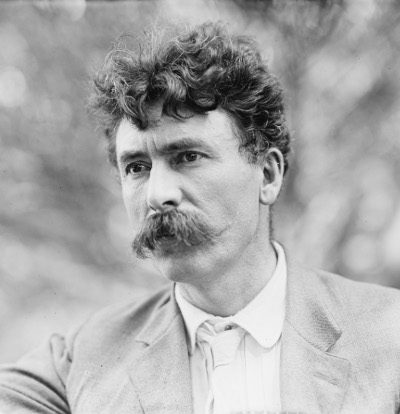
Was this man the missing link between the Boy Scouts and Wicca? (Ernest Thompson Seton, image via Wikimedia Commons)
John Michael Greer and Gordon Cooper’s article “The Red God: Woodcraft and the Origins of Wicca”, published in Gnosis, Summer 1998, was one of the first articles (maybe the very first?) to explore this connection, so credit to them. What follows is mostly adapted from my book, Why Buddha Touched the Earth. For further references, well, buy the book! 🙂
So. Gerald Gardner, generally regarded as the founder of modern Witchcraft, claimed that he was initiated into a witch coven in 1939, and that this coven was a genuine remnant of pre-Christian European religion. The existence and nature of this coven is one of the big mysteries in Neopagan history, but it’s generally accepted by historians that this was not some bit of continuous ancient native religion. (Sorry to disappoint any true believers.)
I am not a Wiccan, let alone a Gardnerian, but I find that I like Gardner. Nothing here is meant as an attack on him. But we know that he had, in the words of his student Frederic Lamond, a “devious creative attitude to factual truth.” (That’s part of why I like him!)
He made false claims of scholarly credentials including non-existent Ph.D. In one book he falsely claimed to be a disinterested observer of witchcraft rather than admitting to his involvement. And he claimed that the coven was led by a woman named Dorthy Clutterbuck, who seems to have been a pious Christian with no links to any sort of witchcraft; he may have used her name either as a prank, or as a blind to conceal the identity of the actual leader.
In Gardner we have an unreliable narrator; his account must be taken with salt.
This much seems clear: after more than three decades working in the British colonies in Ceylon, Borneo, and Malaya, Garner retired to England in 1936. In his time overseas he observed the religious and magical rites of the Dyak and Sakai tribes, and studied the mythology and folk magic of the Malays — especially the part involving their traditional blade, the kris. He became interested in anthropology and archeology, and his work was published by the Royal Asiatic Society. In Ceylon he encountered Buddhism; he was interested by its idea of reincarnation (or at least the popular interpretation of that teaching) but that seems to have been the extent of its impact on him.
On one of his occasional visits to England he became interested in Spiritualism; he believed that some mediums had a genuine ability to contact the “spirit world” and speak to the dead.
So by the time he retired, Gardner had studied a variety of religious practices.
In 1938 he moved to the New Forest district of Hampshire. Nearby he met a “Rosicrucian Theatre” group which seems so ridiculous one could almost seen it as a parody — its leader claimed to own the Holy Grail and to be immortal! But there was a small clique that he got on well with, the group he later identified as a coven.
Who were they really? Was there really a group doing some interesting religious and magical work, or did Gardner attribute his own ideas to others to lend them weight?
We don’t know if Gardner’s coven was real — but we do know that there were groups doing interesting religious and magical work in the New Forest area around that time.
Press pause now on Gardner’s story, and turn now to a man who made a large impact on Western culture during the “Progressive Era” of the late 19th and early 20th centuries but is now mostly unknown: Ernest Thompson Seton.
Seton was a naturalist and explorer, a popular artist and writer, and an early conservationist. But it was his work popularizing Native American culture and spirituality, work that led to the formation of the Boy Scouts, that had the most lasting impact — even as he himself has been largely forgotten.
He was born in England in 1860, and his family moved to upper Ontario to become homesteaders near the town of Lindsay. They failed at farming and soon moved to Toronto, but the young Seton had grown to love the woods around Lindsay, and his mother arranged for him to spend part of his summer vacation there each year.
During these visits he spent time with neighborhood boys, camping out in the woods in homemade tepees and playing at being Indians. He met an old woman he called the Lindsay Witch — and isn’t that interesting? — and learned a lot of wood-lore from her. His book of children’s stories Woodland Tales has a story “The Wood-witch and the Bog-nuts” in which “Granny Wood-witch” teaches a boy about the edible ground nut; perhaps this character is a tribute to that witch.

Seton in his studio, c. 1901. Image via Wikimedia Commons.
In 1879 Seton went to London to study art at the Royal Academy. He attended classes only briefly, but was inspired by reading naturalists like Audubon and Thoreau at the British Museum. In London he lived a self-denying, sexually repressed, ascetic life — partly from poverty, but partly from a disposition towards it. He began to have mystical experiences, hearing a “voice” which urged him to go to Western Canada and then to New York.
He followed that voice and spent much of the 1880s moving between homesteading attempts, nature watching, and art and natural science work in the U.S. and Canada. In this time he became acquainted with members of the Cree and Sioux tribes. He studied several Native languages and was an early member of the Sequoya League, a group dedicated to improving conditions for tribes on the West Coast.
By 1902 he was personally acquainted with several tribal chiefs, was acknowledged as an expert by the U.S. Bureau of Indian Affairs, and was honored by his Native friends by being one of the first whites to be made a “pipe carrier.” A few years later his ideas about Native American spirituality would find hundreds of thousands of followers in the U.S. when he created the “Woodcraft Indians”; later his work inspired groups in England, including near New Forest, to organize under the Woodcraft banner — but with a more Ancient British than Native American flavor.
How directly did this mystic, friend and advocate of Native Americans, co-founder of the Boy Scouts of America, and student of a witch influence the development of Gardnerian Wicca, and the broader Neopagan movement? Well, I don’t know! But stay tuned: we’ll have more history and speculation about this fascinating proto-Pagan in Part II.
You can keep up with “The Zen Pagan” by subscribing via RSS or e-mail.
My next scheduled event is Starwood, July 7-13.
If you do Facebook, you might choose to join a group on “Zen Paganism” I’ve set up there. And don’t forget to “like” Patheos Pagan and/or The Zen Pagan over there,
too.
Previous Post

June 25, 2015
Faith and Perseverance at the Fire Circle
Next Post

June 27, 2015 Beyond Marriage
Browse Our Archives
Select a Category 2017 52 Makeup 2020 52 Makeup Always Roaming With A Hungry Heart Art Because I Could Not Stop For Death Caught On Video COVID-19 Culture Discordianism Ethics, Virtue, and Right Living History Magic(k), Ritual, and Mysticism My Blogging Life and Times Philosophy Podcast Poetry Random Wednesdays Religion & Politics Seasonal Musings Techno-Pagan Theology Uncategorized Warrior Path Zen
Select a Month October 2026 September 2026 August 2026 March 2026 February 2026 January 2026 December 2025 March 2025 January 2025 December 2024 November 2024 September 2024 August 2024 June 2024 May 2024 April 2024 March 2024 February 2024 December 2023 September 2023 August 2023 July 2023 June 2023 May 2023 March 2023 February 2023 January 2023 December 2022 October 2022 September 2022 June 2022 April 2022 February 2022 January 2022 December 2021 November 2021 October 2021 September 2021 August 2021 July 2021 May 2021 April 2021 March 2021 February 2021 January 2021 December 2020 November 2020 October 2020 September 2020 August 2020 June 2020 May 2020 April 2020 March 2020 February 2020 January 2020 December 2019 November 2019 October 2019 September 2019 August 2019 July 2019 June 2019 May 2019 April 2019 March 2019 February 2019 January 2019 December 2018 November 2018 October 2018 September 2018 August 2018 July 2018 June 2018 May 2018 April 2018 March 2018 January 2018 December 2017 November 2017 October 2017 September 2017 August 2017 July 2017 June 2017 May 2017 April 2017 March 2017 February 2017 January 2017 December 2016 November 2016 October 2016 September 2016 August 2016 July 2016 June 2016 May 2016 April 2016 March 2016 February 2016 January 2016 December 2015 November 2015 October 2015 September 2015 August 2015 July 2015 June 2015
Follow Us!
TAKE THE
Religious Wisdom Quiz
Who was the high priest during the boyhood of Samuel?
Select your answer to see how you score.
Ahijah Phinehas Hophni Eli
Related posts from The Zen Pagan

Ouijaphobia! From Swedenborg to the Ouija Board

Frederick Douglass's Root Magic
TRENDING AT PATHEOS Pagan

In one sense walking into Westminster Abbey is like walking down the...

'Super Scam Me' Exposes AI Jon Bon Jovi...
Leslie Pickett believed she was in a relationship with Jon Bon Jovi....

The Brazilian Remake of Kendricks' 'Flywheel' Opens in...
“Flywheel,” the story that launched the Kendrick Brothers’ filmmaking career is getting...

The Dangers of Gradual Accommodation (Winking at Sin)
Recently, the “law of gradualness” resurfaced during the opening of a weeklong,...

The Iron Gates and the Lion of the...
Yesterday, I didn't finish my report about, well, yesterday. So I'll...

The Image: On the Horror of Capitalism and...
The Image Then went the Pharisees, and took counsel how they might...
view all Pagan blogs
Ad-Free & Subscriber Log-In Subscription Support
- About Us
- 2026 Calendar
- Videos
- Podcasts
- Library of World Religions
- Faith In Media Tracker
- Advertise With Us
- Write for Us
- Privacy Policy
- Terms of Service
- Do Not Sell My Data
- Contact Us
- Radiant Digital
- Manage Newsletter Subscriptions
- Unsubscribe From Notifications
- Sitemap
Copyright 2008-2026, Patheos. All rights reserved.
Subscription Support Ad-Free & Subscriber Log-In
Follow Patheos