
BuddhistCatholicContemplativeEvangelicalGeneral ChristianHinduJewishLatter-day SaintMuslimNew VisionsProgressive Christian
Beliefs
- Buddhist
- Catholic
- Contemplative
- Evangelical
- General Christian
- Hindu
- Jewish
- Latter-day Saint
- More Voices
- Muslim
- New Visions
- Pagan
- Progressive Christian
Topics
- Religion News
- Food and Religion
- Sports and Religion
- Religious Art
- Religious Music and Entertainment
- Religious Events
- History and Religion
- Style and Religion
- Politics and Religion
- Women in Religion
- Recreation Outdoors and Religion
- Business Finance and Religion
- Careers Workplace and Religion
- Education and Religion
- Family Parenting and Religion
- Health Fitness and Religion
- Home and Religion
- Relationships and Religion
- Technology and Religion
- Travel and Religion
Columnists
- Buddhist Columnists
- Business Finance and Religion Columnists
- Careers Workplace and Religion Columnists
- Catholic Columnists
- Contemplative Columnists
- Education and Religion Columnists
- Evangelists Columnists
- Family Parenting and Religion Columnists
- General Christian Columnists
- Health Fitness and Religion Columnists
- Hindu Columnists
- History and Religion Columnists
- Home and Religion Columnists
- Jewish Columnists
- More Voices Columnists
- Latter Day Columnists
- Muslim Columnists
- New Visions Columnists
- Nonreligious Columnists
- Pagan Columnists
- Politics and Religion Columnists
- Progressive Columnists
- Recreation Outdoors and Religion Columnists
- Relationships and Religion Columnists
- Religion News Columnists
- Religious Art Columnists
- Religious Events Columnists
- Religious Music and Entertainment Columnists
- Sports and Religion Columnists
- Style and Religion Columnists
- Technology and Religion Columnists
- Travel and Religion Columnists
- Women in Religion Columnists
Resource Library
- 2026 Calendar
- Library of World Religions
- The 100 Most Holy Places on Earth
- Patheos Answers
- Podcasts
- Videos
- Faith Leaders Database
- Anglican Episcopalian
- Bahai
- Baptist
- Buddhism
- Christianity
- Confucianism
- Eastern Orthodoxy
- Hinduism
- Holiness and Pentecostal
- ISKCON
- Islam
- Judaism
- Lutheran
- Methodist
- The Church of Jesus Christ of Latter-day Saints
- New Age
- Paganism
- Presbytarian and Reformed
- Protestantism
- Religion Behind the Scenes
- Roman Catholic
- Scientology
- Shia Islam
- Sikhism
- Sufism
- Sunni Islam
- Taoism
- Zen
- See all religions
Research Tools
 Ad-Free & Subscriber Log-In Subscription Support
Ad-Free & Subscriber Log-In Subscription Support
Follow Patheos 

- Trending:
- Forgiveness
- |
- Marriage
- |
- Consciousness
- |
- Death Penalty
- |
- Election
- |
- Halloween

- Home
- Progressive Christian
- History and Religion
- Revelation: A Failed Prophecy That Finds New Life
Revelation: A Failed Prophecy That Finds New Life
Last updated on: July 6, 2024 at 6:25 pm by William T. Orr, Jr.
Revelation: A Failed Prophecy That Finds New Life 2024-07-06T18:25:18-04:00 William T. Orr, Jr.
Patheos Explore the world's faith through different perspectives on religion and spirituality! Patheos has the views of the prevalent religions and spiritualities of the world.
Some Christians, even today, some 200 years after it was written, believe that the Book of Revelation is a blueprint for the end of time, which they believe is now likely at hand. Let us examine that belief and see what we can make of it.
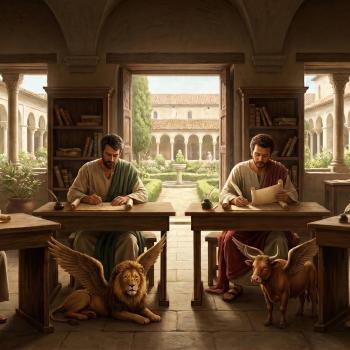
Failed Prophecy Gemini-generated Image by William T. Orr, Jr.
The book reports that it was written by God’s servant, John in the Greek island of Patmos. No one knows who John of Patmos was, where he came from, or why he addressed his book to the “seven churches of Asia.”
The author does not give any further information about himself. Biblical scholars have made speculations as to the identity of the author and whether he can be the author of the Gospel of John and the Johannine Letters.
Scholars now believe that the author of the Book of Revelation, the author of the Gospel of John and the author of the Johannine Letters are three separate and distinct people.
So who is this John of Patmos?
The best and simplest answer is that we simply do not know. (Oxford Companion to the Bible, p. 651 ff.) Over the years, early church fathers, theologians and scholars have variously posited that the author of the Book of Revelation is the same author that wrote the Gospel of John and what are known as the Johannine Epistles.
Due to theological differences, subject matter differences and most especially, significant differences in the style and level of sophistication of the Greek in which the book is written. It has been speculated that Greek is a second language for the author who seems to have been a native speaker of Hebrew or more probably Aramaic.
The differences in the Greek seem to be so significant that the author of the Book of Revelation was metaphorically “writing in crayon” compared to the author of the Gospel of John.
When and Why was the Book of Revelation written?
While we do not know much of anything at all about the author, we can use clues from the text to try to form an informed opinion about the book’s purpose.
There are many sources which can re-cap the book. That is not our purpose here. Excellent synopses can be found in the Oxford Companion to the Bible and in the Wikipedia entry which also provides an excellent selection of additional resources for additional study.
The Book of Revelation is an example of what is known as apocalyptic literature, a genre that became popular during the time in which the Book of Revelation is placed. This was a time when the convergence of Jewish and Christian theological traditions, mythologies from the surrounding cultures and the heavy yoke of the succession of empires had, in turn, subjugated Israel and the Jewish people, culminating with the expanding Roman Empire which was the immediate threat at the time the book was being written.
Other examples of apocalyptic literature in the Judeo-Christian tradition are the Hebrew Bible books of Isaiah, Ezekiel and Daniel and in re-telling the “history” of Israel 1 and 2 Chronicles.
Beginning with Irenaeus 9180 CE), scholars have placed the writing of the Book of Revelation during the latter part of the reign of the Emperor Domitian (81-96 CE). This makes it roughly contemporaneous with the Hebrew Bible book of Daniel. In fact, many of the images in the book of revelation recall images in the Book of Daniel as well as the books of Isaiah and Ezekiel and ancient Jewish literature, clearly influenced by neighboring cultures.
What is Apocalyptic Literature?
We are plagued here with an annoyance that scholars tolerate but which confuses issues in historical inquiry.
In our day, the term apocalyptic literature has come to mean something more specific than the words themselves would imply. Both words, apocalypse and revelation mean an uncovering, an exposition, an unveiling or an unfolding.
These generic definitions have been honed over the centuries to mean:
Apocalyptic literature is a genre of prophetical writing that developed in post-Exilic Jewish culture and was popular among millennialist early Christians. Apocalypse is a Greek word meaning “revelation”, “an unveiling or unfolding of things not previously known and which could not be known apart from the unveiling”
Today, when we speak of apocalyptic literature, we refer to the genre of specifically Jewish and Christian writings that ostensibly predicted the end of the world as it was known at the time and the ushering in of a new universal Kingdom of the Creator god YHWH(Adonai) and administered by a figure known as the Son of Man, a figure who has been associated with the Christian Messiah, Yeshua ben Josef.
What was the need for apocalyptic literature?
The first century CE, that is the first century after the death and reported resurrection of the Christian Messiah, was a dangerous time in the area of the world controlled by Rome and its vassal states. Rome had expanded its empire well into northern Europe and all of the area surrounding the Mediterranean Sea from Iberia east to the Levant and from there, across North Africa.
Rome’s wide reach caused two things, the development of vassal states (Herod’s kingdom of Judea, for example) for administrative simplicity and a brutal and unforgiving control of its possessions.
Rome was known to allow religious flexibility as long as the Emperor was worshipped as a god and as long as the taxes were paid. The Emperors did not much care how these taxes were collected as long as the Empire received its allotted amount. This led, inevitably, to horrible abuses by vassal kings and rulers.
Revelation is Failed Prophecy Gemini-generated Image by William T. Orr, Jr.
By this time in their history, the Jewish people had suffered a succession of invasions and conquests. The small kingdoms of Israel and Judah were constantly threatened by neighboring kingdoms like Edom, Moab and Philistia.
In 722 BCE, the northern kingdom of Israel was overrun and destroyed by the Assyrian Empire who made the southern kingdom of Judah a vassal state.
Then in 586 BCE, the neo-Babylonian empire invaded Judah, destroying its capital, Jerusalem, and the Temple, the central place of worship of the Jewish people.
Babylon removed Judah’s elite (the rich, the educated, the priests and scribes) to Babylon where they were held until the neo-Babylonian Empire fell to the Persian Empire in 538 BCE.
The Persians, in turn, fell to Alexander’s army and finally, the entire area was subjugated by Rome.
By this time, the literature, and in fact the character of the Jewish people reflected a history and a culture of defeat and survival.
What changed in the first century CE?
Israel and the Jews were YHWH’s people since Abraham’s covenant and Moses’s Exodus. The Hebrew Bible is a record (and a fabricated history) of the Jewish people and the nation/people Israel. The Hebrew Bible tells the stories of how Israel disappointed its God time and time again and how its God punished it each time, usually by having Israel invaded by a neighboring kingdom.
The scriptures seemed to promise a means of salvation and there was an expectation of a Savior or Messiah.
This expectation grew over time and as the Roman governors and vassal kings strangled the people more tightly, messiah claimants appeared, preaching in the street and in homes.
The most famous of these, was of course, Yeshua ben Josef, who was given, in the scriptures of the New Testament, no less an identification as the Only Son of God.
The Jewish people were ready, but the Temple priesthood saw a threat to their power and the Roman governor, possibly with their consent, executed Yeshua.
First failed prophecy.
Yeshua, who was reported to have miraculous powers and who was born into a rich Jewish tradition of Messianic expectation, failed, by his death to deliver the Jews once again, from bondage. A few groups of Jews began to think of the past scriptures in different terms and of their failed Messiah in a new light. Perhaps the deliverance was not so much physical, but more spiritual. The salvation might be something that could be looked for in a near future, a near future in which the Kingdom of Heaven would be ushered in on the Earth and in which the Son of Man would reign forever at the right hand of YHWH.
These prophecies, a part of the literature of the Jewish people were built on the stories and symbolisms of the Covenant, the Exodus and the many wars and conquests of the Jews and their neighbors over centuries.
By the time Rome has subjugated Judea, no salvation, no second deliverance had occurred.
Where did the story go from there?
During and immediately following the period of the Babylonian captivity (586BCE – 538 BCE), Jewish scribes, prophets and priests realized that in order for the Jewish people to emerge as a people, a cohesive story of their history had to be written and edited. When the next succession of rulers came and went and Judea finally came under Roman control, prophets like Isaiah, Ezekiel and finally Daniel, began to report visions of the end times, visions which incorporated ancient images and creatures from Israel’s earliest mythology and the mythologies of surrounding countries.
Over time, a general understanding of the end times was adopted by some of the first century CE groups of people who had come to be known as Christians.
So, in the first century CE, Christian and Jewish apocalyptic prophets were writing about the end times that were going to occur within their lifetimes.
Yeshua, himself, according to the Gospels, had believed that the Kingdom of God would come within the lifetimes of his contemporaries.
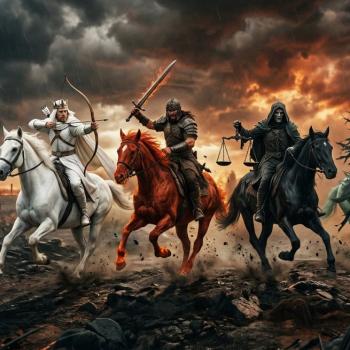
The Book of Revelation tells terrifying stories of the end times.

Images in Revelation are frightening Gemini Generated Image by William T. Orr, Jr.
Clearly, this did not occur.
Once the prophecy of Salvation failed, it was up to the Christian communities to explain this to the people.
A new, revised theology was developed, fought over and adopted in many forms in the following centuries.
Each community, each denomination, each sect, each specific orthodoxy explained things in different ways but the final arrangement allowed core beliefs with infinite varieties.
Where did it all land?
In general, Christians today believe that a person can overcome his “sinful nature” by following the teachings of Yeshua, as interpreted by people who have special knowledge and abilities. These are the priests and ministers of Christian churches. The simple faith of the early Christians has been made complicated and complex by the priestly class, somewhat akin to the machinations of the Levites in the Hebrew Bible.
Churches will tell you exactly how one is to follow Yeshua, but their leaders will not honestly engage you in a dialogue about what they learned in seminary and are withholding from their flock..
A few will even tell you that the events in the Book of Revelation are happening today and will recount events from recent history to “prove” their case.
I would recommend that you look into the scriptures and the many books written to help with understanding and make up your own mind.
I have two final thoughts on the Book of Revelation.
- If you are looking for events in recent history to “fulfill” the prophecy of Revelation, you will be disappointed. The turmoil of the first century CE was a very different time and while human nature does not change, circumstances do. If you encounter Christians or anyone else who says he or she can “prove” anything in the Bible, be wary. Religion deals in faith, not proof.
- The Book of Revelation was written about the Roman Empire and its subjugation of Israel. It was not written about Russia, China, Iran, Saudi-Arabia, modern Israel or the United States. It was not written about Donald Trump, Joe Biden, Vladimir Putin or Kim Jong Un. It was written about Rome and probably Nero.
I know that not everyone will agree with my interpretations. I am a public student of Biblical Scholarship, trying to learn as much as I can in the time I have left. Please join me on this quest. Leave a comment and let me know you are there and thinking.
Progressive Christian
General Christian
Education and Religion

About Willoiam T. Orr, Jr.
William T. Orr, Jr. is a retired educator, most recently the principal of a high school named in the Top 10 in the nation by Newsweek magazine. His school was also named to the Newsweek Top 100 each year while he was principal. Orr has been a teacher, a counselor, and a school administrator. He was influential in working in the district and state to lobby for more equitable pay for educators, and has long been a vocal advocate for more academic freedom for educators. Orr has a B.A. in English Language and Literature, a M.Ed. in Education Administration and Supervision, and an Ed.D. in Education leadership. He’s also completed Postdoctoral study at Yale Divinity School and Dallas Theological Seminary. Shortly after retirement, Orr began to study Abrahamic religions with a focus on why and how small religious sects among an often conquered people became what evolved into three of the most dominant and influential religions in the world today. You can read more about the author here.
Previous Post

June 26, 2024
Do You Know Or Do You Believe?
Next Post
July 8, 2024 6 Kinds of Readers: How One Sees The Bible Is The Difference
Recent Comments
"It gives me great pride to share this column with my oldest son and research ..."
How Paul Turned a Dead Messiah ..."
"It seems that seeing clearly the image of Jesus in Revelation brings up a lot ..."
Bart Ehrman Decodes the Book of ..."
"Ehrman's book really helped me understand how the Bible holds incompatible notions of who Jesus ..."
Bart Ehrman Decodes the Book of ..."
"Thanks for reading and commenting.Do you mean me or Dr. Ehrman?"
Bart Ehrman Decodes the Book of ..."
Browse Our Archives
Select a Category Uncategorized
Select a Month May 2026 April 2026 March 2026 February 2026 January 2026 December 2025 November 2025 August 2025 July 2025 June 2025 May 2025 February 2025 January 2025 November 2024 October 2024 September 2024 August 2024 July 2024 June 2024 May 2024 April 2024 March 2024 February 2024 January 2024 December 2023 November 2023
TAKE THE
Religious Wisdom Quiz
I gleaned in fields behind reapers and caught the eye of a wealthy landowner. Who am I?
Select your answer to see how you score.
Orpah Ruth Naomi Hannah
Related posts from They Didn't Teach Me That...
Family
How Paul Turned a Dead Messiah Into Christianity's...

Family
Revelation's Jesus Isn't the Lamb — He's the...
Family
One Jesus, Four Gospels: Why They Disagree on...
Family
Bart Ehrman Decodes the Book of Revelation: What...
TRENDING AT PATHEOS History and Religion

Catholic Evangelization: Sharing Your Faith Every Day
Welcome back to the Graceful Awakening mini-series called, “From Faith to Mission.” ...

The Pillar of the Boatmen: the Ancient Monument...
The Pillar of the Boatmen is a Romano-Gaulish sculpture that dates from...

In one sense walking into Westminster Abbey is like walking down the...

'Super Scam Me' Exposes AI Jon Bon Jovi...
Leslie Pickett believed she was in a relationship with Jon Bon Jovi....

The Brazilian Remake of Kendricks' 'Flywheel' Opens in...
“Flywheel,” the story that launched the Kendrick Brothers’ filmmaking career is getting...

The Dangers of Gradual Accommodation (Winking at Sin)
Recently, the “law of gradualness” resurfaced during the opening of a weeklong,...
view all History and Religion blogs
What Are Your Thoughts?leave a comment
Ad-Free & Subscriber Log-In Subscription Support
- About Us
- 2026 Calendar
- Videos
- Podcasts
- Library of World Religions
- Faith In Media Tracker
- Advertise With Us
- Write for Us
- Privacy Policy
- Terms of Service
- Do Not Sell My Data
- Contact Us
- Radiant Digital
- Manage Newsletter Subscriptions
- Unsubscribe From Notifications
- Sitemap
Copyright 2008-2026, Patheos. All rights reserved.
Subscription Support Ad-Free & Subscriber Log-In
Follow Patheos