
BuddhistCatholicContemplativeEvangelicalGeneral ChristianHinduJewishLatter-day SaintMuslimNew VisionsProgressive Christian
Beliefs
- Buddhist
- Catholic
- Contemplative
- Evangelical
- General Christian
- Hindu
- Jewish
- Latter-day Saint
- More Voices
- Muslim
- New Visions
- Pagan
- Progressive Christian
Topics
- Religion News
- Food and Religion
- Sports and Religion
- Religious Art
- Religious Music and Entertainment
- Religious Events
- History and Religion
- Style and Religion
- Politics and Religion
- Women in Religion
- Recreation Outdoors and Religion
- Business Finance and Religion
- Careers Workplace and Religion
- Education and Religion
- Family Parenting and Religion
- Health Fitness and Religion
- Home and Religion
- Relationships and Religion
- Technology and Religion
- Travel and Religion
Columnists
- Buddhist Columnists
- Business Finance and Religion Columnists
- Careers Workplace and Religion Columnists
- Catholic Columnists
- Contemplative Columnists
- Education and Religion Columnists
- Evangelists Columnists
- Family Parenting and Religion Columnists
- General Christian Columnists
- Health Fitness and Religion Columnists
- Hindu Columnists
- History and Religion Columnists
- Home and Religion Columnists
- Jewish Columnists
- More Voices Columnists
- Latter Day Columnists
- Muslim Columnists
- New Visions Columnists
- Nonreligious Columnists
- Pagan Columnists
- Politics and Religion Columnists
- Progressive Columnists
- Recreation Outdoors and Religion Columnists
- Relationships and Religion Columnists
- Religion News Columnists
- Religious Art Columnists
- Religious Events Columnists
- Religious Music and Entertainment Columnists
- Sports and Religion Columnists
- Style and Religion Columnists
- Technology and Religion Columnists
- Travel and Religion Columnists
- Women in Religion Columnists
Resource Library
- 2026 Calendar
- Library of World Religions
- The 100 Most Holy Places on Earth
- Patheos Answers
- Podcasts
- Videos
- Faith Leaders Database
- Anglican Episcopalian
- Bahai
- Baptist
- Buddhism
- Christianity
- Confucianism
- Eastern Orthodoxy
- Hinduism
- Holiness and Pentecostal
- ISKCON
- Islam
- Judaism
- Lutheran
- Methodist
- The Church of Jesus Christ of Latter-day Saints
- New Age
- Paganism
- Presbytarian and Reformed
- Protestantism
- Religion Behind the Scenes
- Roman Catholic
- Scientology
- Shia Islam
- Sikhism
- Sufism
- Sunni Islam
- Taoism
- Zen
- See all religions
Research Tools
 Ad-Free & Subscriber Log-In Subscription Support
Ad-Free & Subscriber Log-In Subscription Support
Follow Patheos 

- Trending:
- Forgiveness
- |
- Marriage
- |
- Consciousness
- |
- Death Penalty
- |
- Election
- |
- Halloween

- Home
- History and Religion
- What Reasons Are There Not To Read The Bible?
What Reasons Are There Not To Read The Bible?
Last updated on: June 9, 2024 at 9:30 am by William T. Orr, Jr.
What Reasons Are There Not To Read The Bible? 2024-06-09T09:30:28-04:00 William T. Orr, Jr.
Patheos Explore the world's faith through different perspectives on religion and spirituality! Patheos has the views of the prevalent religions and spiritualities of the world.
In our last post, we discussed several reasons why reading the Bible has value for believers, agnostics and atheists alike. In this post, we will discuss some of the reasons people do not read the Bible.

Bible Reading can be a positive experience even for non-believers Pixabay Image by Yerson Retamai
What are some of the reasons not to read the Bible?
Over time, people have taken positions against reading the Bible. This does not negate its value as a part of the history and culture of Western civilization.
We will, however, discuss some of the reasons why people might believe they should not read the Bible and we will look at these reasons critically and try to find value where others might not do so.
- Conflicts with personal beliefs
- Outdated ideas and context
- Difficulties in reading and complexity of interpretations
- Contradictions and inconsistencies
- Controversial, violent and frightening passages
Conflicts with personal beliefs
It is certainly understandable that some people might hesitate to read a “Holy book” if they believe that the book teaches religious, spiritual or metaphysical concepts that conflict with their personal beliefs.
I respect that position.
While I do respect that position, I also believe that most people can find value within the pages of this huge collection of different kinds of books that comprise the Bible.
- Laws and rules
- History
- Poetry and songs
- Wisdom sayings and proverbs
- Gospels
- Letters
Among these genres, there should be something that can interest almost anyone.
For those who genuinely avoid the Bible because of conflicting beliefs, I can say this:
I have read and studied the Bible and much that has been written about it. There are many teachings found in the Bible that conflict sharply with my personal beliefs but that does not negate the value that can be found there. The Bible also contains beliefs that are hard to argue against.
I would recommend that the skeptic approach the Bible with an open mind. There is more than moral and religious teaching to be found. Thee is a wealth of history, poetry and wisdom.
Outdated ideas and context
The Hebrew Bible (Old Testament) was written by Jewish priests and scribes roughly between 700 BCE nd 450 BCE. The New Testament (Christian Bible) was written in the late first and early second century CE.
I cannot argue against the fact that the text of the Bible was written a long time ago by people who would not recognize our world. The world of the 21st century is vastly different from the Bronze Age and Iron Age of the Hebrew Bible to the Late Antiquity period of the New Testament.
That fact does nothing to alter the value in reading the thoughts of these ancient authors and to compare the ideas presented by Jewish and Christian authors mostly writing in a world dominated by the Assyrian, Babylonian, Persian, Greek and Roman empires that conquered the lands of the Jews and early Christians.
Being old does not make a text outdated. In fact, scholars are constantly seeking the oldest manuscripts of ancient books, Biblical and otherwise.
There is a wealth of history, legend, poetry and philosophy to be had among its books. Not every book, chapter or verse contains religious dogma.
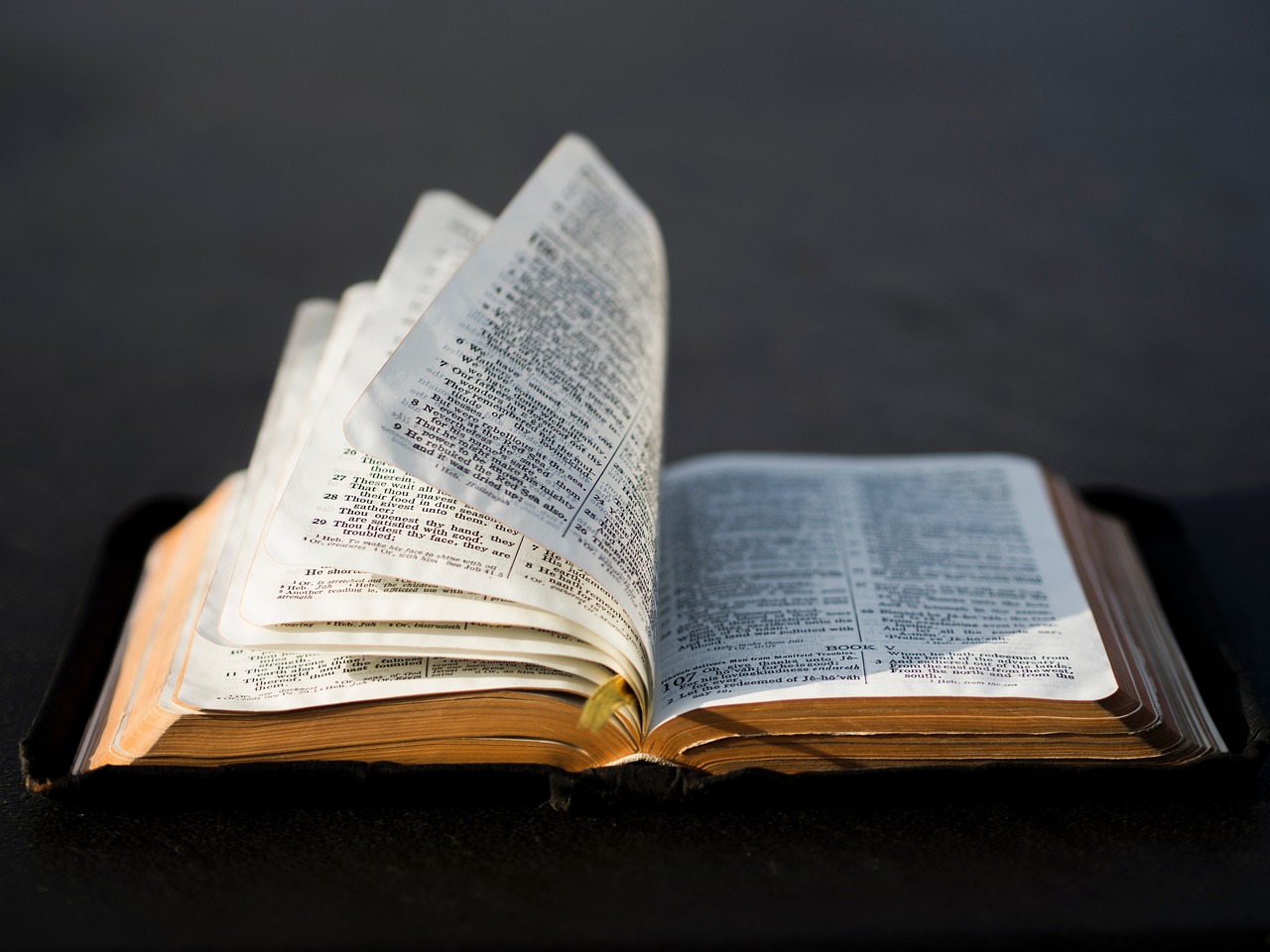
Holy Bible Pixabay Image by StockSnap
Difficulty in reading and complexity of interpretations
Difficulty in reading
It is true that the Bible can be difficult to read.
Passages which are concerned with genealogies and such are not only difficult, but extremely boring. Skip them.
These facts should not deter one as he approaches the Bible. As we saw in a previous article, there are some tips to make Bible reading easier.
- Start with a book that captures your interest
- Find an easy to read translation
- Find a place to read that will be quiet and peaceful
- Take notes to help you organize your thoughts
- Use a dictionary or Bible glossary to look up unfamiliar words
- Underline and highlight as you read
- Have goals for your reading
- Discus your reading with other people
- Join a study group
- Subscribe to a podcast or video channel that seems interesting
Not all of these tips will be helpful to all readers but they can help to make reading the Bible more enjoyable and meaningful.
Complexity of interpretations
I will freely and quickly admit that it is possible to become confused and exasperated by the plethora of Bible guides, concordances, dictionaries and other books written to explain the Bible to the reader. It is also true that there are literally thousands of scholarly articles and popular articles and books that try to interpret and explain what can be a difficult text.
In order to alleviate some of this confusion, I recommend that the reader go to a local bookstore and find a translation that is comfortable and then, to find a guide or concordance that concentrates on historical and philosophical concepts and not so much theological ones.
A guide with maps and charts can be quite helpful. Here are a couple of good Bible guides:
Vine’s Complete Expository Dictionary of Old and New Testament Words is a good general guide.
For deeper study, the reader will find a treasure of useful information in The Oxford Companion to the Bible.
As to Bible translations, I recommend either the English Standard Version (ESV) or the New International Version (NIV). There are many other easy-to-read translations. A good book store will have a good selection.
I would be remiss if I did not include a discussion of the most influential English translation of all, the venerable King James Bible. This translation is a true icon in the modern history of the English-speaking people. The beauty and grandeur of its lofty ;language is unsurpassed. I must point out, in fairness that it is not among the easiest translations to read and understand. Its language is more than 400 years old.
It has heavily influenced politics, philosophy and law since that time.
Christian bookstores often carry items that apply best to a particular faith. The new Bible reader should exercise caution.
Contradictions and inconsistencies
The Bible is not one single book. It is more accurately, a library of many different books and different kinds of books.
The standard Bible used by most Protestant denominations in the U.S. contains 66 books, 39 in the Old Testament and 27 in the New Testament. There are some variations of which to be aware.
Some Protestants use Bibles which also include 14 additional books in a section known as the Apocrypha (though these are not considered canonical) bringing the total to 80 books. This is in contrast with the 73 books of the Catholic Bible, which includes seven deuterocanonical books as a part of the Old Testament. The division between proto-canonical and deuterocanonical books is not accepted by all Protestants who simply view books as being canonical or not and therefore classify books found in the Deuterocanon, along with other books, as part of the Apocrypha. Sometimes the term “Protestant Bible” is simply used as a shorthand for a bible which contains only the 66 books of the Old and New Testaments.
These things being true, it would be almost impossible for a set of books written over several centuries to be entirely consistent and without contradictions. The Bible was written by humans and it contains human stories. Just as humans conflict with each other and behave inconsistently, so do the books humans produce reflect human nature.
I will make a slightly bolder, but incontrovertible statement: The Deity described in the Bible, is himself (or herself) inconsistent and full of contradictions. This is why we have hundreds of Christian and Jewish denominations around the world today.
To be entirely honest, it is these contradictions and inconsistencies that make the study of the Bible so vitally interesting.
Don’t let these things deter you. There is a great deal of value which transcends these human foibles.
Controversial, violent and frightening passages

Images in Revelation are frightening Gemini Generated Image by William T. Orr, Jr.
Yes, there is violence in the Bible. Its books were written in a violent world. If it did not reflect this fact, it would be far less valuable to us today.
These violent passages begin with the murder of Abel by his brother Cain and conclude with the terrifyingly brutal and savage scenes depicted in the Book of Revelation.
The Bible depicts war, sacrifice, slavery, betrayal, intrigue and outright murder and mass genocide of every possible description. Sadly, all of these things were a part of the lives of the authors.
Remember that the Bible was written by people who had been conquered and entirely overpowered in turn, by Assyria, Babylon, Persia, Greece and finally, Rome. The world they knew was violent and their books reflect this fact.
Where does this lead?
In spite of the objections raised here, reading and studying the Bible has great value for the believer, the seeker, the agnostic and the atheist. It is useful to the young, the old and anyone in between. Do not be daunted.
Pick up your favorite translation and your favorite guide and start reading, highlighting, taking notes and discussing your reading with others. Join a Bible-study group.
Watch any of a million podcasts and lectures on YouTube. (A million is not much of an exaggeration.) Every possible interpretation can be found. You might find one you agree with.
For different perspectives, try:
Andrew Henry Religion for Breakfast
Bart Ehrman Misquoting Jesus
Derek Lambert Myth Vision
Justin Sledge Esoterica
Neal Sendlak Gnostic Informant
Aron Ra
John Hamer Centre Place
Not all of these will appeal to all readers. Explore and find ones that cn help you reach better understanding.
Remember that no book, no collection of books can be useful if they are not read and studied.
I know many people will have many opinions. I would be grateful for your comments below. Discussion is the key to understanding.
Education and Religion

About William T. Orr, Jr.
William T. Orr, Jr. is a retired educator, most recently the principal of a high school named in the Top 10 in the nation by Newsweek magazine. His school was also named to the Newsweek Top 100 each year while he was principal. Orr has been a teacher, a counselor, and a school administrator. He was influential in working in the district and state to lobby for more equitable pay for educators, and has long been a vocal advocate for more academic freedom for educators. Orr has a B.A. in English Language and Literature, a M.Ed. in Education Administration and Supervision, and an Ed.D. in Education leadership. He’s also completed Postdoctoral study at Yale Divinity School and Dallas Theological Seminary. Shortly after retirement, Orr began to study Abrahamic religions with a focus on why and how small religious sects among an often conquered people became what evolved into three of the most dominant and influential religions in the world today. You can read more about the author here.
Previous Post
June 6, 2024
Why Should You Read The Bible?
Next Post

June 16, 2024 "If I Should Fall From Grace With God"
Recent Comments
"It gives me great pride to share this column with my oldest son and research ..."
How Paul Turned a Dead Messiah ..."
"It seems that seeing clearly the image of Jesus in Revelation brings up a lot ..."
Bart Ehrman Decodes the Book of ..."
"Ehrman's book really helped me understand how the Bible holds incompatible notions of who Jesus ..."
Bart Ehrman Decodes the Book of ..."
"Thanks for reading and commenting.Do you mean me or Dr. Ehrman?"
Bart Ehrman Decodes the Book of ..."
Browse Our Archives
Select a Category Uncategorized
Select a Month May 2026 April 2026 March 2026 February 2026 January 2026 December 2025 November 2025 August 2025 July 2025 June 2025 May 2025 February 2025 January 2025 November 2024 October 2024 September 2024 August 2024 July 2024 June 2024 May 2024 April 2024 March 2024 February 2024 January 2024 December 2023 November 2023
TAKE THE
Religious Wisdom Quiz
Who found the Book of the Law in the Temple during Josiah's reign?
Select your answer to see how you score.
Joab Jehoiada Shemaiah Hilkiah the priest
Related posts from They Didn't Teach Me That...
Family
How Paul Turned a Dead Messiah Into Christianity's...

Family
Revelation's Jesus Isn't the Lamb — He's the...
Family
One Jesus, Four Gospels: Why They Disagree on...

Family
Bart Ehrman Decodes the Book of Revelation: What...
TRENDING AT PATHEOS History and Religion

Emotion in Early Christianity by Andrew Crislip
Andrew Crislip’s Emotion in Early Christianity examines an often overlooked dimension of...

16 Spiritual Touchstones for a More Grounded Life
After decades of spiritual study, here are 16 principles I try...

Catholic Evangelization: Sharing Your Faith Every Day
Welcome back to the Graceful Awakening mini-series called, “From Faith to Mission.” ...

The Pillar of the Boatmen: the Ancient Monument...
The Pillar of the Boatmen is a Romano-Gaulish sculpture that dates from...

In one sense walking into Westminster Abbey is like walking down the...

'Super Scam Me' Exposes AI Jon Bon Jovi...
Leslie Pickett believed she was in a relationship with Jon Bon Jovi....
view all History and Religion blogs
What Are Your Thoughts?leave a comment
Ad-Free & Subscriber Log-In Subscription Support
- About Us
- 2026 Calendar
- Videos
- Podcasts
- Library of World Religions
- Faith In Media Tracker
- Advertise With Us
- Write for Us
- Privacy Policy
- Terms of Service
- Do Not Sell My Data
- Contact Us
- Radiant Digital
- Manage Newsletter Subscriptions
- Unsubscribe From Notifications
- Sitemap
Copyright 2008-2026, Patheos. All rights reserved.
Subscription Support Ad-Free & Subscriber Log-In
Follow Patheos