
BuddhistCatholicContemplativeEvangelicalGeneral ChristianHinduJewishLatter-day SaintMuslimNew VisionsProgressive Christian
Beliefs
- Buddhist
- Catholic
- Contemplative
- Evangelical
- General Christian
- Hindu
- Jewish
- Latter-day Saint
- More Voices
- Muslim
- New Visions
- Pagan
- Progressive Christian
Topics
- Religion News
- Food and Religion
- Sports and Religion
- Religious Art
- Religious Music and Entertainment
- Religious Events
- History and Religion
- Style and Religion
- Politics and Religion
- Women in Religion
- Recreation Outdoors and Religion
- Business Finance and Religion
- Careers Workplace and Religion
- Education and Religion
- Family Parenting and Religion
- Health Fitness and Religion
- Home and Religion
- Relationships and Religion
- Technology and Religion
- Travel and Religion
Columnists
- Buddhist Columnists
- Business Finance and Religion Columnists
- Careers Workplace and Religion Columnists
- Catholic Columnists
- Contemplative Columnists
- Education and Religion Columnists
- Evangelists Columnists
- Family Parenting and Religion Columnists
- General Christian Columnists
- Health Fitness and Religion Columnists
- Hindu Columnists
- History and Religion Columnists
- Home and Religion Columnists
- Jewish Columnists
- More Voices Columnists
- Latter Day Columnists
- Muslim Columnists
- New Visions Columnists
- Nonreligious Columnists
- Pagan Columnists
- Politics and Religion Columnists
- Progressive Columnists
- Recreation Outdoors and Religion Columnists
- Relationships and Religion Columnists
- Religion News Columnists
- Religious Art Columnists
- Religious Events Columnists
- Religious Music and Entertainment Columnists
- Sports and Religion Columnists
- Style and Religion Columnists
- Technology and Religion Columnists
- Travel and Religion Columnists
- Women in Religion Columnists
Resource Library
- 2026 Calendar
- Library of World Religions
- The 100 Most Holy Places on Earth
- Patheos Answers
- Podcasts
- Videos
- Faith Leaders Database
- Anglican Episcopalian
- Bahai
- Baptist
- Buddhism
- Christianity
- Confucianism
- Eastern Orthodoxy
- Hinduism
- Holiness and Pentecostal
- ISKCON
- Islam
- Judaism
- Lutheran
- Methodist
- The Church of Jesus Christ of Latter-day Saints
- New Age
- Paganism
- Presbytarian and Reformed
- Protestantism
- Religion Behind the Scenes
- Roman Catholic
- Scientology
- Shia Islam
- Sikhism
- Sufism
- Sunni Islam
- Taoism
- Zen
- See all religions
Research Tools
 Ad-Free & Subscriber Log-In Subscription Support
Ad-Free & Subscriber Log-In Subscription Support
Follow Patheos 

- Trending:
- Forgiveness
- |
- Marriage
- |
- Consciousness
- |
- Death Penalty
- |
- Election
- |
- Halloween

- Home
- Pagan
- History and Religion
- Faith And Begorrah! St. Patrick For The Rational
Faith And Begorrah! St. Patrick For The Rational
Last updated on: March 14, 2024 at 6:18 pm by William T. Orr, Jr.
Faith And Begorrah! St. Patrick For The Rational 2024-03-14T18:18:08-04:00 William T. Orr, Jr.
Patheos Explore the world's faith through different perspectives on religion and spirituality! Patheos has the views of the prevalent religions and spiritualities of the world.
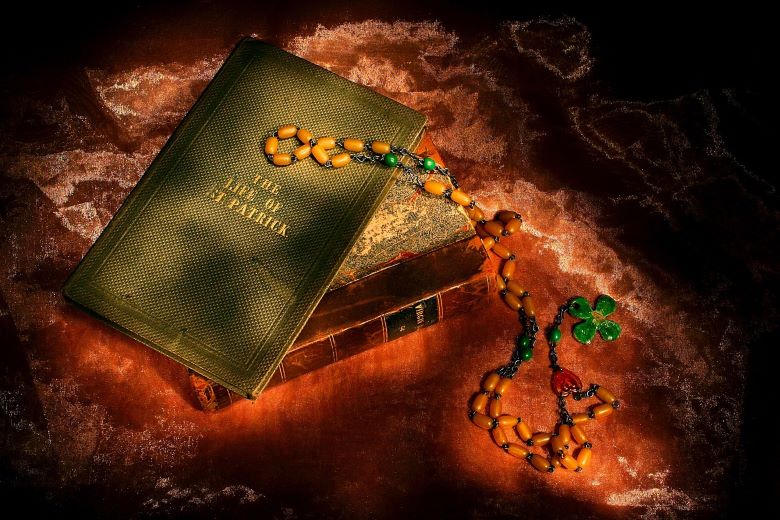
St. Patrick’s Day Pixabay Image by Geraldine Dukes
Who was St. Patrick and why do we celebrate his feast day?
Since the fifth and sixth centuries, Ireland has generally recognized three patron Saints, St. Columba (Irish: Colmcille), St. Brigid and St. Patrick. Patrick (Irish Pádraig) is the most well known of these saints outside Ireland itself.
Each of these Patron Saints has a specific characteristics that make them memorable.
St. Columba (Colmcille)
The name Columba is a Latinization of the Irish Gaelic name Comcille. It means Dove of the Church. Columba lived from 521 CE -597 CE.
Born in County Donegal, Colmcille was the great-great-grandson of one of the Irish High Kings, Niall of the Nine Hostages. While he was a monk, Colmcille wrote a book of Psalms and got into a dispute with his publisher which culminated in the Battle of Cul Dremhe in 561. The battle was a massacre on both sides. The case was taken before the High King who ruled in favor of the publisher.
In remorse for the deaths in the battle, Colmcille set out to convert the Picts in Scotland. While in Scotland, Colmcille performed miracles and other memorable acts which included rescuing a nobleman from the Loch Ness Monster.
Colmcille’s feast day is June 9, the recognized day of his death in 597 CE.
St. Brigid (Brigid of Kildare, Brigit, Brid)
Brigid of Kildare’s origins are a bit more obscure.
She is seen in two distinct but related ways.
Known officially as St. Brigid of Kildare (Brigit of Cill Dara), Brigid’s feast day is February 1 or 2, depending on tradition. St. Brigid’s Day is also celebrated in the Church as Candlemas, or the Day of Presentation.
Interestingly, the Feast of Candlemas was superimposed on a pagan festival, Imbolc, which marked the fading of the chill of winter and the promise of the renewal of spring.
Brigid has been associated with Imbolc long before Ireland was Christianized, as was done with many pagan festivals (Yule and Oester or Oestra, for example).
She is seen in the pagan tradition as the patroness of poetry, learning, healing, protection, blacksmithing, livestock and dairy production. In her honor, a perpetual fire was kept ablaze at Kildare for many centuries.
Both the pagan and Christian traditions hold that Brigid was born to a pagan priest (druid) and a Christian slave woman. According to the tradition, she traded her beauty for an opportunity to serve God.
Brigid is remembered today both as the Pagan Priestess of Imbolc and the Saint of the Church.
Her accurate place in history has not been clearly established.
St. Patrick (Pádraig)
St. Patrick (Pádraig in Irish) is, of course, the best known of the Patron Saints of Ireland.
His feast day is celebrated on March 17. St. Patrick’s Day is celebrated in many countries outside Ireland, most notably in the United States.
Happy St. Patrick’s Day Pixabay Image by Dmytro
Patrick (387 CE – 461 CE) was not Irish by birth. He was born in Roman Britain and captured at around the age of 14 by pirates from Ireland and was taken to Ireland as a slave to tend sheep.
In his time, Ireland was primarily a Pagan land which kept the old ways and Druids were still far more numerous than Catholic priests. Patrick turned to his faith and wrote his memoir, Confessions.
Patrick escaped captivity and returned to England where he, himself, became a priest.
Following his ordination, he returned to Ireland where he set out to convert the Pagans in the northern and western counties.
The traditions of the Church hold that Patrick became a bishop but dates and details have not yet been established.
What are the legends of St. Patrick?
Tradition says that Patrick preached to and converted Pagans all around Ireland, famously using the shamrock to explain the Trinity. (How the three-lobed shamrock has been confused with the four-leaf-clover over time and space is a testament to our willingness to place new ideas within pre-conceived categories.)
A somewhat questionable legend has emerged that Patrick ran all the snakes out of Ireland. To add to the confusion surrounding this claim is that the earliest text (seventh century) mentioning a saint running the snakes out of Ireland is a story about St. Columba.
Patrick is believed to be buried in Down Cathedral, Downpatrick. His grave was marked in 1990 with a granite stone.
How do we celebrate St. Patrick today?
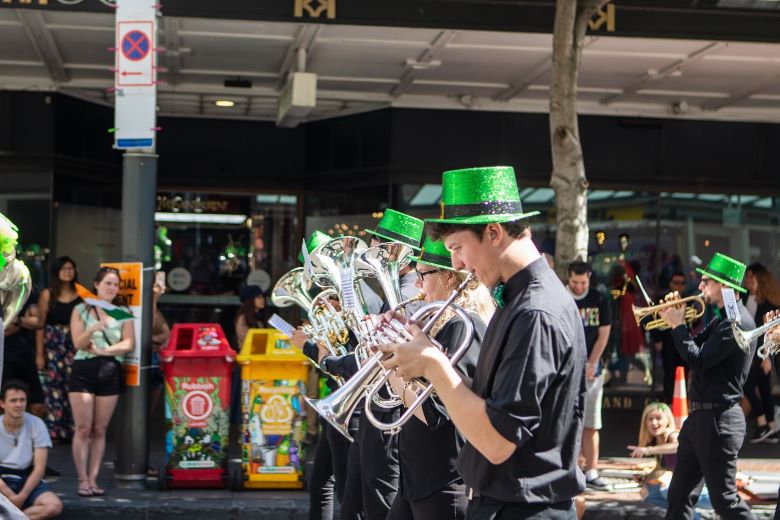
St. Patrick’s Day Parade Pixabay Image by Squirrel Photos
March 17 is celebrated as the (Catholic) Feast Day of St. Patrick or (secular) St. Patrick’s Day.
St. Patrick’s Day is celebrated all over the world by Irish people and by people who claim Irish ancestry. Celebrations are held in Ireland, in the U.S., in Canada, in Australia and New Zealand and in other places in the world.
People, communities, cities and organizations wear green clothing, display shamrocks (and four-leaf-clovers too), hold parades, parties, music festivals and also do extreme things like dying rivers green in downtown areas.
Like many once solemn religious occasions, the Feast of St. Patrick has been converted into a secular day of recognition of Ireland’s conversion to Christianity, the resilience of Irish people and drinking…lots of drinking.
Pagan
Catholic
Religion News

About William T. Orr, Jr.
William T. Orr, Jr. is a retired educator, most recently the principal of a high school named in the Top 10 in the nation by Newsweek magazine. Orr has a B.A. in English Language and Literature, a M.Ed. in Education Administration and Supervision, and an Ed.D. in Education leadership. He’s also completed Postdoctoral study at Yale Divinity School and Dallas Theological Seminary. You can read more about the author here.
Previous Post
March 10, 2024
Parables, Prophecies And Proverbs: The Iffy Gospel Of Thomas
Next Post
March 20, 2024 Just How Many Johns Are There In The New Testament?
Recent Comments
"It gives me great pride to share this column with my oldest son and research ..."
How Paul Turned a Dead Messiah ..."
"It seems that seeing clearly the image of Jesus in Revelation brings up a lot ..."
Bart Ehrman Decodes the Book of ..."
"Ehrman's book really helped me understand how the Bible holds incompatible notions of who Jesus ..."
Bart Ehrman Decodes the Book of ..."
"Thanks for reading and commenting.Do you mean me or Dr. Ehrman?"
Bart Ehrman Decodes the Book of ..."
Browse Our Archives
Select a Category Uncategorized
Select a Month May 2026 April 2026 March 2026 February 2026 January 2026 December 2025 November 2025 August 2025 July 2025 June 2025 May 2025 February 2025 January 2025 November 2024 October 2024 September 2024 August 2024 July 2024 June 2024 May 2024 April 2024 March 2024 February 2024 January 2024 December 2023 November 2023
TAKE THE
Religious Wisdom Quiz
What does the name "Jacob" mean?
Select your answer to see how you score.
Full of light Justified Supplanter Friend of God
Related posts from They Didn't Teach Me That...
Family
How Paul Turned a Dead Messiah Into Christianity's...
Family
Revelation's Jesus Isn't the Lamb — He's the...
Family
One Jesus, Four Gospels: Why They Disagree on...
Family
Bart Ehrman Decodes the Book of Revelation: What...
TRENDING AT PATHEOS History and Religion

In one sense walking into Westminster Abbey is like walking down the...

'Super Scam Me' Exposes AI Jon Bon Jovi...
Leslie Pickett believed she was in a relationship with Jon Bon Jovi....

The Brazilian Remake of Kendricks' 'Flywheel' Opens in...
“Flywheel,” the story that launched the Kendrick Brothers’ filmmaking career is getting...

The Dangers of Gradual Accommodation (Winking at Sin)
Recently, the “law of gradualness” resurfaced during the opening of a weeklong,...

The Iron Gates and the Lion of the...
Yesterday, I didn't finish my report about, well, yesterday. So I'll...

The Image: On the Horror of Capitalism and...
The Image Then went the Pharisees, and took counsel how they might...
view all History and Religion blogs
What Are Your Thoughts?leave a comment
Ad-Free & Subscriber Log-In Subscription Support
- About Us
- 2026 Calendar
- Videos
- Podcasts
- Library of World Religions
- Faith In Media Tracker
- Advertise With Us
- Write for Us
- Privacy Policy
- Terms of Service
- Do Not Sell My Data
- Contact Us
- Radiant Digital
- Manage Newsletter Subscriptions
- Unsubscribe From Notifications
- Sitemap
Copyright 2008-2026, Patheos. All rights reserved.
Subscription Support Ad-Free & Subscriber Log-In
Follow Patheos