
BuddhistCatholicContemplativeEvangelicalGeneral ChristianHinduJewishLatter-day SaintMuslimNew VisionsProgressive Christian
Beliefs
- Buddhist
- Catholic
- Contemplative
- Evangelical
- General Christian
- Hindu
- Jewish
- Latter-day Saint
- More Voices
- Muslim
- New Visions
- Pagan
- Progressive Christian
Topics
- Religion News
- Food and Religion
- Sports and Religion
- Religious Art
- Religious Music and Entertainment
- Religious Events
- History and Religion
- Style and Religion
- Politics and Religion
- Women in Religion
- Recreation Outdoors and Religion
- Business Finance and Religion
- Careers Workplace and Religion
- Education and Religion
- Family Parenting and Religion
- Health Fitness and Religion
- Home and Religion
- Relationships and Religion
- Technology and Religion
- Travel and Religion
Columnists
- Buddhist Columnists
- Business Finance and Religion Columnists
- Careers Workplace and Religion Columnists
- Catholic Columnists
- Contemplative Columnists
- Education and Religion Columnists
- Evangelists Columnists
- Family Parenting and Religion Columnists
- General Christian Columnists
- Health Fitness and Religion Columnists
- Hindu Columnists
- History and Religion Columnists
- Home and Religion Columnists
- Jewish Columnists
- More Voices Columnists
- Latter Day Columnists
- Muslim Columnists
- New Visions Columnists
- Nonreligious Columnists
- Pagan Columnists
- Politics and Religion Columnists
- Progressive Columnists
- Recreation Outdoors and Religion Columnists
- Relationships and Religion Columnists
- Religion News Columnists
- Religious Art Columnists
- Religious Events Columnists
- Religious Music and Entertainment Columnists
- Sports and Religion Columnists
- Style and Religion Columnists
- Technology and Religion Columnists
- Travel and Religion Columnists
- Women in Religion Columnists
Resource Library
- 2026 Calendar
- Library of World Religions
- The 100 Most Holy Places on Earth
- Patheos Answers
- Podcasts
- Videos
- Faith Leaders Database
- Anglican Episcopalian
- Bahai
- Baptist
- Buddhism
- Christianity
- Confucianism
- Eastern Orthodoxy
- Hinduism
- Holiness and Pentecostal
- ISKCON
- Islam
- Judaism
- Lutheran
- Methodist
- The Church of Jesus Christ of Latter-day Saints
- New Age
- Paganism
- Presbytarian and Reformed
- Protestantism
- Religion Behind the Scenes
- Roman Catholic
- Scientology
- Shia Islam
- Sikhism
- Sufism
- Sunni Islam
- Taoism
- Zen
- See all religions
Research Tools
 Ad-Free & Subscriber Log-In Subscription Support
Ad-Free & Subscriber Log-In Subscription Support
Follow Patheos 

- Trending:
- Forgiveness
- |
- Marriage
- |
- Consciousness
- |
- Death Penalty
- |
- Election
- |
- Halloween
 The Wondering Jew
- Home
- Jewish
- Voting: A Jewish Obligation?
Voting: A Jewish Obligation?
Last updated on: November 5, 2024 at 9:07 am by Rabbi David Feder
Voting: A Jewish Obligation? 2024-11-05T09:07:39-05:00 Rabbi David Feder
Patheos Explore the world's faith through different perspectives on religion and spirituality! Patheos has the views of the prevalent religions and spiritualities of the world.
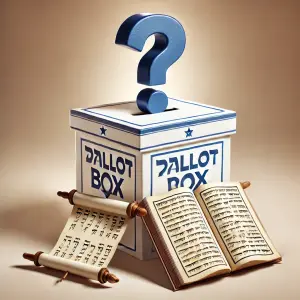
Is there a Jewish Commandment to Vote?
The election is upon us. God-willing this will mean it is once again safe to watch television and listen to the radio without the endless stream of campaign ads and that the spam levels in our inboxes will return to a normal, almost manageable level. For the cynics among us, election season calls to mind the lyrics of Pete Townsend:
“There’s nothing in the street
Looks any different to me
And the slogans are effaced, by-the-bye
And the parting on the left
Is now parting on the right
And the beards have all grown longer overnight
…….
Then I’ll get on my knees and pray
We don’t get fooled again.”
The bright-eyed optimists in our midst are filled with the hope and expectation of change and echo the sentiments of Little Orphan Annie:
“The sun’ll come out
Tomorrow
Bet your bottom dollar
That tomorrow
There’ll be sun!”
But is there a Jewish perspective on voting?
I don’t mean is there a stance on significant issues such as support for Israel, providing for those in most need of assistance, healthcare and dozens of other issues. I mean is there an obligation to vote?
Democracy was not really a concept in Biblical times. The priesthood and monarchy were privileged and everyone else, not so much. Throughout succeeding centuries, the situation was relatively unchanged, whether one was living in Roman Italy, Sassanian Persia, the mellahs of Casablanca or the courts of Vienna. An absolute ruler fashioned the rules under which you lived.
Sometimes there was greater tolerance, sometimes greater oppression, but the individual had no control over his or her fate. Within the Jewish community, sometimes the titular head was appointed, sometimes chosen by community elites, and in some circumstances, the entire population voiced their opinion. By and large, however, people were forced to accept what fate dealt them.
Requirements for an appointed leader?
That doesn’t mean that there aren’t Jewish sources on voting or civic responsibilities. Tractate Berachot in the Talmud has one of the earliest sources that touches on the consent of the governed. According to Rabbi Yitzchak, when Bezalel was appointed as the chief artisan for the construction of the Tabernacle in the wilderness, God asked Moses if Bezalel was acceptable to Moses, and then told him to go consult with the community. The lesson derived here is that one may only appoint a leader if he consults with the community and they agree to the appointment.
Civic Responsibility?
Moving forward about a thousand years after the compilation of the Talmud. Yoseph Karo in 16th century Safed, created the Shulchan Aruch as a code of Jewish law. Rabbi Moses Isserles, the Rema, provided glosses to the text to make it applicable for Ashkenazi Jews. In Choshen Mishpat 163:1, he writes,
“For any community matter on which they cannot find common ground, they should convene all taxpayers, and they should agree that each will voice his view altruistically, and they will follow the majority.”
Beyond needing the consent of the governed, we have progressed to how to settle conflicts over public spending and utilization of public resources. You gather the people together and vote. Now this was not entirely democratic. Those who didn’t pay taxes (the poor and women, most notably) were excluded from voicing their opinion. But the opinion of the majority, so long as it didn’t deviate from established Jewish or civil law, held sway.
Gratitude Requires Engagement
The other major concept supporting the obligation to vote is that of hakarat hatov, recognizing the benefits that we have and expressing gratitude and appreciation. Because of all the benefits we have gained from society: education, roads, sanitation, public health, security, and more, our recognition of that benefit compels us to determine the future direction of those benefits to ourselves and those who follow us.
Consequences of Not Being Involved
Jewish tradition clearly says that it is a good thing to vote, demonstrating both enlightened self-interest and regard for communal welfare. What if one decides not to vote? Midrash Tachuma provides a response:
“If a person of learning participates in public affairs and serves as judge or arbiter, that person gives stability to the land… But if a person sits in their home and says to themselves, “What have the affairs of society to do with me?… Why should I trouble myself with the people’s voices of protest? Let my soul dwell in peace!”—if one does this, they overthrow the world.”
The candidates running for your local, state, or national office might not be ideal. You might have reservations about supporting either candidate for a particular race. You might even feel forced to ask which is the lesser of the two evils and still be unsure, but that doesn’t release us from the obligation to have a voice in consenting to our leaders and determining what is best for our community.
May we choose wisely and may they be granted wisdom.
Previous Post
November 1, 2024
Noah: Trauma, Survival, and Finding Hope After Catastrophe
Next Post

November 8, 2024 Embracing Disappointment: Learning from Abraham
Recent Comments
"I verymuch enjoyed this article, thanks!"
Sukkot: Shelters of Vulnerability
Browse Our Archives
Select a Category Uncategorized
Select a Month December 2024 November 2024 October 2024 September 2024
TAKE THE
Religious Wisdom Quiz
I asked for wisdom above all else, and God granted me riches and honor as well. Who am I?
Select your answer to see how you score.
Josiah Hezekiah David Solomon
Related posts from The Wondering Jew

Chanukah: Minor Holiday or Source of Identity?
Joseph's Lesson: Being Present & Breaking the Cycle
Jacob, Esau, and Lessons for the Holiday Season

Confronting Fear: A Journey toward Adulting and Growth
TRENDING AT PATHEOS Jewish

Building a Little Ark in a Frightening World
This past Shabbat, we read about Noah. I love this story. The...

Yom Kippur : Is There Always Room for...
Making Room for Forgiveness Every year as Yom Kippur approaches, I find...

This Rosh Hashanah: Can I Find New Meaning?
A Sunrise, a New Year, and a Question On our way to...

Killing Amalek: The Torah’s Most Misunderstood Commandment
Few passages of the Torah have provoked more confusion, polemic, and misuse...

I have never trusted a first draft. I don’t mean that...

Back to School, Back to Reality—and a New...
A New School Year Begins… Back to Reality A new school year...
view all Jewish blogs
Ad-Free & Subscriber Log-In Subscription Support
- About Us
- 2026 Calendar
- Videos
- Podcasts
- Library of World Religions
- Faith In Media Tracker
- Advertise With Us
- Write for Us
- Privacy Policy
- Terms of Service
- Do Not Sell My Data
- Contact Us
- Radiant Digital
- Manage Newsletter Subscriptions
- Unsubscribe From Notifications
- Sitemap
Copyright 2008-2026, Patheos. All rights reserved.
Subscription Support Ad-Free & Subscriber Log-In
Follow Patheos