
BuddhistCatholicContemplativeEvangelicalGeneral ChristianHinduJewishLatter-day SaintMuslimNew VisionsProgressive Christian
Beliefs
- Buddhist
- Catholic
- Contemplative
- Evangelical
- General Christian
- Hindu
- Jewish
- Latter-day Saint
- More Voices
- Muslim
- New Visions
- Pagan
- Progressive Christian
Topics
- Religion News
- Food and Religion
- Sports and Religion
- Religious Art
- Religious Music and Entertainment
- Religious Events
- History and Religion
- Style and Religion
- Politics and Religion
- Women in Religion
- Recreation Outdoors and Religion
- Business Finance and Religion
- Careers Workplace and Religion
- Education and Religion
- Family Parenting and Religion
- Health Fitness and Religion
- Home and Religion
- Relationships and Religion
- Technology and Religion
- Travel and Religion
Columnists
- Buddhist Columnists
- Business Finance and Religion Columnists
- Careers Workplace and Religion Columnists
- Catholic Columnists
- Contemplative Columnists
- Education and Religion Columnists
- Evangelists Columnists
- Family Parenting and Religion Columnists
- General Christian Columnists
- Health Fitness and Religion Columnists
- Hindu Columnists
- History and Religion Columnists
- Home and Religion Columnists
- Jewish Columnists
- More Voices Columnists
- Latter Day Columnists
- Muslim Columnists
- New Visions Columnists
- Nonreligious Columnists
- Pagan Columnists
- Politics and Religion Columnists
- Progressive Columnists
- Recreation Outdoors and Religion Columnists
- Relationships and Religion Columnists
- Religion News Columnists
- Religious Art Columnists
- Religious Events Columnists
- Religious Music and Entertainment Columnists
- Sports and Religion Columnists
- Style and Religion Columnists
- Technology and Religion Columnists
- Travel and Religion Columnists
- Women in Religion Columnists
Resource Library
- 2026 Calendar
- Library of World Religions
- The 100 Most Holy Places on Earth
- Patheos Answers
- Podcasts
- Videos
- Faith Leaders Database
- Anglican Episcopalian
- Bahai
- Baptist
- Buddhism
- Christianity
- Confucianism
- Eastern Orthodoxy
- Hinduism
- Holiness and Pentecostal
- ISKCON
- Islam
- Judaism
- Lutheran
- Methodist
- The Church of Jesus Christ of Latter-day Saints
- New Age
- Paganism
- Presbytarian and Reformed
- Protestantism
- Religion Behind the Scenes
- Roman Catholic
- Scientology
- Shia Islam
- Sikhism
- Sufism
- Sunni Islam
- Taoism
- Zen
- See all religions
Research Tools
 Ad-Free & Subscriber Log-In Subscription Support
Ad-Free & Subscriber Log-In Subscription Support
Follow Patheos 

- Trending:
- Forgiveness
- |
- Marriage
- |
- Consciousness
- |
- Death Penalty
- |
- Election
- |
- Halloween
 The Wondering Jew
- Home
- Jewish
- History and Religion
- Identity: Do We Have to Choose?
Identity: Do We Have to Choose?
Last updated on: November 22, 2024 at 6:18 pm by Rabbi David Feder
Identity: Do We Have to Choose? 2024-11-22T18:18:00-05:00 Rabbi David Feder
Patheos Explore the world's faith through different perspectives on religion and spirituality! Patheos has the views of the prevalent religions and spiritualities of the world.
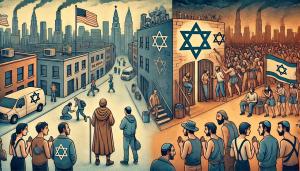
Being between worlds from Abraham’s time until today
I recently read The Dance of the Demons by Esther Kreitman, the older sister of Israel Joshua and Isaac Bashevis Singer, originally published in 1936. Perusing this week’s Torah portion, Chayei Sarah (Genesis 23:1-25:18), I was struck by similarities between the two. On the surface there is little to connect the two. Kreitman’s novel tells a veiled autobiographical tale of a rabbi’s daughter in Poland who feels alienated from her family, the greater community, and the role that she is expected to play. The tale from Genesis tells the story of Sarah’s death and burial, followed by the mission of Abraham’s servant to find a suitable wife for Isaac.
Abraham: Esteemed Outsider?
The unifying theme is that of being an outsider. Abraham, living in what is today, Hebron, describes himself as a resident alien. Rabbi David Kimchi (12th-13th C. Provence), comments “I describe myself first and foremost as a stranger, seeing that I have come from another country. Yet I also describe myself as a resident, seeing that I have lived among you for many years, and I intend to continue to remain among you.” He sees himself in an in-between space. He has lived there for many years, but is not from there. He is part of the community, respected by its inhabitants, but he owns no land and lives there in the sufferance of its Hittite inhabitants. And so, he enters a complex public dance at the city gates negotiating to purchase a burial site for Sarah from Ephron the Hittite.
Initially, the populace urges Abraham to bury his dead in the choicest of local sites; no one will withhold a place from him. Abraham then asks the populace to intercede on his behalf with Ephron, who is standing in their midst. Ephron offers the land as a gift, Abraham demands to pay for it. Ephron counters by saying what is 400 shekels between us, at which point Abraham offers payment of 400 shekels with the entire community serving as witnesses to the transaction.
So why is it so important that Abraham buy a plot that is offered to him as a gift more than once? If the land still belongs to Ephron, he can still do with it as he pleases. He can turn it into condominiums, a golf course, or a strip mall. Abraham wants something permanent in contradistinction to his peripatetic existence.
Are We Abraham’s Heirs?
That sense of otherness, of being an outsider, of being in the land, but not rooted to the land, has continued across the centuries. After the fall of ancient Judea, the next country to give Jews the right of citizenship was the United States, followed shortly thereafter by France, and then gradually other European states. Citizenship did not (and still does not) necessarily mean acceptance. Suspicions of disloyalty, dual loyalty, or being a fifth column reverberate across the modern world.
Whether one is talking about the fallout of the Dreyfus affair on French Jewry, the impact of the Cremieux Decree on the Jews of Algeria, or the restrictions that came with greater tolerance in Austria-Hungary’s Edict of Toleration, the Jewish population was viewed as being somewhat foreign, not really French, or Algerian, or fill in the country of your choice.
Outsiders Without Esteem?
I wish I could say that this was merely a historical artifact and that society has moved beyond this attitude toward greater, if not full, acceptance. Unfortunately, a spirit of nativism has swept over large swaths of the globe. And in many cases, it is the Jews who have been labeled as the other and the reason for the decline of the French, or the British, or the Americans.
In addition, we see growing references to “the Jewish lobby”, Jews controlling the media, or Jews controlling the government, and even a resurgence of discussions of the “Jewish problem”. Witness the JP Conference held in Somerset, Kentucky this past summer that brought together right -wing extremists, white nationalists, and black nationalists to discuss solution to the Jewish problem in the United States.
Similarly, during campus protests against Israel and Zionism, Jews are still frequently treated as not belonging on campus. Support for, or even an affinity for, Israel was sufficient to exclude individuals from campus and American life. Violent rhetoric, harassment, vandalism, and even physical assault against Jews have become normalized, as Israel and the Jewish people continue to be pushed to the margins of society.
Not so long ago, being in that in-between space was an advantage for reflecting upon societal norms and expectations, especially when looking at life from the margins. Kafka’s Gregor Samsa, J. D. Salinger’s Holden Caulfield, and Philip Roth’s Neil Klugman can offer readers a greater understanding of the human condition by their somehow being in-between, whether one is looking at socio-economic status, age, or social integration.
It is becoming increasingly difficult to keep one foot in and one out. Where Abraham could describe himself as having a bifurcated identity and being comfortable with it, more and more it seems, we are being asked to firmly plant our feet in one camp or another and in doing so deny aspects of our identity. It is up to us to follow Abraham’s example. Just as he set out for a new land and society, carrying with him, the memories and experiences of Mesopotamia, his journey was toward wholeness and completeness. We cannot be complete without honoring all of our influences and every aspect of our identity. Let us push back on those forces that seek to restrict us and continue to forge our own path.
History and Religion
Politics and Religion
Previous Post
November 13, 2024
Have We Become Like Sodom?
Next Post
November 28, 2024 Thanksgiving: Family Dynamics Today and in Biblical Times
Recent Comments
"I verymuch enjoyed this article, thanks!"
Sukkot: Shelters of Vulnerability
Browse Our Archives
Select a Category Uncategorized
Select a Month December 2024 November 2024 October 2024 September 2024
TAKE THE
Religious Wisdom Quiz
My reign brought prosperity until pride led me to burn incense in the temple, resulting in leprosy. Who am I?
Select your answer to see how you score.
Hezekiah Uzziah Asa Josiah
Related posts from The Wondering Jew
Chanukah: Minor Holiday or Source of Identity?
Joseph's Lesson: Being Present & Breaking the Cycle
Jacob, Esau, and Lessons for the Holiday Season
Confronting Fear: A Journey toward Adulting and Growth
TRENDING AT PATHEOS Jewish

Building a Little Ark in a Frightening World
This past Shabbat, we read about Noah. I love this story. The...

Yom Kippur : Is There Always Room for...
Making Room for Forgiveness Every year as Yom Kippur approaches, I find...

This Rosh Hashanah: Can I Find New Meaning?
A Sunrise, a New Year, and a Question On our way to...

Killing Amalek: The Torah’s Most Misunderstood Commandment
Few passages of the Torah have provoked more confusion, polemic, and misuse...

I have never trusted a first draft. I don’t mean that...

Back to School, Back to Reality—and a New...
A New School Year Begins… Back to Reality A new school year...
view all Jewish blogs
Ad-Free & Subscriber Log-In Subscription Support
- About Us
- 2026 Calendar
- Videos
- Podcasts
- Library of World Religions
- Faith In Media Tracker
- Advertise With Us
- Write for Us
- Privacy Policy
- Terms of Service
- Do Not Sell My Data
- Contact Us
- Radiant Digital
- Manage Newsletter Subscriptions
- Unsubscribe From Notifications
- Sitemap
Copyright 2008-2026, Patheos. All rights reserved.
Subscription Support Ad-Free & Subscriber Log-In
Follow Patheos