
BuddhistCatholicContemplativeEvangelicalGeneral ChristianHinduJewishLatter-day SaintMuslimNew VisionsProgressive Christian
Beliefs
- Buddhist
- Catholic
- Contemplative
- Evangelical
- General Christian
- Hindu
- Jewish
- Latter-day Saint
- More Voices
- Muslim
- New Visions
- Pagan
- Progressive Christian
Topics
- Religion News
- Food and Religion
- Sports and Religion
- Religious Art
- Religious Music and Entertainment
- Religious Events
- History and Religion
- Style and Religion
- Politics and Religion
- Women in Religion
- Recreation Outdoors and Religion
- Business Finance and Religion
- Careers Workplace and Religion
- Education and Religion
- Family Parenting and Religion
- Health Fitness and Religion
- Home and Religion
- Relationships and Religion
- Technology and Religion
- Travel and Religion
Columnists
- Buddhist Columnists
- Business Finance and Religion Columnists
- Careers Workplace and Religion Columnists
- Catholic Columnists
- Contemplative Columnists
- Education and Religion Columnists
- Evangelists Columnists
- Family Parenting and Religion Columnists
- General Christian Columnists
- Health Fitness and Religion Columnists
- Hindu Columnists
- History and Religion Columnists
- Home and Religion Columnists
- Jewish Columnists
- More Voices Columnists
- Latter Day Columnists
- Muslim Columnists
- New Visions Columnists
- Nonreligious Columnists
- Pagan Columnists
- Politics and Religion Columnists
- Progressive Columnists
- Recreation Outdoors and Religion Columnists
- Relationships and Religion Columnists
- Religion News Columnists
- Religious Art Columnists
- Religious Events Columnists
- Religious Music and Entertainment Columnists
- Sports and Religion Columnists
- Style and Religion Columnists
- Technology and Religion Columnists
- Travel and Religion Columnists
- Women in Religion Columnists
Resource Library
- 2026 Calendar
- Library of World Religions
- The 100 Most Holy Places on Earth
- Patheos Answers
- Podcasts
- Videos
- Faith Leaders Database
- Anglican Episcopalian
- Bahai
- Baptist
- Buddhism
- Christianity
- Confucianism
- Eastern Orthodoxy
- Hinduism
- Holiness and Pentecostal
- ISKCON
- Islam
- Judaism
- Lutheran
- Methodist
- The Church of Jesus Christ of Latter-day Saints
- New Age
- Paganism
- Presbytarian and Reformed
- Protestantism
- Religion Behind the Scenes
- Roman Catholic
- Scientology
- Shia Islam
- Sikhism
- Sufism
- Sunni Islam
- Taoism
- Zen
- See all religions
Research Tools
 Ad-Free & Subscriber Log-In Subscription Support
Ad-Free & Subscriber Log-In Subscription Support
Follow Patheos 

- Trending:
- Forgiveness
- |
- Marriage
- |
- Consciousness
- |
- Death Penalty
- |
- Election
- |
- Halloween
 The Wondering Jew
- Home
- Jewish
- History and Religion
- Have We Become Like Sodom?
Have We Become Like Sodom?
Last updated on: November 14, 2024 at 8:03 am by Rabbi David Feder
Have We Become Like Sodom? 2024-11-14T08:03:24-05:00 Rabbi David Feder
Patheos Explore the world's faith through different perspectives on religion and spirituality! Patheos has the views of the prevalent religions and spiritualities of the world.
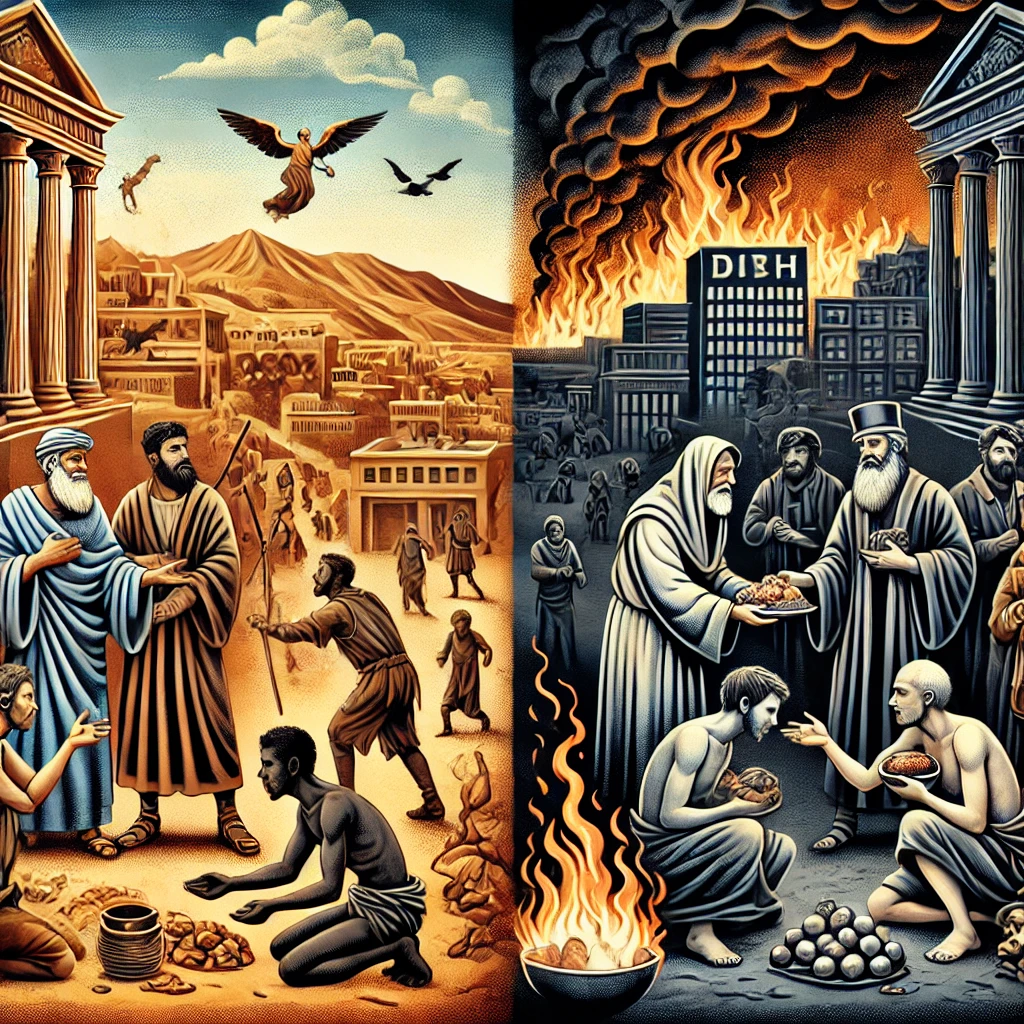
Selfishness and Greed Today’s Sodom | AI image by Author
This week’s Torah portion, Vayera (Genesis 18:1-22:24) contains at least one story with which we’re all familiar, the story of Sodom and Gomorrah: fire, brimstone, and Lot’s wife being turned into a pillar of salt. But why were these cities destroyed? What’s the sin of Sodom? It’s probably not the answer you expect. The sin of Sodom is not sexual in nature, but both personal and social. Sodom was destroyed because of all-consuming selfishness and greed.
Rabbinic sources, primarily the midrashic collection Pirke deRabbi Eliezer and the Talmudic tractate Sanhedrin are filled with examples depicting the character of Sodom’s residents. They detail that there was no cause for the residents to be exceedingly careful with their resources. On the contrary, Sodom was on a rich agricultural plain with plentiful supplies of water that made it fertile land for farming and grazing. Furthermore, the rabbis say they possessed gold, silver, and precious gems. They had more than they needed, but that wasn’t enough.
Greed isn’t good
Fearful that they might lose some fruit from their trees, they surrounded them with netting to be sure that, not only would a passerby be unable to take an apple, but also birds would also be prevented from reaching the trees.
To preserve their own good fortune, they outlawed showing kindness to the poor and the stranger. If a beggar were found begging for bread, each resident would give the beggar a coin and write their own name on it. When the beggar attempted to buy bread, no one would sell to him and eventually he would die of starvation. Once he died, each person would retrieve the coin they had given. Finally, they punished anyone who would dare share his or her good fortune with anyone less fortunate. There was a young woman who would secretly share her bread with the poor. When her actions were discovered, she was placed on the walls of the city, smeared with honey, and left for the hornets who were to sting her to death. Her death, it is said, sealed the fate of Sodom.
Fear of strangers, assuming the worst of them, anxiety over losing resources, and legislating to make certain that only citizens could derive any public benefits, including charity, as well as demonstrating unnecessary cruelty toward the poor and the stranger marked Sodom for divine extirpation. That likely only sped up its demise. The fearfulness shown toward outsiders, the distrust of fellow residents, and the attitude of “I’ve got mine” would have led to the city eventually tearing itself apart.
Fear Isolates
No community can exist when people live in isolation, especially when separation is a choice. There can be no sense of camaraderie when each person eyes his or her neighbor with distrust. If we’re so afraid of losing out by sharing what we have, then we are truly lost.
We see the signs of “Sodomism” all around us. We hear daily the demonization of immigrants, especially those who are undocumented. We see callousness, rather than compassion to their plight. And we hear criticism of any who suggest ways of easing their burden.
I’m not suggesting that we have open borders or pour a never-ending stream of resources into solving the problems of poverty, or simply permit homeless camps to appear anywhere. These are all complex problems that require careful thought, balanced action, and judicious utilization of resources.
I am saying that mean-spiritedness, assigning blame and responsibility to many who are themselves victims, and aggressively defending resources like a toddler hoarding his toys is not the right course of action. Not only does it weaken the already fraying fabric of community, but also poisons those individuals who hold those views. Today, the blame falls on those from Central America; tomorrow, it’s the people in Washington; and the next day, it will be the people on the other side of town. After that, they’re barricaded in their home, completely isolated, and expanding their enemies’ list. Like the Grinch, their hearts are three sizes too small.
Responsibility for Each Other
And like the Grinch, there is always the possibility of change, of recognizing the error of our ways and the blunders in our thoughts. Perhaps as we move toward Thanksgiving, it is time to spend more time focusing on the lessons of this season. We can remember the gratitude of the Pilgrims for the bounty shared with them and the graciousness of the Wampanoag who not only shared what they had, but also helped provide these newcomers to a foreign shore the skills to provide for themselves.
We learn the lesson of Sodom when we look to cooperation before conflict, deliberation before demonization, and empathy before enmity. We have all experienced being the stranger; we have all known difficult times; we have all received a helping hand or a word of encouragement at an opportune time. Let’s learn from our own experience and biblical example and not suffer the same fate as Sodom.
History and Religion
Previous Post
November 8, 2024
Embracing Disappointment: Learning from Abraham
Next Post
November 22, 2024 Identity: Do We Have to Choose?
Recent Comments
"I verymuch enjoyed this article, thanks!"
Sukkot: Shelters of Vulnerability
Browse Our Archives
Select a Category Uncategorized
Select a Month December 2024 November 2024 October 2024 September 2024
TAKE THE
Religious Wisdom Quiz
Which Christian principle is shown by the story of the widow's mite?
Select your answer to see how you score.
Never give Give to be seen Give only if rich Generosity from the heart
Related posts from The Wondering Jew
Chanukah: Minor Holiday or Source of Identity?
Joseph's Lesson: Being Present & Breaking the Cycle
Jacob, Esau, and Lessons for the Holiday Season
Confronting Fear: A Journey toward Adulting and Growth
TRENDING AT PATHEOS Jewish

Building a Little Ark in a Frightening World
This past Shabbat, we read about Noah. I love this story. The...

Yom Kippur : Is There Always Room for...
Making Room for Forgiveness Every year as Yom Kippur approaches, I find...

This Rosh Hashanah: Can I Find New Meaning?
A Sunrise, a New Year, and a Question On our way to...

Killing Amalek: The Torah’s Most Misunderstood Commandment
Few passages of the Torah have provoked more confusion, polemic, and misuse...

I have never trusted a first draft. I don’t mean that...

Back to School, Back to Reality—and a New...
A New School Year Begins… Back to Reality A new school year...
view all Jewish blogs
Ad-Free & Subscriber Log-In Subscription Support
- About Us
- 2026 Calendar
- Videos
- Podcasts
- Library of World Religions
- Faith In Media Tracker
- Advertise With Us
- Write for Us
- Privacy Policy
- Terms of Service
- Do Not Sell My Data
- Contact Us
- Radiant Digital
- Manage Newsletter Subscriptions
- Unsubscribe From Notifications
- Sitemap
Copyright 2008-2026, Patheos. All rights reserved.
Subscription Support Ad-Free & Subscriber Log-In
Follow Patheos