
BuddhistCatholicContemplativeEvangelicalGeneral ChristianHinduJewishLatter-day SaintMuslimNew VisionsProgressive Christian
Beliefs
- Buddhist
- Catholic
- Contemplative
- Evangelical
- General Christian
- Hindu
- Jewish
- Latter-day Saint
- More Voices
- Muslim
- New Visions
- Pagan
- Progressive Christian
Topics
- Religion News
- Food and Religion
- Sports and Religion
- Religious Art
- Religious Music and Entertainment
- Religious Events
- History and Religion
- Style and Religion
- Politics and Religion
- Women in Religion
- Recreation Outdoors and Religion
- Business Finance and Religion
- Careers Workplace and Religion
- Education and Religion
- Family Parenting and Religion
- Health Fitness and Religion
- Home and Religion
- Relationships and Religion
- Technology and Religion
- Travel and Religion
Columnists
- Buddhist Columnists
- Business Finance and Religion Columnists
- Careers Workplace and Religion Columnists
- Catholic Columnists
- Contemplative Columnists
- Education and Religion Columnists
- Evangelists Columnists
- Family Parenting and Religion Columnists
- General Christian Columnists
- Health Fitness and Religion Columnists
- Hindu Columnists
- History and Religion Columnists
- Home and Religion Columnists
- Jewish Columnists
- More Voices Columnists
- Latter Day Columnists
- Muslim Columnists
- New Visions Columnists
- Nonreligious Columnists
- Pagan Columnists
- Politics and Religion Columnists
- Progressive Columnists
- Recreation Outdoors and Religion Columnists
- Relationships and Religion Columnists
- Religion News Columnists
- Religious Art Columnists
- Religious Events Columnists
- Religious Music and Entertainment Columnists
- Sports and Religion Columnists
- Style and Religion Columnists
- Technology and Religion Columnists
- Travel and Religion Columnists
- Women in Religion Columnists
Resource Library
- 2026 Calendar
- Library of World Religions
- The 100 Most Holy Places on Earth
- Patheos Answers
- Podcasts
- Videos
- Faith Leaders Database
- Anglican Episcopalian
- Bahai
- Baptist
- Buddhism
- Christianity
- Confucianism
- Eastern Orthodoxy
- Hinduism
- Holiness and Pentecostal
- ISKCON
- Islam
- Judaism
- Lutheran
- Methodist
- The Church of Jesus Christ of Latter-day Saints
- New Age
- Paganism
- Presbytarian and Reformed
- Protestantism
- Religion Behind the Scenes
- Roman Catholic
- Scientology
- Shia Islam
- Sikhism
- Sufism
- Sunni Islam
- Taoism
- Zen
- See all religions
Research Tools
 Ad-Free & Subscriber Log-In Subscription Support
Ad-Free & Subscriber Log-In Subscription Support
Follow Patheos 

- Trending:
- Forgiveness
- |
- Marriage
- |
- Consciousness
- |
- Death Penalty
- |
- Election
- |
- Halloween
 The Wondering Jew
- Home
- Jewish
- History and Religion
- You Will Become What You Eat
You Will Become What You Eat
Last updated on: October 17, 2024 at 10:44 am by Rabbi David Feder
You Will Become What You Eat 2024-10-17T10:44:03-04:00 Rabbi David Feder
Patheos Explore the world's faith through different perspectives on religion and spirituality! Patheos has the views of the prevalent religions and spiritualities of the world.
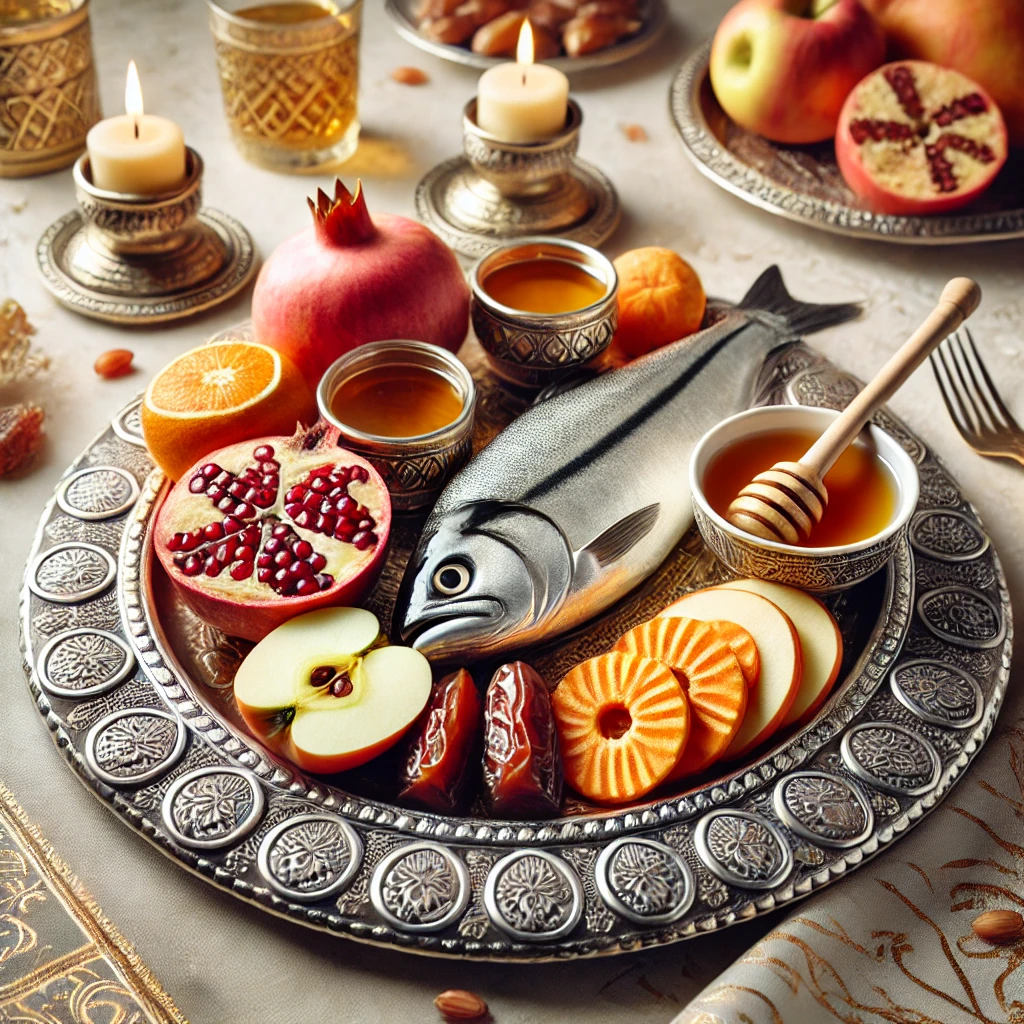
Rosh Hashanah Seder plate / Image created in Dalle by author
People have been eating symbolic foods almost as long as we’ve been cultivating plants and raising animals for food. Eating food for what it represents makes abstract concepts like fortune, security, and longevity, concrete, as well as enabling us to literally digest and internalize them. Eating is also an act of building or strengthening community. We reach out to others, share both what we have and what we hope, and build kinship and cooperation. Most symbolic foods point to either something we hope the future will bring or connect us to some past event.
We can look to examples all over the world. Throughout the South in the United States people eat black-eyed peas, greens, and cornbread for New Years for wealth: peas for pennies, greens for dollars, and cornbread for gold. In Chinese tradition, for the Lunar New Year, noodles are consumed for long life, oranges for prosperity, and fish for abundance. Persian tradition has the seven items of the Haft-seen served for Nowruz symbolizing growth, prosperity, and fertility.
Symbolic foods and Judaism
Judaism is especially rich in symbolic foods. The best example is the Passover Seder with all of the items on and surrounding the Seder plate connected to telling the story of the journey from slavery to freedom. On Shavuot everyone agrees that dairy foods are to be consumed, but no one seems to agree on the exact reason why. (That’s a subject for another column.) Stuffed vegetables are eaten on Sukkot reflecting a bountiful harvest completed or the promise of a future one. On Purim we eat triangular dishes resembling Haman’s hat or ears; on Chanukah foods are fried in oil in remembrance of the miracle of the oil.
Rosh Hashanah is extraordinarily rich in symbolic dining. Most people are familiar with the tradition of eating apples and honey celebrating the hope for a sweet new year. The blessing formula used prior to tasting is repeated for all of the symbolic foods consumed, “Yehi ratzon milfanecha Adonai Eloheinuu v’Elohei avoteinu, shet’chadeish aleinu shanah tovah u’m’tukah – May it be Your will, Our God and God of our ancestors that you renew us for a good and sweet new year.”
Where does this tradition come from?
Like most observances, it emerges from the Talmud and expands as time moves on. Twice in the Talmud, the sage Abbaye urges people to either look at or eat symbolic foods such as squash, beans or fenugreek, leeks, beets, and dates. Who wants to just look at food? Option number two became the preferred choice and people began to ingest their hopes for the coming year. These foods are meaningful because of the wordplay used with their names. They can also be divided into 2 categories: increasing good things from us and decreasing bad things from our enemies.
What is the meaning behind the foods eaten on Rosh Hashanah?
Squash or pumpkin, kara in Aramaic, sounds like the words to tear in Hebrew. Therefore one hopes that all evil decrees will be torn up during the coming year.
Rubia’s meaning is uncertain. While some say it means fenugreek and others a bean like a black-eyed pea, everyone connects it to the Hebrew verb, yirbu, to increase. People hope that their good deeds or merits increase during the coming year.
Leeks or karti are connected to karet, being cut off. We express the hope that those who hate us and wish to do us harm be cut off.
Silka, beets, are related to the Hebrew word salak, to go away, or silek, to retreat. Beets are eaten with the hope that those who seek to do us harm will retreat and depart from us.
Finally, dates or tamar, is connected to the Hebrew tam, to be finished or to end. Once again, it is a plea to remove all those who seek to do us harm.
Once the Talmud gave symbolic foods their start, traditions multiplied, typically related to both what was available in the region and the language spoken there.
Pomegranates with their vast number of seeds easily became associated with the hope that our good deeds, mitzvot, and merits all increase in the future.
The head of a fish or of a sheep expresses the wish that we be the head and not the tail.
Yiddish-speaking Jews eat carrots (mehren), resembling mehr (more) in the hope that the year ahead will be abundant materially and spiritually.
Which foods are eaten, and which formulation of the blessing are not as important as the act itself. Eating any of these foods and expressing some form of desire, wish, or prayer is a means of entering the new year with intentionality. Furthermore, it is a means of involving the whole person, all the senses. We see, smell, touch, and taste the food as we connect this act with our tradition and with our hopes and dreams for the future. May the new year ahead, 5785, bring each of us the realization of our hopes and prayers.
History and Religion
Food and Religion
Previous Post

September 25, 2024
The Sounds of Change
Next Post

October 6, 2024 We Remember Each One of Them: October 7 and Our Losses
Recent Comments
"I verymuch enjoyed this article, thanks!"
Sukkot: Shelters of Vulnerability
Browse Our Archives
Select a Category Uncategorized
Select a Month December 2024 November 2024 October 2024 September 2024
TAKE THE
Religious Wisdom Quiz
What did Ezekiel cook his food over as a sign of coming judgment?
Select your answer to see how you score.
Stones Wood Cow dung Ashes
Related posts from The Wondering Jew

Chanukah: Minor Holiday or Source of Identity?

Joseph's Lesson: Being Present & Breaking the Cycle

Jacob, Esau, and Lessons for the Holiday Season

Confronting Fear: A Journey toward Adulting and Growth
TRENDING AT PATHEOS Jewish

Building a Little Ark in a Frightening World
This past Shabbat, we read about Noah. I love this story. The...

Yom Kippur : Is There Always Room for...
Making Room for Forgiveness Every year as Yom Kippur approaches, I find...

This Rosh Hashanah: Can I Find New Meaning?
A Sunrise, a New Year, and a Question On our way to...

Killing Amalek: The Torah’s Most Misunderstood Commandment
Few passages of the Torah have provoked more confusion, polemic, and misuse...

I have never trusted a first draft. I don’t mean that...

Back to School, Back to Reality—and a New...
A New School Year Begins… Back to Reality A new school year...
view all Jewish blogs
Ad-Free & Subscriber Log-In Subscription Support
- About Us
- 2026 Calendar
- Videos
- Podcasts
- Library of World Religions
- Faith In Media Tracker
- Advertise With Us
- Write for Us
- Privacy Policy
- Terms of Service
- Do Not Sell My Data
- Contact Us
- Radiant Digital
- Manage Newsletter Subscriptions
- Unsubscribe From Notifications
- Sitemap
Copyright 2008-2026, Patheos. All rights reserved.
Subscription Support Ad-Free & Subscriber Log-In
Follow Patheos