
BuddhistCatholicContemplativeEvangelicalGeneral ChristianHinduJewishLatter-day SaintMuslimNew VisionsProgressive Christian
Beliefs
- Buddhist
- Catholic
- Contemplative
- Evangelical
- General Christian
- Hindu
- Jewish
- Latter-day Saint
- More Voices
- Muslim
- New Visions
- Pagan
- Progressive Christian
Topics
- Religion News
- Food and Religion
- Sports and Religion
- Religious Art
- Religious Music and Entertainment
- Religious Events
- History and Religion
- Style and Religion
- Politics and Religion
- Women in Religion
- Recreation Outdoors and Religion
- Business Finance and Religion
- Careers Workplace and Religion
- Education and Religion
- Family Parenting and Religion
- Health Fitness and Religion
- Home and Religion
- Relationships and Religion
- Technology and Religion
- Travel and Religion
Columnists
- Buddhist Columnists
- Business Finance and Religion Columnists
- Careers Workplace and Religion Columnists
- Catholic Columnists
- Contemplative Columnists
- Education and Religion Columnists
- Evangelists Columnists
- Family Parenting and Religion Columnists
- General Christian Columnists
- Health Fitness and Religion Columnists
- Hindu Columnists
- History and Religion Columnists
- Home and Religion Columnists
- Jewish Columnists
- More Voices Columnists
- Latter Day Columnists
- Muslim Columnists
- New Visions Columnists
- Nonreligious Columnists
- Pagan Columnists
- Politics and Religion Columnists
- Progressive Columnists
- Recreation Outdoors and Religion Columnists
- Relationships and Religion Columnists
- Religion News Columnists
- Religious Art Columnists
- Religious Events Columnists
- Religious Music and Entertainment Columnists
- Sports and Religion Columnists
- Style and Religion Columnists
- Technology and Religion Columnists
- Travel and Religion Columnists
- Women in Religion Columnists
Resource Library
- 2026 Calendar
- Library of World Religions
- The 100 Most Holy Places on Earth
- Patheos Answers
- Podcasts
- Videos
- Faith Leaders Database
- Anglican Episcopalian
- Bahai
- Baptist
- Buddhism
- Christianity
- Confucianism
- Eastern Orthodoxy
- Hinduism
- Holiness and Pentecostal
- ISKCON
- Islam
- Judaism
- Lutheran
- Methodist
- The Church of Jesus Christ of Latter-day Saints
- New Age
- Paganism
- Presbytarian and Reformed
- Protestantism
- Religion Behind the Scenes
- Roman Catholic
- Scientology
- Shia Islam
- Sikhism
- Sufism
- Sunni Islam
- Taoism
- Zen
- See all religions
Research Tools
 Ad-Free & Subscriber Log-In Subscription Support
Ad-Free & Subscriber Log-In Subscription Support
Follow Patheos 

- Trending:
- Forgiveness
- |
- Marriage
- |
- Consciousness
- |
- Death Penalty
- |
- Election
- |
- Halloween
 The Witches Next Door
- Home
- Pagan
- Cernunnos: Rarely There And Ever Present
Cernunnos: Rarely There And Ever Present
Last updated on: November 30, 2017 at 12:06 pm by Gwion Raven
Cernunnos: Rarely There And Ever Present 2017-11-30T12:06:00-08:00 Gwion Raven
Patheos Explore the world's faith through different perspectives on religion and spirituality! Patheos has the views of the prevalent religions and spiritualities of the world.
Writing about a god is a bit of a tricky prospect. Writing about a god whose story is basically non-existent, with just a handful of historical references, gets downright treacherous. That’s precisely what we have in Cernunnos. He’s both ubiquitous and enigmatic. There’s the Cernunnos found in Gaul from two thousand years ago and the Cernunnos found on tee shirts at your favourite pagan gathering. There’s a tension between what I’d like to believe and what I actually know from historical and mythological sources.
Will The Real Cernunnos Please Stand Up?
Here’s a very short version of what is known about Cernunnos. The name “Cernunnos” only appears once and it’s missing the “C”. The inscription and accompanying image was carved onto a pillar dated to roughly 14 CE. The pillar, known as the “Pillar of the Boatmen”, was rediscovered in the early 18th century at Notre Dame cathedral in Paris. The image shows a face, antlers, and two torcs hanging from the antlers. There’s one other inscription that probably references Cernunnos. A metal plaque, found in modern-day Luxembourg, bears the phrase “to the God Cerunincos”.
There are a handful of ancient carvings and depictions of an antlered deity with torcs. Antlers, coins, snakes and torcs feature on most/many images of Cernunnos, but not all. Cernunnos is depicted sitting, cross legged, but there are artifacts where he’s standing or it’s not clear. Anthropologists think that the frequency of coins and torcs and livestock, might symbolize wealth. The fact that the Pillar of The Boatmen was placed near a busy river port suggests to some that Cernunnos could have been a commerce deity. The “Cern” part of Cernunnos comes to us through Gaulish, Latin, and German root words which all translate to “horned”.
So what we know is that there was a mostly Gaulish deity present two thousand years ago that had antlers and liked torcs. That’s pretty much it. There is no specific story associated with this Cernunnos but there’s speculation that he might have been a mercantile god.
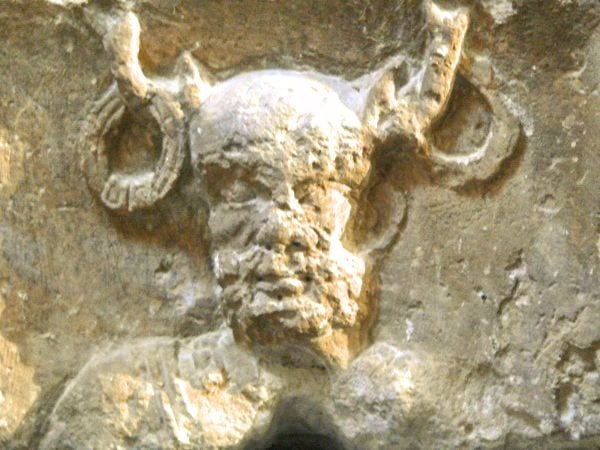
Cernunnos Circa 14 CE
The Lord of The Forest: Death, Sex, & Rebirth
I’m more familiar with Cernunnos of the forest and I bet you are too. The meditating, antlered god who inhabits ancient forests, commands the beasts, and rules over hunting and rutting and dying and coming back again. I love this idea. There’s nothing to support this really, but damn if it ain’t a nice idea. So if there’s nothing “real” about this version of Cernunnos, why do so many people think there is? Again, there isn’t anything, anywhere that says this is who Cernunnos was, but it is how many of us have come to think of him.That’s largely got to do with the fact that present day pagans are a romantic lot and we have really bad male role models. Wait what? Well, let’s look a little more closely at this shall we?
I love a good tale. The story of a forest god that sheds his antlers annually, is a loving consort to the goddess, and makes sure that everything dies and gets reborn in just the right way, is totally romantic. This is basically the story we’ve been told for about the last one hundred years. Margaret Murray, in her 1931 book “The god of the witches” lays out a pretty compelling story that horned and antlered gods were worshiped throughout ancient Britain and Western Europe. Almost all of her conclusions are wrong, but the story has stuck around because we need it to. I’ll come back to that bit in a minute.
We’re back to antlers for now. Antlers are found on deer. Deer live in the forest and they were absolutely everywhere in forested Western Europe. Deer are hunted by humans for food and hides and all manner of things can be made from their bones. When an animal is hunted and is caught, it dies (Death). With any luck, if the rutting season goes well (Sex), there will be more deer to hunt and eat the next year (Rebirth). So, Cernunnos has antlers, and was a deity, and Margaret Murray said there were horned gods revered in Britain and Gaul, and Cernunnos is from Britain and Gaul, so Cernunnos must be the god of the forest worshiped in ancient pagan times.Totally incorrect, but it feels so right, doesn’t it?
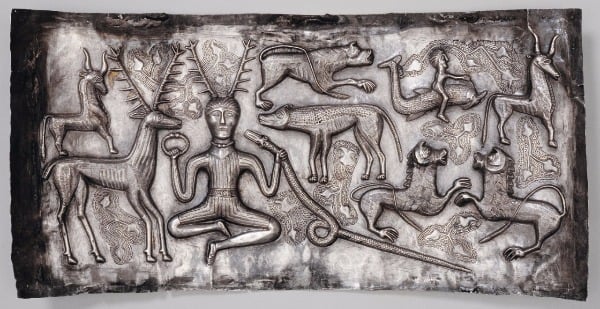
Probably the most common image of Cernunnos
That Bit About Bad Male Role Models And Why Cernunnos Has Stuck Around
We need Cernunnos. The modern myth of Cernunnos doesn’t center around his misdeeds. There isn’t a version of any Cernunnos story where he throws a godly shit-fit and destroys nature or kidnaps the goddess or tosses lightning bolts about all willy-nilly.
Cernunnos, as the modern retelling goes, is the Lord of the Forest. He prevails over hunting and death and the wild places and the wild things in the wild places. He understands that nature has a course to run. Cernunnos watches over the wild without interfering with it. Humans, especially human men, have a nasty habit of not being particularly good about protecting wild spaces or respecting that nature takes time, and needs space to do the stuff that nature does.
Cernunnos doesn’t take. There are precious few myths were we humans don’t take something. He is of the natural world and at peace with that. There are precious few myths were we humans are at peace with the wild world. Apart from some mythologically suspect images of Cernunnos with a large phallus, he’s not dick-centric. Most importantly, he’s a male god that isn’t a total dick. There are precious few myths were the male god isn’t a total dick.
The Cernunnos I Know
I have a large tattoo on my back. It’s inspired by my relationship with Cernunnos. He is the god, archetypal image, man, I aspire to be. His “energy-signature” is primal and masculine. He is equally an observer and participant in life’s dance. His intimate knowledge of his place in nature is coupled with his infinite curiosity of how he impacts the places he occupies. I rarely find him in myth but I feel him ever present in my life and in my magic. It’s a bit weird to say this, but I think some of you might know what I mean. When I feel him close to me, I get all choked up and enlivened simultaneously. He reminds me of who I am and who I can be. And that’s powerful magic.
.
Previous Post

November 16, 2017
Pentacle Of Yourself: Creating Your Own Body Pentacle
Next Post

December 4, 2017 Yule Traditions You Probably Haven't Heard Of
Browse Our Archives
Select a Category Ancestor Work Art and Magic Athena Autumn Equinox Being a Priestess Being A Witch Being Pagan Belatane Beltane candle magic Cauldron Cernunnos cerridwen Choosing a magical name Circle Casting Community Coronovirus Coven Curious about magic Daily Practice Deity Depression Earth Ecstatic Practices Elements of Magic Every Day Magic Fae Food Magic Goddess Grounding House Magick Imbolc Ritual Kitchen Witch Knot Magic Lammas Life Ritualized Mabon Magical Healing Magical Practice Magical Teachers Magickal Tools Making Altars Many Gods West Mountain Magic Nature Witch New Year's Tradition Omens Pagan Books Pagan Camps and Festivals Pagan Food Pagan Gods Pagan History Pagan Holidays Pagan Humor Pagan Humour Pagan leadership Pagan Marriage Pagan Music Pagan Parenting Pagan Relationships Pagan Rituals Pagan Rules Pagan Tattoos Pantheacon Peaceful Home Pearl Pentacle Personal Power Politics Ritual Cleansing Ritual Drumming Samhain Samhain Practices saturnalia Skyclad Spells Spiralheart Witch Camp Spirits of Place Spring Equinox spring magic Summer Solstice Tarot The Magick Of Food Time Magic Uncategorized Winter Solstice Witch History Witch Words WitchCamps Work Magic Year End Review Yule
Select a Month March 2021 February 2021 January 2021 December 2020 October 2020 September 2020 May 2020 April 2020 March 2020 February 2020 January 2020 December 2019 November 2019 October 2019 September 2019 August 2019 July 2019 June 2019 May 2019 April 2019 March 2019 February 2019 January 2019 December 2018 November 2018 October 2018 September 2018 August 2018 July 2018 June 2018 May 2018 April 2018 March 2018 February 2018 January 2018 December 2017 November 2017 October 2017 September 2017 August 2017 July 2017 June 2017 May 2017 April 2017 March 2017 February 2017 January 2017 December 2016 November 2016 October 2016 September 2016 August 2016 July 2016 June 2016 May 2016 April 2016 March 2016 February 2016 January 2016 December 2015 October 2015 September 2015 August 2015 July 2015 June 2015 May 2015 April 2015 March 2015 February 2015
Follow Us!
TAKE THE
Religious Wisdom Quiz
Do to others as you would have them do to ____.
Select your answer to see how you score.
Everyone Themselves You Others
Related posts from The Witches Next Door

Discovering Your Spiritual Allies


The Magical Practice Of Singing
TRENDING AT PATHEOS Pagan

I was recently chatting with someone on Instagram. She asked me what...

While there are many people who share their results, the end of...

On July 23, I saw Christopher Nolan's The Odyssey which is Homer’s...

As I write this two big events have just finished up. One...

Restoring the Watershed of Divine Love
Perhaps cooperation is not something we manufacture through legislation, ideology, or moral...

Many UUs don’t pray because of bad experiences in a previous religion,...
view all Pagan blogs
Ad-Free & Subscriber Log-In Subscription Support
- About Us
- 2026 Calendar
- Videos
- Podcasts
- Library of World Religions
- Faith In Media Tracker
- Advertise With Us
- Write for Us
- Privacy Policy
- Terms of Service
- Do Not Sell My Data
- Contact Us
- Radiant Digital
- Manage Newsletter Subscriptions
- Unsubscribe From Notifications
- Sitemap
Copyright 2008-2026, Patheos. All rights reserved.
Subscription Support Ad-Free & Subscriber Log-In
Follow Patheos