
BuddhistCatholicContemplativeEvangelicalGeneral ChristianHinduJewishLatter-day SaintMuslimNew VisionsProgressive Christian
Beliefs
- Buddhist
- Catholic
- Contemplative
- Evangelical
- General Christian
- Hindu
- Jewish
- Latter-day Saint
- More Voices
- Muslim
- New Visions
- Pagan
- Progressive Christian
Topics
- Religion News
- Food and Religion
- Sports and Religion
- Religious Art
- Religious Music and Entertainment
- Religious Events
- History and Religion
- Style and Religion
- Politics and Religion
- Women in Religion
- Recreation Outdoors and Religion
- Business Finance and Religion
- Careers Workplace and Religion
- Education and Religion
- Family Parenting and Religion
- Health Fitness and Religion
- Home and Religion
- Relationships and Religion
- Technology and Religion
- Travel and Religion
Columnists
- Buddhist Columnists
- Business Finance and Religion Columnists
- Careers Workplace and Religion Columnists
- Catholic Columnists
- Contemplative Columnists
- Education and Religion Columnists
- Evangelists Columnists
- Family Parenting and Religion Columnists
- General Christian Columnists
- Health Fitness and Religion Columnists
- Hindu Columnists
- History and Religion Columnists
- Home and Religion Columnists
- Jewish Columnists
- More Voices Columnists
- Latter Day Columnists
- Muslim Columnists
- New Visions Columnists
- Nonreligious Columnists
- Pagan Columnists
- Politics and Religion Columnists
- Progressive Columnists
- Recreation Outdoors and Religion Columnists
- Relationships and Religion Columnists
- Religion News Columnists
- Religious Art Columnists
- Religious Events Columnists
- Religious Music and Entertainment Columnists
- Sports and Religion Columnists
- Style and Religion Columnists
- Technology and Religion Columnists
- Travel and Religion Columnists
- Women in Religion Columnists
Resource Library
- 2026 Calendar
- Library of World Religions
- The 100 Most Holy Places on Earth
- Patheos Answers
- Podcasts
- Videos
- Faith Leaders Database
- Anglican Episcopalian
- Bahai
- Baptist
- Buddhism
- Christianity
- Confucianism
- Eastern Orthodoxy
- Hinduism
- Holiness and Pentecostal
- ISKCON
- Islam
- Judaism
- Lutheran
- Methodist
- The Church of Jesus Christ of Latter-day Saints
- New Age
- Paganism
- Presbytarian and Reformed
- Protestantism
- Religion Behind the Scenes
- Roman Catholic
- Scientology
- Shia Islam
- Sikhism
- Sufism
- Sunni Islam
- Taoism
- Zen
- See all religions
Research Tools
 Ad-Free & Subscriber Log-In Subscription Support
Ad-Free & Subscriber Log-In Subscription Support
Follow Patheos 

- Trending:
- Forgiveness
- |
- Marriage
- |
- Consciousness
- |
- Death Penalty
- |
- Election
- |
- Halloween
 The Witches Next Door
- Home
- Pagan
- 13 Questions About Samhain
13 Questions About Samhain
Last updated on: October 25, 2016 at 8:07 pm by The Witches Next Door
13 Questions About Samhain 2016-10-25T20:07:22-08:00 The Witches Next Door
Patheos Explore the world's faith through different perspectives on religion and spirituality! Patheos has the views of the prevalent religions and spiritualities of the world.
A non-Pagan friend of ours recently asked us a few questions about Samhain. We realized that we’re pretty much asked the same thing every year at this time.
So here are the Top 13 (yes, 13 because it’s witchy) most frequently asked questions about Samhain.
What is Samhain? This is a simple question to answer and, the simple answer is fraught with peril.
The simple answer is that Samhain is one of the eight Pagan festivals, celebrated in late October or early November. It’s a time when the veil between this world and the next is thin. It’s when witches and Pagans honour their beloved dead and the ancestors.
Depending on who you ask, everything we just wrote is completely true or completely false or mostly true or mostly false. The truth lies, as is often the case, somewhere in the middle.
It is quite true that Samhain is one of the best known holidays in Modern Paganism. It’s also true that many Pagan and Witch traditions celebrate Samhain as one of the eight “traditional” Sabbats. It’s not uncommon to find Ancestor veneration present in Samhain rituals and some Craft traditions, like our Reclaiming tradition, clearly puts an emphasis on remembering our Beloved Dead.
How old is Samhain? Very ancient and very modern. The Roman forces that conquered Gaul and much of the British Isles mention the “Celtic” festival of Samhain. So that puts Samhain on the map about two thousand years ago. Presumably, the native Britons the Romans bumped into on their way to making straight roads and aqueducts didn’t start celebrating Samhain just to spite the Romans, so it’s safe to say that Samhain is more than two thousand years old. But that’s about as accurate as we can be.
Now, there’s no record of exactly what the ancient Britons (or Irish, Welsh or Scots) actually did at Samhain. So while we know that they celebrated something, we don’t really know what or how.
What we think of as Samhain today, a celebration of the dead when the veil is thinnest is, perhaps, about one hundred fifty years old at the most and probably not much less than seventy years old.
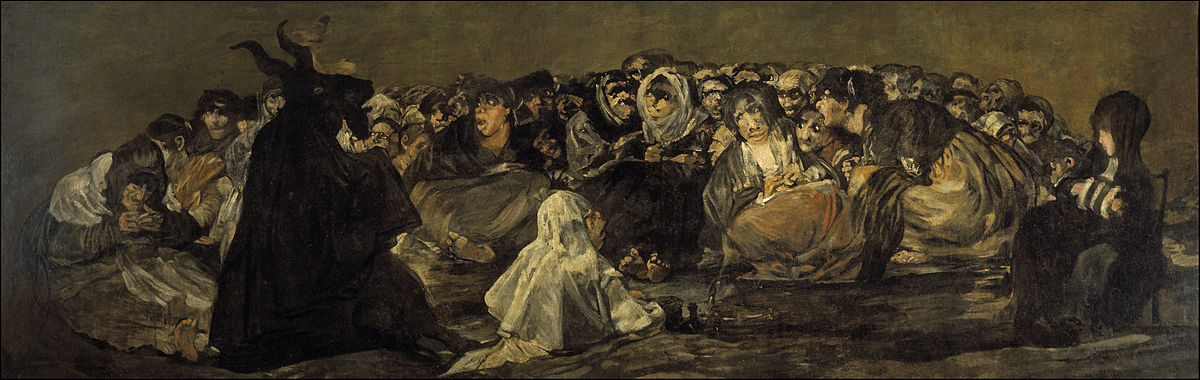
Are Halloween and Samhain the same? Mostly, we can say “NO!” here. We say mostly because witches and many Pagans would attest to Samhain being a high-holiday, a sacred time, a time of veneration, regardless of its historical origins. Wal-mart would tell you that Halloween is the start of the Christmas season and a great excuse to prop up the corn syrup industry.
Who are the Beloved Dead? Generally speaking, when Witches refer to the Beloved Dead, they most often mean friends, teachers, family members, loved ones that were actually known in this lifetime that have died. So you know, Aunt Millie or Mr. Hughes your science teacher that inspired you to become an astronaut.
Who are the Mighty Dead Anyway? This definition will vary from tradition to tradition, but it’s often held that the Mighty Dead are those witches, Pagans, magic makers and world changers on whose shoulders we stand on today. Names like Gerald Gardner and Doreen Valiente, Victor and Cora Anderson, Judy Foster are frequently called. Some traditions keep long lists of those that have passed from this world to the next and, perhaps, are working on the other side for our benefit too.
What’s with the bones and pictures of dead people? Making altars to remember our loved ones, revered ones and memorializing their deeds has been part of the human grief process for as long as we have been able to call ourselves human. And, while it’s not always the most pleasant thought, the fact is that we will all die sooner or later. Skulls, bones, pictures of those gone beyond are effective reminders of our mortality.
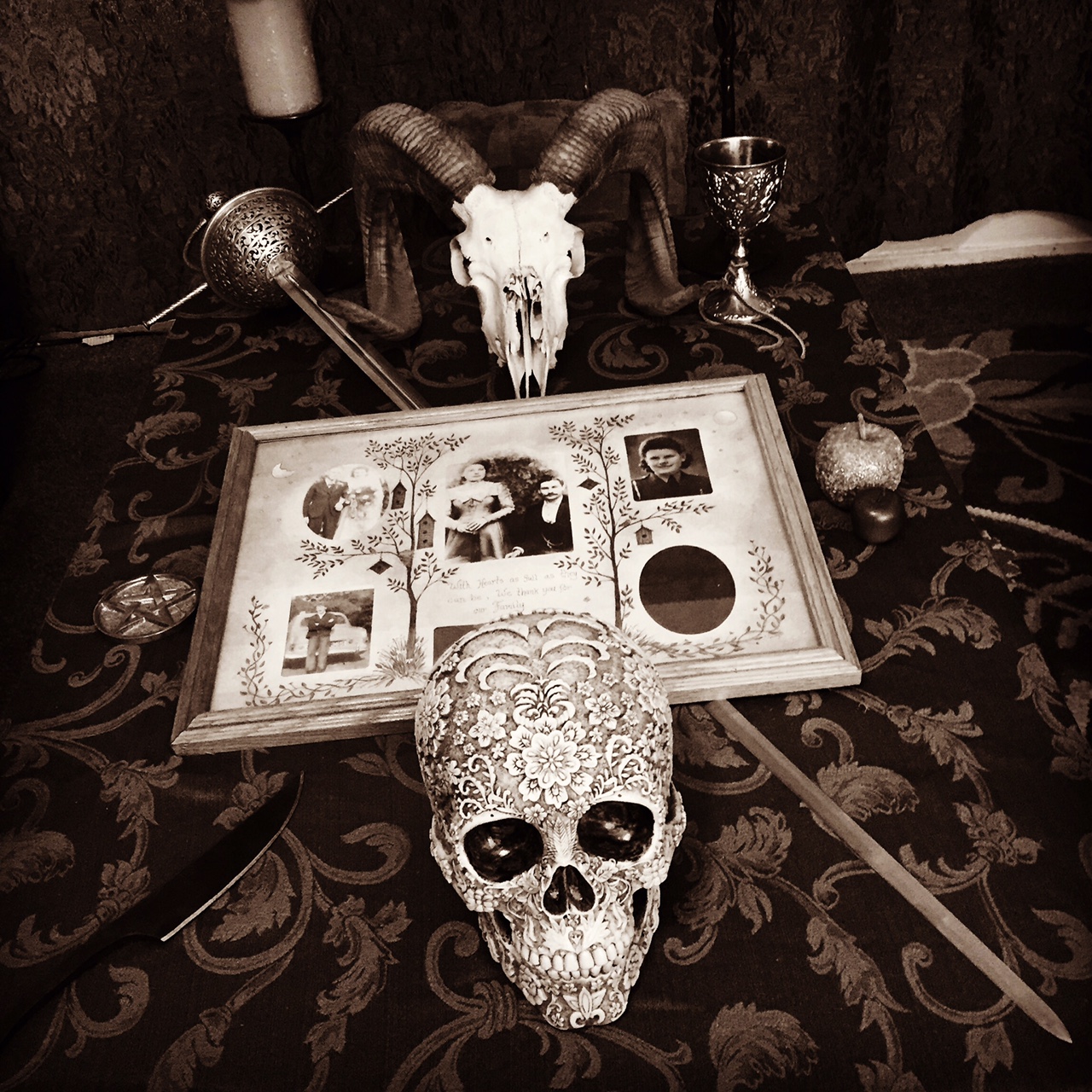
Our Samhain Altar
Can you really talk with the dead? We like to say “Of course you can talk with the dead!” The question really is do they hear us and even answer us? And that’s something you’ll have to discover for yourself.
What do you do in your rituals? There are as many ritual practices as their are people to practice them, it seems. Some things you might expect at this time of year? Ancestor dinners, eating foods that are special to your particular family or culture. Telling the stories of grandparents or family of choice. Remembering what they went through in their lives. Rituals may include a symbolic journey to the Otherworlds (there are a few of them,depending on your tradition) and visiting with deities that preside over death and birth. Still others may focus on visiting the Roadhouse of the Dead and speaking with those that have slipped off their mortal bonds.
Samhain is like Day of The Dead, Right? NO! Day of the Dead, or Dia de los Muertos, belongs to a specific culture with it’s own customs and practices. It’s true that Day of The Dead celebrations often focus on the dearly departed. But Samhain and Day Of The Dead are not the same.
Source: Everyday Feminism
What do they Celebrate in Australia? Well, you should probably ask an Australian. We did actually. Some folks we know celebrate the secular holiday of Halloween with all of the costumes and candies and whatnot. Why spoil a good party right? On a spiritual level, Beltane sits opposite on the calendar to Samhain and so folk might dance around a May Pole and enjoy the Rite of Spring.
Do you dress up in costumes? Of Course! Why not. Actually, some private witch groups will work skyclad. Some will hold public rituals and folks may dress in robes or other ritual “garb”. Other folks wear jeans and tee-shirts.
Can I celebrate Samhain without a coven or group? For sure! Building altars, remembering your ancestors, grieving and/or celebrating your Beloved or Mighty Dead can be a wonderful ritual with just one participant – you!
Why is it called “The Witches New Year”? There’s no real historical evidence anywhere that Samhain was ever celebrated as a New Year festival in the “Celtic” world or throughout the British Isles. There’s no real magical, archival evidence for Samhain being the start of the New Year. We do look at Samhain as a time to slow down, to take stock of the year, to prepare for less daylight and longer nights. If that says “New Year” to you, then HAPPY NEW YEAR!
Previous Post

October 21, 2016
I'm a Hysterical Woman
Next Post

November 8, 2016 In Perfect Love And Perfect Trust
Browse Our Archives
Select a Category Ancestor Work Art and Magic Athena Autumn Equinox Being a Priestess Being A Witch Being Pagan Belatane Beltane candle magic Cauldron Cernunnos cerridwen Choosing a magical name Circle Casting Community Coronovirus Coven Curious about magic Daily Practice Deity Depression Earth Ecstatic Practices Elements of Magic Every Day Magic Fae Food Magic Goddess Grounding House Magick Imbolc Ritual Kitchen Witch Knot Magic Lammas Life Ritualized Mabon Magical Healing Magical Practice Magical Teachers Magickal Tools Making Altars Many Gods West Mountain Magic Nature Witch New Year's Tradition Omens Pagan Books Pagan Camps and Festivals Pagan Food Pagan Gods Pagan History Pagan Holidays Pagan Humor Pagan Humour Pagan leadership Pagan Marriage Pagan Music Pagan Parenting Pagan Relationships Pagan Rituals Pagan Rules Pagan Tattoos Pantheacon Peaceful Home Pearl Pentacle Personal Power Politics Ritual Cleansing Ritual Drumming Samhain Samhain Practices saturnalia Skyclad Spells Spiralheart Witch Camp Spirits of Place Spring Equinox spring magic Summer Solstice Tarot The Magick Of Food Time Magic Uncategorized Winter Solstice Witch History Witch Words WitchCamps Work Magic Year End Review Yule
Select a Month March 2021 February 2021 January 2021 December 2020 October 2020 September 2020 May 2020 April 2020 March 2020 February 2020 January 2020 December 2019 November 2019 October 2019 September 2019 August 2019 July 2019 June 2019 May 2019 April 2019 March 2019 February 2019 January 2019 December 2018 November 2018 October 2018 September 2018 August 2018 July 2018 June 2018 May 2018 April 2018 March 2018 February 2018 January 2018 December 2017 November 2017 October 2017 September 2017 August 2017 July 2017 June 2017 May 2017 April 2017 March 2017 February 2017 January 2017 December 2016 November 2016 October 2016 September 2016 August 2016 July 2016 June 2016 May 2016 April 2016 March 2016 February 2016 January 2016 December 2015 October 2015 September 2015 August 2015 July 2015 June 2015 May 2015 April 2015 March 2015 February 2015
Follow Us!
TAKE THE
Religious Wisdom Quiz
What does the Bible say about planning for the future?
Select your answer to see how you score.
Always worry Commit your plans to the Lord Never plan Don't think ahead
Related posts from The Witches Next Door

Discovering Your Spiritual Allies

The Perils of a Magickal Hangover

Moving Sacred Space from the Old Temple to...
TRENDING AT PATHEOS Pagan

I was recently chatting with someone on Instagram. She asked me what...

While there are many people who share their results, the end of...

On July 23, I saw Christopher Nolan's The Odyssey which is Homer’s...

As I write this two big events have just finished up. One...

Restoring the Watershed of Divine Love
Perhaps cooperation is not something we manufacture through legislation, ideology, or moral...

Many UUs don’t pray because of bad experiences in a previous religion,...
view all Pagan blogs
Ad-Free & Subscriber Log-In Subscription Support
- About Us
- 2026 Calendar
- Videos
- Podcasts
- Library of World Religions
- Faith In Media Tracker
- Advertise With Us
- Write for Us
- Privacy Policy
- Terms of Service
- Do Not Sell My Data
- Contact Us
- Radiant Digital
- Manage Newsletter Subscriptions
- Unsubscribe From Notifications
- Sitemap
Copyright 2008-2026, Patheos. All rights reserved.
Subscription Support Ad-Free & Subscriber Log-In
Follow Patheos