
BuddhistCatholicContemplativeEvangelicalGeneral ChristianHinduJewishLatter-day SaintMuslimNew VisionsProgressive Christian
Beliefs
- Buddhist
- Catholic
- Contemplative
- Evangelical
- General Christian
- Hindu
- Jewish
- Latter-day Saint
- More Voices
- Muslim
- New Visions
- Pagan
- Progressive Christian
Topics
- Religion News
- Food and Religion
- Sports and Religion
- Religious Art
- Religious Music and Entertainment
- Religious Events
- History and Religion
- Style and Religion
- Politics and Religion
- Women in Religion
- Recreation Outdoors and Religion
- Business Finance and Religion
- Careers Workplace and Religion
- Education and Religion
- Family Parenting and Religion
- Health Fitness and Religion
- Home and Religion
- Relationships and Religion
- Technology and Religion
- Travel and Religion
Columnists
- Buddhist Columnists
- Business Finance and Religion Columnists
- Careers Workplace and Religion Columnists
- Catholic Columnists
- Contemplative Columnists
- Education and Religion Columnists
- Evangelists Columnists
- Family Parenting and Religion Columnists
- General Christian Columnists
- Health Fitness and Religion Columnists
- Hindu Columnists
- History and Religion Columnists
- Home and Religion Columnists
- Jewish Columnists
- More Voices Columnists
- Latter Day Columnists
- Muslim Columnists
- New Visions Columnists
- Nonreligious Columnists
- Pagan Columnists
- Politics and Religion Columnists
- Progressive Columnists
- Recreation Outdoors and Religion Columnists
- Relationships and Religion Columnists
- Religion News Columnists
- Religious Art Columnists
- Religious Events Columnists
- Religious Music and Entertainment Columnists
- Sports and Religion Columnists
- Style and Religion Columnists
- Technology and Religion Columnists
- Travel and Religion Columnists
- Women in Religion Columnists
Resource Library
- 2026 Calendar
- Library of World Religions
- The 100 Most Holy Places on Earth
- Patheos Answers
- Podcasts
- Videos
- Faith Leaders Database
- Anglican Episcopalian
- Bahai
- Baptist
- Buddhism
- Christianity
- Confucianism
- Eastern Orthodoxy
- Hinduism
- Holiness and Pentecostal
- ISKCON
- Islam
- Judaism
- Lutheran
- Methodist
- The Church of Jesus Christ of Latter-day Saints
- New Age
- Paganism
- Presbytarian and Reformed
- Protestantism
- Religion Behind the Scenes
- Roman Catholic
- Scientology
- Shia Islam
- Sikhism
- Sufism
- Sunni Islam
- Taoism
- Zen
- See all religions
Research Tools
 Ad-Free & Subscriber Log-In Subscription Support
Ad-Free & Subscriber Log-In Subscription Support
Follow Patheos 

- Trending:
- Forgiveness
- |
- Marriage
- |
- Consciousness
- |
- Death Penalty
- |
- Election
- |
- Halloween
 The Wandering Witch
- Home
- Pagan
- Groundhog Day: History, Lore, and Weather Divination
Groundhog Day: History, Lore, and Weather Divination
Last updated on: January 31, 2019 at 10:29 am by Julia Penelope
Groundhog Day: History, Lore, and Weather Divination 2019-01-31T10:29:44-05:00 Julia Penelope
Patheos Explore the world's faith through different perspectives on religion and spirituality! Patheos has the views of the prevalent religions and spiritualities of the world.
Every year on February 2, news channels across the country broadcast from Punxsutawney, Pennsylvania (fun fact: I was born here) where Groundhog Phil emerges from his burrow to look for his shadow. While many people are only aware of this tradition because of the 1993 Groundhog Day starring Bill Murray, there’s actually a lot more to this holiday than meets the eye. Its origins are quite old in fact and lie within the weather divination practices of our ancient pagan ancestors.

Image via Google Images.
The legend of Groundhog Day is summed up well by this description from the American Philosophical Society in 1888. It states: “If the groundhog sees his shadow on the second of February, he goes back to his hole in the ground for another six weeks’ doze, as he knows that the winter will endure so much longer; per contra, if he cannot see it, he stays out, for he knows that the severe weather is past.”
Belief in the ability of animals to predict the weather is common in many different cultures and is often associated with specific times of the year, in the case of Groundhog Day-Candlemass or Imbolc. “In these superstitions, there is the implicit assumption that plants and animals are somehow in tune with the cosmic forces which determine the weather and that they behave in harmony with these forces.” (Ward, 1968)
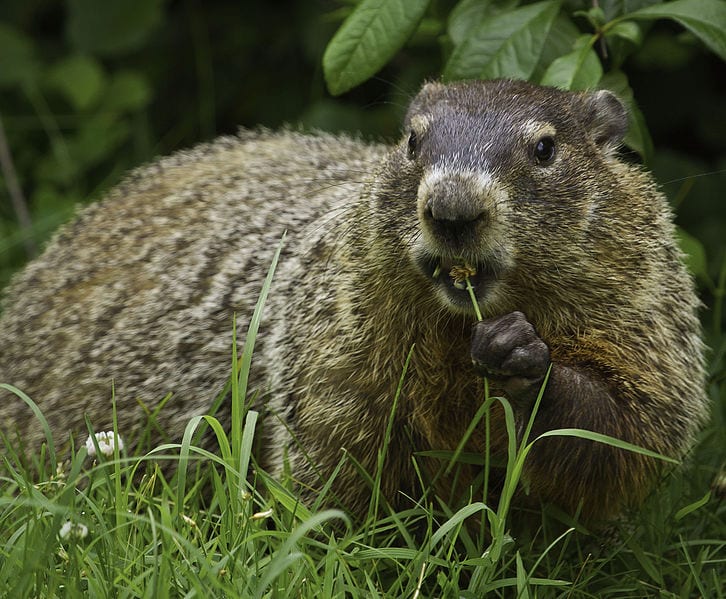
image via Wikimedia
Groundhog Day falls onto the cross-quarter day commonly known as Imbolc or Candlemas. These cross-quarter days (meaning midway between the solstice and equinox) were traditionally times for divination because it was believed that the ‘veil between the worlds’ was thinnest during these periods, thus making divination easier.
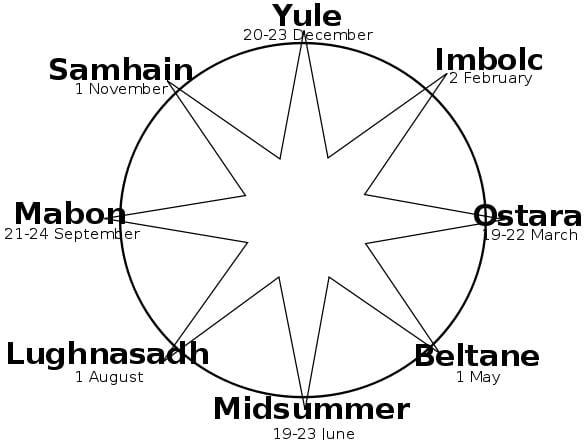
Wheel of the Year. Image via Wikimedia.
“Sign superstitions regarding weather are known to all, the most famous being the groundhog oracle which provides that if the groundhog sees his shadow on the second of February (which, in the church calendar, is Candlemass) there will be six more weeks of winter.” (Western Folklore, 1954)
Several folk proverbs from around Europe speak to this tradition:
From England:
“If Candlemas be fair and bright,
Winter has another flight.
If Candlemas brings clouds and rain,
Winter will not come again.”
From Scotland:
“If Candlemas Day is bright and clear,
There’ll be two winters in the year.”
From Germany:
“The badger peeps out his hole on Candlemas Day, and, if he finds snow, walks abroad; but if he sees the sun shining he draws back into his hole.”
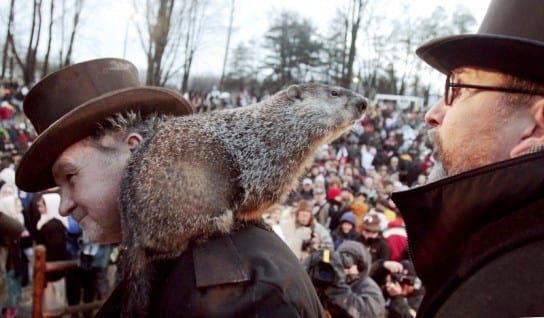
Image via Amish Times
When the Pennsylvania Dutch emigrated to the United States in the 19th century, they brought with them their folk customs including those associated with Candlemas. As there are few badger east of the Mississippi River, the role of weather prophet was transferred to the groundhog.
We see the first written reference to this tradition in the diary of a Pennsylvania storekeeper from 1841.
“Last Tuesday, the 2nd, was Candlemas day, the day on which, according to the Germans, the Groundhog peeps out of his winter quarters and if he sees his shadow he pops back for another six weeks nap, but if the day be cloudy he remains out, as the weather is to be moderate.” –James Morris (February 4, 1841)
In 1886, Pennsylvania’s official celebration of the holiday began and Punxsutawney Phil was given the official title
‘Seer of Seers, Sage of Sages, Prognosticator of Prognosticators, and Weather Prophet Extraordinary’
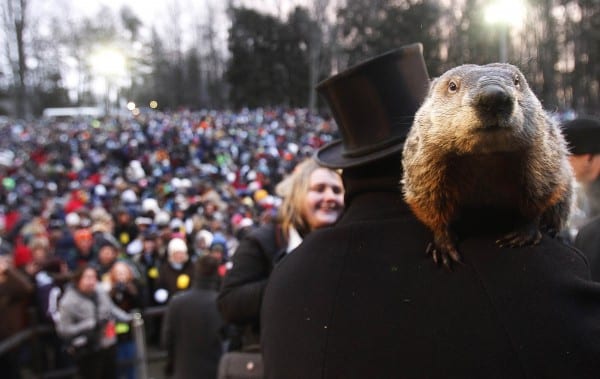
Image via Bangor Daily News
I love the tradition of Groundhog Day. We live in a world where information is at our fingertips. Weather is predictable weeks in advance thanks to technological advancements. The world is disenchanted. For me, Groundhog Phil brings a little of the enchantment back. Here are a few ways you can celebrate:
- Tune in to the festivities live in Gobbler’s Knob, PA here: Groundhog Day Live Stream
- Do a little bit of your own research and find out if any of the local wildlife have weather predicting traits! Go for a walk on the morning of February 2 and keep an eye for animals. Who knows what you might find out?!
- If you’re within driving distance of Punxsutawney, why not head down for the day?
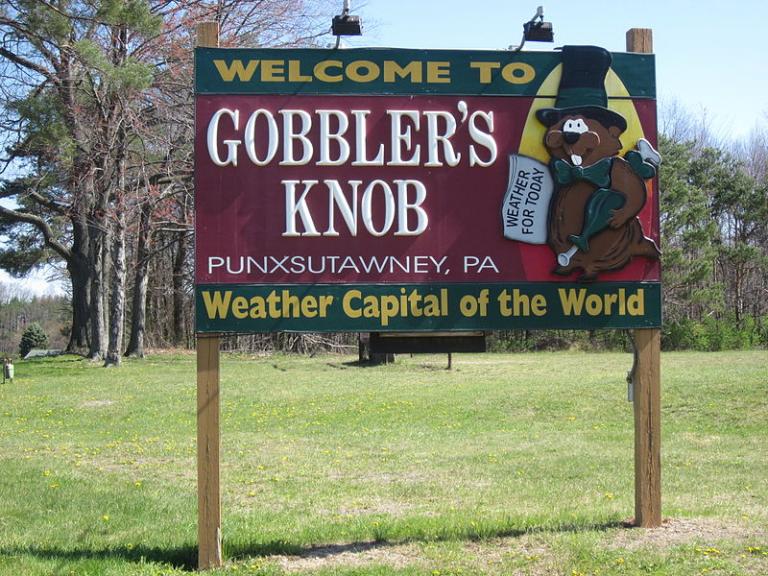
image via Wikimedia
References:
“Groundhog in Dog’s Shadow.” Western Folklore 13, no. 2/3 (1954): 209.
“Groundhog Tradition Attacked.” Western Folklore 10, no. 3 (1951): 252.
Phillips, Henry. “First Contribution to the Folk-Lore of Philadelphia and Its Vicinity.” Proceedings of the American Philosophical Society 25, no. 128 (1888): 159-70.
Randloph, Vance; Ozark Superstitions.
Ward, Donald J. “Weather Signs and Weather Magic: Some Ideas on Causality in Popular Belief.” Pacific Coast Philology 3 (1968): 67-72.

About Julia Penelope
Julia Penelope is a blogger, traveler, occultist, and aspiring archaeologist. She has been a practicing witch for the past ten years and a devotional polytheist for the latter three. She is the founder and organizer of an eclectic women’s circle in southern Maine, the Witches of Downeast You can read more about the author here.
Previous Post

January 24, 2019
Public Service Announcement: Missionaries are COLONIZERS
Next Post
February 6, 2019 Lost in Transcription: On the Difficulty of Writing Oral Narratives
Browse Our Archives
Select a Category Archaeology France The Basics The Black Madonna the blog The Craft The History of Paganism Thoughts Travel Uncategorized United States witchcraft Witchcraft in Literature Witchery
Select a Month May 2020 February 2020 December 2019 November 2019 July 2019 May 2019 April 2019 March 2019 February 2019 January 2019 December 2018 November 2018 October 2018 August 2018 July 2018 June 2018 May 2018 April 2018 March 2018 February 2018 January 2018 December 2017 November 2017 October 2017 September 2017
Follow Us!
TAKE THE
Religious Wisdom Quiz
Who said, "If anyone is in Christ, he is a new creation"?
Select your answer to see how you score.
James John Peter Paul
Related posts from The Wandering Witch
Defying Museum Fatigue: 6 Tips to Keep You...

Life Update: The Wandering Witch


TRENDING AT PATHEOS Pagan

When we talk about Greek religion, we often begin with the dodekatheion—the...

I was recently chatting with someone on Instagram. She asked me what...

While there are many people who share their results, the end of...

On July 23, I saw Christopher Nolan's The Odyssey which is Homer’s...

As I write this two big events have just finished up. One...

Restoring the Watershed of Divine Love
Perhaps cooperation is not something we manufacture through legislation, ideology, or moral...
view all Pagan blogs
Ad-Free & Subscriber Log-In Subscription Support
- About Us
- 2026 Calendar
- Videos
- Podcasts
- Library of World Religions
- Faith In Media Tracker
- Advertise With Us
- Write for Us
- Privacy Policy
- Terms of Service
- Do Not Sell My Data
- Contact Us
- Radiant Digital
- Manage Newsletter Subscriptions
- Unsubscribe From Notifications
- Sitemap
Copyright 2008-2026, Patheos. All rights reserved.
Subscription Support Ad-Free & Subscriber Log-In
Follow Patheos