
BuddhistCatholicContemplativeEvangelicalGeneral ChristianHinduJewishLatter-day SaintMuslimNew VisionsProgressive Christian
Beliefs
- Buddhist
- Catholic
- Contemplative
- Evangelical
- General Christian
- Hindu
- Jewish
- Latter-day Saint
- More Voices
- Muslim
- New Visions
- Pagan
- Progressive Christian
Topics
- Religion News
- Food and Religion
- Sports and Religion
- Religious Art
- Religious Music and Entertainment
- Religious Events
- History and Religion
- Style and Religion
- Politics and Religion
- Women in Religion
- Recreation Outdoors and Religion
- Business Finance and Religion
- Careers Workplace and Religion
- Education and Religion
- Family Parenting and Religion
- Health Fitness and Religion
- Home and Religion
- Relationships and Religion
- Technology and Religion
- Travel and Religion
Columnists
- Buddhist Columnists
- Business Finance and Religion Columnists
- Careers Workplace and Religion Columnists
- Catholic Columnists
- Contemplative Columnists
- Education and Religion Columnists
- Evangelists Columnists
- Family Parenting and Religion Columnists
- General Christian Columnists
- Health Fitness and Religion Columnists
- Hindu Columnists
- History and Religion Columnists
- Home and Religion Columnists
- Jewish Columnists
- More Voices Columnists
- Latter Day Columnists
- Muslim Columnists
- New Visions Columnists
- Nonreligious Columnists
- Pagan Columnists
- Politics and Religion Columnists
- Progressive Columnists
- Recreation Outdoors and Religion Columnists
- Relationships and Religion Columnists
- Religion News Columnists
- Religious Art Columnists
- Religious Events Columnists
- Religious Music and Entertainment Columnists
- Sports and Religion Columnists
- Style and Religion Columnists
- Technology and Religion Columnists
- Travel and Religion Columnists
- Women in Religion Columnists
Resource Library
- 2026 Calendar
- Library of World Religions
- The 100 Most Holy Places on Earth
- Patheos Answers
- Podcasts
- Videos
- Faith Leaders Database
- Anglican Episcopalian
- Bahai
- Baptist
- Buddhism
- Christianity
- Confucianism
- Eastern Orthodoxy
- Hinduism
- Holiness and Pentecostal
- ISKCON
- Islam
- Judaism
- Lutheran
- Methodist
- The Church of Jesus Christ of Latter-day Saints
- New Age
- Paganism
- Presbytarian and Reformed
- Protestantism
- Religion Behind the Scenes
- Roman Catholic
- Scientology
- Shia Islam
- Sikhism
- Sufism
- Sunni Islam
- Taoism
- Zen
- See all religions
Research Tools
 Ad-Free & Subscriber Log-In Subscription Support
Ad-Free & Subscriber Log-In Subscription Support
Follow Patheos 

- Trending:
- Forgiveness
- |
- Marriage
- |
- Consciousness
- |
- Death Penalty
- |
- Election
- |
- Halloween
 The Wandering Witch
- Home
- Pagan
- St.Odile and the Pagan Wall: A French Enigma
St.Odile and the Pagan Wall: A French Enigma
Last updated on: May 8, 2018 at 9:06 am by Julia Penelope
St.Odile and the Pagan Wall: A French Enigma 2018-05-08T09:06:55-04:00 Julia Penelope
Patheos Explore the world's faith through different perspectives on religion and spirituality! Patheos has the views of the prevalent religions and spiritualities of the world.
Located deep within the region of Alsace (an area that has shifted between French and German control for centuries, currently French), is a mysterious mountain peak in the Vosges range with a centuries-old convent at the top.
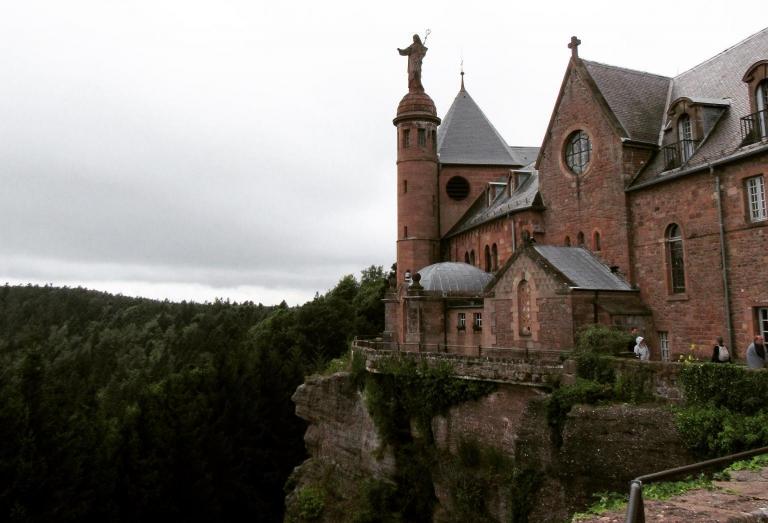
The Abbey of Mont St.Odile
Known as Mont-St-Odile, it is now most famous for its abbey/convent- Hohenburg. According to legend, the abbey was founded in the 7th century by the Duke of Alsace for his daughter Odile. She was born blind and was thus raised by peasants so as not to bring shame on her family. When she was twelve she was brought to a monastery in Palma where she was meant to live out her life in service to God. While there, she was baptized by Saint Erhard of Regensburg and given the name Odile (Sol Dei).
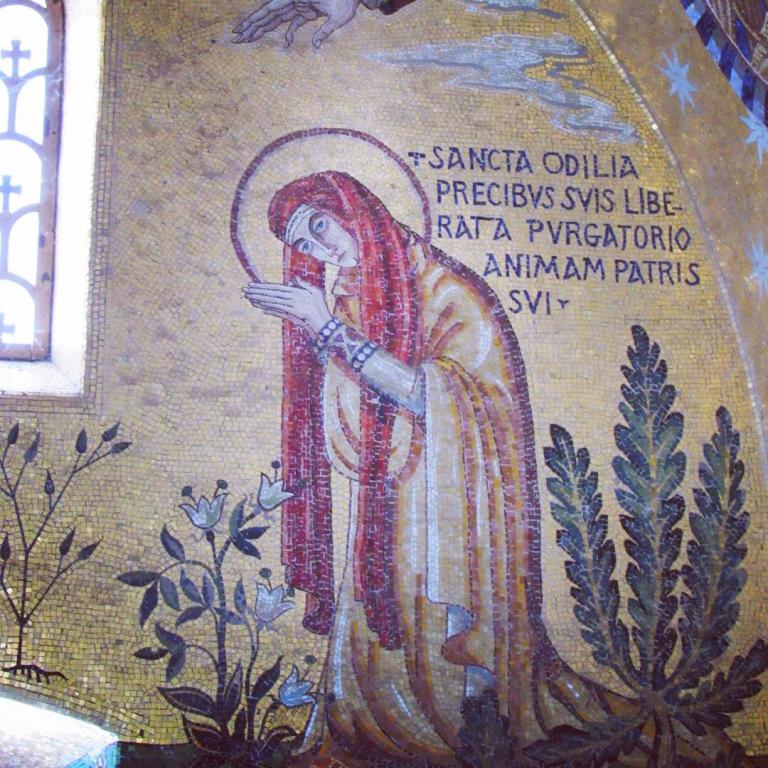
Mosaic image of St.Odile from one of the chapels at the abbey
Following this event, her sight was miraculously restored. Her brother found out that she had been healed and proceeded to bring her home. In typical medieval fashion, the father was so enraged that he accidentally killed his son but Odile, who was now favored by God, was able to bring him back to life. She fled from the castle and proceeded to hide in a cave, which, according to legend opened up from a cliff face. Her father tried to follow but was injured by falling rocks. Years later, her father fell ill and she left the cave and returned home to nurse him to health. Upon his recovery, he finally welcomed his daughter home and proceeded to found a monastery in her honor, where she would later become abbess. She lived happily there for many years before dying in AD 720. The prayers of her convent sisters brought her back to life, but she was so enthralled with the beauty of the afterlife that she took communion and died again.
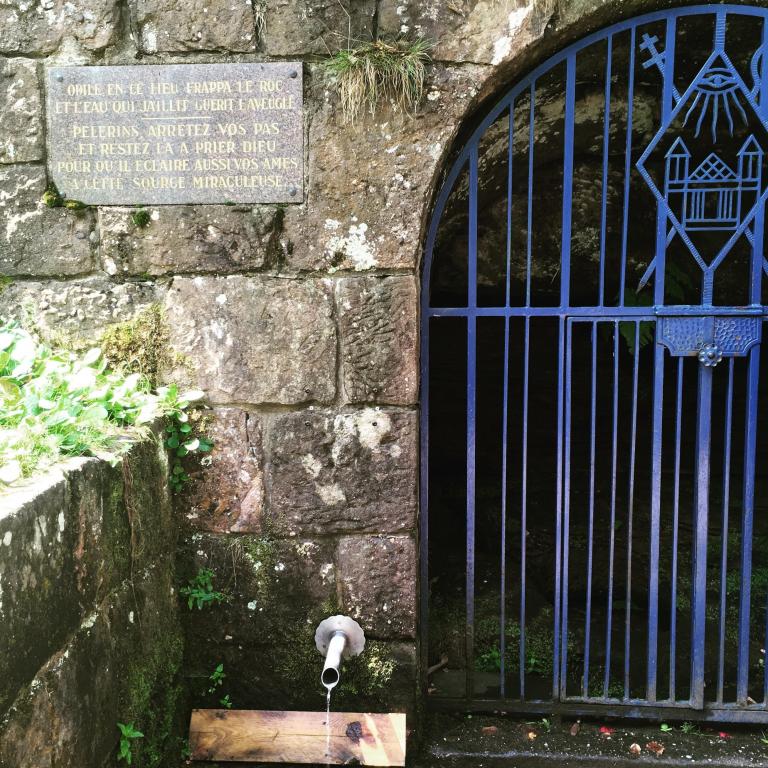
The fount of St.Odile, according to legend it has magical healing properties and can cure poor eyesight
Today she is venerated as the patron saint of Alsace and of the blind. Her monastery is a very popular place of pilgrimage and there is a fountain on the property that is said to have healing properties. I visited this past summer during a stay with my in-laws while in Alsace. As is quite typical with most holy Catholic sites (especially in Europe), there is more to the story. I did a bit of digging before my visit and found that the site was actually home to a Celtic fortress. It is cited by the Romans and was apparently sacked by Vandals in AD 407. There is even speculation that it was the site of a Celtic temple to a solar deity; which would make sense given Odiles Latin name, Sol Dei (of sun). Also interesting to note is that her feast day is December 13 (which also happens to be the feast day of St Lucia ) which was the day of the winter solstice before the Gregorian calendar reform. It’s commonly accepted that this was a pagan feast day that honored solar deities.
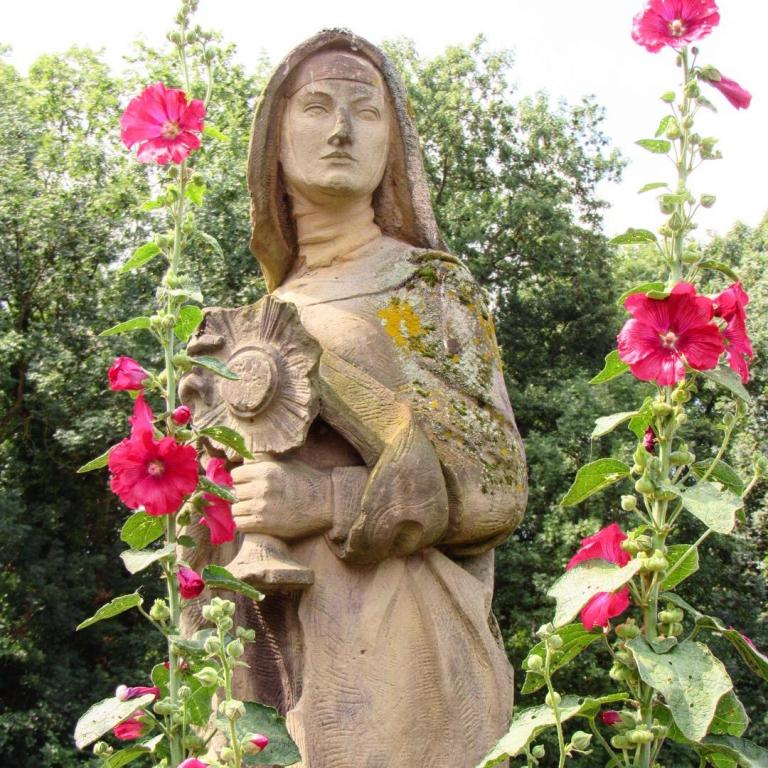
A statue of St.Odile from Obernai, France.
One of the major pieces of evidence that gives credence to the Celtic fortress theory are the remnants of prehistoric fortifications on site. Named the ‘Mur païen’ or Pagan Wall by Pope Leo IX, this structure is over 10 km (6+ miles) long and contains approximately 300,000 stone blocks. There has never been any official state-sanctioned excavation as far as I can tell. However, I did find out that this ‘pagan wall’ was home to archaeological investigations by the Nazi’s during World War II. It’s commonly known that Hitler was very interested in the occult so this just lends further credence to theories about the ancient sacred origins of the site.
“The mountain of St Odile has been an important place for many centuries There are signs of Celtic and Roman occupation the latter consisting of a huge rampart locally known as the Heathen Wall the Romans were perhaps heathens when they built it though that is by no means certain as the date is unknown the former far more vague being chiefly doubtful cromlechs and so called Druids caves.” (Lee)
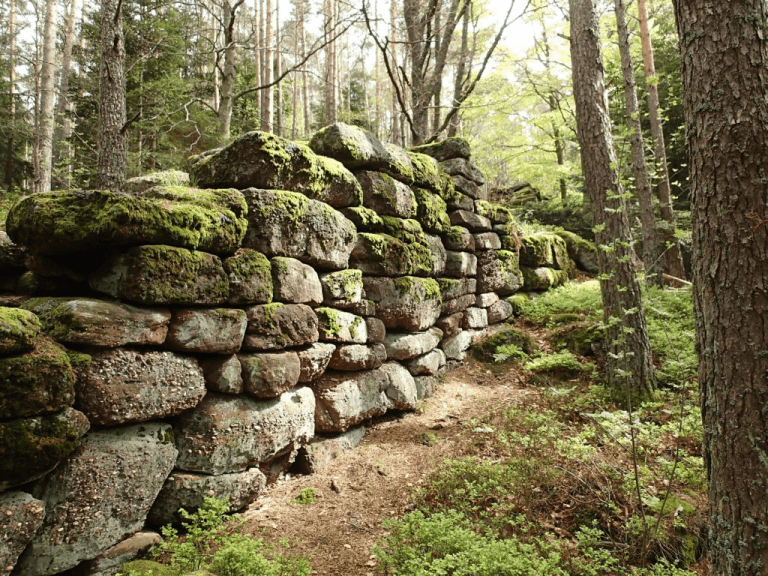
The Pagan Wall, image is from Discover France
“The Odilienberg forms a plateau like ridge about 6 M in circumference surrounded by the Heidenmauer, a prehistoric fortified wall parts of which are still 6 10 ft high and 1 ft thick. It is supposed to be one of the Gaulish places of refuge like Alesia Bibracte etc mentioned by Caesar.” (Baedecker)
Regardless of the Celtic antiquity of the site, I found the story of Odile to be quite incredible. She lived during the Middle Ages in a world dominated by men. She made a name for herself and founded an abbey which she ran for over 40 years. She is the patron saint of the entire Alsace region and her convent is still an important place of pilgrimage. It’s a remarkably beautiful site and I highly recommend a visit to anyone who is in the region.
For more information about the Alsace region check out this link.
*Also just because I can’t not mention this, Mont St.Odile was the center of a crazy literary heist. In 2002, loads of ancient books were going missing from the abbey. Turns out a local teacher had found a secret passage that led up the mountain and he was sneaking in and taking books because he thought they weren’t being preserved well enough. Police only figured out what was happening once they installed cameras!
Works Cited:
Johann Chapoutot, “L’archéologie Nazie,” Vingtième Siècle, Revue D’histoire, no. 96 (2007): 240-44.
Katherine Lee, In the Alsatian Mountains, (Oxford University Press, Oxford, 1883)
Karl Baedeker, The Rhine from Rotterdam to Constance: Handbook for Travellers, (Harvard University Press, Boston,1886)
Previous Post

March 13, 2018
Celtic Complexion
Next Post

April 4, 2018 Ancient Asheville
Browse Our Archives
Select a Category Archaeology France The Basics The Black Madonna the blog The Craft The History of Paganism Thoughts Travel Uncategorized United States witchcraft Witchcraft in Literature Witchery
Select a Month May 2020 February 2020 December 2019 November 2019 July 2019 May 2019 April 2019 March 2019 February 2019 January 2019 December 2018 November 2018 October 2018 August 2018 July 2018 June 2018 May 2018 April 2018 March 2018 February 2018 January 2018 December 2017 November 2017 October 2017 September 2017
Follow Us!
TAKE THE
Religious Wisdom Quiz
How long was the wedding celebrations length in Biblical times?
Select your answer to see how you score.
10 days 3 days 5 days 7 days
Related posts from The Wandering Witch
Defying Museum Fatigue: 6 Tips to Keep You...


7 More Reasons to Stop Using the Word...
TRENDING AT PATHEOS Pagan

When we talk about Greek religion, we often begin with the dodekatheion—the...

I was recently chatting with someone on Instagram. She asked me what...

While there are many people who share their results, the end of...

On July 23, I saw Christopher Nolan's The Odyssey which is Homer’s...

As I write this two big events have just finished up. One...

Restoring the Watershed of Divine Love
Perhaps cooperation is not something we manufacture through legislation, ideology, or moral...
view all Pagan blogs
Ad-Free & Subscriber Log-In Subscription Support
- About Us
- 2026 Calendar
- Videos
- Podcasts
- Library of World Religions
- Faith In Media Tracker
- Advertise With Us
- Write for Us
- Privacy Policy
- Terms of Service
- Do Not Sell My Data
- Contact Us
- Radiant Digital
- Manage Newsletter Subscriptions
- Unsubscribe From Notifications
- Sitemap
Copyright 2008-2026, Patheos. All rights reserved.
Subscription Support Ad-Free & Subscriber Log-In
Follow Patheos