
BuddhistCatholicContemplativeEvangelicalGeneral ChristianHinduJewishLatter-day SaintMuslimNew VisionsProgressive Christian
Beliefs
- Buddhist
- Catholic
- Contemplative
- Evangelical
- General Christian
- Hindu
- Jewish
- Latter-day Saint
- More Voices
- Muslim
- New Visions
- Pagan
- Progressive Christian
Topics
- Religion News
- Food and Religion
- Sports and Religion
- Religious Art
- Religious Music and Entertainment
- Religious Events
- History and Religion
- Style and Religion
- Politics and Religion
- Women in Religion
- Recreation Outdoors and Religion
- Business Finance and Religion
- Careers Workplace and Religion
- Education and Religion
- Family Parenting and Religion
- Health Fitness and Religion
- Home and Religion
- Relationships and Religion
- Technology and Religion
- Travel and Religion
Columnists
- Buddhist Columnists
- Business Finance and Religion Columnists
- Careers Workplace and Religion Columnists
- Catholic Columnists
- Contemplative Columnists
- Education and Religion Columnists
- Evangelists Columnists
- Family Parenting and Religion Columnists
- General Christian Columnists
- Health Fitness and Religion Columnists
- Hindu Columnists
- History and Religion Columnists
- Home and Religion Columnists
- Jewish Columnists
- More Voices Columnists
- Latter Day Columnists
- Muslim Columnists
- New Visions Columnists
- Nonreligious Columnists
- Pagan Columnists
- Politics and Religion Columnists
- Progressive Columnists
- Recreation Outdoors and Religion Columnists
- Relationships and Religion Columnists
- Religion News Columnists
- Religious Art Columnists
- Religious Events Columnists
- Religious Music and Entertainment Columnists
- Sports and Religion Columnists
- Style and Religion Columnists
- Technology and Religion Columnists
- Travel and Religion Columnists
- Women in Religion Columnists
Resource Library
- 2026 Calendar
- Library of World Religions
- The 100 Most Holy Places on Earth
- Patheos Answers
- Podcasts
- Videos
- Faith Leaders Database
- Anglican Episcopalian
- Bahai
- Baptist
- Buddhism
- Christianity
- Confucianism
- Eastern Orthodoxy
- Hinduism
- Holiness and Pentecostal
- ISKCON
- Islam
- Judaism
- Lutheran
- Methodist
- The Church of Jesus Christ of Latter-day Saints
- New Age
- Paganism
- Presbytarian and Reformed
- Protestantism
- Religion Behind the Scenes
- Roman Catholic
- Scientology
- Shia Islam
- Sikhism
- Sufism
- Sunni Islam
- Taoism
- Zen
- See all religions
Research Tools
 Ad-Free & Subscriber Log-In Subscription Support
Ad-Free & Subscriber Log-In Subscription Support
Follow Patheos 

- Trending:
- Forgiveness
- |
- Marriage
- |
- Consciousness
- |
- Death Penalty
- |
- Election
- |
- Halloween
 The Wandering Witch
- Home
- Pagan
- Mary- a mother goddess?
Mary- a mother goddess?
Last updated on: April 16, 2019 at 6:00 pm by Julia Penelope
Mary- a mother goddess? 2019-04-16T18:00:39-04:00 Julia Penelope
Patheos Explore the world's faith through different perspectives on religion and spirituality! Patheos has the views of the prevalent religions and spiritualities of the world.
The concept of a mother goddess is one as old as humanity itself. Much of the world’s earliest art, such as the Venus of Willendorf, is speculated to be a representation of a mother goddess idol. Therefore, it is no wonder that in Western Art we continue to find the dominance of the mother goddess. This time, however, she is in disguise; hidden from the oppressing theology of monotheism as Mary-Mother of God (Gadon, 206). Despite having quite a minor role in scripture, Mary became and still is one of the most dominant figures in all of Christendom. We can see the evolution of her person hood by examining artistic renditions of her at various points in art history.
For the first 400 or so years after the death of Christ, the identity and importance of Mary was in question. Finally, in AD 431 at the Council of Ephesus, Mary was proclaimed to be the Theotokos or literally ‘Birth-Giver of God’. This gave precedence to Marian veneration and prompted the birth of the Cult of the Virgin as it stands today (Gadon, 202-206). The earliest artistic representations that we have of Mary are what are known as icons. These are usually Orthodox paintings on wood, metal, or stone intended to be “independent devotional images” (Stokstad, 257). Unfortunately, many of the earliest icons were destroyed during the iconoclasm, when the Church decided to forbid images because they were deemed ‘too pagan’.
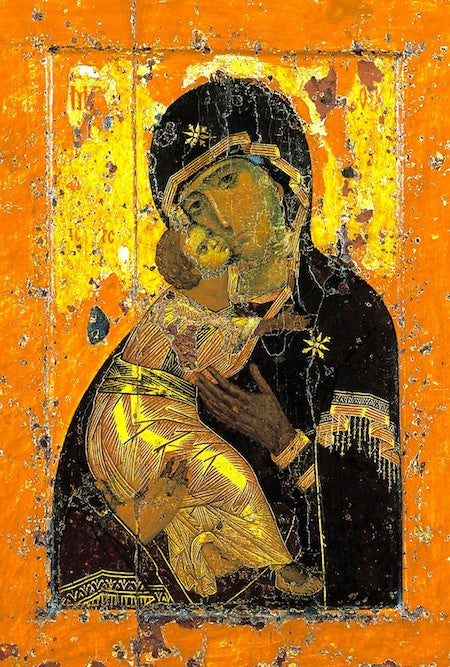
Vladimir Virgin, Late 11th Century
One of the most famous images is known as the Theotokos of Vladimir (right), aptly named for the Russian city it was brought to after an invasion of Constantinople. This is universally considered to be one of the finest pieces of early iconography. It is tempera on wood and is in the iconic style known as *Elousa (*Virgin of Compassion), which represents the Virgin and Child in an embrace. This is intended to represent the Church of Christ, showing the love between God and man. A love that is only achieved through the bosom of the Church, the Mother. Here we can see that although not in her full form as mother goddess, Mary is given a divine role based exclusively on her role as mother. A change that occurred due to a need among the people of the Church to connect with the divine in a more intimate way, “This distinctively humanized image is another example of the growing desire for a more immediate and personal religion” (Stokstad, 258).
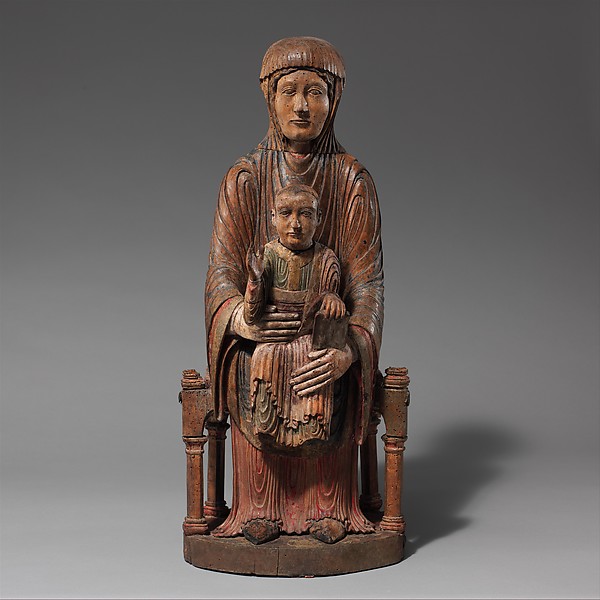
Enthroned Virgin and Child, AD 1150, Auvergne, France
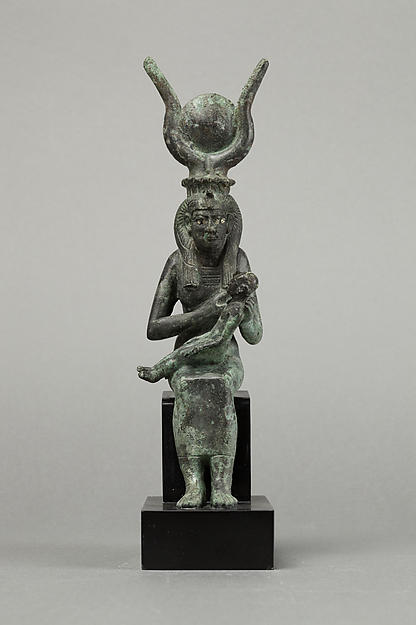
Isis and Horus, Late Period-Ptolemaic, 665-30 BCE, metal and clay
During the Romanesque period we see the concept of the Theotokos taken a step further in the representation of Mary as the “Throne of Wisdom”. As we can see in the Enthroned Virgin and Child (left), Mary is now seated on a throne. Sitting on her lap is the young Christ child. Both are facing forward, in a rigid upright posture, emulating regal power. Mary “As Mother and ‘God-bearer’ (Theotokos) gave Jesus his human nature”(Stokstad, 485). Like earlier mother goddess figures, such as Isis, Mary had become the throne that legitimized the rule of her son, “images of the Virgin and Child call to mind Egyptian representations of Isis nursing her son Horus” (Met Museum).
During the next few hundred years, the cult of Mary grew tremendously. She quickly became one of the central figures in an ever expanding religion. With this burgeoning popularity, came works dedicated in her honor. During the Gothic period, most of the major cathedrals were given the title Notre Dame (Our Mother) for this very reason. It was also during this period, that the role of Mary began to shift. No longer simply a divine vessel, she became the Queen of Heaven in her own right.
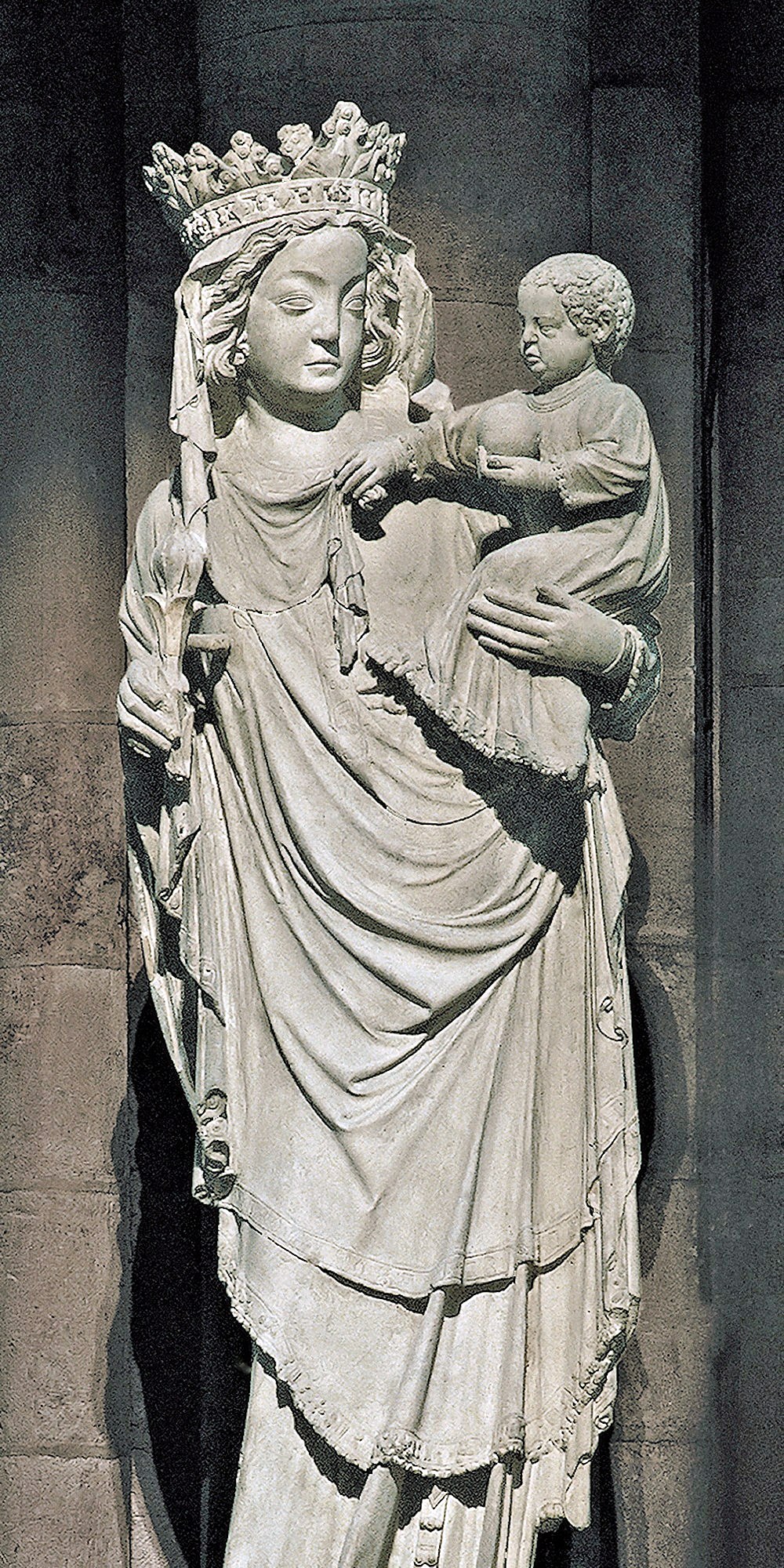
Virgin of Paris, Stone, France. Early 14th century
The Virgin of Paris (left), found in Notre Dame de Paris is a perfect example of this. Here we find Mary, standing up right, crowned and regal, draped in jewels as befits a queen. Carved from stone and sculpted in the round, the style is entirely different than earlier representations. She is still holding the infant Christ but she is clearly the central figure. She appears to be almost Classical in style. Her body is draped in fabric, completely concealing her feminine figure. Her body is swaying in an S shape, an effect used to project elegance. The figure of Mary had evolved from a divine vessel, useful simply for her womb, to one that demanded respect as the chosen Queen of God. Here, also for the first time, we see a strong emphasis on the relationship between mother and child. She is holding the Christ child perched on her hip. Christ himself, looks more like an actual child than he does in most earlier representations where he typically resembles a small adult. He is holding a ball (symbol for the Church) and seems to be playfully reaching toward his mother. This only serves to emphasize Mary’s role as the Divine Mother, suggesting the immense power she had as Mother of God.
These three pieces, the Theotokos of Vladimir*, Enthroned Virgin and Child*, and the Virgin of Notre Dame, represent pivotal points in history, not only within art but within Christian theology. Mary emerged from a place of obscurity to become one of the most important figures in a religion dominated by men. Although still debated today in certain religious circles, Mary is generally acknowledged as the ‘Birthgiver of God’ which therefore gives her an almost divine status. Moreover, this title developed to legitimize the rule of Christ as seen through Mary as the “Throne of Wisdom”. Within the Roman Catholic Church, she has further become the Queen of Heaven; uniting with the totality of the godhead.
In my opinion, Mary represents to Western society the cultural memory of the mother goddess. Despite the efforts of patriarchal monotheism over the course of the last 2000 years to suppress her, the mother goddess has lived on; albeit in many different forms. I’ll leave you with this quote from the Book of Jeremiah, which I feel perfectly summarizes why it was impossible to quell worship of the mother goddess.
“We will certainly do everything we said we would: We will burn incense to the Queen of Heaven and will pour out drink offerings to her just as we and our ancestors, our kings and our officials did in the towns of Judah and in the streets of Jerusalem. At that time we had plenty of food and were well off and suffered no harm.” -Jeremiah 44:17
The Old Testament Israelite’s did not want to stop worshiping ‘The Queen of Heaven” because when they served her, all was right with the world.

They say this like it’s a bad thing 😉
Works Cited:
Gadon, Elinor W. The Once and Future Goddess: A Symbol for Our Time. Harper and Row; San Francisco. 1989
Department of Medieval Art and The Cloisters. “The Cult of the Virgin Mary in the Middle Ages.” In Heilbrunn Timeline of Art History. New York: The Metropolitan Museum of Art, 2000–. http://www.metmuseum.org/toah/hd/virg/hd_virg.htm (October 2001)
https://www.metmuseum.org/art/collection/search/471853
Stokstad, Marilyn. Art History: Medieval Art. Pearson Education, 2014
https://www.khanacademy.org/humanities/medieval-world/latin-western-europe/romanesque1/a/throne-of-wisdom
Previous Post

November 26, 2017
Is witchcraft evil? and other common misconceptions
Next Post
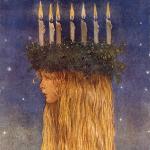
December 12, 2017 Sankta Lucia: The Survival of a Nordic Sun Goddess
Browse Our Archives
Select a Category Archaeology France The Basics The Black Madonna the blog The Craft The History of Paganism Thoughts Travel Uncategorized United States witchcraft Witchcraft in Literature Witchery
Select a Month May 2020 February 2020 December 2019 November 2019 July 2019 May 2019 April 2019 March 2019 February 2019 January 2019 December 2018 November 2018 October 2018 August 2018 July 2018 June 2018 May 2018 April 2018 March 2018 February 2018 January 2018 December 2017 November 2017 October 2017 September 2017
Follow Us!
TAKE THE
Religious Wisdom Quiz
What is the Christian teaching about humility?
Select your answer to see how you score.
Demand honor Be proud always Value others above yourself Boast often
Related posts from The Wandering Witch

Swedish Candle Magic Spell Kits by Needfire Wellness...

Defying Museum Fatigue: 6 Tips to Keep You...

what is remembered lives: grappling with loss in...

Life Update: The Wandering Witch
TRENDING AT PATHEOS Pagan

When we talk about Greek religion, we often begin with the dodekatheion—the...

I was recently chatting with someone on Instagram. She asked me what...

While there are many people who share their results, the end of...

On July 23, I saw Christopher Nolan's The Odyssey which is Homer’s...

As I write this two big events have just finished up. One...

Restoring the Watershed of Divine Love
Perhaps cooperation is not something we manufacture through legislation, ideology, or moral...
view all Pagan blogs
Ad-Free & Subscriber Log-In Subscription Support
- About Us
- 2026 Calendar
- Videos
- Podcasts
- Library of World Religions
- Faith In Media Tracker
- Advertise With Us
- Write for Us
- Privacy Policy
- Terms of Service
- Do Not Sell My Data
- Contact Us
- Radiant Digital
- Manage Newsletter Subscriptions
- Unsubscribe From Notifications
- Sitemap
Copyright 2008-2026, Patheos. All rights reserved.
Subscription Support Ad-Free & Subscriber Log-In
Follow Patheos