
BuddhistCatholicContemplativeEvangelicalGeneral ChristianHinduJewishLatter-day SaintMuslimNew VisionsProgressive Christian
Beliefs
- Buddhist
- Catholic
- Contemplative
- Evangelical
- General Christian
- Hindu
- Jewish
- Latter-day Saint
- More Voices
- Muslim
- New Visions
- Pagan
- Progressive Christian
Topics
- Religion News
- Food and Religion
- Sports and Religion
- Religious Art
- Religious Music and Entertainment
- Religious Events
- History and Religion
- Style and Religion
- Politics and Religion
- Women in Religion
- Recreation Outdoors and Religion
- Business Finance and Religion
- Careers Workplace and Religion
- Education and Religion
- Family Parenting and Religion
- Health Fitness and Religion
- Home and Religion
- Relationships and Religion
- Technology and Religion
- Travel and Religion
Columnists
- Buddhist Columnists
- Business Finance and Religion Columnists
- Careers Workplace and Religion Columnists
- Catholic Columnists
- Contemplative Columnists
- Education and Religion Columnists
- Evangelists Columnists
- Family Parenting and Religion Columnists
- General Christian Columnists
- Health Fitness and Religion Columnists
- Hindu Columnists
- History and Religion Columnists
- Home and Religion Columnists
- Jewish Columnists
- More Voices Columnists
- Latter Day Columnists
- Muslim Columnists
- New Visions Columnists
- Nonreligious Columnists
- Pagan Columnists
- Politics and Religion Columnists
- Progressive Columnists
- Recreation Outdoors and Religion Columnists
- Relationships and Religion Columnists
- Religion News Columnists
- Religious Art Columnists
- Religious Events Columnists
- Religious Music and Entertainment Columnists
- Sports and Religion Columnists
- Style and Religion Columnists
- Technology and Religion Columnists
- Travel and Religion Columnists
- Women in Religion Columnists
Resource Library
- 2026 Calendar
- Library of World Religions
- The 100 Most Holy Places on Earth
- Patheos Answers
- Podcasts
- Videos
- Faith Leaders Database
- Anglican Episcopalian
- Bahai
- Baptist
- Buddhism
- Christianity
- Confucianism
- Eastern Orthodoxy
- Hinduism
- Holiness and Pentecostal
- ISKCON
- Islam
- Judaism
- Lutheran
- Methodist
- The Church of Jesus Christ of Latter-day Saints
- New Age
- Paganism
- Presbytarian and Reformed
- Protestantism
- Religion Behind the Scenes
- Roman Catholic
- Scientology
- Shia Islam
- Sikhism
- Sufism
- Sunni Islam
- Taoism
- Zen
- See all religions
Research Tools
 Ad-Free & Subscriber Log-In Subscription Support
Ad-Free & Subscriber Log-In Subscription Support
Follow Patheos 

- Trending:
- Forgiveness
- |
- Marriage
- |
- Consciousness
- |
- Death Penalty
- |
- Election
- |
- Halloween

- Home
- General Christian
- Education and Religion
- Can We Trust the Bible? How Textual Criticism Provides Answers
Can We Trust the Bible? How Textual Criticism Provides Answers
Last updated on: January 15, 2025 at 12:01 pm by Todd Weller
Can We Trust the Bible? How Textual Criticism Provides Answers 2025-01-15T12:01:42-05:00 Todd Weller
Patheos Explore the world's faith through different perspectives on religion and spirituality! Patheos has the views of the prevalent religions and spiritualities of the world.
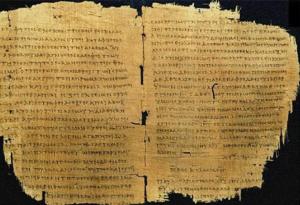
Codex Sinaiticus is a 4th century codex containing the entire OT and NT and is of the Alexandrian Text-Type. We have single-paged manuscripts that go back further to the 2nd century. Image is from Africa Research Consult and can be found here: https://african-research.com/research/oldest-bible-on-earth-codex-sinaiticus-is-1621-years-old/
Have you ever typed a paper on a word document? After typing the document, have you ever been shocked by the amount of squiggly red lines under the heinous amount of words that you’ve typed?
How do we make so many mistakes?
Spelling errors abound. Using the wrong “their”, “there”, or “they’re” is understandable. Even typing the word “the” twice is one of my favorite errors that I make. (You may even see it in this article. Leave a comment if you find it!)
Now what if you were to take that paper and read it to a room of 50 folks. Their task is to copy what is read aloud word for word, line for line, with as little mistakes as possible. Do you think you would get 50 flawless papers? Or would there be some mistakes?
Let’s up the stakes. What if we took computers out of the picture? Now, these 50 people had to write it down, word for word, line by line, and get it 100% correct. What are the results now?
Passing It On
When I was a kid, my uncle used to say that the Bible was written by “broken old men” who were simply making a power play. The Bible was written in order to keep men and women in check and to concentrate power to a few people. He was influence by the Da Vinci Code and the movie Angels and Demons like everyone else in popular culture at the time. As a young 8 year-old, this was confusing. Actually, as a 26 year-old it’s still confusing but for different reasons.
I remember thinking “Oh. The faith I have is dumb and maybe I should give up on it. If I can’t trust the Bible, then how can I trust what’s in the Bible.”
What’s in the Bible is a plethora of information: The history of Israel and her Kings, miracle claims, information about God and his character, information about Jesus and his mission, and the the list goes on and on. Basic foundations for the Christian Worldview that, if they couldn’t be trusted and weren’t in the original manuscripts, would crumble my faith as if it were built on sand.
If I couldn’t trust the Bible, then how could I trust these things in the Bible were true?
My stance now, is very different. The reason for this is because of the role of textual criticism. This article is not going to go through every single topic related to Textual Criticism. We will take a look at some of the major textual witnesses to the Bible and will see some of the most common mistakes that are made in its transmission. We will also see that the most common issues have no impact on any major theological issue in our Bible today.
What is Textual Criticism?
Textual Criticism is the attempt to trace the transmission of the text of the Bible. It is Textual Criticism that allows us to see errors, correct mistakes, and attempt to recreate the original text as much as possible. Textual Critics look at the textual witnesses for both the Old Testament and New Testament and determine what is original and what is not.
So What Textual Witnesses Do We Have?
Let’s start here. There are 1,000s of manuscript copies and fragments for the documents of the Bible. The Old Testament and New Testament are both represented (with far more manuscripts for the New Testament).
Here are some of the major players in the field:
- The Masoretic Text was preserved by Jewish scholars. This Text is normally dated in the early Medieval Period and has been accepted as the authentic Hebrew Bible.
- The Septuagint is a Greek copy of the Hebrew Bible that was begun in 250 B.C.
- Codex Alexandrinus is a 5th century majuscule manuscript that contains most the Old and New Testament.
- Codex Sinaiticus is a 4th century majuscule manuscript that has all of the New Testament and most of the Old Testament.
- Codex Ambrosia is 6th and 7th century manuscript of the Peshitta, the Syriac bible.
- Codex Vaticanus is a 4th century majuscule manuscript that contains most of the New and Old Testament
- The Allepo Codex is is a mid 10th century, Masoretic manuscript.
- Codex Bezae is a 5th century majuscule that contains the Gospels and Acts.
- The Dead Sea Scrolls were found between 1946 and 1956. All of the documents are dated between 250 BC and 70 AD. All books of the Old Testament documents except for Esther and Nehemiah are represented. It’s possible that Nehemiah was a part of the Ezra scroll.
There are nearly 5,000 Greek Manuscripts for the New Testament that include whole pages, pieces and parts.
In other words: There are a ton (more actually) of textual witnesses for critics to sift through. And we are able reconstruct the original text with extreme accuracy.
Can We Trust What’s Written?
We’ve talked about the different manuscripts copies that we have, but what about the mistakes? Aren’t there so many errors that there is no way that we are able to figure out what the original text is?
Not quite.
While there are many errors in the biblical manuscripts, we can tell what the errors are and why they appear. According to Bruce Waltke, an Old Testament scholar, there is no significant variation in 90% if the text.*
Even so, Bart Ehrman, who is not a Christian, says this: “In fact, most of the changes found in early Christian manuscripts have nothing to do with theology or ideology. Far and away the most changes are the result of mistakes pure and simple-slips of the pen, accidental omissions, inadvertent additions, misspelled words, blunders of one sort of another”**.
The words we see reflected in our Bibles are as faithful to the originals as they come when compared to other ancient documents.
What are the Common Errors
So what are the common errors that we see in the Biblical Manuscripts? Here is a short list:
Omissions: While copying the text, some scribes accidentally omit letters, words, or phrases that were located the source document that they were using.
Haplography: A type of omission where the scribe who is copying omits one letter that appears back to back.
Parablepsis: What appears to be when a scribe jumps from one line containing a cluster of letters to another line with a similar cluster, resulting in a larger collection of omitted words.
Dittography: A scribe copies a letter, word, or section twice by accident.
Conflation: A scribe includes 2 variants in the copy instead of choose between the 2.
Gloss: When Christian scribes were copying the text, sometimes they would write interpretations, explanations, or commentary in the margins or in between lines.
Metathesis: this is when a scribe hearing the reading of line writes the wrong letters corresponding with the sound.
Mistaking Letters: Greek Majuscules and the Hebrew alphabet poses challenges with letters appearing similar, this sometimes causes scribes to mistake one letter for another.
Homophony: Scribes would sometimes confuse the spelling of words that sounded the same.
These are a few of the most common errors that occur in the manuscripts that we have for both the New and Old Testament. And because of fields such as Textual Criticism, we are able to locate them.
As We Can See…
Textual Criticism helps us see the errors that are in the Bible and can help us learn what is in the originals. We’ll touch on Textual Criticism and Biblical Transmission more in the future. For now, seeing the common errors and some of the textual witnesses will suffice.
What are your thoughts? Do you think Textual Criticism Helps verify the trustworthiness of Scripture? Or does it do more harm?
Leave a Comment Below!
Continue to follow our content in the following ways…
Make sure to subscribe to our Newsletter!
You can follow us on Facebook by clicking Here
Find us on X @TheistThinking
Check Out Our Last Article as we take a look at what Jesus teaches about Hell.
*Bruce Waltke in “Textual Criticism of the Old Testament and Its Relation to Exegesis and Theology.”
** Bart Ehrman in Misquoting Jesus, pg. 55
Evangelical
Education and Religion
Previous Post

December 14, 2024
What does Jesus teach about Hell? - Part 2
Next Post

February 27, 2025 Do Christians Need to Apologize for Their Faith?
Recent Comments
"1 and 2. Sunan an-Nasai 3378; Sunan an-Nasai 3379; Sahih al-Bukhari 3896; Sahih al-Bukhari 5133. ..."
Muhammad’s Youngest Bride: Challenging Muhammad’s Character
"Mr. Todd still tou are trying to proof a point with false and misleading information. ..."
Guest
Muhammad’s Youngest Bride: Challenging Muhammad’s Character
"Hello Tod,I read your comments and still yiu misleading the readers. In response to your ..."
Guest
Muhammad’s Youngest Bride: Challenging Muhammad’s Character
"Are you referring to Islam?"
Muhammad’s Youngest Bride: Challenging Muhammad’s Character
Browse Our Archives
Select a Category Christmas Cultural Issues Dealing With Doubt Islam The Bible The Church The Cross and It's Impact Theology Uncategorized Youth Ministry
Select a Month September 2026 August 2026 July 2026 June 2026 March 2025 February 2025 January 2025 December 2024 August 2024 July 2024 June 2024 May 2024 April 2024 March 2024 January 2024 December 2023 September 2023 July 2023 May 2023 February 2023 January 2023 December 2022 September 2022 August 2022 July 2022
TAKE THE
Religious Wisdom Quiz
What does "Eden" mean in Hebrew?
Select your answer to see how you score.
River Tree Delight Mountain
Related posts from The Thinking Theist
General Christian
The Early Church: Lessons for the American Church...

General Christian
Biblical Reliability: Names and Titles in the Gospels
General Christian
Biblical Reliability: An Introduction

General Christian
Who is Most Miserable According to Muhammad's Wife?
TRENDING AT PATHEOS General Christian

A Biblical Vision of Success in Christian Life...
The Concern and Quest Recent trends and tendencies I note around me...

Indigenous Peoples’ Day and the Church
Indigenous' Peoples Day or Columbus Day? Depending on where you live...

When Spiritual Growth Looks Like Losing Ground
Four Passive Spiritual Disciplines: An Introduction When I was a college freshman,...

Faith and Finding Your Current Season
“To everything there is a season,” Ecclesiastes tells us, “and a time...

Did Jesus Fear God's Wrath in Gethsemane?
That Time Jesus Was Terrified Before we begin, let me say at...

A Generation Searching for God in All the...
Revival Begins With God’s People! Holidays Are Upon Us! Welcome to October!...
view all General Christian blogs
What Are Your Thoughts?leave a comment
Ad-Free & Subscriber Log-In Subscription Support
- About Us
- 2026 Calendar
- Videos
- Podcasts
- Library of World Religions
- Faith In Media Tracker
- Advertise With Us
- Write for Us
- Privacy Policy
- Terms of Service
- Do Not Sell My Data
- Contact Us
- Radiant Digital
- Manage Newsletter Subscriptions
- Unsubscribe From Notifications
- Sitemap
Copyright 2008-2026, Patheos. All rights reserved.
Subscription Support Ad-Free & Subscriber Log-In
Follow Patheos