
BuddhistCatholicContemplativeEvangelicalGeneral ChristianHinduJewishLatter-day SaintMuslimNew VisionsProgressive Christian
Beliefs
- Buddhist
- Catholic
- Contemplative
- Evangelical
- General Christian
- Hindu
- Jewish
- Latter-day Saint
- More Voices
- Muslim
- New Visions
- Pagan
- Progressive Christian
Topics
- Religion News
- Food and Religion
- Sports and Religion
- Religious Art
- Religious Music and Entertainment
- Religious Events
- History and Religion
- Style and Religion
- Politics and Religion
- Women in Religion
- Recreation Outdoors and Religion
- Business Finance and Religion
- Careers Workplace and Religion
- Education and Religion
- Family Parenting and Religion
- Health Fitness and Religion
- Home and Religion
- Relationships and Religion
- Technology and Religion
- Travel and Religion
Columnists
- Buddhist Columnists
- Business Finance and Religion Columnists
- Careers Workplace and Religion Columnists
- Catholic Columnists
- Contemplative Columnists
- Education and Religion Columnists
- Evangelists Columnists
- Family Parenting and Religion Columnists
- General Christian Columnists
- Health Fitness and Religion Columnists
- Hindu Columnists
- History and Religion Columnists
- Home and Religion Columnists
- Jewish Columnists
- More Voices Columnists
- Latter Day Columnists
- Muslim Columnists
- New Visions Columnists
- Nonreligious Columnists
- Pagan Columnists
- Politics and Religion Columnists
- Progressive Columnists
- Recreation Outdoors and Religion Columnists
- Relationships and Religion Columnists
- Religion News Columnists
- Religious Art Columnists
- Religious Events Columnists
- Religious Music and Entertainment Columnists
- Sports and Religion Columnists
- Style and Religion Columnists
- Technology and Religion Columnists
- Travel and Religion Columnists
- Women in Religion Columnists
Resource Library
- 2026 Calendar
- Library of World Religions
- The 100 Most Holy Places on Earth
- Patheos Answers
- Podcasts
- Videos
- Faith Leaders Database
- Anglican Episcopalian
- Bahai
- Baptist
- Buddhism
- Christianity
- Confucianism
- Eastern Orthodoxy
- Hinduism
- Holiness and Pentecostal
- ISKCON
- Islam
- Judaism
- Lutheran
- Methodist
- The Church of Jesus Christ of Latter-day Saints
- New Age
- Paganism
- Presbytarian and Reformed
- Protestantism
- Religion Behind the Scenes
- Roman Catholic
- Scientology
- Shia Islam
- Sikhism
- Sufism
- Sunni Islam
- Taoism
- Zen
- See all religions
Research Tools
 Ad-Free & Subscriber Log-In Subscription Support
Ad-Free & Subscriber Log-In Subscription Support
Follow Patheos 

- Trending:
- Forgiveness
- |
- Marriage
- |
- Consciousness
- |
- Death Penalty
- |
- Election
- |
- Halloween
 The Table Spread
- Home
- Muslim
- Dr. King’s Legacy: Fulfilling The Pledge of A ‘Promised Land’
Dr. King’s Legacy: Fulfilling The Pledge of A ‘Promised Land’
Last updated on: January 18, 2016 at 1:06 am by Zainab Chaudry
Dr. King’s Legacy: Fulfilling The Pledge of A ‘Promised Land’ 2016-01-18T01:06:35-04:00 Zainab Chaudry
Patheos Explore the world's faith through different perspectives on religion and spirituality! Patheos has the views of the prevalent religions and spiritualities of the world.
Rev. Dr. Martin Luther King Jr. street sign
“I just want to do God’s will. And he’s allowed me to go to the mountain. And I’ve looked over, and I’ve seen the Promised Land! I may not get there with you, but I want you to know tonight that we as a people will get to the Promised Land.” – Rev. Dr. Martin Luther King, Jr.
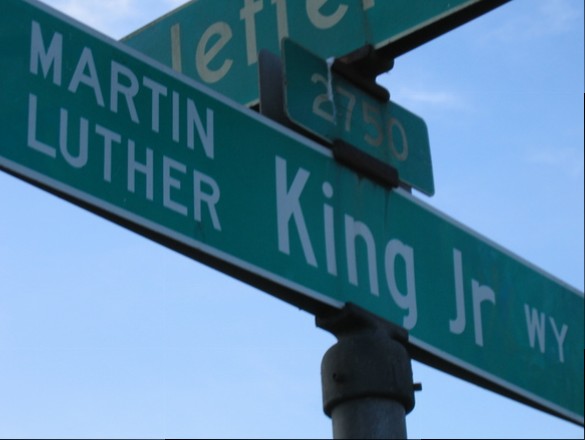
On April 3, 1968, Dr. Martin Luther King, Jr. – arguably one of the greatest orators our nation has ever produced – stood in a church in Memphis, Tennessee and made this vow during what would be his final public address.
His flight into Memphis the day before had been delayed due to a bomb threat, but that neither deterred him nor compelled him to change his travel plans.
African-American sanitation workers protesting unequal pay and working conditions in the city needed his support, and the threats on his life were not more urgent to him than his conviction that he was called to do God’s work.
As Dr. King delivered this historic speech, he could not know that he would be assassinated the next day outside his motel room at the age of 39; yet, his words foreshadowed his death.
His calling to do God’s work defined his life’s selfless mission. It forged a legacy that shaped the trajectory of our nation and eventually led to the designation of America’s first national holiday honoring an African American.
Today, every major city in America boasts a street, library, school, or recreation center named after this civil rights icon to remind us of his contributions and tremendous impact on government and civil society.
Nearly five decades after his death, his legacy steadfastly endures. Americans still reflect on his vision, remember his words, and mourn his loss. Marble, concrete, and stone monuments around the country are a testimony to the magnitude of respect it evokes.
But even as we reflect on its profound implications, we know the work to attain the ideals of that elusive Promised Land is far from over. Unequal treatment of minority communities and egregious civil rights violations continue to take place at an alarming rate.
In spite of numerous attempts to pass legislation banning racial profiling, law enforcement officers’ discriminatory practice of targeting citizens for suspicion of a crime based on race or religion is still lawful today in the 21st century.
Accounts of police brutality and misconduct against black men and women in America have dominated headlines in the last year – sparking heated debates and propelling communities into action.
These injustices have led to the formation of broad-based coalitions and movements like #BlackLivesMatter, which provides a new generation of social justice activists a visible platform to demand accountability, oversight, and criminal justice reform from Ferguson to Baltimore.
The greatest obstacle to achieving an equitable society is rooted in white supremacy and colonialism that dates back to the days of slavery. But today’s generation of energized activists has produced transformative ideas to challenge it. Their voices are elevated through technology including social media to educate, inform, and inspire others.
Dr. King’s ideas and vision are etched into the minds and hearts of countless Americans organizing to address structural and systemic issues plaguing our country from conflict-ridden urban streets to the powerful halls of Washington.
Emulating his example of non-violent resistance, Americans of all races and religions have banded together, marching in cities from coast to coast to protest the dehumanization and devaluation of black lives.
The steps our country has taken in the right direction come with a hefty price tag. Last June, our nation witnessed the brutal, racially motivated Charleston, S.C. church massacre that claimed the lives of nine innocent black people.
This event set in motion a sequence of nonviolent actions that led to the removal of the Confederate flag – widely seen to symbolize America’s racist heritage – from the state capitol grounds.
More recently, when city officials largely ignored concerns of toxic drinking water piped into the homes of a Michigan town that has a predominantly underprivileged, black population, citizen activists refused to remain silent.
The chorus of protests has steadily grown to reveal one of the largest scandals facing public officials in recent history. President Obama declared a federal emergency, and a federal investigation was launched, although the full extent of damage done is still unknown.
Dr. King famously said, “The arc of the moral universe is long, but it bends toward justice.” Decades after post-Reconstructionist era Jim Crow and the 1960’s Civil Rights Movement, we have learned that the needle will only move in the right direction if we guide and prod it.
The Promised Land Dr. King referenced in his final speech alludes to a land where justice, equality, mutual respect, and fairness prevail for all.
The nation we live in today does not yet reflect these ideals, but that pledge is far from a distant memory, buried away in the pages of history books. The vow itself is a living, breathing covenant, and it is our collective duty to ensure that it is fulfilled.
We can do so by not only remembering Dr. King’s legacy, but also incorporating it into our daily lives; by being a voice for the voiceless and advocating for justice; and by recognizing our respective privilege and not allowing it to taint our vision.
There is no greater way to honor the man or his legacy than by committing to do our part to attain the ideals of that Promised Land and ensure that his pledge is fulfilled.
Previous Post

December 27, 2015
In These Times of Strife, Emulate the Prophet Muhammad
Browse Our Archives
Select a Category Uncategorized
Select a Month September 2016 February 2016 January 2016 December 2015 November 2015 October 2015
Follow Us!
TAKE THE
Religious Wisdom Quiz
In Philippians, what does Paul say he has learned in any and every situation?
Select your answer to see how you score.
To pray without ceasing To be content To give thanks To trust God
Related posts from The Table Spread

Scenes from an American Muslim Debate Watch Party

On Noor Tagouri and Playboy - Standing Up...

Marking 15 Years Since 9/11 as an American...

Ring the Bell In Honor of Black History...
TRENDING AT PATHEOS Muslim

25 Years Later: How Much Has Changed for...
As we approach the 25th anniversary of September 11th, I’ve found myself...

Podcast: Third Spaces & The Rise of Yemeni...
In the latest episode of The Artistic Foodies Podcast, hosts Abbas...

HalalFest Picks: Best 60 Halal Spots for Super...
Back in 2016, I came up with a list of 29...

Unity Is America’s Strength — Division Is Its...
by Hidayatullah Ahsan When Valentina Gomez, a Republican candidate for Congress in...

Zohran Mamdani and New York’s Fight Against Islamophobia
This past June, against all odds, Zohran Mamdani won the Democratic primary...

What the Fourth of July Means to a...
As we mark another Fourth of July, millions of Americans will celebrate...
view all Muslim blogs
Ad-Free & Subscriber Log-In Subscription Support
- About Us
- 2026 Calendar
- Videos
- Podcasts
- Library of World Religions
- Faith In Media Tracker
- Advertise With Us
- Write for Us
- Privacy Policy
- Terms of Service
- Do Not Sell My Data
- Contact Us
- Radiant Digital
- Manage Newsletter Subscriptions
- Unsubscribe From Notifications
- Sitemap
Copyright 2008-2026, Patheos. All rights reserved.
Subscription Support Ad-Free & Subscriber Log-In
Follow Patheos