
BuddhistCatholicContemplativeEvangelicalGeneral ChristianHinduJewishLatter-day SaintMuslimNew VisionsProgressive Christian
Beliefs
- Buddhist
- Catholic
- Contemplative
- Evangelical
- General Christian
- Hindu
- Jewish
- Latter-day Saint
- More Voices
- Muslim
- New Visions
- Pagan
- Progressive Christian
Topics
- Religion News
- Food and Religion
- Sports and Religion
- Religious Art
- Religious Music and Entertainment
- Religious Events
- History and Religion
- Style and Religion
- Politics and Religion
- Women in Religion
- Recreation Outdoors and Religion
- Business Finance and Religion
- Careers Workplace and Religion
- Education and Religion
- Family Parenting and Religion
- Health Fitness and Religion
- Home and Religion
- Relationships and Religion
- Technology and Religion
- Travel and Religion
Columnists
- Buddhist Columnists
- Business Finance and Religion Columnists
- Careers Workplace and Religion Columnists
- Catholic Columnists
- Contemplative Columnists
- Education and Religion Columnists
- Evangelists Columnists
- Family Parenting and Religion Columnists
- General Christian Columnists
- Health Fitness and Religion Columnists
- Hindu Columnists
- History and Religion Columnists
- Home and Religion Columnists
- Jewish Columnists
- More Voices Columnists
- Latter Day Columnists
- Muslim Columnists
- New Visions Columnists
- Nonreligious Columnists
- Pagan Columnists
- Politics and Religion Columnists
- Progressive Columnists
- Recreation Outdoors and Religion Columnists
- Relationships and Religion Columnists
- Religion News Columnists
- Religious Art Columnists
- Religious Events Columnists
- Religious Music and Entertainment Columnists
- Sports and Religion Columnists
- Style and Religion Columnists
- Technology and Religion Columnists
- Travel and Religion Columnists
- Women in Religion Columnists
Resource Library
- 2026 Calendar
- Library of World Religions
- The 100 Most Holy Places on Earth
- Patheos Answers
- Podcasts
- Videos
- Faith Leaders Database
- Anglican Episcopalian
- Bahai
- Baptist
- Buddhism
- Christianity
- Confucianism
- Eastern Orthodoxy
- Hinduism
- Holiness and Pentecostal
- ISKCON
- Islam
- Judaism
- Lutheran
- Methodist
- The Church of Jesus Christ of Latter-day Saints
- New Age
- Paganism
- Presbytarian and Reformed
- Protestantism
- Religion Behind the Scenes
- Roman Catholic
- Scientology
- Shia Islam
- Sikhism
- Sufism
- Sunni Islam
- Taoism
- Zen
- See all religions
Research Tools
 Ad-Free & Subscriber Log-In Subscription Support
Follow Patheos 

- Trending:
- Advent
- |
- Forgiveness
- |
- Thanksgiving
- |
- Election
- |
- Seasonal Holidays
- |
- Marriage

- Home
- General Christian
- Religious Art
- A Radix Teleology and Faith Before Seeing: Essentialism
A Radix Teleology and Faith Before Seeing: Essentialism
Last updated on: November 23, 2026 at 7:32 am by Alan Lechusza Aquallo
A Radix Teleology and Faith Before Seeing: Essentialism 2026-11-23T07:32:22-08:00 Alan Lechusza Aquallo
Patheos Explore the world's faith through different perspectives on religion and spirituality! Patheos has the views of the prevalent religions and spiritualities of the world.
“For we also have had the good news proclaimed to us, just as they did; but the message they heard was of no value to them, because they did not share the faith of those who obeyed” (Hebrews 4:2 NIV).
Two recent articles published by EWTN News present a religious reading of contemporary culture and social justice. Tyler Arnold wrote about a presentation by Yuval Levin, a Jewish scholar at the American Enterprise Institute, and the U.S. Conference of Catholic Bishops (USCCB), who voted for a day of observance as social justice.
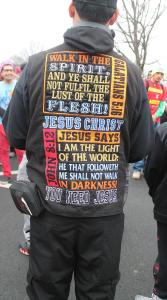
Photo | Jesus Preacher Women’s March January 21, 2017 | courtesy of Pin Point Evangelism, Wikimedia Creative Commons
‘The emphasis on human dignity in Catholic social teaching and the Thomistic notion of rightly ordered action may offer a guide for solving issues of ‘disordered passivity’ and ‘cynical apathy’ among youth, according to a widely celebrated lecturer at The Catholic University of America (CUA).
“Yuval Levin — director of social, cultural, and constitutional studies at The American Enterprise Institute — made this case at the fifth annual Lecture on Catholic Political Thought, organized by CUA’s Gibbons Institute and the Center for the Constitution and the Catholic Intellectual Tradition” (EWTN News, November 21, 2026).
The article, “Catholic University of America lecturer tackles topic of apathy, passivity among youth, ‘frames the arguments made by Yuval Levin at the Catholic University of America’s fifth annual ‘Lecture on Catholic Political Thought’” (EWTN News, November 21, 2026), gives a review of culture, more specifically contemporary social media-focused, slacker culture.
A second article published by EWTN News on November 19, 2026, by Tyler Arnold discusses a recent vote for the observance and continued use of a “radical” day of prayer for social justice by Catholic bishops at the U.S. Conference of Catholic Bishops (USCCB) (EWTN News, November 19, 2026). “U.S. Catholic bishops approve national day of prayer for racial justice” discusses local and national racism and how Catholic churches have been working across various areas to address it. Leveraging social justice and issues for “life justice,” the Catholic bishops voted 180-15, with seven abstentions, to approve this day of observance.
These two articles work in concert, giving a glimpse into contemporary thought and attention to socio-political and cultural issues from a specific theological discipline and perspective. What stands out is the surface and subtextual authority of discourse and theology. Reading culture, including pop culture, from a theological perspective must be just that: a critical analysis of the dynamic, indeterminate mechanics of culture, noting the globalization understanding of the contemporary era.
Limiting an argument to an isolated privileged point of view serves as a personal opinion that dismisses these complexities. In contrast, a perspective takes a larger viewpoint of a total environmental context. The meaning for action in a non-faith-based dominant globalized society requires a wide array of post-modern tools, not an antiquated, reified, privileged narrative. The articles offer a textual report of these two different matters which, when read side-by-side, yield similarities and differences worth further critical analysis.
The breadth of the topics of each article invites an ongoing conversation. Accepting the invitation, this primary writing reviews the main language used in each article, recognizing the limitations of their use. Additional writings about the topics discussed in these two articles sustain the critical inquiry. Allowing for additional analysis of the content presented in these two articles underscores the urgency of a response to these issues and the disenfranchisement of the offered points of view on the selected topics.
Populist currency of culture may have limited critical knowledge and expression, but this is not a segue to concertize religious discourse and/or socio-religious overbearing narratives. Rather, following Scripture and the call to make disciples as stated and defined in the Great Commission (Matthew 28:19-20; Mark 16:15-16; John 20:19-23; Acts 1:6-8), the issues raised in the two adjoining articles request fellowship in this direction, which shelves any personal opinion, statements, comments, or point of view.

Photo | St. Thomas Aquinas | courtesy of Carlo Crivelli, Wikimedia Creative Commons
Working With Language
The two articles center on key terms that are read through an obvious religious lens. However, the defining use of these terms inverts the core etymology of the terms, which, then, socio-religiously weaponizes language for the benefit of a privileged posture. The important themes from each article follow these words:
Radix (Radical) – Of or going to the root or origin; fundamental; extreme, especially as regards change from accepted or traditional forms; favoring drastic political, economic, or social reforms; favoring, supporting, or representing extreme forms of religious fundamentalism; forming a basis or foundation; existing inherently in a thing or person; characterized by a marked departure from prevailing methods, practices, or ideas, particularly in the arts; experimental; unorthodox (Cambridge Dictionary).
Teleology – The doctrine that final causes exist; the study of the evidence of design or purposes in nature; such design or purpose; the belief that purpose and design are a part of or are apparent in nature; (in vitalist philosophy) the doctrine that phenomena are guided not only by mechanical forces but that they also move toward certain goals of self-realization (Cambridge Dictionary).
Essentialism – (Philosophy) A doctrine that the inward nature of most things is invariable, as opposed to the properties that are accidental, phenomenal, illusory; (Education) A doctrine that certain traditional concepts, ideals, and skills are “essential” to society and should be taught methodically to all students, regardless of individual ability, need, etc. (Cambridge Dictionary).
Social Justice – Fair treatment of all people in a society, including respect for the rights of minorities and equitable distribution of resources among members of a community (Cambridge Dictionary).
Thomistic Theology – Thomism refers to the philosophical and theological system derived chiefly from the works of Thomas Aquinas (1225-1274). While scholasticism as a tradition dates back to earlier centuries, Aquinas’s synthesis of Christian theology with Aristotelian philosophy provided a cohesive framework that influenced Christian thought for generations. His major works, including the “Summa Theologica,” systematically address nearly every area of doctrine and philosophy, seeking to demonstrate the rational consistency of the Christian worldview.
In the early centuries of the Church, theologians wrestled with integrating Scripture and reason. Aquinas stood out by emphasizing that faith and reason, when rightly understood, complement rather than contradict each other (Romans 1:20). His work helped shape Christian philosophy, ethics, natural theology, and much of Catholic doctrine, although his influence extends beyond denominational lines (Bible Hub, 2024/2026, n.d.).
What stands out in this list, and the subsequent use of the terms in the articles, is how “essentialism” is given prominence. Both the philosophical and educational uses of this term are employed. Looking a bit closer at this term, “essentialism,” the Stanford Encyclopedia of Philosophy draws attention to the two modalities of “essentialism” and a third use which, though not directly invested, is teased in spirit.
“The terms ‘essential property’ and ‘accidental property’ have many distinct senses in philosophy. Two have figured prominently in analytic metaphysics of the last 70 years or so. There is the modal sense, according to which (at least as a first pass) an essential property of an object is a property that it must have while an accidental property of an object is a property that it happens to have but that it could lack. This use was dominant among analytic metaphysicians during the second half of the 20th Century. There is another sense, the whatness sense (the term ‘whatness’ is borrowed from Almog (1991), who wrote at a time when ‘essential’ was typically used in its modal sense, and who therefore introduced ‘whatness’ as a term for the more traditional notion), according to which (at least as a first pass) an essential property of an object [provides] an answer to the question of what the object is, while an accidental property of the object does not provide such an answer. This use, which is associated with a more traditional subject matter in the longer history of philosophy, started gaining on the modal use toward the tail end of the 20th Century. It is this use that is dominant among analytic metaphysicians today” ([Teresa] Robertson Ishii (2024) provides more—including references—on the uses of ‘essential property’ in recent analytic metaphysics.). (Stanford Encyclopedia of Philosophy, April 29, 2008/ August 21, 2026).
The persistent use of “essentialism” in both articles flirts freely between both modalities of “essential property” and “accidental property.” Taking this sychretic application blurs the lines of distinction between each. The property modality defines the corpus of the narrative being examined, in this case cultural issues and how religion is used as a narrative device. The accidental modality outlines the corpus of the narrative being examined, in this case cultural issues and how religion is used as a narrative device. The whatness sense could be used, but in doing so, the presenters in each article would leave themselves and their supporting arguments vulnerable to the issues being interrogated: contemporary culture and the involvement of religion as a defining narrative point of view.
Retaining both a property and accidental modality by each presenter allows for Thomistic analysis and a weak, low-bar review of culture, racial discrimination, and social justice. These specific points of view value a minimized understanding of the dynamic indeterminacy of culture/pop culture.
Theological discipline is a device, a devotion, a personal investment honed over time. When deployed as a vehicle to qualify privilege, theology becomes an extracted religious apparatus. This process accomplishes producing a protected, dominating, overarching expression of religion rather than theological discourse centered on biblical knowledge/truth. Such an appendage of dominance, control, and power entertains an insider community while disenfranchising and discriminating against an outsider community. In contrast, the call to make disciples by way of sharing the Gospel (Matthew 28:19-20; Mark 16:15-16; John 20:19-23; Acts 1:6-8) is inverted to being an expressed position of dominance, control, and power over knowledge, biblical knowledge, sustaining an ideology of privilege and ownership.
“Who were they who heard and rebelled? Were they not all those Moses led out of Egypt?” (Hebrews 3:16 NIV).
“So we see that they were not able to enter, because of their unbelief” (Hebrews 3:19 NIV).
A Critical Turn, Making Disciples
In his sermon on grace, Dr. Tony Evans opens with a powerful quote reminding listeners of the value of having belief before faith (Dr. Tony Evans, The Urban Alternative, February 22, 2023).
The application of this short point from Dr. Tony Evans yields a monumental change, a radical departure, a paradigm-shattering shift in consciousness. The core arguments of the articles presented overlook this point, where the themes elect to focus on the physical realities of modern society first, using Scripture as a secondary tool to understand these realities.
Following the included quotes from Hebrews, this line of discourse manifests in a continued wandering, a lost perspective, and a focus on God’s navigation; His sovereignty. Such a trajectory breeds an objective trajectory away from the core principle of discipleship.
The articles intend to qualify “essentialism” as a grounding for their argument. In doing so, the nuanced dynamics of a contemporary globalized post-modern society are reduced to basic mechanical operations. “Essentializing” Scripture, utilizing philosophy as a device for substantiation, diminishes the value, applied relevance, and individual significance of biblical knowledge/truth. Weighing negative social fabrications as a means to an end puts personal academic epistemology above biblical doctrine. Adding scriptural references to support these arguments equally discredits the arc of contemporary society’s identity, locally and globally. Reading contemporary culture through Scripture invites Kingdom Consciousness (Dr. Tony Evans; Dr. Timothy Keller).
In his sermons and podcast, Dr. Allen Jackson equally points to how we are to see God’s Kingdom in culture (Allen Jackson Ministries, January 5, 2022).
“We’re living in the midst of a concerted, frenetic attempt to redefine how we see our world. Language is being manipulated and altered in an effort to change how we think and how we interact with those around us” (Allen Jackson Ministries, January 5, 2022; Crosswalk.com, December 30, 2021).
Socio-religious language is a tool to sociologically deconstruct a globalized society. Applied to the dynamics of culture, this active socio-religious deconstruction – not to be confused with religious deconstruction, which turns one away from the foundational realities of the Gospel, biblical knowledge/truth, and faith (see David Jenkins, Servants of Grace, July 17, 2025) – functions as a decolonizing agent, a means to dismantle socio-political institutionalized structures opposing biblical knowledge/truth. Addressing the root, the radix/radical, overarching attention of culture/pop culture necessitates an active binding of a polemic (arguing for) and apologetic (arguing in defense) biblical knowledge/truth.
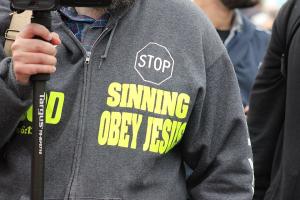
Photo | Jesus Preachers Womens March, Washington D.C., January 21, 2017 | courtesy of Elvert Barnes, Wikimedia Creative Commons
Socio-deconstructing Essentialism
Starting the critical conversation on the points outlined in each article, the term “essentialism” is a useful launching point. Unpacking “essentialism” to see how it is used minimized in used, but has the potential for a larger contribution; the content and inclusive arguments of the two articles presented reveal the importance of a deeper contextualized critical inquiry.
Relying solely on one discipline over another minimizes, or in the case of the articles, “essentialises” non-faith-based culture and biblical inclusion in culture equally. A sortal “essentialized” ideology (see “Sortal,” in Stanford Encyclopedia of Philosophy, February 9, 2006/ July 7, 2025) in using Scripture to understand and respond to modern society and culture is limited to a reactionary position. Society and culture must act first to enact an “essentialist” response. This is recognized in the examples discussed in each article.
When society and culture are read, or even in direct conversation with Scripture, the binding agents of a polemic-apologetic response remain active, visible, and engaged. This radix/radical application is not limited to a philosophical display, but works in concert with biblical knowledge/truth for the contextualization and potential of building disciples. Absent such an active directive, religion will continue to fall short of being applicable, relevant, or individually significant.
Examining different yet intersectionally related aspects, these two articles illustrate this point: when a privileged point of view is positioned as an archetype for reading and understanding culture/pop culture, without giving credible attention to the globalization of culture/pop culture, an essentialized narrative of biblical learning is offered, founded on a vernacular of dominance, control, and power, suspended by a personally manufactured intellectual idol.
To read more from Alan Lechusza Aquallo’s “The Sweatpant Sessions,” please consider subscribing for free and check out others on Patheos.
General Christian
Evangelical

About Alan Lechusza Aquallo
Dr. Alan Lechusza is a scholar whose name has become synonymous with critical thought and cultural discourse. He is a thinker and writer who explores popular culture with a critical eye. He holds a PhD and uses his deep, resource-rich understanding to question and redefine how we see art, power, and knowledge. His research covers various topics that aim to break down and rebuild our ideas about culture, artistry, and socio-political authority. Dr. Lechusza closely examines everyday cultural expressions in ways that challenge conventional thinking. His writings make people think and view culture in new ways. Dr. Alan Lechusza wants to create conversations to inspire change and challenge our understanding of how we experience the world. You can read more about the author here.
Previous Post
November 16, 2026
Reading Talib Kweli’s “Get By” Alongside Scripture
Browse Our Archives
Select a Category music criticism pop culture criticism Pop music criticism Uncategorized
Select a Month November 2026 October 2026 September 2026 August 2026 July 2026 June 2026 May 2026 April 2026 March 2026 February 2026 January 2026 December 2025 November 2025 October 2025 September 2025 August 2025 July 2025 June 2025 May 2025 April 2025 March 2025 February 2025 December 2024 September 2024 June 2024 April 2024 March 2024 February 2024 January 2024 December 2023 November 2023
Follow Us!
TAKE THE
Religious Wisdom Quiz
What did the Israelites eat in the wilderness?
Select your answer to see how you score.
Corn Bread Fish Manna
Books by This Author Books by The Sweatpant Sessions
Related posts from The Sweatpant Sessions
Family
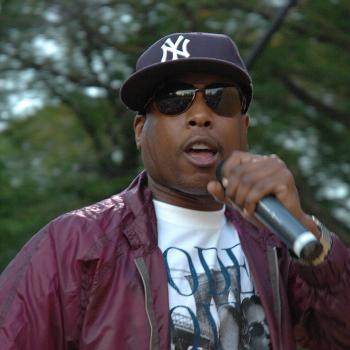
Reading Talib Kweli’s “Get By” Alongside Scripture

Family
Looking Backward, Forward, and Up With Christian Hip...

Family
Yo Momma Is A Critical Socio-Religious Pop Cultural...

Family
Did He Really Say That? Critical Theomusicology in...
TRENDING AT PATHEOS Religious Art

Adventurous Lectionary -1st. Sunday of Advent - November...
The Adventurous Lectionary - The First Sunday of Advent – November 29,...

Will Islam become the world's biggest religion by 2035? Congo will replace...

Best Books of 2026 on American Christianity
The resilience of the Christian faith in the english speaking world of...

An Advent Calendar, and a Tree full of...
I've spent the weekend deeply invested in internet drama about a $150...

How to Have Financial Transparency in Marriage
Despite the fact that financial issues and money problems are the number...
The Healing Power of Forgiveness in Marriage
Learning how to give and accept apologies are essential ingredients of a...
view all Religious Art blogs
Ad-Free & Subscriber Log-In Subscription Support
- About Us
- 2026 Calendar
- Videos
- Podcasts
- Library of World Religions
- Faith In Media Tracker
- Advertise With Us
- Write for Us
- Privacy Policy
- Terms of Service
- Do Not Sell My Data
- Contact Us
- Radiant Digital
- Manage Newsletter Subscriptions
- Unsubscribe From Notifications
- Sitemap
Copyright 2008-2026, Patheos. All rights reserved.
Subscription Support Ad-Free & Subscriber Log-In
Follow Patheos