
BuddhistCatholicContemplativeEvangelicalGeneral ChristianHinduJewishLatter-day SaintMuslimNew VisionsProgressive Christian
Beliefs
- Buddhist
- Catholic
- Contemplative
- Evangelical
- General Christian
- Hindu
- Jewish
- Latter-day Saint
- More Voices
- Muslim
- New Visions
- Pagan
- Progressive Christian
Topics
- Religion News
- Food and Religion
- Sports and Religion
- Religious Art
- Religious Music and Entertainment
- Religious Events
- History and Religion
- Style and Religion
- Politics and Religion
- Women in Religion
- Recreation Outdoors and Religion
- Business Finance and Religion
- Careers Workplace and Religion
- Education and Religion
- Family Parenting and Religion
- Health Fitness and Religion
- Home and Religion
- Relationships and Religion
- Technology and Religion
- Travel and Religion
Columnists
- Buddhist Columnists
- Business Finance and Religion Columnists
- Careers Workplace and Religion Columnists
- Catholic Columnists
- Contemplative Columnists
- Education and Religion Columnists
- Evangelists Columnists
- Family Parenting and Religion Columnists
- General Christian Columnists
- Health Fitness and Religion Columnists
- Hindu Columnists
- History and Religion Columnists
- Home and Religion Columnists
- Jewish Columnists
- More Voices Columnists
- Latter Day Columnists
- Muslim Columnists
- New Visions Columnists
- Nonreligious Columnists
- Pagan Columnists
- Politics and Religion Columnists
- Progressive Columnists
- Recreation Outdoors and Religion Columnists
- Relationships and Religion Columnists
- Religion News Columnists
- Religious Art Columnists
- Religious Events Columnists
- Religious Music and Entertainment Columnists
- Sports and Religion Columnists
- Style and Religion Columnists
- Technology and Religion Columnists
- Travel and Religion Columnists
- Women in Religion Columnists
Resource Library
- 2026 Calendar
- Library of World Religions
- The 100 Most Holy Places on Earth
- Patheos Answers
- Podcasts
- Videos
- Faith Leaders Database
- Anglican Episcopalian
- Bahai
- Baptist
- Buddhism
- Christianity
- Confucianism
- Eastern Orthodoxy
- Hinduism
- Holiness and Pentecostal
- ISKCON
- Islam
- Judaism
- Lutheran
- Methodist
- The Church of Jesus Christ of Latter-day Saints
- New Age
- Paganism
- Presbytarian and Reformed
- Protestantism
- Religion Behind the Scenes
- Roman Catholic
- Scientology
- Shia Islam
- Sikhism
- Sufism
- Sunni Islam
- Taoism
- Zen
- See all religions
Research Tools
 Ad-Free & Subscriber Log-In Subscription Support
Ad-Free & Subscriber Log-In Subscription Support
Follow Patheos 

- Trending:
- Forgiveness
- |
- Marriage
- |
- Consciousness
- |
- Death Penalty
- |
- Election
- |
- Halloween

- Home
- General Christian
- Religious Art
- Beginning an Ending Analysis of Linkin Park’s “In The End”
Beginning an Ending Analysis of Linkin Park’s “In The End”
Last updated on: July 20, 2026 at 5:38 am by Alan Lechusza Aquallo
Beginning an Ending Analysis of Linkin Park’s “In The End” 2026-07-20T05:38:34-07:00 Alan Lechusza Aquallo
Patheos Explore the world's faith through different perspectives on religion and spirituality! Patheos has the views of the prevalent religions and spiritualities of the world.
This article takes a sociological deconstruction of a prolific track by the Nu-Metal/Alternative Rock band Linkin Park, “In The End.”
Pop culture musical analysis gives a clear pass on the work, praising it for the robust theme, generational-defining sound, and social commentary that continues to speak to the angst of the times. This analysis employs a critical theomusicological reading of the work, using sociological deconstruction as agency.
Discussing the audio and visual elements and how they invite the opportunity to “flip the script” (Geneva Smitherman, 1971/1977, 2005) or invert the narrative, there is room for each of these elements to be fully dismantled, critiqued, and discussed further. The directive of this essay is not to fully sociologically deconstruct each element; rather, the trajectory is to illustrate how a widely known, non-faith-based pop cultural iconic work, “In The End,” can be read through a theomusicological lens as an apologetic discourse, which creates multiple entry points to invest biblical knowledge and scripture.

Photo | Linkin Park in concert at the Miejskim Stadium | courtesy of Jakub Janecki, Wikimedia Creative Commons
A Socio-religious Analysis and Theomusicological Reading of Linkin Park’s “In The End”
Here is a scripture that was shared by the Institute for Creation Research (ICR) on July 17.
“That the Gentiles should be fellowheirs, and of the same body, and partakers of his promise in Christ by the gospel” (Ephesians 3:6 KJV).
The biblical verse highlights the inclusion and recognition that “we” are of the same body (read: social corpus, both sacred and secular), where “our” position and posture in life is to be caretakers of the words of Christ, and to share those with whom we acknowledge as “our” brother/sisters and those to whom “we” can share this knowledge who may otherwise not be aware of this location and identity.
If that is the case, the biblical verse is a call to action, a raising of arms using whatever mechanism is available through one’s talents. In this case, a critical theomusicological analysis of a non-faith-based work, one which has a formidable profile and unmistakable identity, is challenged by and read through a theomusicological apologetic, illustrating that the selected track can be agency sharing, speaking to, and talking about biblical knowledge, emphasizing the main points in the verse: fellowheirs (community and discipleship), same body (church, community, personal location), promise (testimony, agency/activism, evangelism) and Christ through the gospel (personal testimony, evangelism, discipleship, biblical knowledge, communityh, and activism).
Socio-religious Analysis/A Critical Theomusicological Apologetic applied to Linkin Park, “In The End,” 2000/October 26, 2009. Full video link
Hearing Untruth
Applying a sociological deconstruction of video, signs, icons, and images of false gods, and a glorification of victimization are performed in a dystopian landscape. Contemporary society is reduced to a binary, both entombing physically, emotionally, and spiritually.
A regular viewing audience is charged with images generating an environment absent of progress; a life bound by the chains of time with no potential for liberation. The sounding landscape heightens the emotions while emphasizing the negativity of the video. Arriving at a point in pop cultural history where there was a primal scream from Gen Z to be heard, understood, and exist by its own means, this work visually and audibly became an anthem.
Taking a closer look, the critical praise for the track glorifies a dark lifestyle, a dystopian social norm.
Dystopia is understood as “a very bad or unfair society in which there is a lot of suffering, especially a society imagined in the future, after something terrible has happened” (Cambridge Dictionary, n.d.).
An apt description of how the track “In The End” elects to read contemporary society, one sustained as a negative social norm, casting a gaze to the future.
The slow pace of the video is juxtaposed against the grinding distortion of the music. The narrating, faster-paced vocals (Mike Shinoda) are contrasted by the slower, heavy-toned songster lyrics (Chester Bennington), arresting the listener between the two.
This inner space between the two vocal styles, for the listener, is not objected to but rather is welcomed. The disturbed space becomes a comfortable space where both vocal styles are assumed to be listening to the angst of the viewer. The heavy, inescapable weight of the socio-political contemporary context finds an amplified sensitive partner, providing a secure 3:38 space to release the density of the modern world for a faux reality, seen, heard, and emotionally experienced.
The binding agent of the space between the two vocal styles articulates the three different operating levels of sin, as recognized in scriptural knowledge: the sins of the eyes, the flesh, and the pride of the world.
“For all that is in the world—the desires of the flesh and the desires of the eyes and pride of life—is not from the Father but is from the world” (1 John 2:16 ESV).
The addictive sound of the work hypnotizes the reviewer, aligning the lyrics as a mantra of desolation and absence of belief or faith. Each verse could be sociolinguistically deconstructed to reveal this process. However, two important hooks are repeated that contextualize the totality of the work.
“I tried so hard/ and got so far/ (but) in the end/ it doesn’t even matter,” “I had to fall/ to lose it all/ (but) in the end/ it doesn’t even matter.”
“I put my trust in you/ pushed as far as I can go/ for all this/ there’s only one thing you should know/” (emphasis added).
The lyrics in these chorus hooks are in the first person. This means the song is not meant to be spoken to, but spoken from the viewpoint of the listener. The singer, in this case, Chester Bennington, is a surrogate voice for the listener. The responsibility of the defeat, the lack of faith, and the victimization is not given but intrinsically forced on the listener. There is no room for compromise; an audience member is taken out of context and put directly in the body of the work. Thus, when analyzed theomusicologically, the three sins (eyes, flesh, pride of the world) are placed squarely on the existence of the listener.
There are two glimmers of hope in these hooks. The lines “I had to fall” and “I put my trust in you” present themselves as the most hopeful points in the entire work. Looking at “I had to fall” references, the listener, by way of the primary perspective, lets an observer know that the vocalist, the individual, has come to the lowest point in their life. It’s a fall from an assumed higher, better position in life. Whatever took place, the individual fell from this higher position, which can be understood as a better position, to a lower, undesirable place. At this point, the lowest point in one’s life, is where, when, and how one can learn dependence, trust, and faith in a Savior, the Savior, Christ.
“So, if you think you are standing firm, be careful that you don’t fall!” (1 Corinthians 10:12 ESV).
“You who are trying to be justified by the law have been alienated from Christ; you have fallen away from grace” (Galatians 5:4 ESV).
Once one is at the lowest point, broken, fallen, it is at this point that Christ can, and will, lift one. This is the hope invested in that short four-word line. The following phrase, “(but) in the end/ it doesn’t even matter/” is where faith is shattered. The hope from the start of the verse is immediately countered by defeat.
The listener, who is the actor in the track, is internalizing that they can try to improve in life, but such actions are worthless. The opening phrase, “I tried so hard/” is contextualized in common. This four-word phrase breathes an effort of hope through intent and action, but again is dismantled by the same closing phrase, “(but) in the end/ it doesn’t even matter/”.
Again, the listener who is the a priori actor in the work by application of the first-person pronouns is repeating and glorifying verbally simplistic and unrealistic hope which doesn’t go any further than the breath of two four-word phrases suppressed by the singular closing phrase, the theme of the work, “(but) in the end/ it doesn’t even matter/”.
The next phrase hinges on a conditional belief, one that cannot be trusted. Following the logic of the track, then, the conditions given by the first-person actor really don’t matter.
“I put my trust in you/ pushed as far as I can go/ for all this/ there’s only one thing you should know/”.
The keywords “I,” “my,” and “you” in the first part establish ownership and set the stage for the conditions: “I put my trust in you/”. The second half is where the condition of the deal being made, nonverbally stated as salvation and a cry for help, circumnavigating on hope. This point about hope does play a minor theme without variation throughout the lyrics, but is not explored by other analysis who are more interested in glorifying the second hook, “it doesn’t really matter,” to establish an essentialized application of the work on a universal, materialistic, and relativistic level.
“[F]or all this/ there’s only one thing you should know/”.
The keywords in this line underscore the opaque desire and need for hope in something from the first-person actor (read: the listener). “All,” “only,” “one,” “you,” and “know” tie this point together.
“[F]or all this/ there’s only one thing you should know/”.
The cry for hope is based on the conditions in the first part. In this second half, the hope is stated, yet hidden; asked to be given, but personally denied by the actor (read: listener). This verbal, transparent movement encapsulates the track’s closed discourse; the listener is the victim in any circumstance and, therefore, nothing matters.
It’s worth noting that the music changes tone, giving space to this couplet, which goes unanswered: “What is it that the unknown ‘you’ should ‘know’?” The rhetorical answer is the bleak acknowledgement held in high regard throughout the track, that, in the end (read: a total collapse, an implosion along with an explosion), nothing has any value, purpose, worth, and therefore doesn’t matter.
A lengthy scriptural retort to the two hooks and the repeated theme of the overall track can be seen in 2 Chronicles 30:7-9 and 2 Chronicles 30: 18-20. These verses speak of turning away from the desolation that has come through generations and turning to the Lord for renewal and eventual sanctification. These verses speak to those who have gone astray from God to return and witness God’s grace, which, through active atonement, even if he is “not cleansed,” can be purified and saved by God’s grace.
If the opaque hope is explored and rightly sought after, the latter part of 2 Chronicles 30:21-22 should be of particular interest to pop culture, as this verse refers to the joy expressed by the community when hope is accumulated by “singing” and “accompanied by loud instruments.”

Photo | Linkin Park on the Carnivores Tour | courtesy of Kristina Servant, Wikimedia Creative Commons
Viewing Untruth
The video provides two contrasting environments, one in a desert and one in the main body of an elevated statue.
In the first visual example, the desert environment is dry and barren, which has patches of green grass growing in an isolated location, but overrun by dry vines. This illustrates a birth-death cycle where the birthing metaphor, the green grass patches, is limited in space and slow to grow in comparison to the fast-acting and abundant dry vines, which appear to have more strength with obvious dominance.
Performing the theme of the track, that nothing matters in life, including life itself, this can be inverted by employing the lessons learned from Ezekiel 37. It is in this chapter that dry bones come to life.
A useful reminder from Pastor David in “Bible Study” points out the importance of Ezekiel’s prophecy.
“This powerful metaphor speaks about the state of Israel and the hope for spiritual renewal and restoration…[the chapter speaks of its] deeper meaning, which resonates with our struggles and aspirations for revival in our lives and communities” (Pastor David, Bible Study, n.d.).
Tied together with the image of Mike Shinoda wandering in a desert landscape, we are reminded of the Israelites wandering through the wilderness (read: desert or troubled context) for 40 years “after their exodus from Egypt, as recorded in the books of Exodus, Leviticus, Numbers, and Deuteronomy. This period is a significant chapter in the history of Israel, marked by divine guidance, testing, and preparation for entering the Promised Land” (Bible Hub, n.d.).
In contrast to the eventual arrival of the Israelites in the land set aside for them from God, Mike Shinoda is destined to wander in this area, making a brief movement to join the rest of the band in the dominating presence of the statue (read: false idol).
Together, the references of the dry landscape (read: desert or wilderness), the fast-growing dead and strangling vines (read: symbolic of life being strangled, bound, captive), limited green patches of grass (read: life and survival are minimal), and the dark attire of Mike Shinoda (read: signifying a walking dead person) articulate the thesis of the track, life is meaningless, a wandering existence where life is shackled and tied by the tenticles of the world, leaving one to be imprisioned in a lifeless environment where nothing really, literally, does not matter.
Applying this defeated, victimized, limited view of life to biblical knowledge, we can see that the lessons of survival, perseverance, reliance on God’s will, grace, and covenant promises invert the theme of the track. Linkin Park’s dystopian anthem can serve as a segue to read, learn, strive to understand, and be filled with hopeful application of scriptural knowledge to what would otherwise be an echo of contemporary lifelessness.
The Second Visual Theme: Idolatry
The second main theme in the video is the inclusion of the majority of the band, elevated, and in the context of a statue. This begs the reference to idolatry. A point often dismissed by pop culture music critics, the inclusion of the large statue immediately invites biblical references on how culture is not to erect or worship idols. In the video, both of these points are squarely put forth and praised.
“Idolatry, in the biblical context, refers to the worship of idols or the elevation of anything or anyone to a status that rivals or replaces the worship of the one true God. The Bible consistently condemns idolatry as a grave sin, emphasizing the exclusive worship of Yahweh. The first and second commandments explicitly address this issue: “You shall have no other gods before Me. You shall not make for yourself an idol” (Exodus 20:3-4) (Bible Hub, n.d.).
Throughout the Old and New Testaments, idolatry is noted as going against God’s commandments. Giving a majority of time to this location in the video, Linkin Park subvocally gives pop cultural approval for such actions. Following the band’s theme, if nothing “really matters” and mankind is destined to fill a vacant space (read: life) until the end, then what harm is there in looking toward an icon/image, a faux god for some level of personal comfort?
To emotionally satisfy one’s empty days while we soujourn to the end, whatever means of acceptance can be found and used, then, is applicable. In this case, the inclusion of a large statue, a composite male-female icon/image, compartmentalizing general pseudo-religious iconography, is a fundamental plane for one to rest their inner desire to worship. Linkin Park may not be speaking for any one specific religious identity, but the inclusion of this icon/image statue, a synthetic commercialized god, talks to a generation who find dissatisfaction with organized religion and lack the desire to seriously ascertain biblical knowledge, that being unfashionable, and counter-cultural.
Taking up the meaninglessness, assumed innocence, and trivialized approach to faith, pop culture hears the words, is moved emotionally by the sound, and is now culturally founded with the undertaking of a distorted subaltern ideology of idol worship.
“Throughout the Old Testament, idolatry is depicted as a recurring temptation for the Israelites, often leading them away from God. The prophets frequently rebuked the people for their idolatrous practices, which included the worship of Baal, Asherah, and other deities of neighboring nations. For instance, the prophet Elijah confronted the prophets of Baal on Mount Carmel, demonstrating the power of the true God over false idols (1 Kings 18:20-40).
”Idolatry is not limited to the worship of physical idols but extends to anything that takes precedence over God in one’s life. Ezekiel 14:3 states, “Son of man, these men have set up idols in their hearts and put wicked stumbling blocks before their faces.” This highlights the internal nature of idolatry, where desires, ambitions, or relationships can become idols.
“In the New Testament, idolatry is similarly condemned. The Apostle Paul warns against it in his letters, urging believers to flee from idolatry (1 Corinthians 10:14) and to avoid being ‘partners with them’ (Ephesians 5:7). He also equates greed with idolatry, as it places material wealth above God (Colossians 3:5)” (Bible Hub, n.d.).
This lengthy citation from Bible Hub underscores how idolatry is seen through Scripture. Multiple biblical references can be used to further validate this point. The application of biblical knowledge is inviting when this major point in the video and sounding theme in the music’s lyrics, if no other analysis were invested, reading the idolatry of “In The End” re-positions the work less as a praise anthem for a generation and more as one chock-full of inviting scripture narratives and biblical knowledge.
Learning From A Dystopian Social Narrative
What is collected is how scripture can weave pop culture through a narrative inversion, flippin’ the script (Geneva Smitherman) on the icon/image and identity promoted in lyrics, image, and sound. Pop culture, and this track in particular, focuses on self-reference, personal assumed privilege, pride, as a primary source, a priori, against how biblical knowledge can, and does, critically read pop culture, rather than pop culture reading scripture.
Applying a critical theomusicological apologetic to the track “In The End,” the entry points to counter social norms elevated in this unmistakable work dismantle the self-defining deficit. It is this manner of application that theomusicology offers as an agent to express the core elements of theomusicology (personal testimony, discipleship, evangelism, biblical lyrics/narrative, community, and activism) to sociologically deconstruct pop culture and replace the scaffolding with scripture and biblical knowledge.
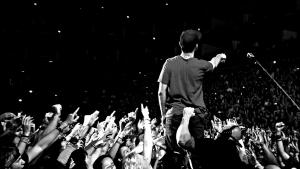
Photo | Linkin Park at the O2 Arena, London | courtesy of Drew de F Fawkes, Wikimedia Creative Commons
Taken Another Way
The Institute for Creation Research (IRC) posted an interesting devotion on July 18 that aligns with this analysis.
“And as it is appointed unto men once to die, but after this the judgment” (Hebrews 9:27).
Like the hidden theme of hope in the lyrics to the track, which juxtaposes against the visceral-sounding environment and idolatry in the video, this verse contemporarily cuts across materialism, selfishness, and the triad of an illicit lifestyle (sin, transgression, and inequity).
The Institute for Creation Research provides the following contextualization of the verse, which gives further emphasis to the points argued.
“One tactic that ‘the rulers of the darkness of this world’ use to entice mankind to ignore eternity involves portraying the here and now as all there is (Ephesians 6:12). Advertisements, music, and even academic works unashamedly prioritize the now. What’s wrong with believing that the experiences of this world exhaust all realities?
”The Lord Jesus warns His listeners with the story of a man who lived to increase his wealth, treating this life as the only one. The rich man said, ‘And I will say to my soul, Soul, thou hast much goods laid up for many years; take thine ease, eat, drink, and be merry. But God said unto him, Thou fool, this night thy soul shall be required of thee: then whose shall those things be, which thou hast provided?” (Luke 12:19-20).
“In The End” is considered by pop culture critics to be an anthem for the times and further. Embedded are the twin flames of fleshy desires and pride, visually captured and repeated for a global audience interaction.
The track is an example of the story referenced by the ICR, where the hook of the story, the fool’s revealing, is twisted and neglected in the track. Why? This allows the work to remain barren at its core, without giving any attention to the noted silent hope. There is no need for such a revelation as to recognize selfish greed, prideful actions, and succumbing to one’s earthly desires.
Linkin Park articulated and forcefully exacerbated a pre-emptive move; nothing matters in the end, so why bother at all? The silent tone of hope is erased, and the triad illicit behavior is given life, a marginal life that is barely breathing.
The Institute for Creation Research continues,
”One big pitfall of pursuing material pleasures is that it ignores judgment day. God’s righteous nature compels Him to judge every wrong committed. “For, behold, the day cometh, that shall burn as an oven; and all the proud, yea, and all that do wickedly, shall be stubble” (Malachi 4:1).
“But unto you that fear my name shall the Sun of righteousness arise with healing in his wings” (Malachi 4:2). Jesus Christ suffered sin’s hellish punishment for each of us so that everlasting joy can await those who ‘repent . . . and believe the gospel’ during this brief life (Mark 1:15). The best part of now is not the lie that now is all we have, but the chance to live for our Savior both now and forever.”
As a perfect circle, the opening verse reminds us of how we should be fellow heirs, companions who participate in a gospel-centered life because of the promise Christ gave and made for us.
“That the Gentiles should be fellowheirs, and of the same body, and partakers of his promise in Christ by the gospel” (Ephesians 3:6 KJV).
Following this thread, theomusicologically analyzing the track “In The End” opens multiple doors of discipleship, evangelism, and sharing biblical knowledge. Where the a priori selfish, prideful, and earthly desires are visible, even sustained and structured with the embodiment of idolatry, these are countered by scripture, which captures the glimpse of unsuspecting hope in the track.
An End or A Renewal?
Deuteronomy 27:15-26 lists multiple actions to be avoided by the people (read: Israelites, the chosen people), lest one be considered “cursed” (read: punished, a sinful action, transgression, an inequity). When applying these to the work under review, nearly all of the multiple actions to be avoided are illustrated in the work by Linkin Park. A theomusicological critique, then, flips and inverts the overarching script/narrative of the work as one not glofiying a desolate attitude of contemporary life, not reifying an essentialized universalist posture where “all men” fail in life, but, the theomusicological critial analysis inverts these points as the opportunity to explore biblical knowledge, and apply scriptural understanding to one’s life in a learning process; an advancement away from a slave mentality.
The point of the track is to elevate a universalistic perspective that mankind is destined to suffer. Not arguing this point, what the track does do is limit how to approach and grow from the point of suffering. Instead of providing support, clarity, or addressing the necessity of applicable movement beyond suffering, Linkin Park recorded a generationally defining song about suffering, defeat, apathy, and a lack of personal responsibility in the position of an idol.
One music journal states about the lyrics that they “reflect a relationship that’s falling apart—whether romantic, professional, or personal—where one person is giving everything while the other seems indifferent” (Meaninfy-The Story Untold, March 2026). Continuing further, this same music source sees the work as being “genius.”
“The genius of these lyrics is their ambiguity—they could be about a failed relationship, a career setback, or the general disillusionment of youth. This universality is what made the song resonate with so many different people from all walks of life…This song became the soundtrack for an entire generation dealing with the transition from adolescence to adulthood in a rapidly changing world. It captured the Gen X and early millennial experience of feeling disillusioned with traditional paths to success while still desperately wanting to matter.” (Meaningfy-The Story Untold, March 2026).
Reaching number two for 38 weeks on the Billboard Hot 100 listing, a certified Diamond rating by the RIAA, selling over 10 million US copies, released on October 24, 2000, “In The End” was nearly an instant success to a generation feeling socially handicapped. The Louder writes of the work as “an unabashed commercial proposition that captured both the zeitgeist and the future” (Louder, April 7, 2026).
When read theomusicologically, the themes which pop culture identifies as “genius,” the “zeitgeist,” and the “future” of reality, these qualities are realistically those same identities which scripture states to avoid.
“Even now [2026], In The End continues to resonate. In July 2020, it passed one billion streams on YouTube, the band’s second track to do so following Numb. The reformed band has reinstated it into their live set, with new singer Emily Armstrong performing the parts of Chester following the beloved frontman’s death in 2017” (Louder, April 7, 2026).
This data underscores how much attention has been given to a discourse of decline. Framing the work as apt for the “zeitgeist,” the current times, essentializes pop culture to a manufactured posture capable of being swayed by emotional stimulation. Idol worship is praised, trying to correct one’s life by one’s own failures is considered normal, wondering aimlessly through life being arrested by external circumstances is framed as rational, and denying the responsibility to better oneself is recognized as the apex. When hope becomes visible, no matter how minor, it is immediately crushed by the power of victimization. Labeling itself as a vernacular of pride, “In The End” discredits any beginning, rejects any existence, and sensationalizes a terminal.
As argued, scripture speaks against each of these elements employed by the track. When read theomusicologically, the song’s archetypal framework invites biblical knowledge to be introduced. The forceful spirit of the work pushes against these inclusions, which amplifies a critical theomusciological analysis.
Maintaining an analysis of the work, through a theomusicological lens, illustrates the apologetic agency of the discipline. What theomusicological analysis does, for such a high-low pop culture icon, is dislocate the work from its idolistic, iconographic position.
Giving no light to the accolades which the work has accumulated throughout its 26-years, theomusicology flips the script/narrative of the work sonically, visually, and culturally. Adding how the work “In The End” functions to bring forth scriptural knowledge is beyond what pop culture music critics ascertain. It is at this juncture that the track gains the most leverage in sharing biblical knowledge to a dominant non-faith-based audience. “In The End,” then, can be the beginning of introducing scripture, giving relevant, useful, and apt timing of how scripture is and does work in contemporary society – the zeigeist.
As one music critic noted that “In The End” speaks to the future, it is through a theomusicological analysis that the work can extend into the future, not as a dystopian soundtrack but as a platform for contemporary inclusion, learning, understanding, and application of biblical knowledge.
To read more from Alan Lechusza Aquallo’s “The Sweatpant Sessions,” please consider subscribing for free and check out others on Patheos.
General Christian
Evangelical

About Alan Lechusza Aquallo
Dr. Alan Lechusza is a scholar whose name has become synonymous with critical thought and cultural discourse. He is a thinker and writer who explores popular culture with a critical eye. He holds a PhD and uses his deep, resource-rich understanding to question and redefine how we see art, power, and knowledge. His research covers various topics that aim to break down and rebuild our ideas about culture, artistry, and socio-political authority. Dr. Lechusza closely examines everyday cultural expressions in ways that challenge conventional thinking. His writings make people think and view culture in new ways. Dr. Alan Lechusza wants to create conversations to inspire change and challenge our understanding of how we experience the world. You can read more about the author here.
Previous Post

July 13, 2026
Simulating Pop Culture: Elevation Rhythm's Narrative Style
Next Post

July 27, 2026 Did You Hear What She Said? Female Christian Heavy Metal
Browse Our Archives
Select a Category music criticism pop culture criticism Pop music criticism Uncategorized
Select a Month October 2026 September 2026 August 2026 July 2026 June 2026 May 2026 April 2026 March 2026 February 2026 January 2026 December 2025 November 2025 October 2025 September 2025 August 2025 July 2025 June 2025 May 2025 April 2025 March 2025 February 2025 December 2024 September 2024 June 2024 April 2024 March 2024 February 2024 January 2024 December 2023 November 2023
Follow Us!
TAKE THE
Religious Wisdom Quiz
True or False: Moses entered the Promised Land before he died.
Select your answer to see how you score.
TRUE FALSE
Books by This Author Books by The Sweatpant Sessions
Related posts from The Sweatpant Sessions

Family
Christian Hip Hop and Secular Rap: Finding the...
Family
Why Punk and Hip Hop May Hear God...

Family
Emotional Ashes: Emo and Scripture Knowledge, Psalm 91
Family
Learning Devotion and Discipline: A Brief Analysis of...
TRENDING AT PATHEOS Religious Art

Emotion in Early Christianity by Andrew Crislip
Andrew Crislip’s Emotion in Early Christianity examines an often overlooked dimension of...

16 Spiritual Touchstones for a More Grounded Life
After decades of spiritual study, here are 16 principles I try...

Catholic Evangelization: Sharing Your Faith Every Day
Welcome back to the Graceful Awakening mini-series called, “From Faith to Mission.” ...

The Pillar of the Boatmen: the Ancient Monument...
The Pillar of the Boatmen is a Romano-Gaulish sculpture that dates from...

In one sense walking into Westminster Abbey is like walking down the...

'Super Scam Me' Exposes AI Jon Bon Jovi...
Leslie Pickett believed she was in a relationship with Jon Bon Jovi....
view all Religious Art blogs
Ad-Free & Subscriber Log-In Subscription Support
- About Us
- 2026 Calendar
- Videos
- Podcasts
- Library of World Religions
- Faith In Media Tracker
- Advertise With Us
- Write for Us
- Privacy Policy
- Terms of Service
- Do Not Sell My Data
- Contact Us
- Radiant Digital
- Manage Newsletter Subscriptions
- Unsubscribe From Notifications
- Sitemap
Copyright 2008-2026, Patheos. All rights reserved.
Subscription Support Ad-Free & Subscriber Log-In
Follow Patheos