
BuddhistCatholicContemplativeEvangelicalGeneral ChristianHinduJewishLatter-day SaintMuslimNew VisionsProgressive Christian
Beliefs
- Buddhist
- Catholic
- Contemplative
- Evangelical
- General Christian
- Hindu
- Jewish
- Latter-day Saint
- More Voices
- Muslim
- New Visions
- Pagan
- Progressive Christian
Topics
- Religion News
- Food and Religion
- Sports and Religion
- Religious Art
- Religious Music and Entertainment
- Religious Events
- History and Religion
- Style and Religion
- Politics and Religion
- Women in Religion
- Recreation Outdoors and Religion
- Business Finance and Religion
- Careers Workplace and Religion
- Education and Religion
- Family Parenting and Religion
- Health Fitness and Religion
- Home and Religion
- Relationships and Religion
- Technology and Religion
- Travel and Religion
Columnists
- Buddhist Columnists
- Business Finance and Religion Columnists
- Careers Workplace and Religion Columnists
- Catholic Columnists
- Contemplative Columnists
- Education and Religion Columnists
- Evangelists Columnists
- Family Parenting and Religion Columnists
- General Christian Columnists
- Health Fitness and Religion Columnists
- Hindu Columnists
- History and Religion Columnists
- Home and Religion Columnists
- Jewish Columnists
- More Voices Columnists
- Latter Day Columnists
- Muslim Columnists
- New Visions Columnists
- Nonreligious Columnists
- Pagan Columnists
- Politics and Religion Columnists
- Progressive Columnists
- Recreation Outdoors and Religion Columnists
- Relationships and Religion Columnists
- Religion News Columnists
- Religious Art Columnists
- Religious Events Columnists
- Religious Music and Entertainment Columnists
- Sports and Religion Columnists
- Style and Religion Columnists
- Technology and Religion Columnists
- Travel and Religion Columnists
- Women in Religion Columnists
Resource Library
- 2026 Calendar
- Library of World Religions
- The 100 Most Holy Places on Earth
- Patheos Answers
- Podcasts
- Videos
- Faith Leaders Database
- Anglican Episcopalian
- Bahai
- Baptist
- Buddhism
- Christianity
- Confucianism
- Eastern Orthodoxy
- Hinduism
- Holiness and Pentecostal
- ISKCON
- Islam
- Judaism
- Lutheran
- Methodist
- The Church of Jesus Christ of Latter-day Saints
- New Age
- Paganism
- Presbytarian and Reformed
- Protestantism
- Religion Behind the Scenes
- Roman Catholic
- Scientology
- Shia Islam
- Sikhism
- Sufism
- Sunni Islam
- Taoism
- Zen
- See all religions
Research Tools
 Ad-Free & Subscriber Log-In Subscription Support
Ad-Free & Subscriber Log-In Subscription Support
Follow Patheos 

- Trending:
- Forgiveness
- |
- Marriage
- |
- Consciousness
- |
- Death Penalty
- |
- Election
- |
- Halloween

- Home
- Jewish
- Religious Art
- Making Sense Of Worship Music And Shachah: A Critical Read
Making Sense Of Worship Music And Shachah: A Critical Read
Last updated on: June 8, 2026 at 9:16 am by Alan Lechusza Aquallo
Making Sense Of Worship Music And Shachah: A Critical Read 2026-06-08T09:16:37-07:00 Alan Lechusza Aquallo
Patheos Explore the world's faith through different perspectives on religion and spirituality! Patheos has the views of the prevalent religions and spiritualities of the world.
“Also that day they offered great sacrifices, and rejoiced, for God had made them rejoice with great joy; the women and the children also rejoiced, so that the joy of Jerusalem was heard afar off” (Nehemiah 12: 43 KJV).
An interesting article published by The Root discussed the loss of Choirs in the Black Church.
Asheea Smith. The Root. What Happened To the Black Church Choirs? The Answer: Praise Teams: Black church choirs are dwindling as praise teams rise across many congregations, a shift shaped by COVID-19, changing church culture, and the growth of contemporary worship. June 3, 2026.
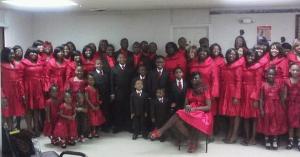
Photo | Gospel Showcase Choir, June 22, 2012 | courtesy of Dodawalk85, Wikimedia Creative Commons
The article cites Huan Walker, “a seasoned musician at Life Change Church with 20 years in church music ministry.” Reminiscing on what the article defines as the “good old days of Black Choirs,” the article does little more than just that, wax on what Huan Walker and Asheea Smith see as bygone days.
The rise of “praise teams” and contemporary Christian music (CCM) is contextualized due to the COVID pandemic, as the slow termination of “traditional” Black Choirs. Short on any further analysis, The Root article by Asheea Smith reads more depressing than spiritually encouraging.
The concluding paragraphs of the article begin to move the proverbial needle in a constructive direction.
“While choirs and praise teams may differ in size, style, and presentation, Huan Walker argues that the purpose of worship remains unchanged. Whether it’s a 50-person choir in matching robes or a six-member praise team backed by a contemporary band, effective worship isn’t measured by the number of voices on stage, but by the sincerity of the hearts behind them.
“As long as the person leading has their heart in the right place, they should be able to impact the spirit of worship in a great way,’ Walker said. ‘I think this new model can still be effective and serve as a great tool for worship. More than anything, it comes down to heart posture” (The Root, June 3, 2026).
This statement by Huan Walker is a juxtaposition against the opening argument of the article; the slow loss of Black Choirs is due to external conditions and the rise of a Christian music market industry. Yet, here, Huan Walker reverts back to a foundational principle of worship music: to celebrate and give thanks to God through music. Holding contrary positions is not uncommon in critical theoretical circles. However, these contrary positions are staged to give a positive mask and authoritative tone to the otherwise bleak outline of the article.
Contemporary Christian music (CCM) circumnavigates around and originates from a market faith-based industrial complex. To coin “praise teams” as a defining profile for these smaller, country/rock/quasi-alternative music ensembles (bands) who employ surface biblical context and disperse these productions as credible faith-based “worship” music is useful as a socio-religious jab, but also discriminatory to favor and privilege “traditional” Black Choirs.
The market use of faith-based context with an inept relationship to the core elements of theomusicology is the complication with contemporary Christian music (CCM), expressed through “praise teams” as noted by Huan Walker. The term applied to these smaller ensemble/bands who operate through, willingly or unconsciously through the contemporary Christian music (CCM) market industrial complex satisfies two seemingly unrelated but mutually inclusive points: 1. The ensemble/band believes they are expressing true “worship” music, and 2. The selection of music financially promotes the contemporary Christian music industrial complex. Church audiences, as they would be in this analysis, are external observers who participate from an outside position of a non-performer seeking to internalize the “worship” selection for personal gain. This operates under the larger, unrecognized yet quite visible contemporary Christian music industrial complex. The “praise team” ensemble/band manufactures a representation of this market industry for the church audience. Both participants are insiders-outsiders to the mechanics of the contemporary Christian music (CCM) market industrial complex. Huan Walker and Asheea Smith point in the right direction, but allow their biases to privilege “traditional” Black Choirs, missing the larger growth of a market industry which is more the rational reason for the slow erosion of the “traditional” Black Choir.
“Both the singers and the gatekeepers kept the charge of their God and the charge of the purification, according to the command of David and Solomon his son” (Nehemiah 12: 45 KJV).
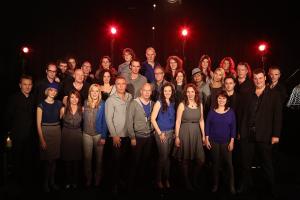
Photo | Gospel Boulevard XXL, January 25, 2014 | courtesy of Stylish Music, Wikimedia Creative Commons
Worship Another Way
If we recognize the importance of “worship,” as noted by Huan Walker, without falling into the pitfall argued, then looking at other options for “worship” expands the conversation.
Recognizing that Christianity fundamentally comes from Judaism, it would be logical to see what contemporary “worship” options are being expressed from a Jewish perspective. “Worship” is a strongly held term with subtextual references and personal implications from a socio-religious Christian perspective. Judaism recognizes “worship” as Shachah.
Shachah (שָׁחָה, pronounced roughly shaw-khaw’ or sha-khah) is a key Hebrew verb in the Bible, meaning to bow down, prostrate oneself, or depress/low oneself. It often implies a physical act of humility, reverence, or submission — such as bowing low, falling on one’s face, or kneeling before a superior (a king, God, or even an angel) (worshiparts.net). The most common Hebrew word translated as “worship” in the Old Testament (biblehub.com). The use can range from lowering oneself to signify submission to both positive worship of God and, in some cases, negative worship of false gods.
Already, the term Shachah expands the discourse and limitation of “worship.” Where Christian “praise” or “worship” music relies heavily on a communal experience (external) which is to align one with their religious practice and discipline (internal), Shachah starts at a personal level (internal) with the expansion to the employed community (external). The difference here draws a connection to Matthew 20:27, “And whoever wants to be first among you must be your servant” (NLT).
Bible Hub notes that “Matthew 20:27 teaches that true greatness in the Kingdom of God is measured by service and humility, not by power or status. Jesus instructs His disciples that anyone who desires to be first must adopt the posture of a servant, reversing worldly notions of leadership and authority (Matthew 20:27-28 NIV). The term “servant” here is translated from the Greek word doulos, which implies complete devotion and selfless service to others, highlighting the radical nature of Jesus’ teaching in a society where slaves were considered the lowest class” (Bible Gateway, n.d.).
This analysis brings to light how Shachah operates from the individual (the servant – doulos) to inform, support, and serve the community. This draws a varied approach to how religious music is applied from a Jewish perspective than the Christian assumptive perspective noted previously. If we follow the servitude identity of Shachah, there is no “worship” or “praise” music. Each musical moment is a prayer, not isolated for personal consumption, managed by a market-industrial complex, or objectified socio-religiously. Each time music is engaged, the individual is transformed into servitude, to bow low in reverence.
Where the Black Choir music leader and author of The Root article emphasized a musical traditional privilege which allows for personal inclusion as a secondary principle, Shachah gives immediate attention to personal inclusion first, with the community available to organically follow. This is not to say that Christian “worship” or “praise” music does not entertain a profile of servitude. Rather, the archetype of contemporary Christian music (CCM) comes from a market-influenced industrial complex that emphasizes the contact point of contemporary Christian music (CCM) to be navigated, produced, and sustained from a defined market-influenced industrial complex. In contrast, Jewish music, traditional and contemporary, following the historical narrative and understanding of Shachah, defies a market-influenced industrial complex. The music supports the community by way of the religious discipline.
The relationship between these two musical trajectories does have convergent points as much as divergent points. One central difference would be how congregations retain and entertain music as a biblical discipline in their daily lives. Christian communities are more apt to reference religious music in their daily activities less as a moment of prayer but more as one of temporary comfort; a recollection of a phenomenological moment of happiness (read: personally and temporarily defined) rather than joy (read: personally and permanently defined). Whereas music from a Jewish, Shachah perspective is an act of joy (read: personally and permanently defined) which then brings happiness (read: personally and temporarily defined).
It may appear as an inverse application of the same point. However, anyone who is invested in their faith-based journey will recognize the difference in depth and breadth between happiness and joy. Joy is the height one seeks to attain in a life of prayer and devotion to God. Happiness comes from the minor moments that lift one from low points to temporary highs. Further, Huan Walker’s lament over “traditional” Black Choir musical expression is a voice of lost happiness. Shachah knows only joy, with the lament being how one misses multiple opportunities in their days to bow low and serve God through music.
Scriptural references of Shachah speak to the embedded understanding of this theomusicological discipline.
Genesis 18:2 — Abraham “bowed himself” (shachah) to the ground before his visitors.
Exodus 4:31 — The people “bowed their heads and worshiped” (shachah).
Psalm 95:6 — “Come, let us worship and bow down” (using shachah).
The witness, testimony, community involvement, evangelism, discipleship, and activism extend from the biblical knowledge and scriptural truth signified in Shachah. The more common use of Shachah is for biblical worship, noted as humble and demonstrating reverent submission to God, expressed physically. “Worship” or “praise” music strives to generate humility and produce reverence. The physicality, the humility, the reverence, and the discipline are contextualized in Shachah. “Worship” or “praise” music promotes these elements through a musical market-industrial complex, which is satisfied by expressing temporary happiness. Shachah obfuscates the musical market-industrial complex by not operating from this locus, thereby giving central attention and voice to permanent joy.
Living Humility In Song
To see how Shachah is contextualized in contemporary Jewish and Christian socio-religious music disciplines, the selected works below outline a theomusicological profile and execute the core agency of Shachah.
Shachah “Deliver Us” Music Video ft. John Wells -The Tonic, Cross Movement Records, August 25, 2009,
Shachah, “Arise (Stand Up)” Music Video, Cross Movement Records, September 8, 2008,
Shachah, “Won’t Stop”, Revel8n8r7, August 3, 2008,
These examples take advantage of pop alternative trip hop bound by the joy Shachah illustrates. Then there’s a vocal-centered, scaled-back, heart-stopping song, highlighting the intent of Shachah that words fail to express.
Shachah (Bow Low), May 10, 2026,
https://youtu.be/FdJKFcVkVAQ?si=i6h_p8X9ffWE2zph
The notes published on the YouTube page underscore the solemnity and humility heard in the track.
“Shachah” (שָׁחָה) means to bow low, to kneel, to surrender before the King. This song is a callback to biblical worship — not performance, not hype, not emotional spectacle — but obedience, sacrifice, humility, and lives fully yielded to YHWH. This video is intentionally simple: music, lyrics, and no distractions. No flashing lights. No concert atmosphere. Just a raw reminder that worship was never supposed to stop when the song ends. Real worship looks like: • loving your neighbor • serving quietly • forgiving when it hurts • carrying your cross • walking in obedience • becoming a living sacrifice. Shachah was never merely sung… it was lived. Close your eyes. Listen carefully. Bow low before the Father” (YouTube, May 2026).
This is profound to read in the general notes for a minimalistic music video. What stands out is the importance of devotion. The notes themselves are simple, direct, and listed with pointed rhetoric. Worship music, or simply “worship” as some prefer, is known for its power to open the heart and prepare the mind to receive biblical truth, knowledge, and learning. This track, “Shachah,” reminds the listener of this process regardless of their position or time of day. This gives voice to the discipline of “praying without ceasing.”
“Rejoice always, pray without ceasing, give thanks in all circumstances; for this is the will of God in Christ Jesus for you” (1 Thessalonians 5:17 ESV).
“For in the days of David and Asaph of old there were chiefs of the singers, and songs of praise and thanksgiving to God” (Nehemiah 12: 46 KJV).

Photo | Open rehearsal of the Jerusalem Vocal Consort, July 31, 2025 | courtesy of Umberto Nahon Museum of Italian Jewish Art, Wikimedia Creative Commons
Making Sense Of The Unification In Sound
The tradition of Black Choir music may have endured a slow erosion as stated by Huan Walker and Asheea Smith, but the history, intent, and discipline of socio-religious theomusicology has not faded. Shachah does not stand as an alternative counterpoint to the traditions of Christian “worship” or “praise” music. Rather, the commonalities between these two disciplines need to be read to help balance the scales.
Where the unfolding tradition of contemporary Christian music (CCM) seeks to embrace momentary religious involvement, Shachah strives to broaden this perspective. One starts externally, working toward a personal, internal involvement. The other begins internally with the external expression to follow. The articulation of theomusicological core elements is invested differently, with the overarching intent of bringing these elements to life for all those involved.
Regardless of what musical trajectory is preferred, the scope, intent, and experience that music affords personally and communally is not to be overlooked, as a means to give thanksgiving to the Lord, daily and without ceasing.
To read more from Alan Lechusza Aquallo’s “The Sweatpant Sessions,” please consider subscribing for free and check out others on Patheos.
Jewish
General Christian

About Alan Lechusza Aquallo
Dr. Alan Lechusza is a scholar whose name has become synonymous with critical thought and cultural discourse. He is a thinker and writer who explores the world of popular culture with a critical eye. He holds a PhD and utilizes his in-depth, resource-rich understanding to question and redefine how we perceive art, power, and knowledge. His research covers various topics that aim to break down and rebuild our ideas about culture, artistry, and socio-political authority. Dr. Lechusza closely examines everyday cultural expressions in a way that challenges usual thinking. His writings make people think and view culture in new ways. Dr. Alan Lechusza aims to foster conversations that inspire change and challenge our understanding of how we perceive the world. You can read more about the author here.
Previous Post

May 31, 2026
When Christianity and Jewish Music Collide: Messianic Music
Next Post

June 14, 2026 Gospel Rap vs. Christian Hip Hop: They're Not the Same
Browse Our Archives
Select a Category music criticism pop culture criticism Pop music criticism Uncategorized
Select a Month October 2026 September 2026 August 2026 July 2026 June 2026 May 2026 April 2026 March 2026 February 2026 January 2026 December 2025 November 2025 October 2025 September 2025 August 2025 July 2025 June 2025 May 2025 April 2025 March 2025 February 2025 December 2024 September 2024 June 2024 April 2024 March 2024 February 2024 January 2024 December 2023 November 2023
Follow Us!
TAKE THE
Religious Wisdom Quiz
What is the main theme of the Ten Commandments?
Select your answer to see how you score.
How to earn your way to Heaven How to live in Jewish society How to be successful How to live and treat others
Books by This Author Books by The Sweatpant Sessions
Related posts from The Sweatpant Sessions
Family
Christian Hip Hop and Secular Rap: Finding the...
Family
Why Punk and Hip Hop May Hear God...
Family
Emotional Ashes: Emo and Scripture Knowledge, Psalm 91
Family
Learning Devotion and Discipline: A Brief Analysis of...
TRENDING AT PATHEOS Religious Art

Looking at the Largest Orthodox Cathedral on Earth
There is often a considerable amount of anger and, shall we...

The Problem with False Prophets
Miller’s Station UMC| 10/18/26| Anchor Verse: Jeremiah 23: 1, 9-23 I...

Emotion in Early Christianity by Andrew Crislip
Andrew Crislip’s Emotion in Early Christianity examines an often overlooked dimension of...

16 Spiritual Touchstones for a More Grounded Life
After decades of spiritual study, here are 16 principles I try...

Catholic Evangelization: Sharing Your Faith Every Day
Welcome back to the Graceful Awakening mini-series called, “From Faith to Mission.” ...

The Pillar of the Boatmen: the Ancient Monument...
The Pillar of the Boatmen is a Romano-Gaulish sculpture that dates from...
view all Religious Art blogs
Ad-Free & Subscriber Log-In Subscription Support
- About Us
- 2026 Calendar
- Videos
- Podcasts
- Library of World Religions
- Faith In Media Tracker
- Advertise With Us
- Write for Us
- Privacy Policy
- Terms of Service
- Do Not Sell My Data
- Contact Us
- Radiant Digital
- Manage Newsletter Subscriptions
- Unsubscribe From Notifications
- Sitemap
Copyright 2008-2026, Patheos. All rights reserved.
Subscription Support Ad-Free & Subscriber Log-In
Follow Patheos