
BuddhistCatholicContemplativeEvangelicalGeneral ChristianHinduJewishLatter-day SaintMuslimNew VisionsProgressive Christian
Beliefs
- Buddhist
- Catholic
- Contemplative
- Evangelical
- General Christian
- Hindu
- Jewish
- Latter-day Saint
- More Voices
- Muslim
- New Visions
- Pagan
- Progressive Christian
Topics
- Religion News
- Food and Religion
- Sports and Religion
- Religious Art
- Religious Music and Entertainment
- Religious Events
- History and Religion
- Style and Religion
- Politics and Religion
- Women in Religion
- Recreation Outdoors and Religion
- Business Finance and Religion
- Careers Workplace and Religion
- Education and Religion
- Family Parenting and Religion
- Health Fitness and Religion
- Home and Religion
- Relationships and Religion
- Technology and Religion
- Travel and Religion
Columnists
- Buddhist Columnists
- Business Finance and Religion Columnists
- Careers Workplace and Religion Columnists
- Catholic Columnists
- Contemplative Columnists
- Education and Religion Columnists
- Evangelists Columnists
- Family Parenting and Religion Columnists
- General Christian Columnists
- Health Fitness and Religion Columnists
- Hindu Columnists
- History and Religion Columnists
- Home and Religion Columnists
- Jewish Columnists
- More Voices Columnists
- Latter Day Columnists
- Muslim Columnists
- New Visions Columnists
- Nonreligious Columnists
- Pagan Columnists
- Politics and Religion Columnists
- Progressive Columnists
- Recreation Outdoors and Religion Columnists
- Relationships and Religion Columnists
- Religion News Columnists
- Religious Art Columnists
- Religious Events Columnists
- Religious Music and Entertainment Columnists
- Sports and Religion Columnists
- Style and Religion Columnists
- Technology and Religion Columnists
- Travel and Religion Columnists
- Women in Religion Columnists
Resource Library
- 2026 Calendar
- Library of World Religions
- The 100 Most Holy Places on Earth
- Patheos Answers
- Podcasts
- Videos
- Faith Leaders Database
- Anglican Episcopalian
- Bahai
- Baptist
- Buddhism
- Christianity
- Confucianism
- Eastern Orthodoxy
- Hinduism
- Holiness and Pentecostal
- ISKCON
- Islam
- Judaism
- Lutheran
- Methodist
- The Church of Jesus Christ of Latter-day Saints
- New Age
- Paganism
- Presbytarian and Reformed
- Protestantism
- Religion Behind the Scenes
- Roman Catholic
- Scientology
- Shia Islam
- Sikhism
- Sufism
- Sunni Islam
- Taoism
- Zen
- See all religions
Research Tools
 Ad-Free & Subscriber Log-In Subscription Support
Ad-Free & Subscriber Log-In Subscription Support
Follow Patheos 

- Trending:
- Forgiveness
- |
- Marriage
- |
- Consciousness
- |
- Death Penalty
- |
- Election
- |
- Halloween

- Home
- General Christian
- Religious Art
- Juneteenth and Philemon: Two Stories of Freedom
Juneteenth and Philemon: Two Stories of Freedom
Last updated on: June 21, 2026 at 4:44 am by Alan Lechusza Aquallo
Juneteenth and Philemon: Two Stories of Freedom 2026-06-21T04:44:32-07:00 Alan Lechusza Aquallo
Patheos Explore the world's faith through different perspectives on religion and spirituality! Patheos has the views of the prevalent religions and spiritualities of the world.
A Heart’s Reading of Juneteenth from Decolonizing Philemon
“A false witness will not go unpunished,
and whoever pours out lies will not go free” (Proverbs 19:5 NIV).
“Today is Juneteenth, a holiday long celebrated, especially by black Americans, to commemorate the end of slavery in the United States. In 2021, Congress, recognizing that the end of slavery was an event worthy of national recognition, established it as a federal holiday for all Americans. The holiday’s name refers to June 19, 1865, the day when Union Maj. Gen. Gordon Granger issued General Order No. 3 ordering the enforcement of the Emancipation Proclamation in Texas: ‘The people of Texas are informed that, in accordance with a proclamation from the Executive of the United States, all slaves are free” (The Bulwark, June 19).
“For generations, the history of slavery and emancipation has been minimized, distorted, or simply written out of the national narrative…The story of Juneteenth survived because Black families carried it forward, year after year, while the broader culture looked away or invented comforting fictions in its place” (Kevin Levin, Civil War Memory, June 18).
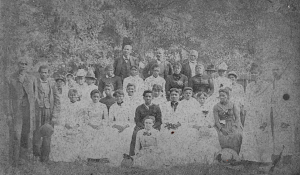
Photo | Juneteenth Celebration at Emancipation Park, 1880 | courtesy of crowdsourcing, Wikimedia Creative Commons
Juneteenth is not an idea. It’s a reality, a truth, an empirical truth that has shaped our nation for generations. Reading Juneteenth as a narrative of struggle, resistance to longstanding oppression, delayed reconciliation, and the application of liberation, this day holds value to humanity metaphorically as well as socio-politically.
Taking Juneteenth as a departure point from the crystallized social norms of an industrialized geopolitical nation, the location often overlooked in most circles is how Juneteenth serves as an active discourse on religious freedom. The small book of Philemon is typically read as a slave narrative, a religious abolition of slavery to promote spiritual growth. Though a valued entry to the depth of the apostle Paul’s intent, this traditional understanding and expressed arc of Philemon plateaus without seeing the further horizon ahead.
Kevin Levin writes an interesting point about how scholars have noted Juneteenth as “insisting that slavery and its undoing sit at the center of American history rather than at its margins” (Kevin Levin, Civil War Memory, June 18).
This minor quote moves the social needle. The subtext here is balanced on the insider/outsider axis; the slave owner/Master-slave. Reading Juneteenth from a socio-religious perspective, the temptation is to remain positioned at the intersecting point, the conjunction between the binary, and see our social and religious lives as an either/or with the hope of spiritual transformation.
To be transformed, one essentializes it as an investment in deeper biblical learning, righteous living, and employment of scripture knowledge, flirting with the understanding and desire to follow these principles. Without becoming legalistic, the transformation sought comes from a rational understanding with the desire to have a personal paradigm-shattering moment (Dr. Tim Keller) when the heart becomes actively involved. This, then, moves us from our personal historical margins, expanding on the quote from Kevin Levin, to an undoing of a slave mentality, a spiritual slave mentality.
Juneteenth becomes more than a physical political marker in America’s history. Juneteenth serves as a call to remember our personal spiritual slavery, a life defined by a slave mentality from which Philemon is the critical discourse to understand and apply liberation, an abolishment of the slave mentality and oppressed condition through the spiritual binding of the mind-heart (read: rational-spiritual) which disturbs the socio-religious norm.
“A false witness will not go unpunished,
and whoever pours out lies will not go free” (Proverbs 19: 9 NIV).
Disturbing the Norm
Reframing the slave narrative, looking at the invested spiritual liberation rather than a physically oppressive structure. Historically, Philemon is positioned against the background of a slave owner/Master-slave narrative. The binary operates to separate, create division, and establish an identity of privilege. Applied through a gospel critique, this division illustrates man’s separation from God (Genesis 3). Philemon urges this reading to be inverted, transposed, and reframed. Philemon offers the reader the opportunity to see “freedom” (personal, spiritual) from an insider position (slave owner/Master) and an outsider position (slave).
Paul’s letter to Philemon contextualizes a slave narrative in a contemporary understanding for the era (what years? – cite). Throughout the letter, the request from Paul is to liberate Onesimus (read: outsider) from a position of slave to that not the assumed “freed slave,” but rather as a “brother.” This identity transposition application by Paul is not the limited colonial to post-colonial trajectory. Rather, this identity transposition application, defined by Paul, is a decolonization, a check against hegemonic norms to rebalance the social scale. Taking up the debt which Onesimus owes to Philemon is a metaphor for Christ’s taking up of humanity’s debt. In doing so, Christ offers untethered liberation, freedom.
It is humanity, through the continued practice of sin, which tarnishes the grace of freedom, and returns humanity to the posture of a slave. Reconciliation, by heartfelt confession and disciplined repentance, through Christ continues to offer and provide the untethered liberation, freedom, humanity desires; to come to know Christ’s love for humanity and reciprocate that love to humanity, Christ, the Holy Spirit, and God.
The shackles of slavery are man-made, personally defined, and employed. The application of freedom, untethered liberal freedom, comes through what Christ did for humanity. Knowing this process and the dangerous pitfall of repeating this cycle, Paul seeks to disturb and terminate the cycle for Onesimus to advance from a slave (read: as a metaphor for humanity) to a “beloved brother” (read: untethered, liberal, and free). The judge and jury are Philemon (read: a metaphor of man’s rational mind). Paul challenges Philemon, by way of an invitation, subtextually founded on the disturbance of the slave-freed slave identity, to personally accept Onesimus as a “beloved brother” (read: as a metaphor for personal heart transposition, a sanctification).
Limiting the analysis of this process to the insider/outsider binary and slave owner/Master-slave narrative disregards the act of mind-heart transposition which Paul is calling Philemon to endure. A more granular analysis, yet one which is grounded in gospel truth, Christian knowledge, and scriptural discipline. The process that Paul challenges Philemon to endure rubs against the social norms of the era. Paul is operating outside of those social norms (read: slave definitions) to open an invitation, an opportunity to become an insider, but not one in the physical, rational location. Rather, an insider in a sanctified, heart-centered location (read: untethered liberation of spiritual freedom).

Photo | Galveston Juneteenth Parade and Celebration, June 19, 2025 | courtesy of 2C2K Photography, Wikimedia Creative Commons
Beloved, Joy, Heart, and Spirit
The brevity of Philemon is not to be overlooked for its importance and depth of scriptural knowledge. Looking at what terms are employed for transformational power, these words stand out: “beloved/love,” “joy,” “heart,” and “spirit.” The use of each illustrates how a personal paradigm-shattering shift is applicable.
Throughout the entire book of Philemon, “beloved/love” is used six times; “joy” is used twice; “heart” is used three times; and “spirit” is used once. This is easy to overlook, but when connected, an interesting read is emphasized.
“Love with the heart, to have joy in the spirit” (emphasis added). If “beloved” is added, the same sentence can be read as, “Beloved, love with the heart, to have joy in the spirit” (emphasis added).
This is the core agency of Philemon. This is the unencumbered, untethered liberating freedom Philemon offers. This is a summary of Paul’s intent, his call to action to Philemon and, by proxy, us to remove the physical slave narrative and slave mentality which we struggle to retain for self-colonizing purposes.
When we restrict our bodies and minds once we are free, by the actions of Christ, we remain colonized, imprisoned by our own failures as those who exist on the outside of God’s grace. Yet, when we accept personally God’s grace and the substitution Christ did for us, we are freed from those self-induced colonializing oppressions. This is Paul’s subtextual statement echoed in the composite relationship and gift of freedom for Onesimus to Philemon. This is the border-crossing application, the ability to be transposed from physical and spiritual limitations.
By decolonizing ourselves, using the lexicon of liberation, a biblical, gospel lexicon of liberation Paul notes to Philemon, the binding of the mind (rationale) and heart (spiritual) is possible and available. Freedom is not a futuristic idea, a terminal contact point reserved for arrival in a distant future. Freedom, a spiritual decolonizing process, is available as a contemporary lived experience.
What Would Freedom Sound Like?
The audio examples span 47 years between their performance. The visceral struggle to articulate freedom comes from the conscious decision to bring this matter to light. Presented against a backdrop of socio-political issues, the spirit and heart of the desire to advance from a slave mentality to a cognizant and lived experience of freedom. The purpose of selecting non-faith-based, pop cultural music examples is specific.
What these two examples define for their respective generation is the urgency for a lexicon of liberation. Yet, the action is done in a secular environment. When read through a theomusicological lens, the works become representative of the points made in Philemon. Action is made for and in community. Discipleship is founded on the urgency to gain and practice freedom (read: socio-political liberty). An evangelistic voice is expressed as each artist uses their work to speak to and inspire their generation to work toward securing a posture of freedom. Personal testimony and biblical-text/lyrics are not immediately present. Yet, given the cultural significance of the artists, the context of their work, and the community embodiment of the themes, there is a personal testimony referenced. Absent direct scripture inclusion or statement, the theme of these selections, “freedom,” and the sociological deconstruction of oppressive power is aligned with the transformation of Onesimus, a slave, into a beloved brother, a useful community partner.
Taking this critique, the central theme of each track, “freedom,” can be seen as a simile to that of freedom as recognized in Philemon. Reading these non-faith-based works through a theomusicological lens, it becomes apparent that these works operate as a compressed analysis of the themes of Philemon for their specific generation and beyond.
Richie Havens, “Freedom” at Woodstock 1969, Video Link.
Beyonce, Featuring Kendrick Lamar, “Freedom,” 2016, Video Link.
“Whoever keeps commandments keeps their life,
but whoever shows contempt for their ways will die” (Proverbs 19:16 NIV).
The Power Of The Miniature
The book of Philemon is the shortest in the bible. One chapter, twenty-five verses, and 335 words: the hypercompressed knowledge in the book of Philemon should not be overlooked. Limiting Philemon to a post-colonial analysis works against the transformative opportunity invested. Reducing the actors to singular, essentialized positions and cultural norms equally truncates the liberation Philemon offers.
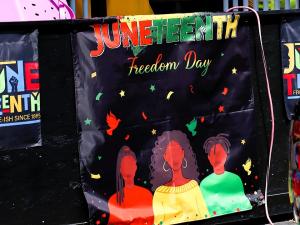
Photo | June 19, 2025, Galveston Juneteenth Parade and Celebration | courtesy of 2C2K Photography, Wikimedia Creative Commons
Capturing the decolonial narrative of Philemon, recognizing the transformative agency presented, embracing the paradigm-shattering application of moving beyond a conscious stature to a spiritual liberation, Philemon subvocally speaks to the necessity for a mind-heart binding, a border crossing of a codification reading, understanding, and sustaining an insider/outsider binary. Historic demarcations of power and privilege are dismantled; a slave mentality is disrupted and transposed by accepting a substitution for one’s penalties, thus advancing an individual from an outsider to an insider, from a slave to a person of value, a beloved brother – in Christ.
Philemon is a mini case study of transformation. Taking the knowledge of Philemon and applying it to the soundtrack of our lives, we can see, or hear, theomusicologically how freedom can and does sound.
To read more from Alan Lechusza Aquallo’s “The Sweatpant Sessions,” please consider subscribing for free and check out others on Patheos.
General Christian
Evangelical

About Alan Lechusza Aquallo
Dr. Alan Lechusza is a scholar whose name has become synonymous with critical thought and cultural discourse. He is a thinker and writer who explores popular culture with a critical eye. He holds a PhD and uses his deep, resource-rich understanding to question and redefine how we see art, power, and knowledge. His research covers various topics that aim to break down and rebuild our ideas about culture, artistry, and socio-political authority. Dr. Lechusza closely examines everyday cultural expressions in ways that challenge conventional thinking. His writings make people think and view culture in new ways. Dr. Alan Lechusza wants to create conversations to inspire change and challenge our understanding of how we experience the world. You can read more about the author here.
Previous Post

June 14, 2026
Gospel Rap vs. Christian Hip Hop: They're Not the Same
Next Post

June 29, 2026 Hey, JD, Watch What You Say When You Talk About P Diddy
Browse Our Archives
Select a Category music criticism pop culture criticism Pop music criticism Uncategorized
Select a Month October 2026 September 2026 August 2026 July 2026 June 2026 May 2026 April 2026 March 2026 February 2026 January 2026 December 2025 November 2025 October 2025 September 2025 August 2025 July 2025 June 2025 May 2025 April 2025 March 2025 February 2025 December 2024 September 2024 June 2024 April 2024 March 2024 February 2024 January 2024 December 2023 November 2023
Follow Us!
TAKE THE
Religious Wisdom Quiz
Which book of the Bible contains the story of Balaam’s talking donkey?
Select your answer to see how you score.
Numbers 1 Samuel Judges Exodus
Books by This Author Books by The Sweatpant Sessions
Related posts from The Sweatpant Sessions
Family
Christian Hip Hop and Secular Rap: Finding the...

Family
Why Punk and Hip Hop May Hear God...

Family
Emotional Ashes: Emo and Scripture Knowledge, Psalm 91
Family
Learning Devotion and Discipline: A Brief Analysis of...
TRENDING AT PATHEOS Religious Art

The Iron Gates and the Lion of the...
Yesterday, I didn't finish my report about, well, yesterday. So I'll...

Dolly Parton’s Last Song Wins Dove Award with...
Bluegrass band The Grascals, speaking on the red carpet at the 57th...

The Image: On the Horror of Capitalism and...
The Image Then went the Pharisees, and took counsel how they might...

We are approaching the date of our new American national holiday: October...

Letters on Living the Faith by C.S. Lewis
Most of us met C.S. Lewis as a public intellectual. Mere Christianity....

When Halloween Unmasks Married Hearts
Written by Dr. David K. Ewen from Eternal Truth Bible College Behind...
view all Religious Art blogs
Ad-Free & Subscriber Log-In Subscription Support
- About Us
- 2026 Calendar
- Videos
- Podcasts
- Library of World Religions
- Faith In Media Tracker
- Advertise With Us
- Write for Us
- Privacy Policy
- Terms of Service
- Do Not Sell My Data
- Contact Us
- Radiant Digital
- Manage Newsletter Subscriptions
- Unsubscribe From Notifications
- Sitemap
Copyright 2008-2026, Patheos. All rights reserved.
Subscription Support Ad-Free & Subscriber Log-In
Follow Patheos