
BuddhistCatholicContemplativeEvangelicalGeneral ChristianHinduJewishLatter-day SaintMuslimNew VisionsProgressive Christian
Beliefs
- Buddhist
- Catholic
- Contemplative
- Evangelical
- General Christian
- Hindu
- Jewish
- Latter-day Saint
- More Voices
- Muslim
- New Visions
- Pagan
- Progressive Christian
Topics
- Religion News
- Food and Religion
- Sports and Religion
- Religious Art
- Religious Music and Entertainment
- Religious Events
- History and Religion
- Style and Religion
- Politics and Religion
- Women in Religion
- Recreation Outdoors and Religion
- Business Finance and Religion
- Careers Workplace and Religion
- Education and Religion
- Family Parenting and Religion
- Health Fitness and Religion
- Home and Religion
- Relationships and Religion
- Technology and Religion
- Travel and Religion
Columnists
- Buddhist Columnists
- Business Finance and Religion Columnists
- Careers Workplace and Religion Columnists
- Catholic Columnists
- Contemplative Columnists
- Education and Religion Columnists
- Evangelists Columnists
- Family Parenting and Religion Columnists
- General Christian Columnists
- Health Fitness and Religion Columnists
- Hindu Columnists
- History and Religion Columnists
- Home and Religion Columnists
- Jewish Columnists
- More Voices Columnists
- Latter Day Columnists
- Muslim Columnists
- New Visions Columnists
- Nonreligious Columnists
- Pagan Columnists
- Politics and Religion Columnists
- Progressive Columnists
- Recreation Outdoors and Religion Columnists
- Relationships and Religion Columnists
- Religion News Columnists
- Religious Art Columnists
- Religious Events Columnists
- Religious Music and Entertainment Columnists
- Sports and Religion Columnists
- Style and Religion Columnists
- Technology and Religion Columnists
- Travel and Religion Columnists
- Women in Religion Columnists
Resource Library
- 2026 Calendar
- Library of World Religions
- The 100 Most Holy Places on Earth
- Patheos Answers
- Podcasts
- Videos
- Faith Leaders Database
- Anglican Episcopalian
- Bahai
- Baptist
- Buddhism
- Christianity
- Confucianism
- Eastern Orthodoxy
- Hinduism
- Holiness and Pentecostal
- ISKCON
- Islam
- Judaism
- Lutheran
- Methodist
- The Church of Jesus Christ of Latter-day Saints
- New Age
- Paganism
- Presbytarian and Reformed
- Protestantism
- Religion Behind the Scenes
- Roman Catholic
- Scientology
- Shia Islam
- Sikhism
- Sufism
- Sunni Islam
- Taoism
- Zen
- See all religions
Research Tools
 Ad-Free & Subscriber Log-In Subscription Support
Ad-Free & Subscriber Log-In Subscription Support
Follow Patheos 

- Trending:
- Forgiveness
- |
- Marriage
- |
- Consciousness
- |
- Death Penalty
- |
- Election
- |
- Halloween

- Home
- General Christian
- Religious Art
- Good news! God made me funky! Headhunters and Jamiroquoi
Good news! God made me funky! Headhunters and Jamiroquoi
Last updated on: March 8, 2026 at 5:21 am by Alan Lechusza Aquallo
Good news! God made me funky! Headhunters and Jamiroquoi 2026-03-08T05:21:32-07:00 Alan Lechusza Aquallo
Patheos Explore the world's faith through different perspectives on religion and spirituality! Patheos has the views of the prevalent religions and spiritualities of the world.
“And my God will supply every need of yours according to his riches in glory in Christ Jesus” (Philippians 4:19).
Reading pop music through a theomusicological lens might seem a bit difficult. One might ask, “How can a song not meant to have a religious perspective be heard with a religious perspective?” Good question. Fortunately, pop culture offers works, from time to time, that are a bit easier to understand theomusicologically.

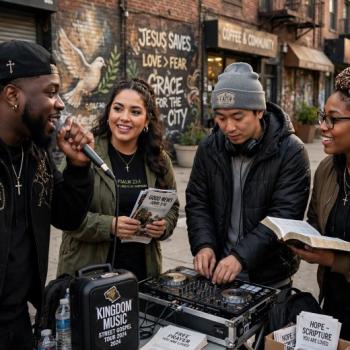
Image | Three Christian Hip Hop artists performing | generated by the author, 2025
The foundations of contemporary theomusicology are discipleship, evangelism, biblically-centered text/lyrics, personal testimony, community, and activism. When listening to a song, either from pop culture (secular) or religious in context (sacred), keeping these points in mind provides the methodology needed to see if and how a work can be understood from a theomusicological perspective. What is the value of this technique? To see how scripture is applied and expressed in everyday life. If theomusicology remains limited to sacred works or compositions, the proverbial choir is singing to the choir; it’s a circular narrative. When pop music, non-religious, non-sacred secular music is read through a theomusicological lens, the reference to how scripture truth (read: the gospel, the “good news”) is and can be applied and related to everyday life is expanded. The proverbial community choir is now singing to a worldwide choir.
To see how this technique, reading and listening to pop music as theomusicology, the 1970s funk band The Headhunters recorded the work “God Made Me Funky.” The title leads the conversation with a lingering question, “How can God make someone funky?” The Headhunters answer the question, succinctly and theomusicologically.
As a counterpoint, the track was recorded by the contemporary pop artist Jamiroquai. His version takes a different direction on the track, one that most would find more fitting in pop culture. Jamiroquai sidesteps the inclusion of the full title, specifically weaving his disjunct use of the original lyrics away from the inclusion of “God.” Taking this perspective, Jamiroquai avoids the necessity to provide a socio-religious statement while revamping a work that has a strong funk drive. Jamiroquoi performs to his base audience. Not including “God” in his version, Jamiroquai leans heavily on the latter point of the title, the “funk.”
A short analysis of each version of the work “God Made Me Funky” by the Headhunters, and Jamiroquai illustrates how a singular work serves both the faith-based and non-faith-based communities theomusicologically, and as an entry way to gospel truth, the “good news.”
God Make Me Funky: Gospel Truth from the Headhunters
The Headhunters, “God Made Me Funky,” Live version, February 21, 1975, posted May 21, 2025,
The Headhunters, “God Made Me Funky,” May 9, 2917, live at the Winterland, San Francisco, CA (Official), posted, September 23, 2014,
When the lyrics of “God Made Me Funky” by the Headhunters are read theomusicologically, it is clear that the work leans on the dependence of God to provide. Having such a work with these lyrics as a moving force during the Funk era of the 1970s alone is worth noting. This exemplifies how pop culture did not dismiss the interconnection of sacred and secular vernacular. Widely known for its spiritual exploration, the 1970s, coming from the 1960s Civil Rights era, granted itself a cultural liberal awakening and acceptance of spirituality. Further, the 1970s saw the worldwide growth of the Jesus Movement (1965-1969 – 1970s).
All of these points articulate how the track “God Made Me Funky” could find a well-situated place in the cultural fabric of the 1970s. A hidden gem for the post-Funk era and post-Jesus Movement decade, taking hold of this work with an updated theomusicological reading, illustrates a timeless pop cultural, musical relationship of the work and the endless importance of scriptural value in culture.
Lyrics:
You know some people pray for wealth
But I don’t even own my health
And when I get on my knees and pray
‘Cause the only thing I can say
That God, God…
God made me funky
Ohh God made me funky
God, God
God made me funky
God made me funky
God made me funky
Ya know some people wanna be saved
But they don’t know how to behave
And when they go to church… yeah
They don’t listen to what the preacher said
He sayin’ God can give you anything you want
He sayin’ God can give you anything you want
He sayin’ God can give you anything you want
He sayin’ God can give you anything you want
Help me! anything you want
Ohh [?] me anything you want
He can give you anything you want
And you can do anything you want
Ohh…
God made me funky, ahh yeah
God made me funky
God made me funky
God made me funky, ahh yeah
God made me funky
(Anything you want!)
God made me funky
God made me funky
I said God, God made me funky
Made me funky, God made me funky
God made me, God made me funky
Made me funky, God made me funky
Ahh, God made me funky
He made me funky, God made me funky
God made me funky, God made me funky
Said… God made me funky
Uhh… God made me funky
God made me funky
Made me funky, God made me funky
Made me funky, God made me funky
God, made, God made me funky
He made me funky, God made me funky
Made me funky, God made me funky
Ohh yeah God made me funky
God made me funky
God made me funky
“And God can make all grace abound to you, so that having all sufficiency in all things at all times, you may abound in every good work” (2 Corinthians 9:8).
Core Narrative
Verse 1: You know some people pray for wealth
But I don’t even own my health
And when I get on my knees and pray
‘Cause the only thing I can say
That God, God…
The opening verse states the tone of the work right away. The juxtaposition between secular desires and faith dependence balances each other through line three when the perspective ends on humility and submission to God. It is from that point that the chorus/hook is introduced, stating the discipleship of the song’s protagonist, “God Made Me Funky.” Funk, then, is the talent, the vehicle, the discourse through which biblical knowledge is to be shared. Without integrating any biblical scripture, the narrative highlights a main biblical theme, relying on God for all things.
“Trust in the Lord with all your heart and lean not on your own understanding; in all your ways submit to him, and he will make your paths straight” (Proverbs 3:5-6).
“I will instruct you and teach you in the way you should go; I will counsel you with my loving eye on you” (Psalm 32:8).
“The Lord will guide you always; he will satisfy your needs in a sun-scorched land and will strengthen your frame. You will be like a well-watered garden, like a spring whose waters never fail” (Isaiah 58:11).
Verse 2: Ya know some people wanna be saved
But they don’t know how to behave
And when they go to church… yeah
They don’t listen to what the preacher said…
The second verse continues the same line of thinking as verse one, secular desire in contrast to faith dependence. The addition in verse two is the importance of listening. Coming by way of a “preacher,” the subtext of these two lines draws out the need for a sound biblical hermeneutic. Ironically, this work presents a biblical hermeneutic for pop culture. The rhetorical question, then, is begged: “Does pop culture listen to what these lyrics have to say about a biblically-centered life as the alternative to a self-absorbed secular life?” Further, the biblically-centered life, as the title outlines, is a funky life, the one God made for all to enjoy, express, and be used as a discipleship and personal testimonial tool.
Chorus/The Hook: He can give you anything you want
And you can do anything you want/
God made me funky…
The chorus/hook of the song speaks to the subtext of gospel truth: He (read: God) gives you “anything you want” (read: what you need to survive in this world with the understanding that there is thanks given to God for His provisions and grace). The second part, “…you can do anything you want,” could be taken out of context. The subtextual gospel truth is that one can do what it is that God has made you to be (read: “anything you want”). This precludes that the trust and faith are given to God to lead the one who relies on God to direct, open the doors, make the way to what it is that one ultimately would want (read: what God made you to be). The last line is the summary of these two previous lines, acknowledging and expressing the personal testimony, “God made me funky” (emphasis added). The repetition of the chorus/hook is the preacher-esque nature employed in the work.
Each of these points, the biblically-centered lyrics/narrative, and the use of funk to underscore the gift given by God, this version by the Headhunters magnifies gospel truth (read: the “good news”) to both a faith-based and non-faith-based community. It can be said that God is using funk, through the Headhunters, to communicate and express His Word.

Photo | Jamiroquai performing at Coachella, 2018 | courtesy of Ralph_PH, Wikimedia Creative Commons
God Make Me Funky: Gospel Truth diverted by Jamiroquai
Jamiroquai, “God Made Me Funky” (cover), live at the Tokyo Club Citta, October 1993, posted April 12, 2011,
The version by Jamiroquai misrepresents the intent of the work. The focus of the cover by Jamiroquai is on being “funky,” with very little to no full expression of the title, “God Made Me Funky.”
God is removed from this version. Jamiroquai metaphorically speaks to how mainstream pop culture involves itself with a relationship to God, absent. Emphasizing the funk character and narrative of the original work, Jamiroquai states that there is no need to look further than a visceral, self-indulgent expression.
God, as the title says, “made you” a certain way, in this case, “funky.” But this is not an open invitation to only be “funky.” Rather, this is the means through which to celebrate and give thanks that God made you funky.
Going straight to the end of the title, “funky,” and bypassing the first term, “God,” shows how little pop culture, as illustrated by Jamiroquai, places on the importance of God, the last, and not the first. It’s perfectly fine to be funky and to produce funk. The importance, however, is not the product, “funk,” but the means and the importance of thanking God for making you and allowing you to be funky.
What Jamiroquai speaks to is the celebration of the self, the gift, and not the Creator, making funk an idol-filled absence. It is this maintained point, showcased by Jamiroquai, which furthers the divide between secular and sacred, pop culture and theology, selfishness and gospel celebration.
The title of the track, when read through Jamiroquai’s version, could be rescripted as “I Am Funky.” God’s gift, funk, is exacerbated but not celebrated as a gift. What’s the need for Jamiroquai to produce a version of a song clearly giving credit to God? Simple; Jamiroquai is speaking to his base audience, a non-faith-based community. If Jamiroquai did include and echo the title of the work as consistently as the Headhunters, he would have to follow up with a statement on this rationale.
Was Jamiroquai prepared to make such a statement? Was he uncomfortable with making such a statement? Would he lose fans by invoking “God” in his work? All valid questions that Jamiroquai may have entertained. The simple, economically-driven answer is to perform a strong funk-based work from the 1970s (read: many of Jamiroquai’s fans may never have heard the original work), and focus on what the fan base, a largely non-faith-based audience, wants: the funk, the strong groove, the pop flash, and the specticle not the gospel. If this is, indeed, the rationale, either articulated or subtextual, Jamiroquai conducted his presentation and version of a strong faith-based funk work as one which the pop music community desires, all the funk and none of the junk (read: gospel truth).
God may have made the work funky, and, yes, God may have given Jamiroquai a tinge of funk. But he neglects the opportunity to be thankful for this gift in exchange for the fan accolades and the financial gain. The worldly idols of fame and fortune echo as a chorus/hook in this cover version by Jamiroquai.
And God Created Funk
“For I know the plans I have for you, declares the Lord, plans for welfare and not for evil, to give you a future and a hope” (Jeremiah 29:11).
“God Made Me Funky” is a wealthy song, full of theomusicological credit expressing a firm yet subtle gospel truth. Operating as a mechanism for discipleship, “God Made Me Funky” speaks to a complex, dynamic community, sacred and secular. For the sensitive, the work leverages funk as an entryway to learning biblical lessons. Those who listen to the work centrally, as a funk work with a title of little importance, find it remains localized in the hallowed halls of 1970s funk. The Headhunters give back to the community funk by way of God’s gift. Jamiroquai gives and takes from the community funk as a gesture of economic satisfaction, his satisfaction, placing his work as a gift to his audience, seeing no need to overwork the obvious. God gave the world funk as a gift, not a token to cash in.
To read more from Alan Lechusza Aquallo’s “The Sweatpant Sessions,” please consider subscribing for free and check out others on Patheos.
General Christian
Evangelical

About Alan Lechusza Aquallo
Dr. Alan Lechusza is a scholar whose name has become synonymous with critical thought and cultural discourse. He is a thinker and writer who explores the world of popular culture with a critical eye. He holds a PhD and utilizes his in-depth, resource-rich understanding to question and redefine how we perceive art, power, and knowledge. His research covers various topics that aim to break down and rebuild our ideas about culture, artistry, and socio-political authority. Dr. Lechusza closely examines everyday cultural expressions in a way that challenges usual thinking. His writings make people think and view culture in new ways. Dr. Alan Lechusza aims to foster conversations that inspire change and challenge our understanding of how we perceive the world. You can read more about the author here.
Previous Post

March 1, 2026
Apologetics In Pop Music: A Theomusicological Reading
Next Post

March 15, 2026 Where's the Beat? Claiming Pop Christian Music As Pop Music
Browse Our Archives
Select a Category music criticism pop culture criticism Pop music criticism Uncategorized
Select a Month October 2026 September 2026 August 2026 July 2026 June 2026 May 2026 April 2026 March 2026 February 2026 January 2026 December 2025 November 2025 October 2025 September 2025 August 2025 July 2025 June 2025 May 2025 April 2025 March 2025 February 2025 December 2024 September 2024 June 2024 April 2024 March 2024 February 2024 January 2024 December 2023 November 2023
Follow Us!
TAKE THE
Religious Wisdom Quiz
What is the largest predominantly Catholic country in South America?
Select your answer to see how you score.
Brazil Argentina Peru Mexico
Books by This Author Books by The Sweatpant Sessions
Related posts from The Sweatpant Sessions
Family
Christian Hip Hop and Secular Rap: Finding the...

Family
Why Punk and Hip Hop May Hear God...

Family
Emotional Ashes: Emo and Scripture Knowledge, Psalm 91

Family
Learning Devotion and Discipline: A Brief Analysis of...
TRENDING AT PATHEOS Religious Art

The First Eucharistic Controversy: Christ’s Real Presence
For Catholics, the Eucharist is the source and summit of the Christian...

How to Make a Decision When You Can't...
Main point: It’s much more valuable to stay close to God so...

Archdiocese Hosts Military Marriage Retreat in Germany
RASTATT, Germany — The transient military lifestyle, with its frequent deployments and...

Nearly every morning, I make the drive to Detroit with my high-school-age...

The Real AI Story Is Adoption Without Trust
Artificial intelligence has crossed a political threshold. It is no longer a...

A new article, written by Jeff Lindsay and Gale L. Pooley,...
view all Religious Art blogs
Ad-Free & Subscriber Log-In Subscription Support
- About Us
- 2026 Calendar
- Videos
- Podcasts
- Library of World Religions
- Faith In Media Tracker
- Advertise With Us
- Write for Us
- Privacy Policy
- Terms of Service
- Do Not Sell My Data
- Contact Us
- Radiant Digital
- Manage Newsletter Subscriptions
- Unsubscribe From Notifications
- Sitemap
Copyright 2008-2026, Patheos. All rights reserved.
Subscription Support Ad-Free & Subscriber Log-In
Follow Patheos