
BuddhistCatholicContemplativeEvangelicalGeneral ChristianHinduJewishLatter-day SaintMuslimNew VisionsProgressive Christian
Beliefs
- Buddhist
- Catholic
- Contemplative
- Evangelical
- General Christian
- Hindu
- Jewish
- Latter-day Saint
- More Voices
- Muslim
- New Visions
- Pagan
- Progressive Christian
Topics
- Religion News
- Food and Religion
- Sports and Religion
- Religious Art
- Religious Music and Entertainment
- Religious Events
- History and Religion
- Style and Religion
- Politics and Religion
- Women in Religion
- Recreation Outdoors and Religion
- Business Finance and Religion
- Careers Workplace and Religion
- Education and Religion
- Family Parenting and Religion
- Health Fitness and Religion
- Home and Religion
- Relationships and Religion
- Technology and Religion
- Travel and Religion
Columnists
- Buddhist Columnists
- Business Finance and Religion Columnists
- Careers Workplace and Religion Columnists
- Catholic Columnists
- Contemplative Columnists
- Education and Religion Columnists
- Evangelists Columnists
- Family Parenting and Religion Columnists
- General Christian Columnists
- Health Fitness and Religion Columnists
- Hindu Columnists
- History and Religion Columnists
- Home and Religion Columnists
- Jewish Columnists
- More Voices Columnists
- Latter Day Columnists
- Muslim Columnists
- New Visions Columnists
- Nonreligious Columnists
- Pagan Columnists
- Politics and Religion Columnists
- Progressive Columnists
- Recreation Outdoors and Religion Columnists
- Relationships and Religion Columnists
- Religion News Columnists
- Religious Art Columnists
- Religious Events Columnists
- Religious Music and Entertainment Columnists
- Sports and Religion Columnists
- Style and Religion Columnists
- Technology and Religion Columnists
- Travel and Religion Columnists
- Women in Religion Columnists
Resource Library
- 2026 Calendar
- Library of World Religions
- The 100 Most Holy Places on Earth
- Patheos Answers
- Podcasts
- Videos
- Faith Leaders Database
- Anglican Episcopalian
- Bahai
- Baptist
- Buddhism
- Christianity
- Confucianism
- Eastern Orthodoxy
- Hinduism
- Holiness and Pentecostal
- ISKCON
- Islam
- Judaism
- Lutheran
- Methodist
- The Church of Jesus Christ of Latter-day Saints
- New Age
- Paganism
- Presbytarian and Reformed
- Protestantism
- Religion Behind the Scenes
- Roman Catholic
- Scientology
- Shia Islam
- Sikhism
- Sufism
- Sunni Islam
- Taoism
- Zen
- See all religions
Research Tools
 Ad-Free & Subscriber Log-In Subscription Support
Ad-Free & Subscriber Log-In Subscription Support
Follow Patheos 

- Trending:
- Forgiveness
- |
- Marriage
- |
- Consciousness
- |
- Death Penalty
- |
- Election
- |
- Halloween

- Home
- General Christian
- Religious Art
- Alternative Meanings: Biffy Clyro’s Socio-Religious Reading
Alternative Meanings: Biffy Clyro’s Socio-Religious Reading
Last updated on: September 22, 2025 at 4:25 am by Alan Lechusza Aquallo
Alternative Meanings: Biffy Clyro’s Socio-Religious Reading 2025-09-22T04:25:34-07:00 Alan Lechusza Aquallo
Patheos Explore the world's faith through different perspectives on religion and spirituality! Patheos has the views of the prevalent religions and spiritualities of the world.
Alternative music was first used in 1979 by Terry Tonkin, a music clerk and writer at the time, to describe underground music. Since then, the genre known as alternative has covered pop and rock music. The genre itself incorporates music and bands that work outside of the traditional and standard definitions of pop and rock music. No longer seen as underground, alternative music is a firm fixture in the music industry.

Photo | Biffy Clyro | courtesy of Warner Music New Zealand | Wikimedia Creative Commons
Biffy Clyro is an alternative rock band from Kilmarnock in Ayrshire, a heavily Protestant community. The band has, over the course of their 30 years together, produced works which has socio-religious references and biblical-themed titles. The band has been open about their intention not to make a religious statement. The band does, however, intend to present an alternative understanding of religious belief. Following this point, the band is providing pop culture with a (mis)guided view of faith, where they enlist a self-defining definition of religion, belief, and faith.
Where Does Their Work Go?
The direction of this analysis is less on the visuals of the videos, which demands an entire critique itself. The argument presented is how Biffy Clyro incorporates biblical themes, titles, and nuances in their work, which subjegates and objectifies faith and belief through a post-modern socio-religious context which is closely aligned to, and can lead toward, a deconstruction of faith.
Biffy Clyro – incorporating a socio-religious deconstruction where faith is questioned, challenged, and dismantled, substituting foundational principles of faith, belief, and hope with icons/images from (pop) culture.

Photo | Biffy Clyro, 2013 | courtesy Stefan Brending | Wikimedia Creative Commons
Samples from the Biffy Clyro catalogue
The following tracks are samples from the expansive Biffy Clyro catalogue, which covers ten studio recordings and hundreds of live recordings. The works selected have a common theme; they each contain a religious title. Others in the band’s catalog are not explicit in their religious title. For this review, songs with clearly defined religious titles have been included.
These samples help qualify the analysis of Biffy Clyro’s (mis)use of these biblical titles, references, and meanings. There is sometimes a thin veil connecting the title to the intent of the song. However, the tracks that do include a biblical title or reference hold some level of a socio-religious perspective. These tracks are not intended to be a stable or consistent biblical work. The tracks use these references to make a broad statement about social relationships, with the foundation being on one’s individual approach to religion.
The band is clear that they are not making a religious statement. Yet, they continue to enlist biblical references throughout their works. Such a contradiction may not be readily assessed by fans or audiences. What is seen is some connection to religion, while the music does not follow “church music” but a strong alternative music identity. This latter point gives more credibility to the work than the surface biblical reference. This operating strategy allows Biffy Clyro to invest their own questioning of religion while not falling into the trap of being a “religious band.” Fans and audiences are given a creative sonic world, and the band can share their thoughts about religion, which is centered on personal interpretations, not scriptural doctrine, and a secular understanding of love.
Biffy Clyro – Biblical (Official Music Video)
Biffy Clyro – God and Satan (Official Music Video)
Biffy Clyro – Errors in the History of God (Visualiser)
Biffy Clyro – “Holier Than Thou” from The Metallica Blacklist
Biffy Clyro – Holy Water (Visualiser)
Biffy Clyro – True Believer (Official Visualiser)
Biffy Clyro – True Believer (Clean/Radio Edit)
This last track, “True Believer,” has recently been discussed by the band’s lead singer, Simon Neil.
“Speaking of the track [True Believer], frontman Simon Neil says: “True Believer is about faith: not religious faith, but having faith in your life decisions. Try not to doubt yourself so much. Whenever you’re in those moments to make big life decisions, you’re not as flippant as you think you are. Sometimes I look back and think, ‘Why did I make that decision?’ and actually, I knew exactly what I was doing at the time. So have faith in yourself and the people you love. Love is the only thing in my life I have conditional faith in. It’s what drives my relationships and our music” (qtd. in Radio X, September 5).
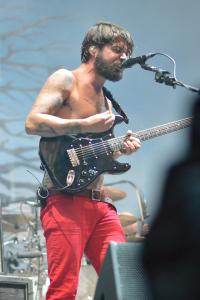
Photo | Biffy Clyro, Rock in Pott, 2013 | courtesy Krd | Wikimedia Creative Commons
This last track, a highly anticipated release from the band’s 10th album, crosses a lyrical and visual line. As quoted, the band frames the intent along the lines of believing in oneself. There are questionable hand gestures and profanity prominent in the track. Taking these two items together, Simon Neil’s qualification of the song, stating the satisfaction and ability of one to rely on oneself, following love, and having faith in oneself, detracts from the honest intent of the song. Biblically speaking, each of these is counter to faith, belief, and where Christian trust is to be placed.

Photo | Biffy Clyro, 2013 | courtesy Stefan Brending | Wikimedia Creative Commons
Misunderstanding Titles, Misusing Terms
To start, Micah 7:5 clearly states not to put trust in others.
“Do not trust in a friend; Do not put your confidence in a companion; Guard the doors of your mouth From her who lies in your bosom” (Micah 7:5 NKJV).
Proverbs reminds us not to lean on our own understanding.
“Trust in the Lord with all your heart, and do not lean on your own understanding. In all your ways acknowledge him, and he will make straight your paths” (Proverbs 3:5-6 ESV).
Ephesians 2:8 qualifies how we have been saved through faith, a gift from God.
“For by grace you have been saved through faith. And this is not your own doing; it is the gift of God,” (Ephesians 2:8 ESV).
These short verses serve as a counterpoint to Biffy Clyro’s perspective on self-reliance. Promoting a self-reliance option based on love may give the impression of a positive context, attitude, and pride. Each of these, again, is a danger to be avoided when living by faith.
“Do not love the world or the things in the world. If anyone loves the world, the love of the Father is not in him. For all that is in the world—the desires of the flesh and the desires of the eyes and pride of life—is not from the Father but is from the world. And the world is passing away along with its desires, but whoever does the will of God abides forever” (1 John 2:15017 ESV).
Fans and audiences may misinterpret the message presented by Biffy Clyro as being religious. Given the words from the band’s frontman, Simon Neil, and a short review of applicable biblical scripture, it is clear that the titles are not biblical in nature, there’s no applicable biblical testimony being made, and the band is not making a religious statement. Yet, how many fans or audience members will take the time to delve into the background of the titles, their meaning, and how they do not point to an accurate biblical understanding?
The danger of these titles, by Biffy Clyro, is the misleading representation. On the surface, the titles denote a biblical reference or knowledge. However, the opposite is the case. The gesture of the titles is an inaccurate influence. Biffy Clyro is not making a statement in support of religion; they are making a socio-religious point based on the self, a danger which scripture clearly points out for (true) believers to avoid.
“So I say, walk by the Spirit, and you will not gratify the desires of the flesh. For the flesh craves what is contrary to the Spirit, and the Spirit what is contrary to the flesh. They are opposed to each other, so that you do not do what you want” (Galatians 5:16-17 NKJV).
“I know that nothing good lives in me, that is, in my flesh. For I have the desire to do what is good, but I cannot carry it out” (Romans 7:18 NKJV).
“For if you live according to the flesh, you will die; but if by the Spirit you put to death the deeds of the body, you will live” (Romans 8:13 NKJV).

Photo | Biffy Clyro, 2017 | courtesy Stefan Brending | Wikimedia Creative Commons
To Listen Or Not To Listen?
Musically speaking, the works of Biffy Clyro are enriching, challenging, engaging, and entertaining. When putting the misuse of these titles aside, their works stand on their own, a testament to their 30-year career. However, when the lyrics present a reference to religion, no matter how slight, the level of enjoyment in a credible socio-religious, faith-based context is difficult.
Navigating these inclusions, which don’t follow a predictable structure, makes the listening difficult with a faith-based discipline. Is it possible to listen beyond this perspective? Yes. Is it necessary to listen with this perspective? Yes. Does one need to be this critical when listening to alternative pop or rock music? Again, yes. Letting down this critical guard deflects the importance of living a faith-centered life. The sounding reality which Biffy Clyro presents is comfortable for some, while others will need to listen with caution, so as not to listen with any compromise.
For more articles from Alan Lechusza’s The Sweatpant Sessions on Patheos, consider subscribing, following, and sharing. Also
General Christian
Evangelical

About Alan Lechusza Aquallo
Dr. Alan Lechusza is a scholar whose name has become synonymous with critical thought and cultural discourse. He is a thinker and writer who explores the world of popular culture with a critical eye. He holds a PhD and uses his deep resource-rich understanding to question and redefine how we see art, power, and knowledge. His research covers various topics that aim to break down and rebuild our ideas about culture, artistry, and socio-political authority. Dr. Lechusza closely examines everyday cultural expressions in a way that challenges usual thinking. His writings make people think and view culture in new ways. Dr. Alan Lechusza wants to create conversations to inspire change and challenge our understanding of how we experience the world. You can read more about the author here.
Previous Post

September 16, 2025
Rappin' Faith: Christian Apologetics In Hip Hop
Next Post

September 29, 2025 Seeking Truth: Framing Contemporary Theomusicology
Browse Our Archives
Select a Category music criticism pop culture criticism Pop music criticism Uncategorized
Select a Month October 2026 September 2026 August 2026 July 2026 June 2026 May 2026 April 2026 March 2026 February 2026 January 2026 December 2025 November 2025 October 2025 September 2025 August 2025 July 2025 June 2025 May 2025 April 2025 March 2025 February 2025 December 2024 September 2024 June 2024 April 2024 March 2024 February 2024 January 2024 December 2023 November 2023
Follow Us!
TAKE THE
Religious Wisdom Quiz
Look to the LORD and his strength; seek his face, ____________.
Select your answer to see how you score.
Forever Every Time Eternally Always
Books by This Author Books by The Sweatpant Sessions
Related posts from The Sweatpant Sessions

Family
Christian Hip Hop and Secular Rap: Finding the...

Family
Why Punk and Hip Hop May Hear God...

Family
Emotional Ashes: Emo and Scripture Knowledge, Psalm 91

Family
Learning Devotion and Discipline: A Brief Analysis of...
TRENDING AT PATHEOS Religious Art

The Problem with False Prophets
Miller’s Station UMC| 10/18/26| Anchor Verse: Jeremiah 23: 1, 9-23 I...

Emotion in Early Christianity by Andrew Crislip
Andrew Crislip’s Emotion in Early Christianity examines an often overlooked dimension of...

16 Spiritual Touchstones for a More Grounded Life
After decades of spiritual study, here are 16 principles I try...

Catholic Evangelization: Sharing Your Faith Every Day
Welcome back to the Graceful Awakening mini-series called, “From Faith to Mission.” ...

The Pillar of the Boatmen: the Ancient Monument...
The Pillar of the Boatmen is a Romano-Gaulish sculpture that dates from...

In one sense walking into Westminster Abbey is like walking down the...
view all Religious Art blogs
Ad-Free & Subscriber Log-In Subscription Support
- About Us
- 2026 Calendar
- Videos
- Podcasts
- Library of World Religions
- Faith In Media Tracker
- Advertise With Us
- Write for Us
- Privacy Policy
- Terms of Service
- Do Not Sell My Data
- Contact Us
- Radiant Digital
- Manage Newsletter Subscriptions
- Unsubscribe From Notifications
- Sitemap
Copyright 2008-2026, Patheos. All rights reserved.
Subscription Support Ad-Free & Subscriber Log-In
Follow Patheos