
BuddhistCatholicContemplativeEvangelicalGeneral ChristianHinduJewishLatter-day SaintMuslimNew VisionsProgressive Christian
Beliefs
- Buddhist
- Catholic
- Contemplative
- Evangelical
- General Christian
- Hindu
- Jewish
- Latter-day Saint
- More Voices
- Muslim
- New Visions
- Pagan
- Progressive Christian
Topics
- Religion News
- Food and Religion
- Sports and Religion
- Religious Art
- Religious Music and Entertainment
- Religious Events
- History and Religion
- Style and Religion
- Politics and Religion
- Women in Religion
- Recreation Outdoors and Religion
- Business Finance and Religion
- Careers Workplace and Religion
- Education and Religion
- Family Parenting and Religion
- Health Fitness and Religion
- Home and Religion
- Relationships and Religion
- Technology and Religion
- Travel and Religion
Columnists
- Buddhist Columnists
- Business Finance and Religion Columnists
- Careers Workplace and Religion Columnists
- Catholic Columnists
- Contemplative Columnists
- Education and Religion Columnists
- Evangelists Columnists
- Family Parenting and Religion Columnists
- General Christian Columnists
- Health Fitness and Religion Columnists
- Hindu Columnists
- History and Religion Columnists
- Home and Religion Columnists
- Jewish Columnists
- More Voices Columnists
- Latter Day Columnists
- Muslim Columnists
- New Visions Columnists
- Nonreligious Columnists
- Pagan Columnists
- Politics and Religion Columnists
- Progressive Columnists
- Recreation Outdoors and Religion Columnists
- Relationships and Religion Columnists
- Religion News Columnists
- Religious Art Columnists
- Religious Events Columnists
- Religious Music and Entertainment Columnists
- Sports and Religion Columnists
- Style and Religion Columnists
- Technology and Religion Columnists
- Travel and Religion Columnists
- Women in Religion Columnists
Resource Library
- 2026 Calendar
- Library of World Religions
- The 100 Most Holy Places on Earth
- Patheos Answers
- Podcasts
- Videos
- Faith Leaders Database
- Anglican Episcopalian
- Bahai
- Baptist
- Buddhism
- Christianity
- Confucianism
- Eastern Orthodoxy
- Hinduism
- Holiness and Pentecostal
- ISKCON
- Islam
- Judaism
- Lutheran
- Methodist
- The Church of Jesus Christ of Latter-day Saints
- New Age
- Paganism
- Presbytarian and Reformed
- Protestantism
- Religion Behind the Scenes
- Roman Catholic
- Scientology
- Shia Islam
- Sikhism
- Sufism
- Sunni Islam
- Taoism
- Zen
- See all religions
Research Tools
 Ad-Free & Subscriber Log-In Subscription Support
Ad-Free & Subscriber Log-In Subscription Support
Follow Patheos 

- Trending:
- Forgiveness
- |
- Marriage
- |
- Consciousness
- |
- Death Penalty
- |
- Election
- |
- Halloween

- Home
- General Christian
- Religious Art
- I am what I am? A punk apologetic deconstruction of Popeye
I am what I am? A punk apologetic deconstruction of Popeye
Last updated on: January 27, 2024 at 10:03 pm by Alan Lechusza Aquallo
I am what I am? A punk apologetic deconstruction of Popeye 2024-01-27T22:03:05-08:00 Alan Lechusza Aquallo
Patheos Explore the world's faith through different perspectives on religion and spirituality! Patheos has the views of the prevalent religions and spiritualities of the world.
What did he say?
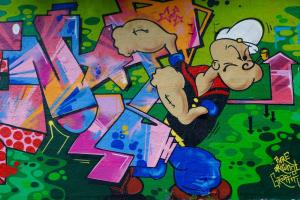
Popeye the Sailorman
It’s true, today, Wednesday, January 17, 2024, is National Popeye the Sailorman Day. Seriously, it’s a fact. Here’s the proof!
Now, given this unexpected day, we have some choices to make. We can all light a candle in a can of spinach. We could go to a dock and sing the “Popeye the Sailorman theme song.” Or, we can spend money and time to get an anchor tattoo on our overly defined forearms. Let’s – for argument’s sake – consider that none of those will take place. Okay, maybe the song is not such a hard thing to do, in honor of the 95th birthday of that pop culture cartoon icon.
What stands to note is the tagline that has brought Popeye into the limelight, “I am what I am.” So, here’s the twist. There’s a bible quote that relates to this pop culture signifying vernacular. Here’s the quote in full from the NKJ version,
I Corinthians 15:10 NKJV
But by the grace of God I am what I am, and His grace toward me was not in vain; but I labored more abundantly than they all, yet not I, but the grace of God which was with me.
So, on this unexpected day with a faith-based twist, let’s deconstruct this reference along the lines of an apologetic punk deconstruction vernacular. Oh, what fun!
Is it a word? Is it a phrase? Is it even necessary?
If Popeye continued to repeat the phrase that became his moniker, “I Am What I Am,” then he draws upon a self-determined position of identity. Popeye falls back upon one of the core values of Punk ideology, Do It Yourself (DIY). Since the birth of the punk genre c. 1970s in Britain, the DIY status has remained central to those who are not even versed in punk philosophy. However, I read DIY a bit differently.
DIY, as an apologetic deconstructionist, is not localized on doing things by yourself. That attitude is the road toward selfishness and contributes to the ego and pride. The pop culture signifier that DIY is a magnum opus of how one can state their singular representation, identity, and value – for me – misses the mark, entirely.
DIY is about doing “things” by yourself. However, it’s the “things” that are important. In working through one’s days (read: D – doing), you set yourself in an active context. The matter at hand (read: I – it) is what occupies your state for that particular moment. Trying to handle these matters on your own (read: Y – yourself) neglects the importance of seeking assistance, guidance, input, and support from a community – even a single individual. My point is that doing what is necessary is not the question. The issue of attempting to wrestle through a matter or forcing your desired outcome upon an interaction is where the lack of faith/belief becomes central.
Taking matters into your own hands and avoiding any opportunity to gain insight, assistance, and clarity from your faith/belief system narrates the “Y” as being ego-driven. I argue that the “Y” is important to retain, but is not to be assimilated or essentialized in a dead zone of pride. Rather, the “Y” – yourself – I argue, should be inverted to see how you can be assisted through faith/belief and in cooperation with others to better enhance what has drawn your attention. Do-It-Yourself (in faith and with belief) is how I read the DIY philosophy.
Apologetic Deconstructive Lingusitc Gymnastics
Getting back to Popeye’s use of “I Am What I Am.” This sociolinguist phrase is perfectly used by Popeye. He uses this repeated phrase in self-reference to how he, and he alone, can resolve complications. This answers why the Popeye character was so popular with youth in the West (read: America). Popeye phrased that being individually focused, ego-driven, and prideful is the American way (read: the only way) to resolve a disturbance. Popeye’s phrase disturbed generations into believing that there was no need, value, or necessity to acquire help at troubled times. This thought process leads to a self-centered belief structure and a disregard for faith. Though the Popeye character may appear to be an innocent character sharing the importance of being self-reliant. In truth, Popeye was fortifying an ideology of domination and machismo that strayed away -far, far away – from a central faith/belief system.
Troubling as it may seem, this ideology has become institutionalized in the 20th/21st American/Western socio-political agenda. This magnifies the reductive attention on faith/belief systems. “I Am What I Am”; a subtextual standard for Western cultures. The more that the centrist “I” is active, the farther away faith/belief comes to assist the “You” in the self.

Popeye the Sailorman
An apologetic viewpoint would read that the “You” can be understood as the corpus of the community; a collected identity of faith. The Self is the community’s viewpoint in reflection upon its own identity. The support of the community is the larger Self, poised with faith/belief. To redirect Popeye’s phrase – “I Am What I Am” – the “I” is reframed within a larger faith/belief community. It is within this locus that the “I” becomes valuable to the corpus “You.” The logical conclusion, then, is that there becomes an active faith/belief system of “We.”
What does he still have to say?
In the encounter at the burning bush (Exodus 3:14) Moses asks what he is to say to the Israelites when they ask what God (‘Elohiym) has sent him. God (YHWH) replies, “I Am who I Am”, adding, “Say this to the people of Israel, ‘I Am [He who] has sent me to you.'”
After all of this, A Tribe Called Quest reminds us that it’s important to check the rhyme of how we talk. It’s not just the singular words that are important. It’s the connection, the directive, the sociolinguistic economy of the words that generate their power. In faith, with belief, it’s important to know the history of the words being used and shared.
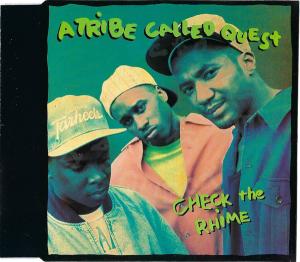
A Tribe Called Quest
Words come and words go, or so we would like to believe. Words have power. Faith/belief is fundamental to our lives. If we allow our words to script our interactions and responses to complications, we neglect to check the rhyme on how our actions-meaning-content/context is or is not aligned with our core faith/belief system. Popeye should have listened to more Hip Hop, in particular A Tribe Called Quest. Had he done so (if that were even existentially possible!) he may have learned to check the rhymeof his catchphrase. If that were the case, Popeye may have resolved to say, “I Am What We Say I Am” in faith and belief.
General Christian

About Alan Lechusza
Alan Lechusza, PhD Join me on a writing journey that expands through, beyond, and toward powerful creative expressions with rich perspectives centered on inspiring work. I delve into the socio-political dynamics at the intersection of culture, pop culture, news and media, social issues, politics, faith, and everything in between. You can read more about the author here.
Previous Post

January 9, 2024
Good House Keeping: House, Faith, and Stoicism
Next Post
February 8, 2024 Not just for kids, Nemo, Elmo, and calling 311
Browse Our Archives
Select a Category music criticism pop culture criticism Pop music criticism Uncategorized
Select a Month October 2026 September 2026 August 2026 July 2026 June 2026 May 2026 April 2026 March 2026 February 2026 January 2026 December 2025 November 2025 October 2025 September 2025 August 2025 July 2025 June 2025 May 2025 April 2025 March 2025 February 2025 December 2024 September 2024 June 2024 April 2024 March 2024 February 2024 January 2024 December 2023 November 2023
Follow Us!
TAKE THE
Religious Wisdom Quiz
"A cheerful heart is good medicine" is found in what book?
Select your answer to see how you score.
Matthew Psalms Genesis Proverbs
Books by This Author Books by The Sweatpant Sessions
Related posts from The Sweatpant Sessions
Family
Learning Devotion and Discipline: A Brief Analysis of...
Family
Hearing Past Hip Hop: Theomusicological Truth and Knowledge
Family
The Martyring of Saint Tupac Shakur: A Theological...

Family
Applying A Decolonial Apologetic To Race, Culture, Tolerance
TRENDING AT PATHEOS Religious Art

Looking at the Largest Orthodox Cathedral on Earth
There is often a considerable amount of anger and, shall we...

The Problem with False Prophets
Miller’s Station UMC| 10/18/26| Anchor Verse: Jeremiah 23: 1, 9-23 I...

Emotion in Early Christianity by Andrew Crislip
Andrew Crislip’s Emotion in Early Christianity examines an often overlooked dimension of...

16 Spiritual Touchstones for a More Grounded Life
After decades of spiritual study, here are 16 principles I try...

Catholic Evangelization: Sharing Your Faith Every Day
Welcome back to the Graceful Awakening mini-series called, “From Faith to Mission.” ...

The Pillar of the Boatmen: the Ancient Monument...
The Pillar of the Boatmen is a Romano-Gaulish sculpture that dates from...
view all Religious Art blogs
Ad-Free & Subscriber Log-In Subscription Support
- About Us
- 2026 Calendar
- Videos
- Podcasts
- Library of World Religions
- Faith In Media Tracker
- Advertise With Us
- Write for Us
- Privacy Policy
- Terms of Service
- Do Not Sell My Data
- Contact Us
- Radiant Digital
- Manage Newsletter Subscriptions
- Unsubscribe From Notifications
- Sitemap
Copyright 2008-2026, Patheos. All rights reserved.
Subscription Support Ad-Free & Subscriber Log-In
Follow Patheos