
BuddhistCatholicContemplativeEvangelicalGeneral ChristianHinduJewishLatter-day SaintMuslimNew VisionsProgressive Christian
Beliefs
- Buddhist
- Catholic
- Contemplative
- Evangelical
- General Christian
- Hindu
- Jewish
- Latter-day Saint
- More Voices
- Muslim
- New Visions
- Pagan
- Progressive Christian
Topics
- Religion News
- Food and Religion
- Sports and Religion
- Religious Art
- Religious Music and Entertainment
- Religious Events
- History and Religion
- Style and Religion
- Politics and Religion
- Women in Religion
- Recreation Outdoors and Religion
- Business Finance and Religion
- Careers Workplace and Religion
- Education and Religion
- Family Parenting and Religion
- Health Fitness and Religion
- Home and Religion
- Relationships and Religion
- Technology and Religion
- Travel and Religion
Columnists
- Buddhist Columnists
- Business Finance and Religion Columnists
- Careers Workplace and Religion Columnists
- Catholic Columnists
- Contemplative Columnists
- Education and Religion Columnists
- Evangelists Columnists
- Family Parenting and Religion Columnists
- General Christian Columnists
- Health Fitness and Religion Columnists
- Hindu Columnists
- History and Religion Columnists
- Home and Religion Columnists
- Jewish Columnists
- More Voices Columnists
- Latter Day Columnists
- Muslim Columnists
- New Visions Columnists
- Nonreligious Columnists
- Pagan Columnists
- Politics and Religion Columnists
- Progressive Columnists
- Recreation Outdoors and Religion Columnists
- Relationships and Religion Columnists
- Religion News Columnists
- Religious Art Columnists
- Religious Events Columnists
- Religious Music and Entertainment Columnists
- Sports and Religion Columnists
- Style and Religion Columnists
- Technology and Religion Columnists
- Travel and Religion Columnists
- Women in Religion Columnists
Resource Library
- 2026 Calendar
- Library of World Religions
- The 100 Most Holy Places on Earth
- Patheos Answers
- Podcasts
- Videos
- Faith Leaders Database
- Anglican Episcopalian
- Bahai
- Baptist
- Buddhism
- Christianity
- Confucianism
- Eastern Orthodoxy
- Hinduism
- Holiness and Pentecostal
- ISKCON
- Islam
- Judaism
- Lutheran
- Methodist
- The Church of Jesus Christ of Latter-day Saints
- New Age
- Paganism
- Presbytarian and Reformed
- Protestantism
- Religion Behind the Scenes
- Roman Catholic
- Scientology
- Shia Islam
- Sikhism
- Sufism
- Sunni Islam
- Taoism
- Zen
- See all religions
Research Tools
 Ad-Free & Subscriber Log-In Subscription Support
Follow Patheos 

- Trending:
- Advent
- |
- Forgiveness
- |
- Thanksgiving
- |
- Election
- |
- Seasonal Holidays
- |
- Marriage

- Home
- Pagan
- History and Religion
- The Dead Man’s Hand: Appalachian Graveyard Magic
The Dead Man’s Hand: Appalachian Graveyard Magic
Last updated on: October 3, 2026 at 9:10 am by Heather Blankenship
The Dead Man’s Hand: Appalachian Graveyard Magic 2026-10-03T09:10:27-04:00 Heather Blankenship
Patheos Explore the world's faith through different perspectives on religion and spirituality! Patheos has the views of the prevalent religions and spiritualities of the world.
When the Mountains Go Dark: Appalachian Folklore for Spooky Season Installment 3
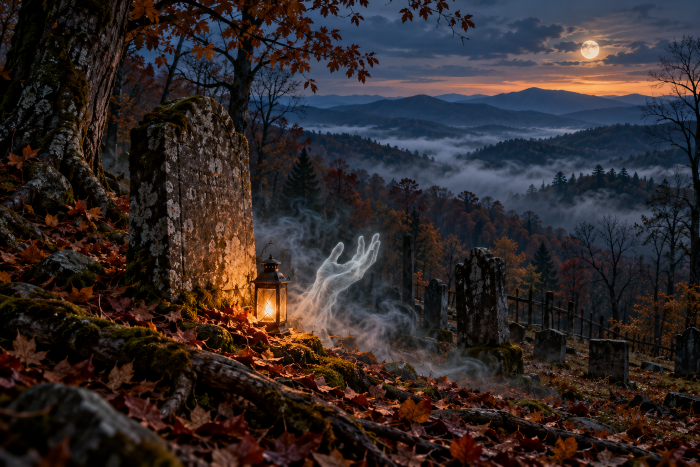
Spectral hang emerging from the ground
Healing charms, graveyard earth, and the uneasy belief that death did not put an end to power.
An old mountain cemetery can make you lower your voice without anyone asking.
You might arrive in full daylight, with the sun warming your shoulders and birds moving through the trees. Still, once you step among the stones, something changes. You begin reading names. You notice a child’s short life, a husband and wife buried side by side, or a marker so worn that the person beneath it has become almost anonymous.
Then you look down at the earth beneath your shoes.
For some people, it was simply the ground where their loved ones rested. In certain folk beliefs, however, that earth—and even the body committed to it—could hold a power that the living hoped to borrow.
One of the most unsettling expressions of that idea was also surprisingly ordinary in its purpose: the touch of a dead person’s hand might remove a wart.
No elaborate haunting. No figure rising from a coffin.
Just a living person reaching toward the dead, hoping to leave an affliction behind.
A Hand That Could Still Heal
An account of older burial customs published by Appalachian History describes visitors touching a deceased person’s hands in the hope of healing sickness or removing a wart. That account is evidence of a reported belief, rather than proof that the treatment worked or that every mountain community practiced it.[1]
Even with that distinction, the image is difficult to forget.
A hand that had worked, cooked, comforted children, or held someone else’s hand was now motionless. Yet someone standing beside the body could still see it as capable of changing a living person’s condition.
I find that both eerie and oddly intimate. We tend to picture graveyard magic as something conducted secretly at midnight. Here, the encounter belongs to the room where neighbors were paying their respects.
The feared and the familiar were close enough to touch.
One way to interpret this kind of charm is through the idea of transfer: the unwanted condition passes away from the living person through contact with death. That is an interpretation of the charm’s possible logic, not a claim that every person who used it would have explained it that way.
Some may simply have trusted what an older relative told them. A remedy can survive in a family long after anyone remembers why it was supposed to work.
The Earth Above the Dead
The hand was not the only thing associated with a grave that appeared in folk healing.
Folklorist Cory Thomas Hutcheson, writing at New World Witchery, cites Patrick W. Gainer’s Witches, Ghosts, & Signs for a West Virginia belief connecting earth from a newly made grave with the removal of warts. His discussion places this among several regional wart charms, rather than presenting one uniform system of mountain magic.[2]
What interests me is the relationship between the affliction and the place chosen to receive it. A grave is where something is put away. It is where a presence becomes an absence, at least in the ordinary experience of the household.
In that symbolic setting, the hope that an unwanted condition might disappear acquires a particular force.
Of course, a grave is also where somebody’s mother, brother, child, or friend has been buried. The magical association never erases that human reality. The dirt carries meaning because the place carries meaning.
Graveyard Dirt and Conjure
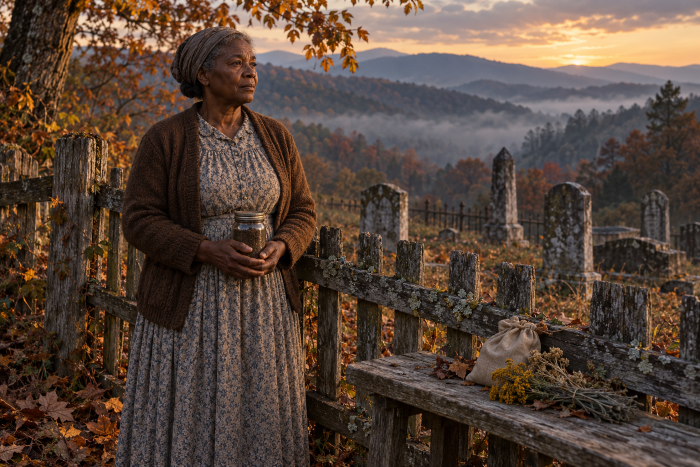
African American root worker
Any discussion of Southern graveyard magic also needs to acknowledge African American conjure and rootwork.
These traditions have their own histories. They should not be folded into a vague collection of “mountain witchcraft” as though the identities of their practitioners do not matter.
NCpedia’s entry on root doctors describes traditional healing and conjuring in the rural Black South. It records graveyard dirt as an ingredient associated with some preparations called goofer dust, within a wider tradition encompassing healing, protection, and work intended to affect other people.[3]
That does not mean every use of graveyard earth was the same. Nor does it establish that a particular practice was common throughout Appalachia. A North Carolina source about the broader South needs to be read at that geographic scale.
The distinction matters because ingredients can resemble one another while their purposes and cultural settings differ. A wart charm recorded in West Virginia and a conjure preparation described in Southern rootwork are not interchangeable merely because both involve earth associated with burial.
When we write about folklore, the temptation is to gather every strange detail into one dramatic story. The history becomes more interesting when we allow the differences to remain.
What About the Hand of Glory?
The phrase “dead man’s hand” may bring another image to mind: a severed hand holding a candle while a thief slips through a sleeping house.
That is the Hand of Glory, a motif associated with European magical lore. The Museum of Witchcraft and Magic describes the belief that a prepared hand from an executed criminal, used with a candle, could immobilize those confronted with it and thereby assist burglars.[4]
It is a memorable legend. It is also a different subject from touching the hand of a deceased neighbor in hopes of removing a wart.
The sources discussed here do not establish the Hand of Glory as a widespread Appalachian practice. Presenting it that way would turn an evocative comparison into an unsupported claim.
Still, the comparison reveals an intriguing range of imagined powers. In one setting, the dead hand might help a living person heal. In another, it might assist a thief. Death could be imagined as holding possibilities that depended on who approached it and what they wanted.
A Cemetery Was Also a Place of Love
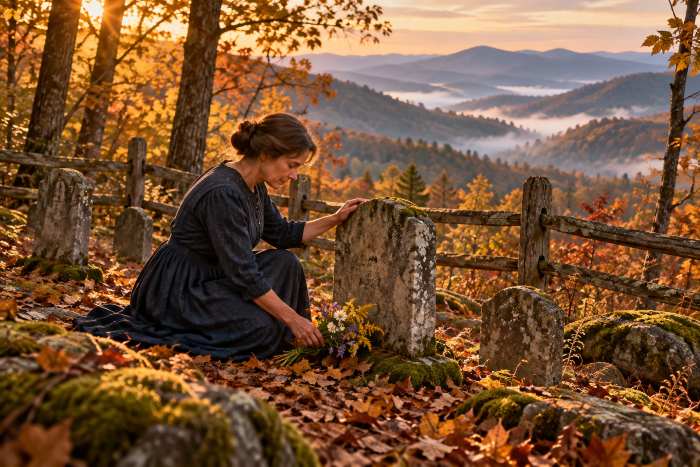
A place of love
I would hate to leave the impression that mountain cemeteries existed primarily as frightening places or sources of magical materials.
They held people who were loved.
A small burial ground might preserve several generations of a family. A name on a stone could call up a voice, a kitchen, a story repeated at every gathering. The quiet could be as comforting as it was unsettling.
That closeness gives these beliefs their emotional weight. The dead were not always distant strangers. They had belonged to the same households and communities as the people who remembered their powers.
To me, the most haunting part of the dead-hand charm is that it turns a final touch into a request.
Someone stands beside a body, carrying an ordinary trouble, and hopes that the person who has gone might somehow help once more.
It is a small hope. Perhaps even a desperate one.
But it belongs to the same human world as the larger questions we bring to a grave: Are you still near us? Does anything remain? Can you hear what I never managed to say?
The Power We Give the Grave
These beliefs cannot tell us that the dead could cure sickness or that graveyard earth possessed supernatural force. They can tell us that some living people approached death with hopes as well as fears.
They reached toward the place most associated with an ending and imagined that something might still pass between worlds.
The hand lay still. The grave remained closed.
The living, however, had not finished asking.
Did your family pass down any beliefs about graveyards, funeral customs, or old healing charms? I would love to hear what you remember—and where the story came from.
Sources and Further Reading
- “An Old Time Appalachian Burial,” Appalachian History.
- “Wart Charming,” New World Witchery, discussing Patrick W. Gainer’s Witches, Ghosts, & Signs and distinguishing Appalachian examples from Ozark material.
- “Root Doctors,” NCpedia.
- “Skeletal Hand,” Museum of Witchcraft and Magic, including historical dead-hand healing beliefs and the Hand of Glory.
This article discusses historical beliefs and their meanings, rather than offering medical treatments or instructions for collecting materials from graves.
Pagan

About Heather Blankenship
Heather is a writer, amateur historian, polyglot and aspiring digital nomad. She hopes to share her various experiences from two very different faiths and the richness of both. She is passionate about animal rights and is owned by a furry feline overlord. Chocolate and coffee are her life blood. You can read more about the author here.
Previous Post

September 28, 2026
Angel Crowns: An Eerie Appalachian Death Tradition
Recent Comments
Browse Our Archives
Select a Category Uncategorized
Select a Month October 2026 September 2026 May 2025 March 2025 February 2025 November 2023 June 2023
TAKE THE
Religious Wisdom Quiz
Which Old Testament book is entirely written as a dialogue between God and a prophet?
Select your answer to see how you score.
Zechariah Habakkuk Malachi Amos
Related posts from The Spiritual History Geek
Angel Crowns: An Eerie Appalachian Death Tradition

Haint Blue: How a Color Protected Appalachian People
Appalachian Tales of Meeting Satan in Disguise
Something Followed Me Home: The Dead Who Wouldn't...
TRENDING AT PATHEOS History and Religion
The Dead Man’s Hand: Appalachian Graveyard Magic
When the Mountains Go Dark: Appalachian Folklore for Spooky Season Installment 3...
Angel Crowns: An Eerie Appalachian Death Tradition
When the Mountains Go Dark: Appalachian Folklore for Spooky Season Angel Crowns:...
Is 'Separation of Church and State' Really a...
There has long been a popular belief that Zen Buddhism is as...

Is Our Spirituality Communal or Individual?
Here, I take swings at sacred cows. I suspect that more sacred...
How Could Christianity be Different?
Christians can no longer plead ignorance. And Christians' reluctance to listen will...
view all History and Religion blogs
What Are Your Thoughts?leave a comment
Ad-Free & Subscriber Log-In Subscription Support
- About Us
- 2026 Calendar
- Videos
- Podcasts
- Library of World Religions
- Faith In Media Tracker
- Advertise With Us
- Write for Us
- Privacy Policy
- Terms of Service
- Do Not Sell My Data
- Contact Us
- Radiant Digital
- Manage Newsletter Subscriptions
- Unsubscribe From Notifications
- Sitemap
Copyright 2008-2026, Patheos, part of the Radiant Digital network of media brands. All rights reserved.
Subscription Support Ad-Free & Subscriber Log-In
Follow Patheos