
BuddhistCatholicContemplativeEvangelicalGeneral ChristianHinduJewishLatter-day SaintMuslimNew VisionsProgressive Christian
Beliefs
- Buddhist
- Catholic
- Contemplative
- Evangelical
- General Christian
- Hindu
- Jewish
- Latter-day Saint
- More Voices
- Muslim
- New Visions
- Pagan
- Progressive Christian
Topics
- Religion News
- Food and Religion
- Sports and Religion
- Religious Art
- Religious Music and Entertainment
- Religious Events
- History and Religion
- Style and Religion
- Politics and Religion
- Women in Religion
- Recreation Outdoors and Religion
- Business Finance and Religion
- Careers Workplace and Religion
- Education and Religion
- Family Parenting and Religion
- Health Fitness and Religion
- Home and Religion
- Relationships and Religion
- Technology and Religion
- Travel and Religion
Columnists
- Buddhist Columnists
- Business Finance and Religion Columnists
- Careers Workplace and Religion Columnists
- Catholic Columnists
- Contemplative Columnists
- Education and Religion Columnists
- Evangelists Columnists
- Family Parenting and Religion Columnists
- General Christian Columnists
- Health Fitness and Religion Columnists
- Hindu Columnists
- History and Religion Columnists
- Home and Religion Columnists
- Jewish Columnists
- More Voices Columnists
- Latter Day Columnists
- Muslim Columnists
- New Visions Columnists
- Nonreligious Columnists
- Pagan Columnists
- Politics and Religion Columnists
- Progressive Columnists
- Recreation Outdoors and Religion Columnists
- Relationships and Religion Columnists
- Religion News Columnists
- Religious Art Columnists
- Religious Events Columnists
- Religious Music and Entertainment Columnists
- Sports and Religion Columnists
- Style and Religion Columnists
- Technology and Religion Columnists
- Travel and Religion Columnists
- Women in Religion Columnists
Resource Library
- 2026 Calendar
- Library of World Religions
- The 100 Most Holy Places on Earth
- Patheos Answers
- Podcasts
- Videos
- Faith Leaders Database
- Anglican Episcopalian
- Bahai
- Baptist
- Buddhism
- Christianity
- Confucianism
- Eastern Orthodoxy
- Hinduism
- Holiness and Pentecostal
- ISKCON
- Islam
- Judaism
- Lutheran
- Methodist
- The Church of Jesus Christ of Latter-day Saints
- New Age
- Paganism
- Presbytarian and Reformed
- Protestantism
- Religion Behind the Scenes
- Roman Catholic
- Scientology
- Shia Islam
- Sikhism
- Sufism
- Sunni Islam
- Taoism
- Zen
- See all religions
Research Tools
 Ad-Free & Subscriber Log-In Subscription Support
Ad-Free & Subscriber Log-In Subscription Support
Follow Patheos 

- Trending:
- Forgiveness
- |
- Marriage
- |
- Consciousness
- |
- Death Penalty
- |
- Election
- |
- Halloween

- Home
- Pagan
- History and Religion
- Talking the Fire Out
Talking the Fire Out
Last updated on: September 10, 2026 at 8:13 pm by Heather Blankenship
Talking the Fire Out 2026-09-10T20:13:22-04:00 Heather Blankenship
Patheos Explore the world's faith through different perspectives on religion and spirituality! Patheos has the views of the prevalent religions and spiritualities of the world.
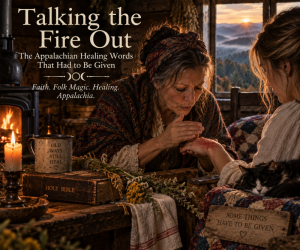
Blowing the fire out of a burn
Someone go get the Fire Doctor!
Imagine western North Carolina perhaps a century ago. Someone reaches across a woodstove and badly burns her hand. They yelp with pain, holding the burnt hand and grimacing. There may be no doctor nearby, but someone in the community knows exactly who to fetch.
The healer doesn’t open a spellbook or grimoire.
She doesn’t cast a circle.
She bends over the injured hand and begins whispering.
Maybe she blows gently across the burn. Maybe her hand moves above it. Maybe the words are Christian.
And everyone in the room knows what she’s doing.
She’s talking the fire out.
Of all the traditions I’ve encountered while studying Appalachian folk magic, talking the fire out fascinates me because it raises a question I keep encountering again and again: Where exactly does prayer end and magic begin?
What Does “Talking the Fire Out” Mean?
“Talking the fire out” is essentially when a gifted person sometimes called a fire doctor or burn doctor—speaking or murmuring a charm or prayer while blowing upon or gesturing over a burn. The desired result was to remove the “fire,” especially the pain.
That’s fascinating language in itself.
They’re not necessarily described as healing damaged tissue.
They’re removing the fire.
That gives you something wonderful to explore symbolically: fire becomes almost a substance that has entered the body and can therefore be persuaded, commanded, prayed or drawn back out.
The Secret Words
There isn’t one universally standardized Appalachian fire-talking ritual.
Accounts vary—which is important. There isn’t one universally standardized Appalachian fire-talking ritual.
But recurring elements include Christian invocations, whispered words, blowing or breathing over the burn, repeated actions and movements of the hand. The Smithsonian cites Anthony Cavender’s research describing a charm invoking the Trinity.
One short prayer I found in Ossman and Steel’s Classic Appalachian Guide to Folk Healing cites the following as, “A Very Good Remedy For Taking Fire Out of Burns or Scalds.”
Repeat the following three times:
“Our dear Sarah journeyed through the land, having a fiery hot, hot brand in her hand. The firebrand heats and the firebrand sweats. Firebrand stop your heat. In the Name of the Father, the Son, and the Holy Ghost. Amen”
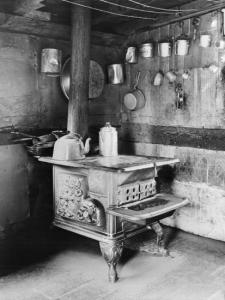
Old stove inside log cabin kitchen
You Don’t Just Learn It From a Book
I found numerous accounts saying the gift had rules governing how it could be transmitted. One common version says it must pass between opposite sexes. Other accounts allow only a limited number of people to be taught; still others say the healer loses the gift after passing it on. These rules vary considerably by family and locality, so we should present them as variants, not universal Appalachian law.
There’s even a family oral-history transcript in which a man remembered that his grandmother could talk burns and said the secret had to pass woman → man → woman.
Authority came through relationship and transmission—not through buying a book titled 101 Appalachian Spells. Mamaw or Papaw likely taught you.
“Don’t Thank Me”
Here’s another detail I love.
According to the tradition described by Cavender and summarized by the Smithsonian, no fee was charged, and the recipient wasn’t supposed to thank the healer because the healing was considered the work of the Lord.
If I walked into that mountain household with my twenty-first-century Pagan vocabulary and announced that I had just witnessed a spell, I suspect the woman performing it might have been deeply offended.
And yet…
Secret words.
Ritual repetition.
Gestures.
Breath.
Transmission from practitioner to practitioner.
Rules governing who may receive the knowledge.
From our perspective, it certainly looks like charm magic.
From hers?
God healed the burn.
She was just the conduit
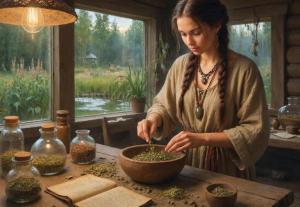
Prayer, Spell—or Both?
Is there really a difference?
Maybe. Most of the time prayer is asking God for a blessing or something else.
A spell? It’s prayer + action.
Our modern categories—religion over here, magic over there, medicine somewhere else—don’t always map neatly onto traditional folk practice.
Duke University Press describes regional folk medicine among Native, Anglo and African American communities as including practices such as fire talking, blood stopping, wart curing, herbal healing and rootwork, sometimes operating alongside biomedical treatment rather than necessarily replacing it.
Who Did This Tradition Come From?
Be careful here. The internet loves giving every Appalachian practice a single exotic origin.
I found modern accounts attributing fire talking to Cherokee or Native traditions, while other accounts emphasize European/Christian charm traditions. Appalachian folk medicine developed amid Native, European and African American traditions, and similar verbal burn charms existed beyond Appalachia as well.
That’s actually more interesting than forcing it into one origin story.
Appalachian folk magic is rarely as tidy as the internet wants it to be. Traditions traveled with people, lived beside other traditions, changed between families, and accumulated new meanings along the way.
So, saying all of these traditions could be true.
Did It Actually Work?
There are plenty of oral histories saying yes. People remember burns ceasing to hurt after someone talked the fire out. Contemporary Appalachian discussions contain similar family stories.
But anecdotes aren’t clinical evidence.
However, we don’t need to debunk the people telling these stories or claim supernatural burn healing as medical fact either.
Of course, I would like to say yes. Even if it was just the placebo effect. But I like to think that Mamaw or Papaw may have had a gift.
I don’t know whether anyone can literally talk fire out of human flesh. What fascinates me is that generations of people were absolutely convinced they had watched someone do it.
My fascination with fire talking deepened while reading Jake Richards, (author of Backwoods Witchcrat), whose work helped me understand Appalachian folk practice not as an aesthetic assembled from old-timey objects, but as something transmitted through people, families and place. Generations of families passing it down to children and grandchildren.
What Fire Talking Teaches Me as a Solitary Practitioner
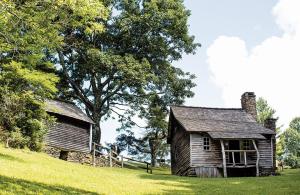
Old mountain cabin
As a solitary practitioner, I find the secrecy surrounding fire talking strangely beautiful. Modern witchcraft has conditioned us to expect instant access to everything. If I want a spell, I can find fifty versions online before breakfast.
Appalachian folk tradition reminds me that historically, some knowledge wasn’t available merely because someone wanted it.
Some things had to be given.
Perhaps an ancestor will feel kindly enough to appear in a dream and give me their version. Perhaps it will just remain a mystery.
Maybe respecting a tradition sometimes means accepting that I am allowed to study something without automatically being entitled to practice it.
Remember the woman at the beginning?
The fire doctor finishes whispering.
She draws her hand away.
The injured person perhaps starts to thank her—and is stopped.
Don’t thank me.
Because according to the old understanding, she didn’t do it.
God did.
Maybe I will never know the words that generations of Appalachian fire doctors whispered over burned hands. Strangely, I think I am becoming comfortable with that. I can learn the history. I can preserve the stories. I can listen to the people whose families carried the tradition. But perhaps some words were never meant to belong to everyone.
Some things have to be given.
Pagan

About Heather Blankenship
Heather is a writer, amateur historian, polyglot and aspiring digital nomad. She hopes to share her various experiences from two very different faiths and the richness of both. She is passionate about animal rights and is owned by a furry feline overlord. Chocolate and coffee are her life blood. You can read more about the author here.
Previous Post
September 6, 2026
Going Home: Following My Ancestors Into Appalachia
Next Post
September 15, 2026 When an Owl Calls Your Name: Appalachian Folklore
Recent Comments
Browse Our Archives
Select a Category Uncategorized
Select a Month October 2026 September 2026 May 2025 March 2025 February 2025 November 2023 June 2023
TAKE THE
Religious Wisdom Quiz
What does "Maranatha" mean?
Select your answer to see how you score.
The Lord is my rock God is great Come, Lord Jesus Praise the Lord
Related posts from The Spiritual History Geek
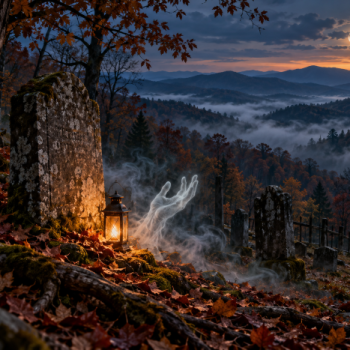
The Dead Man’s Hand: Appalachian Graveyard Magic
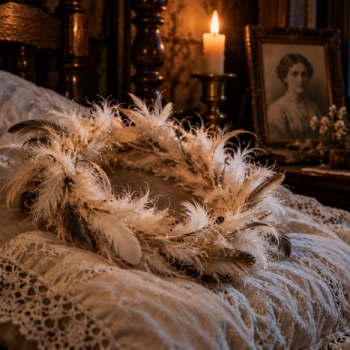
Angel Crowns: An Eerie Appalachian Death Tradition

Haint Blue: How a Color Protected Appalachian People
Appalachian Tales of Meeting Satan in Disguise
TRENDING AT PATHEOS History and Religion

The Dead Man’s Hand: Appalachian Graveyard Magic
When the Mountains Go Dark: Appalachian Folklore for Spooky Season Installment 3...

Angel Crowns: An Eerie Appalachian Death Tradition
When the Mountains Go Dark: Appalachian Folklore for Spooky Season Angel Crowns:...

Is 'Separation of Church and State' Really a...

There has long been a popular belief that Zen Buddhism is as...

Is Our Spirituality Communal or Individual?
Here, I take swings at sacred cows. I suspect that more sacred...

How Could Christianity be Different?
Christians can no longer plead ignorance. And Christians' reluctance to listen will...
view all History and Religion blogs
What Are Your Thoughts?leave a comment
Ad-Free & Subscriber Log-In Subscription Support
- About Us
- 2026 Calendar
- Videos
- Podcasts
- Library of World Religions
- Faith In Media Tracker
- Advertise With Us
- Write for Us
- Privacy Policy
- Terms of Service
- Do Not Sell My Data
- Contact Us
- Radiant Digital
- Manage Newsletter Subscriptions
- Unsubscribe From Notifications
- Sitemap
Copyright 2008-2026, Patheos. All rights reserved.
Subscription Support Ad-Free & Subscriber Log-In
Follow Patheos