
BuddhistCatholicContemplativeEvangelicalGeneral ChristianHinduJewishLatter-day SaintMuslimNew VisionsProgressive Christian
Beliefs
- Buddhist
- Catholic
- Contemplative
- Evangelical
- General Christian
- Hindu
- Jewish
- Latter-day Saint
- More Voices
- Muslim
- New Visions
- Pagan
- Progressive Christian
Topics
- Religion News
- Food and Religion
- Sports and Religion
- Religious Art
- Religious Music and Entertainment
- Religious Events
- History and Religion
- Style and Religion
- Politics and Religion
- Women in Religion
- Recreation Outdoors and Religion
- Business Finance and Religion
- Careers Workplace and Religion
- Education and Religion
- Family Parenting and Religion
- Health Fitness and Religion
- Home and Religion
- Relationships and Religion
- Technology and Religion
- Travel and Religion
Columnists
- Buddhist Columnists
- Business Finance and Religion Columnists
- Careers Workplace and Religion Columnists
- Catholic Columnists
- Contemplative Columnists
- Education and Religion Columnists
- Evangelists Columnists
- Family Parenting and Religion Columnists
- General Christian Columnists
- Health Fitness and Religion Columnists
- Hindu Columnists
- History and Religion Columnists
- Home and Religion Columnists
- Jewish Columnists
- More Voices Columnists
- Latter Day Columnists
- Muslim Columnists
- New Visions Columnists
- Nonreligious Columnists
- Pagan Columnists
- Politics and Religion Columnists
- Progressive Columnists
- Recreation Outdoors and Religion Columnists
- Relationships and Religion Columnists
- Religion News Columnists
- Religious Art Columnists
- Religious Events Columnists
- Religious Music and Entertainment Columnists
- Sports and Religion Columnists
- Style and Religion Columnists
- Technology and Religion Columnists
- Travel and Religion Columnists
- Women in Religion Columnists
Resource Library
- 2026 Calendar
- Library of World Religions
- The 100 Most Holy Places on Earth
- Patheos Answers
- Podcasts
- Videos
- Faith Leaders Database
- Anglican Episcopalian
- Bahai
- Baptist
- Buddhism
- Christianity
- Confucianism
- Eastern Orthodoxy
- Hinduism
- Holiness and Pentecostal
- ISKCON
- Islam
- Judaism
- Lutheran
- Methodist
- The Church of Jesus Christ of Latter-day Saints
- New Age
- Paganism
- Presbytarian and Reformed
- Protestantism
- Religion Behind the Scenes
- Roman Catholic
- Scientology
- Shia Islam
- Sikhism
- Sufism
- Sunni Islam
- Taoism
- Zen
- See all religions
Research Tools
 Ad-Free & Subscriber Log-In Subscription Support
Ad-Free & Subscriber Log-In Subscription Support
Follow Patheos 

- Trending:
- Forgiveness
- |
- Marriage
- |
- Consciousness
- |
- Death Penalty
- |
- Election
- |
- Halloween

- Home
- Pagan
- History and Religion
- Something Followed Me Home: The Dead Who Wouldn’t Leave
Something Followed Me Home: The Dead Who Wouldn’t Leave
Last updated on: September 19, 2026 at 11:29 pm by Heather Blankenship
Something Followed Me Home: The Dead Who Wouldn’t Leave 2026-09-17T19:30:06-04:00 Heather Blankenship
Patheos Explore the world's faith through different perspectives on religion and spirituality! Patheos has the views of the prevalent religions and spiritualities of the world.
When the Mountains Go Dark: 13 Nights of Appalachian Folklore — Night One
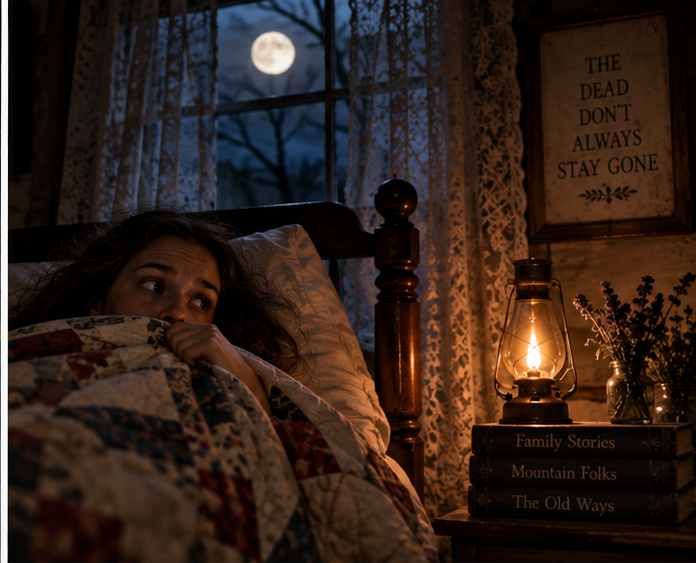
Cowering in bed
The footsteps stopped at the bedroom door.
That was the part she remembered.
Hearing footsteps in an old mountain house wasn’t particularly unusual. Houses made noise. Wood contracted in the cold. Wind found its way through cracks around windows. Mice scratched inside walls.
But these footsteps were different.
They crossed the porch.
Slowly.
The front door never opened.
Still, the footsteps entered the house.
They crossed the front room and started down the hallway.
One step.
Then another.
Then another.
Until they reached the bedroom door.
And stopped.
The girl pulled the quilt higher around her face and waited.
Nothing.
Eventually, exhaustion won.
The next morning, she told her grandmother what had happened.
Grandma didn’t laugh.
She didn’t tell her the house had been settling.
She didn’t ask whether the girl had dreamed it.
Instead, she asked a much stranger question.
“Who did they sound like?”
Welcome to the mountains after dark.
When the Mountains Go Dark
Appalachian ghost stories feel different.
Maybe it’s the setting.
A lonely road disappearing between mountains.
An abandoned house sinking slowly back into the earth.
A family cemetery hidden beyond the tree line.
A creek you can hear but cannot see.
Fog settling into a hollow as daylight disappears.
Or maybe it’s because so many Appalachian ghost stories don’t begin with someone going looking for the supernatural.
Nobody rents a haunted house for the weekend.
Nobody brings an EMF meter.
Nobody announces that tonight they’re going ghost hunting.
Someone is simply washing dishes.
Walking home.
Sitting beside the fire.
Trying to sleep.
And then something happens.
A dead relative appears beside the bed.
Someone hears footsteps in an empty room.
A voice calls from outside.
A light moves through the trees where no person should be walking.
Someone sees a figure standing beside the road—and when they turn around, no one is there.
Then the story gets told.
And told again.
Perhaps it changes a little each time.
Eventually, nobody remembers exactly when it happened.
Only that somebody’s grandmother swore it did.
That is how folklore survives.
The American Folklife Center at the Library of Congress preserves Appalachian storytelling materials collected across generations, including folktales, beliefs, ghost stories, witch stories, and other supernatural narratives. The archives remind us that spooky mountain stories aren’t simply a modern internet aesthetic. Storytelling itself has long been an important part of Appalachian folklife. (Congress.gov)
But I’ve become interested in something beyond whether the stories are true.
I want to know why Appalachia told so many stories in which the dead didn’t seem particularly interested in staying dead.
Sometimes the Ghost Was Someone You Knew
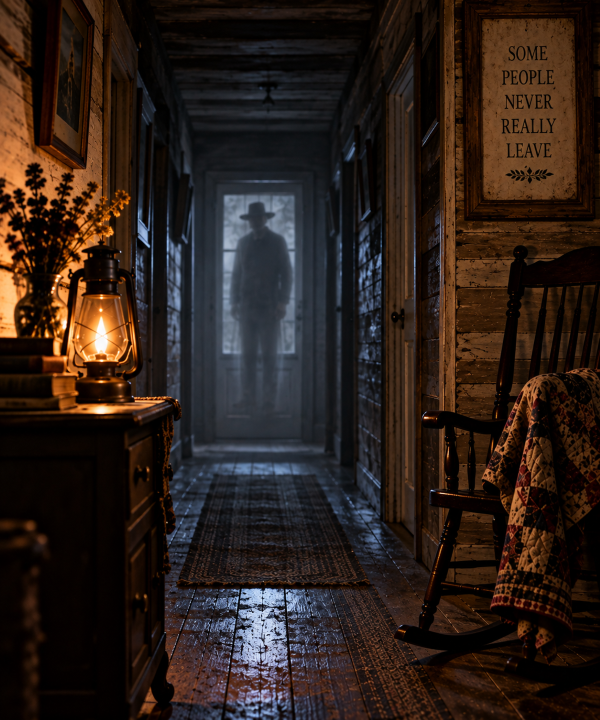
Who’s in the doorway
Modern horror has trained us to expect ghosts to be frightening.
The haunted little girl at the end of the hallway.
The murdered woman in white.
The sinister figure reflected in the mirror.
But traditional ghost stories don’t always work that way.
Sometimes the ghost is frightening simply because it shouldn’t be there.
It’s Dad.
Grandma.
An uncle.
The neighbor who died last winter.
Someone sees the dead person sitting in their familiar chair.
Someone hears the distinctive sound of their footsteps.
Someone smells their tobacco.
Someone hears their voice.
And sometimes the dead person doesn’t appear to hurt anyone.
They seem to have come back because they have something left to do.
A warning to deliver.
A message to give.
A person to visit.
A promise to fulfill.
Or perhaps simply because, for reasons nobody understands, they came home.
That is a very different kind of haunting.
And I think it’s considerably more unsettling.
A monster in the woods is frightening.
Hearing your dead mother’s footsteps coming down the hallway is something else entirely.
Because you know exactly who is coming.
The Dead Used to Be Closer
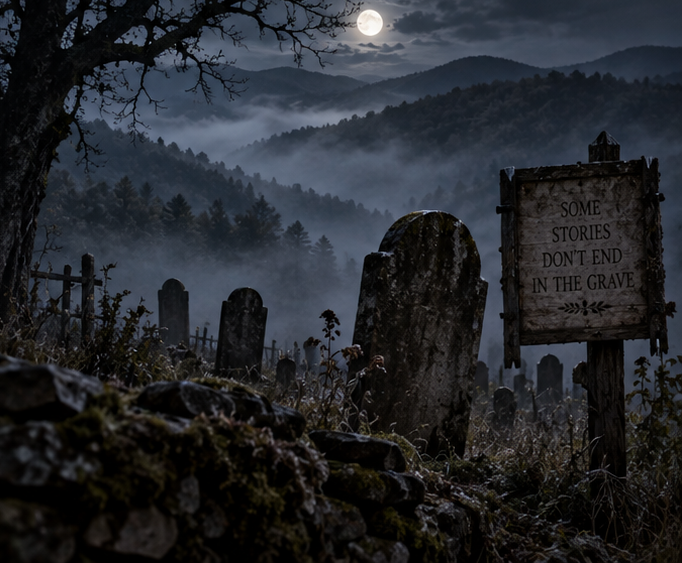
Cemetery at night
I think we sometimes forget how dramatically our relationship with death has changed.
Today, death can be remarkably hidden.
Someone becomes critically ill and goes to the hospital.
When they die, their body may be taken to a funeral home.
Professionals prepare them.
A funeral follows.
Then burial or cremation.
For many families, much of the physical work surrounding death has moved into specialized institutions.
Historically, particularly in rural communities, death could remain much closer to everyday domestic life.
People became sick at home.
People died at home.
Families and neighbors could participate directly in preparing the dead.
The house where you cooked breakfast might also become the place where someone took their final breath.
And the landscape itself could keep the dead nearby.
Appalachian scholarship and archival collections treat death, funerals, gravemarkers, oral history, religion, folklore and family life as deeply connected aspects of regional culture rather than completely separate subjects. (WVRHC)
Imagine what that meant psychologically.
Grandma doesn’t disappear into an institution.
Grandma dies in the house.
Maybe even in the bedroom.
The family mourns her there.
Then life continues.
Her daughter sleeps in that house.
Her grandchildren play there.
Someone cooks at the stove where Grandma cooked.
Her chair remains beside the fireplace.
Her things remain in drawers.
And one night—
someone hears footsteps.
Of course they sound like Grandma’s.
The entire house sounds like Grandma.
A House Can Remember Someone
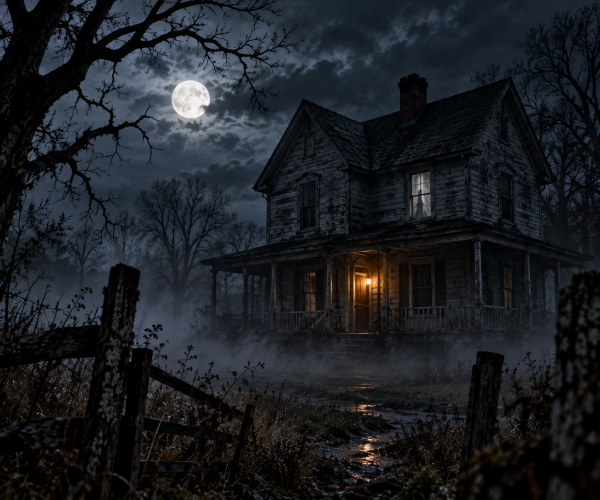
The house remembers…
This is where I think ghost stories become more interesting than the question:
“Do you believe in ghosts?”
I’m not sure that question gets us very far.
Suppose a widower wakes in the middle of the night and hears his wife’s footsteps crossing the bedroom.
Was she there?
Maybe.
Maybe not.
Grief can do strange things to perception and memory.
Old houses make sounds.
Half-sleeping brains interpret incomplete sensory information.
Human beings are extraordinarily good at finding familiar patterns.
But none of those explanations makes the experience meaningless.
Because in another sense, his wife absolutely is still inside that house.
She chose the curtains.
Her handwriting is inside the cookbook.
She planted the flowers outside.
A dress still hangs in the closet because he hasn’t been able to bring himself to move it.
He knows which floorboard creaked when she walked across it.
Memory has attached itself to physical space.
Sometimes so strongly that a house can feel inhabited long after one of its inhabitants is gone.
Perhaps that’s why one of the oldest ghost-story ingredients remains one of the simplest:
the familiar sound made by someone who isn’t there anymore.
The Voice Outside
Cowering in bed
Then there are stories that tell you not to follow.
Someone hears their name called outside.
The voice sounds familiar.
They open the door.
Nobody is there.
Perhaps the voice comes again, farther away.
Now we’re entering dangerous folklore territory—not because the ghost will necessarily get us, but because modern internet culture has created an enormous amount of supposedly “ancient Appalachian lore” around voices, whistles, mimics, and mysterious creatures.
TikTok Appalachia would have you believe there is a comprehensive mountain survival manual:
Don’t whistle at night.
Don’t look into the trees.
If you hear your name, no you didn’t.
If something sounds human but isn’t quite human, run.
Never acknowledge the thing outside your cabin.
Some of these ideas have parallels in older supernatural traditions. Others have been reshaped, combined with beliefs from very different cultures or amplified through modern horror storytelling.
So throughout this series, I’m going to be careful.
“People on TikTok say Appalachians believed this” is not the same thing as historical evidence that Appalachian communities believed it.
Sometimes a creepy story is old.
Sometimes it’s new folklore wearing old boots.
Both are interesting.
But they aren’t the same thing.
The Ghost Beside the Road
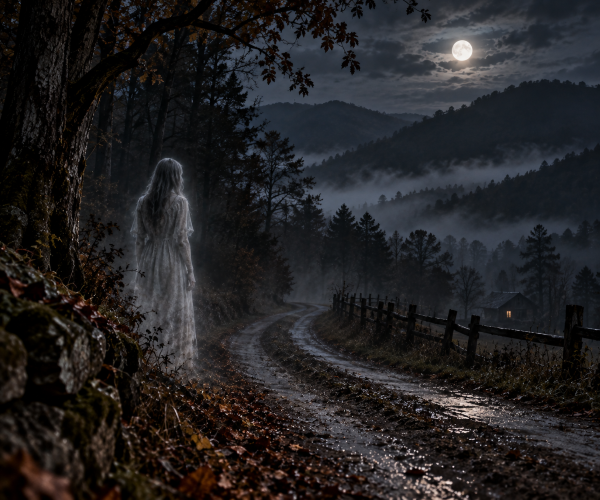
The Ghost by the Road
Every region seems to have one.
The woman walking beside the road.
The stranger who needs a ride.
The child seen near a bridge.
The figure standing at a curve where someone died years earlier.
You pass them.
Look in the mirror.
Gone.
Roadside ghost stories work particularly well in the mountains because Appalachian roads already feel liminal after dark.
A curve disappears around the mountain.
Trees close in.
Fog settles low.
Your headlights illuminate perhaps a few hundred feet of pavement, and everything beyond them ceases to exist.
Then something appears in the headlights.
A person.
You brake.
And suddenly there’s nobody there.
The rational explanation might be an animal, fog, exhaustion, reflected light or a brain trying to turn an ambiguous shape into something recognizable.
But folklore isn’t especially interested in the rational explanation.
Folklore asks:
Who died on this road?
And suddenly an ordinary moment becomes a story.
Some Ghosts Had Business to Finish
One recurring idea in supernatural storytelling far beyond Appalachia is that the dead return because something remains unresolved.
Something was hidden.
Something wasn’t said.
A promise wasn’t kept.
A person wasn’t properly buried.
Someone needs to be warned.
An injustice needs to be exposed.
The ghost therefore becomes almost like a messenger between worlds.
This tells us something important about storytelling.
A ghost gives the dead a voice.
Think about how powerful that can be.
Someone dies without revealing where something important is hidden.
The family cannot find it.
Then a relative dreams of the dead person pointing toward a particular place.
They search there.
They find it.
What gets remembered?
Not the dozen unsuccessful searches.
Not coincidence.
Not the possibility that the dreamer unconsciously remembered seeing the object there.
The story becomes:
He came back and showed us.
And that story might survive for generations.
Ghost Stories Are Family History Wearing a White Sheet
That may be my favorite way of thinking about them.
Because underneath many ghost stories is a surprisingly ordinary piece of history.
A person.
A house.
A death.
A road.
A mine.
A war.
A flood.
A family tragedy.
Something happened here.
The details may disappear.
The story remains.
Sometimes the ghost becomes the mechanism that preserves the memory.
The Library of Congress’s Appalachian holdings are especially revealing in this respect because the collections don’t separate storytelling neatly from local history, customs, beliefs, songs, and everyday life. Field recordings preserve these things together because, in lived culture, they often existed together. (Congress.gov)
Maybe that’s why I’m drawn to folklore as much as genealogy.
Genealogy tells me:
She died in 1897.
Folklore tells me:
After she died, her daughter swore she still heard her rocking chair at night.
One belongs easily in a database.
The other tells me something about how the family remembered her.
I want both.
But Appalachia Isn’t One Giant Haunted Cabin
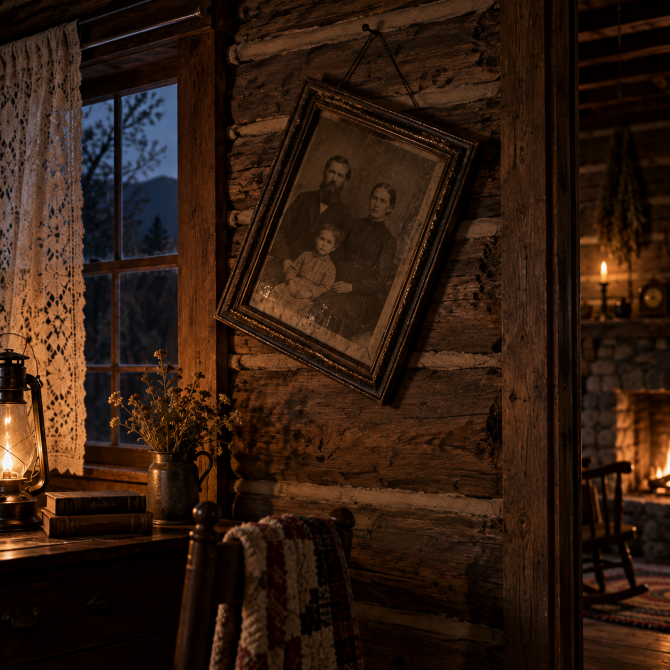
A picture falls?
There’s another trap I want to avoid during this series.
Romanticizing Appalachia as some ancient, isolated land where everyone believed in ghosts, witches and omens.
They didn’t.
Appalachia isn’t culturally uniform.
It contains many communities, religious traditions, ethnic histories, landscapes and local cultures.
Some people probably believed every ghost story Grandma told.
Some enjoyed telling the stories without believing a word of them.
Some would have considered them nonsense.
Some stories traveled into the mountains from elsewhere and changed there. Appalachian storytelling itself includes traditions with deep European antecedents that storytellers adapted to mountain settings and community life. (Congress.gov)
African American storytelling traditions also profoundly shaped the wider South and Appalachia, while Indigenous communities possess their own distinct traditions that shouldn’t be collapsed into a generic category of “mountain ghost stories.”
There isn’t one authentic Appalachian supernatural worldview.
There are stories.
Lots and lots of stories.
And that’s more interesting anyway.
Why Tell Ghost Stories?
Imagine a family before television.
It’s dark.
The work is finished.
Maybe everyone is sitting around the fire.
An older relative starts talking.
There was a house…
Or:
Your grandfather told me this happened to him…
Or the unbeatable opening:
This is a true story.
Immediately, every child in the room is listening.
Storytelling entertains.
It teaches.
It warns.
It preserves memory.
And sometimes it scares the living daylights out of your grandchildren, which I suspect has been one of humanity’s favorite intergenerational activities since we learned to speak.
Appalachian storytelling traditions became important enough that folklorists spent decades recording them, and the Library of Congress now preserves extensive collections of Appalachian storytellers and oral traditions. Ray Hicks, for example, became nationally known for carrying a family storytelling tradition from the North Carolina mountains, including Jack tales and ghost stories. (Library of Congress Tile)
A ghost story told around a fire isn’t simply a primitive attempt to explain something.
It’s a performance.
The pauses matter.
The voice matters.
The storyteller knows exactly when to lower it.
And right when everyone is leaning closer—
something hits the window.
That’s probably when Grandma nearly kills everybody in the room.
When the Story Becomes Memory
Here’s the part that fascinates me most.
Suppose your grandmother tells you that when she was twelve years old, she saw her dead grandfather standing beside the barn.
You believe Grandma.
Not necessarily because you’ve conducted a paranormal investigation.
Because she’s Grandma.
You know her.
You trust her.
She isn’t telling you something she read in a book.
She’s telling you something she says happened to her.
Years later, Grandma dies.
Now you tell your daughter:
“Your great-grandmother once saw a ghost.”
Another generation passes.
Now the story begins:
“There was a ghost that used to appear beside the old family barn.”
See what happened?
An experience became a family story.
The family story became folklore.
The person who experienced it disappeared.
The ghost remained.
That is how the dead can survive twice.
Once as ancestors.
And once as stories.
Maybe Something Did Follow Us Home
I’m preparing to make the North Carolina mountains part of my own everyday landscape, and I think that’s one reason these stories have started meaning something different to me.
I don’t want to move there pretending every shadow contains an ancient secret.
I don’t expect the mountains to magically hand me ancestral knowledge simply because people in my family once lived among them.
I’ll have to learn.
Read.
Listen.
Walk cemeteries.
Study records.
Talk to people.
Learn which stories are documented and which ones appeared on social media last Tuesday.
But I also don’t want skepticism to make me deaf.
Because whether or not ghosts exist, ghost stories certainly do.
And they’ve followed Appalachian families for generations.
Perhaps that’s what really follows us home.
Memory.
A grandmother’s warning.
A story somebody told beside a stove eighty years ago.
A name in a cemetery.
The sound a particular person’s boots once made on the floorboards.
The story of the night those same footsteps supposedly returned after the boots had been buried with their owner.
History leaves records.
Families leave memories.
And sometimes memory puts on a ghost’s clothes.
Who Did They Sound Like?
So let’s return to that bedroom.
The footsteps cross the porch.
They enter the house.
They move slowly down the hallway.
Then they stop outside the door.
Maybe the house was settling.
Maybe an animal was underneath the porch.
Maybe the girl dreamed the whole thing.
Maybe grief turned ordinary sounds into familiar footsteps.
Those are reasonable explanations.
But Grandma doesn’t ask for a reasonable explanation.
She asks:
“Who did they sound like?”
And suddenly the story becomes something else.
Because maybe the frightening question in an Appalachian ghost story wasn’t always whether the dead could return.
Sometimes everyone in the story already accepted that possibility.
The question was:
Why had this particular one come home?
Maybe they had unfinished business.
Maybe they wanted to warn somebody.
Maybe they simply wanted to be remembered.
Or maybe nothing supernatural happened at all.
The fire burns lower.
The house becomes quiet again.
Outside, the mountains have disappeared into darkness.
And somewhere in that darkness, a branch breaks.
I am absolutely certain there’s a perfectly reasonable explanation for it.
I’m also not going outside to check.
This is Night One of When the Mountains Go Dark: 13 Nights of Appalachian Folklore, my Spooky Season journey into the ghosts, witches, death omens, strange creatures and old beliefs that came alive after sunset.
Next Night: Witch-Ridden: The Appalachian Witches Who Came While You Slept.
Pagan

About Heather Blankenship
Heather is a writer, amateur historian, polyglot and aspiring digital nomad. She hopes to share her various experiences from two very different faiths and the richness of both. She is passionate about animal rights and is owned by a furry feline overlord. Chocolate and coffee are her life blood. You can read more about the author here.
Previous Post
September 16, 2026
The Witch in the Hollow
Next Post

September 24, 2026 Haint Blue: How a Color Protected Appalachian People
Recent Comments
Browse Our Archives
Select a Category Uncategorized
Select a Month October 2026 September 2026 May 2025 March 2025 February 2025 November 2023 June 2023
TAKE THE
Religious Wisdom Quiz
Who was the wife of Isaac?
Select your answer to see how you score.
Sarah Rachel Rebekah Leah
Related posts from The Spiritual History Geek
The Dead Man’s Hand: Appalachian Graveyard Magic
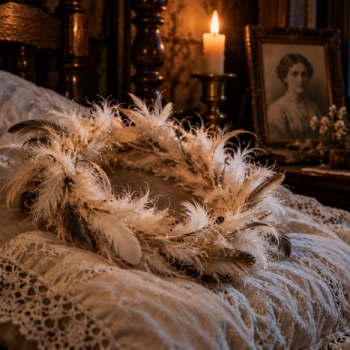
Angel Crowns: An Eerie Appalachian Death Tradition
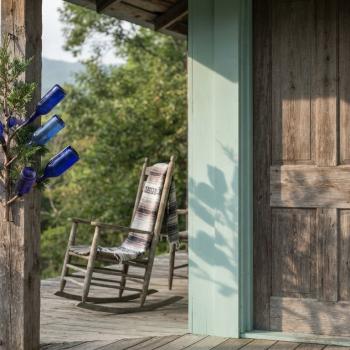
Haint Blue: How a Color Protected Appalachian People
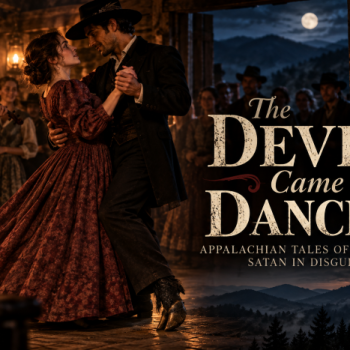
Appalachian Tales of Meeting Satan in Disguise
TRENDING AT PATHEOS History and Religion

The Dead Man’s Hand: Appalachian Graveyard Magic
When the Mountains Go Dark: Appalachian Folklore for Spooky Season Installment 3...

Angel Crowns: An Eerie Appalachian Death Tradition
When the Mountains Go Dark: Appalachian Folklore for Spooky Season Angel Crowns:...

Is 'Separation of Church and State' Really a...

There has long been a popular belief that Zen Buddhism is as...

Is Our Spirituality Communal or Individual?
Here, I take swings at sacred cows. I suspect that more sacred...

How Could Christianity be Different?
Christians can no longer plead ignorance. And Christians' reluctance to listen will...
view all History and Religion blogs
What Are Your Thoughts?leave a comment
Ad-Free & Subscriber Log-In Subscription Support
- About Us
- 2026 Calendar
- Videos
- Podcasts
- Library of World Religions
- Faith In Media Tracker
- Advertise With Us
- Write for Us
- Privacy Policy
- Terms of Service
- Do Not Sell My Data
- Contact Us
- Radiant Digital
- Manage Newsletter Subscriptions
- Unsubscribe From Notifications
- Sitemap
Copyright 2008-2026, Patheos. All rights reserved.
Subscription Support Ad-Free & Subscriber Log-In
Follow Patheos