
BuddhistCatholicContemplativeEvangelicalGeneral ChristianHinduJewishLatter-day SaintMuslimNew VisionsProgressive Christian
Beliefs
- Buddhist
- Catholic
- Contemplative
- Evangelical
- General Christian
- Hindu
- Jewish
- Latter-day Saint
- More Voices
- Muslim
- New Visions
- Pagan
- Progressive Christian
Topics
- Religion News
- Food and Religion
- Sports and Religion
- Religious Art
- Religious Music and Entertainment
- Religious Events
- History and Religion
- Style and Religion
- Politics and Religion
- Women in Religion
- Recreation Outdoors and Religion
- Business Finance and Religion
- Careers Workplace and Religion
- Education and Religion
- Family Parenting and Religion
- Health Fitness and Religion
- Home and Religion
- Relationships and Religion
- Technology and Religion
- Travel and Religion
Columnists
- Buddhist Columnists
- Business Finance and Religion Columnists
- Careers Workplace and Religion Columnists
- Catholic Columnists
- Contemplative Columnists
- Education and Religion Columnists
- Evangelists Columnists
- Family Parenting and Religion Columnists
- General Christian Columnists
- Health Fitness and Religion Columnists
- Hindu Columnists
- History and Religion Columnists
- Home and Religion Columnists
- Jewish Columnists
- More Voices Columnists
- Latter Day Columnists
- Muslim Columnists
- New Visions Columnists
- Nonreligious Columnists
- Pagan Columnists
- Politics and Religion Columnists
- Progressive Columnists
- Recreation Outdoors and Religion Columnists
- Relationships and Religion Columnists
- Religion News Columnists
- Religious Art Columnists
- Religious Events Columnists
- Religious Music and Entertainment Columnists
- Sports and Religion Columnists
- Style and Religion Columnists
- Technology and Religion Columnists
- Travel and Religion Columnists
- Women in Religion Columnists
Resource Library
- 2026 Calendar
- Library of World Religions
- The 100 Most Holy Places on Earth
- Patheos Answers
- Podcasts
- Videos
- Faith Leaders Database
- Anglican Episcopalian
- Bahai
- Baptist
- Buddhism
- Christianity
- Confucianism
- Eastern Orthodoxy
- Hinduism
- Holiness and Pentecostal
- ISKCON
- Islam
- Judaism
- Lutheran
- Methodist
- The Church of Jesus Christ of Latter-day Saints
- New Age
- Paganism
- Presbytarian and Reformed
- Protestantism
- Religion Behind the Scenes
- Roman Catholic
- Scientology
- Shia Islam
- Sikhism
- Sufism
- Sunni Islam
- Taoism
- Zen
- See all religions
Research Tools
 Ad-Free & Subscriber Log-In Subscription Support
Follow Patheos 

- Trending:
- Advent
- |
- Forgiveness
- |
- Thanksgiving
- |
- Election
- |
- Seasonal Holidays
- |
- Marriage

- Home
- Pagan
- History and Religion
- Haint Blue: How a Color Protected Appalachian People
Haint Blue: How a Color Protected Appalachian People
Last updated on: September 25, 2026 at 3:59 pm by Heather Blankenship
Haint Blue: How a Color Protected Appalachian People 2026-09-25T15:59:58-04:00 Heather Blankenship
Patheos Explore the world's faith through different perspectives on religion and spirituality! Patheos has the views of the prevalent religions and spiritualities of the world.
Packing Up the Past: What Haint Blue and a Cobalt Bottle Taught Me About Spiritual Self-Defense

I was kneeling on my living room floor, surrounded by half-taped cardboard boxes and that distinct layer of dust that only appears when you decide to move your entire life, when I found it. Tucked way in the back of a cabinet, wrapped in a forgotten dish towel, was a small, heavy cobalt glass bottle. Holding it up to the window, the way the afternoon sun hit that deep blue glass immediately pulled my brain away from logistics and straight into my favorite hyperfixation: the history of vernacular spiritual defense.
Because for a self-proclaimed spiritual history geek, that bottle isn’t just old glass. It’s an artifact of a brilliant, syncretic lineage of folk magic that connects the West African diaspora, the Gullah Geechee coast, and the isolated hollows of Appalachia.

Gullah Geechee Home with Haint Blue Window Sills
It made me look at my front door and realize I couldn’t pack up without finally writing down the story of “haint blue”—and the deeply human history behind how we protect our thresholds.
The Anatomy of a Haint
To understand why anyone would paint their porch a specific shade of pale water-blue, you first have to understand the specific entity they were trying to outsmart. Growing up reading ghost stories, I always thought of spirits as tragic, wispy things floating down hallways. But in the folk taxonomy of the American South and the Appalachian mountains, a “haint” (a dialect derivation of haunt) is something entirely different.
Haints aren’t just passing through; they are restless, mischievous, and often explicitly malevolent. In mountain lore, a haint is blamed for the milk curdling overnight, the livestock suddenly falling ill, unexplained knocking in the walls, and the terrifying experience of waking up pinned to your bed, unable to breathe (what science calls sleep paralysis, but old-timers attributed to a “witch-riding” or a Boo Hag).

Truly terrifying!
The term itself, along with the foundational mechanics of how to ward them off, traveled to the American landscape via Gullah Geechee culture—the descendants of enslaved West and Central Africans who preserved their ancestral spiritual cosmologies along the sea islands of South Carolina and Georgia. As enslaved labor, maritime trade, and migration pathways pushed inward into the Piedmont and up into the steep ridges of the Blue Ridge and Allegheny mountains, these African rootwork traditions met, mingled, and fused with the folk beliefs of Scots-Irish and German settlers.

An exchange of traditions
The resulting mountain landscape—shrouded in dense morning mists, cut by deep, shadowed hollows, and defined by profound physical isolation—proved to be incredibly fertile soil for these protective practices to evolve.
The Spiritual Engineering of the Blue Threshold
So, how do you stop a haint? You build a spiritual trap right into the architecture of your home.
The core theology behind haint blue is simple and elegant: traditional folklore across multiple continents dictates that restless spirits and malevolent entities cannot cross living water. By mixing up a batch of lime wash, milk paint, and crushed indigo, early households painted their door lintels, window sills, and porch ceilings in a soft, pale blue-green. To a wandering spirit approaching the house at dusk, the blue trim looked exactly like a running river or the open sky. Confused and disoriented by the illusion of a watery barrier, the haint would turn away, leaving the home untroubled.
What fascinates me most as a history nerd is how these spiritual protections almost always doubled as brilliant, practical life hacks. The original haint paint recipes weren’t just culturally significant; they were functional:
- The Chemical Deterrent: The heavy lime content in traditional milk-and-indigo washes acted as a natural insecticide. It actively repelled spiders, wasps, and dirt daubers, keeping porch ceilings clear of nests.
- The Optical Illusion: The pale, luminous quality of the blue shade maximized the fading mountain twilight. It literally made the porch look lighter for longer, a massive asset in the days before rural electrification.
- The Psychological Anchor: Living in a harsh, isolated environment meant dealing with massive amounts of ambient anxiety. Painting your threshold blue gave a family a tangible, visible sense of control over the boundary between the safe domestic sphere and the chaotic wild outside.
The Logic of the Bottle Tree

Haint blue bottles
Which brings me back to the cobalt bottle sitting on my packing box. The exterior counterpart to the painted door frame is the Appalachian bottle tree.
Whenever you see a dead tree branch or a wooden frame in a southern garden dressed in old blue glass bottles—originally Milk of Magnesia containers, medicine vials, or cobalt wine bottles—you are looking at a practice rooted directly in 9th-century Kongo traditions.
The spiritual physics here are delightfully clever. Wandering nighttime spirits are naturally attracted to light and color. Seeing the moon shimmer against the cobalt glass, a haint will slip inside the neck of the bottle. Once inside, they become trapped, unable to find their way back out (the low, eerie hum of the wind blowing over the open bottles was traditionally said to be the sound of the haints groaning in captivity). When the sun rises, the first rays of morning light strike the glass, destroying the trapped entity before it can ever set foot across your porch.
The Mountain Rules of Engagement
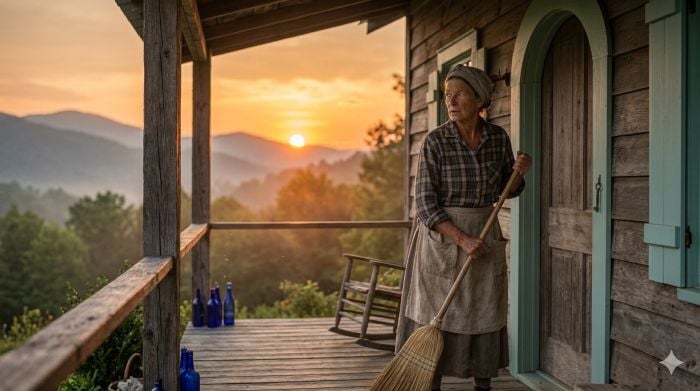
Sweep BEFORE the sun goes down!
If you talk to anyone deeply embedded in Appalachian folklore, they’ll tell you that haint blue and bottle trees are just the baseline grid of a much larger ecosystem of household rules. Growing up in these communities meant learning a strict set of daily habits designed to keep from accidentally inviting the supernatural inside:
- The Empty Rocking Chair: You never leave a rocking chair moving on its own. An empty, swaying chair is an open invitation for a wandering haint to sit down. Once they take a seat, it requires a complicated spiritual cleansing to get them out of the house.
- No Sweeping After Dark: Mountain tradition strictly forbade sweeping dirt out of the front door after the sun went down. To do so was believed to literally sweep away the home’s good fortune and invite wandering entities to slip in through the unsealed doorway.
- Whistling After Sundown: Whistling in a hollow or on a mountain trail after dusk was considered an active summons. You didn’t whistle unless you were looking to see what kind of entity would answer back.
Packing the Magic With Me
As I finally wrapped my little cobalt bottle in bubble wrap and tucked it into a box marked “Kitchen/Fragile,” I realized that these traditions endure because they tap into a universal human need.
Whether we look at haint blue through the lens of historical theology, psychological comfort, or architectural charm, it represents the creative ways our ancestors attempted to draw a line between the chaos of the world and the peace of the hearth.
I think when I get to the new house, the very first thing I’m going to do is unpack this bottle, set it on the windowsill, and head down to the hardware store to find the perfect shade of pale, watery blue for the front door.
After all, a little extra threshold protection never hurts.
Pagan

About Heather Blankenship
Heather is a writer, amateur historian, polyglot and aspiring digital nomad. She hopes to share her various experiences from two very different faiths and the richness of both. She is passionate about animal rights and is owned by a furry feline overlord. Chocolate and coffee are her life blood. You can read more about the author here.
Previous Post

September 19, 2026
Something Followed Me Home: The Dead Who Wouldn't Leave
Next Post

September 25, 2026 Appalachian Tales of Meeting Satan in Disguise
Recent Comments
Browse Our Archives
Select a Category Uncategorized
Select a Month October 2026 September 2026 May 2025 March 2025 February 2025 November 2023 June 2023
TAKE THE
Religious Wisdom Quiz
Which New Testament city was known for worshipping Artemis?
Select your answer to see how you score.
Corinth Rome Athens Ephesus
Related posts from The Spiritual History Geek
The Dead Man’s Hand: Appalachian Graveyard Magic

Angel Crowns: An Eerie Appalachian Death Tradition

Appalachian Tales of Meeting Satan in Disguise

Something Followed Me Home: The Dead Who Wouldn't...
TRENDING AT PATHEOS History and Religion

The Dead Man’s Hand: Appalachian Graveyard Magic
When the Mountains Go Dark: Appalachian Folklore for Spooky Season Installment 3...

Angel Crowns: An Eerie Appalachian Death Tradition
When the Mountains Go Dark: Appalachian Folklore for Spooky Season Angel Crowns:...

Is 'Separation of Church and State' Really a...

There has long been a popular belief that Zen Buddhism is as...

Is Our Spirituality Communal or Individual?
Here, I take swings at sacred cows. I suspect that more sacred...

How Could Christianity be Different?
Christians can no longer plead ignorance. And Christians' reluctance to listen will...
view all History and Religion blogs
What Are Your Thoughts?leave a comment
Ad-Free & Subscriber Log-In Subscription Support
- About Us
- 2026 Calendar
- Videos
- Podcasts
- Library of World Religions
- Faith In Media Tracker
- Advertise With Us
- Write for Us
- Privacy Policy
- Terms of Service
- Do Not Sell My Data
- Contact Us
- Radiant Digital
- Manage Newsletter Subscriptions
- Unsubscribe From Notifications
- Sitemap
Copyright 2008-2026, Patheos, part of the Radiant Digital network of media brands. All rights reserved.
Subscription Support Ad-Free & Subscriber Log-In
Follow Patheos